

SEOUL, July 24 (AJP) -The United States kept South Korea on its currency monitoring list on Thursday, saying the country continued to run large external surpluses while acknowledging Seoul's intervention to curb excessive volatility in the won and its efforts to further liberalize the foreign exchange market.
The U.S. Treasury again designated South Korea as a currency monitoring country in its semiannual report to Congress on the macroeconomic and foreign exchange policies of major trading partners, alongside China, Japan, Taiwan, Singapore, Vietnam, Germany, Ireland, Switzerland and Thailand.
All 10 economies were also included in the previous report released in January.
The Treasury did not designate any major U.S. trading partner as a currency manipulator.
South Korea remained on the monitoring list because it continued to meet two of the Treasury's three criteria for enhanced analysis: a current account surplus exceeding 3 percent of gross domestic product and a goods and services trade surplus with the United States of more than $15 billion.
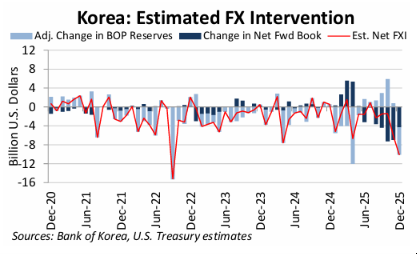
It did not meet the third criterion of persistent, one-sided foreign exchange purchases, as authorities were net sellers of dollars during the review period. The Treasury generally keeps economies that meet two of the three criteria on the monitoring list for at least two consecutive reports to ensure that improvements are sustained.
Its goods and services surplus with the United States narrowed to $45 billion from $54 billion in 2024 as U.S. imports of Korean products, particularly automobiles, declined, but remained well above the Treasury's monitoring threshold.
The Treasury said Korean authorities sold a net $28 billion in foreign exchange, equivalent to 1.5 percent of GDP, during 2025 to slow the won's depreciation, with about $22.5 billion of the intervention taking place in the fourth quarter. It assessed the intervention as aimed at smoothing excessive volatility amid depreciation pressure on the won rather than securing a competitive trade advantage.
The report said the won's appreciation against the dollar was concentrated in the final trading sessions of 2025, strengthening 2.6 percent from 1,481 won per dollar on Dec. 23 to 1,445 won on Dec. 31 amid heavy reported intervention by Korean authorities.
Depreciation deepened this year. After floating above 1,500 won in June, the dollar has come down to 1,476.5 won Friday.
Referring to its Jan. 14 statement, the Treasury reiterated that the recent depreciation pressure on the won was not consistent with South Korea's strong economic fundamentals and stressed that excessive volatility in the foreign exchange market was undesirable.
The Treasury also gave a positive assessment of Seoul's foreign exchange market reforms.
"Authorities are making progress in reducing restrictions on foreign investor participation in onshore foreign exchange markets," the report said, adding that the measures "should help liquidity and price discovery in local markets over the medium term."
It also noted a bilateral understanding under which South Korea has begun sharing monthly information on foreign exchange intervention with the United States and publishing additional reserve data in line with International Monetary Fund standards.
The Treasury's monitoring framework is based on three criteria: a bilateral goods and services surplus with the United States of at least $15 billion, a current account surplus of at least 3 percent of GDP and persistent, one-sided net foreign currency purchases totaling at least 2 percent of GDP over a 12-month period.
No major U.S. trading partner met all three criteria during the latest review period, the Treasury said, concluding that none manipulated its currency to gain an unfair competitive advantage.
Copyright ⓒ Aju Press All rights reserved.
