

SEOUL, July 26 (AJP) - South Korea's technology sector enters its most closely watched week of the earnings season as memory giant SK hynix reports second-quarter results on Wednesday, followed by Samsung Electronics' full earnings on Thursday, with investors looking beyond record profits for clues on whether the AI-driven semiconductor boom still has room to run.
The two companies now sit at the center of the global AI infrastructure cycle, and their earnings conference calls are expected to shape investor sentiment toward semiconductor stocks worldwide as markets debate whether the industry's extraordinary profitability has further upside or is approaching its peak.
Consensus forecasts compiled from 14 domestic brokerages project SK hynix will post record quarterly revenue of 84.1 trillion won ($60.7 billion) and operating profit of 64.1 trillion won, extending the unprecedented earnings surge driven by high-bandwidth memory (HBM), AI DRAM and enterprise solid-state drives.
If realized, SK hynix's quarterly operating profit alone would exceed the company's entire 2025 annual operating profit of 47.2 trillion won by nearly 17 trillion won.
Combined with first-quarter operating profit of 37.6 trillion won, the chipmaker would surpass 100 trillion won in operating profit during the first half of this year.
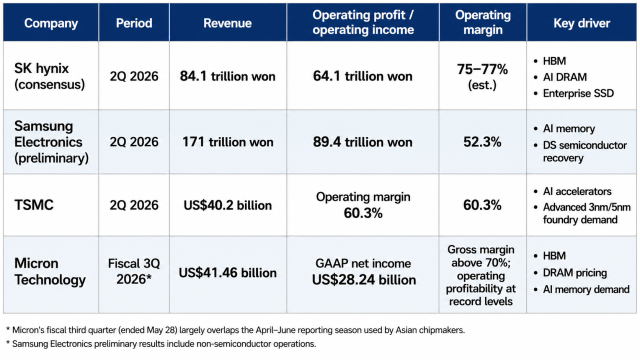
Samsung Electronics, which earlier this month reported preliminary second-quarter operating profit of 89.4 trillion won on revenue of 171 trillion won, is expected to disclose detailed divisional results on July 30. Investors will focus on the performance of its Device Solutions semiconductor division and management's outlook for AI memory demand.
Should SK hynix meet market expectations, the combined second-quarter operating profit of the two Korean chipmakers would exceed 150 trillion won, underscoring the industry's dominant role in powering the AI investment cycle.
Analysts attribute the record earnings to the extension of the memory supercycle that began in the second half of last year.
HBM shipments continued to expand during the April-June period while conventional DRAM prices remained firm. Strong capital spending by North American cloud service providers on AI data centers also lifted demand for enterprise SSDs, supporting a recovery in NAND flash prices.
"The expansion of HBM production will continue to limit supply of conventional memory products," said Kim Dong-won, head of research at KB Securities. "Long-term supply agreements are increasing, and sales to global big tech companies and AI data centers are expected to account for around 70 percent of revenue."
The earnings boom has also pushed profitability to levels rarely seen in manufacturing.
Brokerages estimate SK hynix's second-quarter operating margin at 75 to 77 percent, up from 72 percent in the previous quarter, meaning the company would generate more than 7,500 won in operating profit for every 10,000 won of products sold.
If achieved, SK hynix would outperform Taiwan Semiconductor Manufacturing Co. in operating margin for a third consecutive quarter. TSMC, widely regarded as one of the semiconductor industry's most profitable companies, reported a 60.3 percent operating margin for the second quarter.
SK hynix first surpassed TSMC in profitability in the fourth quarter of last year, posting a 58 percent operating margin compared with TSMC's 54 percent. The gap is expected to widen to as much as 15 to 17 percentage points this quarter.
The company's balance sheet has strengthened alongside its earnings.
SK hynix returned to a net cash position in the third quarter of last year for the first time since 2019 and expanded net cash holdings to 35 trillion won at the end of the first quarter. Analysts expect cash reserves to increase further after another quarter of record earnings.
Despite the blockbuster numbers, investors are expected to focus less on the reported results than on management's outlook for the second half.
Key questions include whether HBM supply can keep pace with surging AI demand, whether pricing power in conventional memory can be sustained, how quickly major cloud providers will expand AI infrastructure spending, and whether the current AI investment cycle is entering a more mature phase.
With semiconductor stocks accounting for a substantial share of South Korea's benchmark indexes, the guidance from SK hynix and Samsung Electronics next week will likely to influence not only domestic equities but also broader sentiment across global AI-related technology stocks.
Copyright ⓒ Aju Press All rights reserved.
