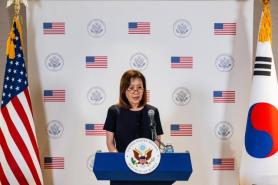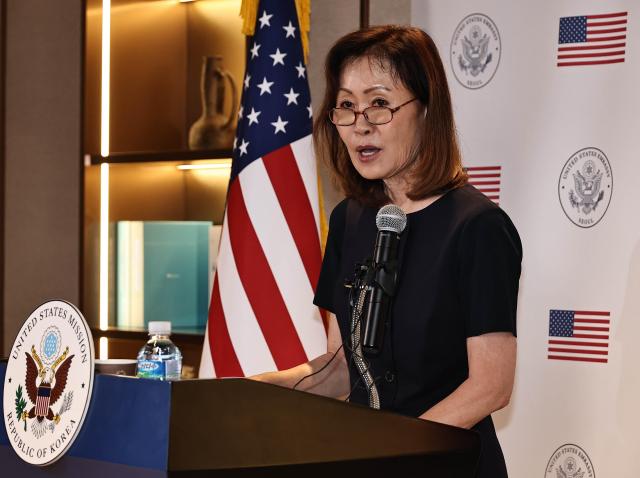
But these may not be ordinary circumstances. Michael Steel's arrival on Thursday has drawn unusual attention here, not so much because she is another Korean-American envoy to serve in the role after Sung Kim, who held the position from 2011 to 2014, but because the bilateral relationship is facing an unusually complicated moment.
In her first message upon arrival, Steel deliberately described the alliance between the two countries as one of the world's strongest, built through sacrifice, trust, and decades of cooperation. She also called on both countries to write the "next chapter" of the partnership, emphasizing the need to remain focused on practical results. That message reflects a basic reality of diplomacy. Even the closest allies do not survive on history alone as they endure because they continually find ways to manage differences.
The timing of Steel's appointment is significant. She is the first U.S. ambassador to Seoul since President Donald Trump returned to the White House for his non-consecutive second term early last year, and her arrival comes as the two countries navigate a difficult set of issues. Economic disputes, questions over investment commitments, industrial policy, and security cooperation have all become sources of friction.
Yet beneath the language of shared values and enduring friendship lie growing disagreements over defense, trade, investment, and the broader direction of regional strategy.
The real challenge is not whether disagreements exist, as every alliance has them. What matters is whether these disagreements are handled diplomatically and constructively or allowed to turn into public signs of distrust.
Steel arrives with a background that will inevitably shape how she is perceived in Seoul. As a Korean American and the daughter of immigrants, she represents a personal connection between the two societies. Her family story reflects one shared by many Korean Americans: a journey of migration, hardship, and a dedication to serving the public.
At the same time, her political record has drawn some mixed reactions here. During her time in Congress, Steel took a firm stance on North Korea and expressed skepticism toward approaches she viewed as making too many concessions to Pyongyang, placing greater emphasis on deterrence and pressure while remaining cautious about engagement.
Steele's stance may put her at odds with those who support the current South Korean administration's push for rapprochement with North Korea. But ambassadors cannot be expected to share every political view of the country where they serve. Their role is to represent their own government while also understanding the concerns and realities of the host country. Finding that balance will be one of Steel's main challenges.
The most important question is not whether Seoul and Washington agree on every issue. They never have. The more important question is whether they still share a fundamental understanding of why the alliance matters.
The security situation and political environment around the Korean Peninsula have become more difficult. North Korea's military arsenal continues to grow, China's influence is increasing, and rivalry among major powers is reshaping the regional landscape. In such a context, a weakened U.S.-South Korean alliance could create uncertainty beyond the two countries.
Steel's reported access to Trump may give her strong influence in Washington. If that is the case, it could become an advantage for Seoul. A successful ambassador is not simply a messenger who carries instructions from one government to another. The best ambassadors help each side understand one another.
Her appointment, therefore, should not be viewed only through the lens of political differences or disagreements. It is also an opportunity to test whether the alliance is strong enough to manage them while staying focused on its larger purpose.
South Korea's longstanding alliance with the U.S., forged in war and strengthened through decades of cooperation, has endured for generations. Its future, however, will depend less on memories of the past than on the choices made today.
Steel has taken up her post at a moment when diplomacy matters more than symbolism. Her success will not be measured by whether she avoids challenges during her time in Seoul. It will be measured by whether she leaves the alliance stronger, more stable, and better prepared for whatever comes next.
Copyright ⓒ Aju Press All rights reserved.