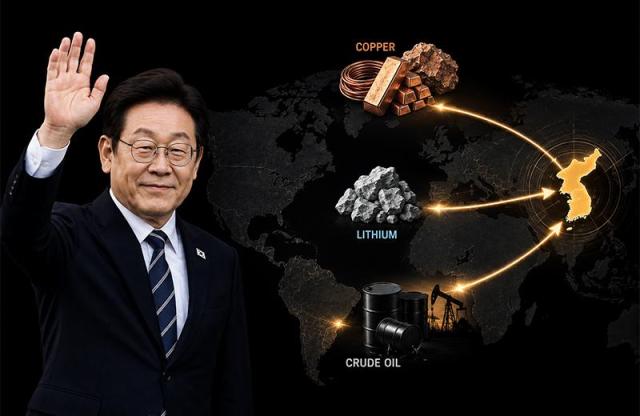
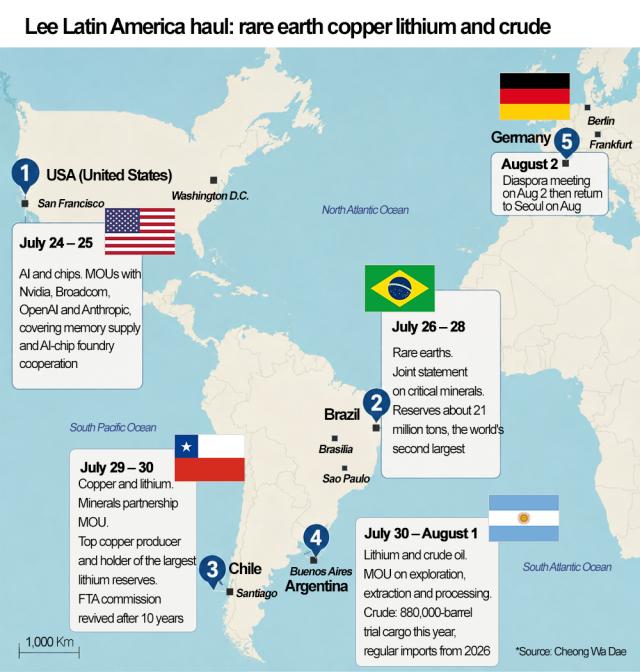
The tour effectively connected both ends of the AI ecosystem. In San Francisco, Lee sought partnerships with Nvidia, Broadcom, OpenAI and Anthropic to strengthen Korea's position in AI chips, models and data centers. In Brazil, Chile and Argentina, he pursued the minerals and energy needed to keep those AI factories running, linking Silicon Valley's computing power with Latin America's resource wealth.
Each stop targeted a strategic bottleneck.
In Chile, the world's largest copper producer and holder of the biggest known lithium reserves, Lee signed a critical minerals partnership and agreed with President Jose Antonio Kast to revive the Korea-Chile Free Trade Commission, dormant since 2015.
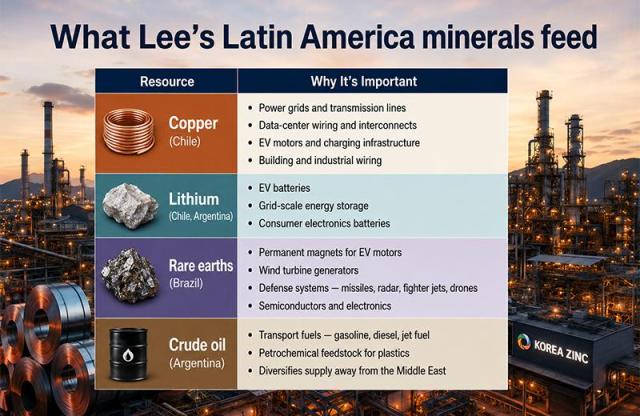
Copper has become indispensable for AI infrastructure, wiring power grids, transmission networks and hyperscale data centers, while lithium remains central to batteries for electric vehicles, energy storage systems and electronics.
The International Energy Agency projects global copper supply will fall roughly one-quarter short of demand by 2035 because of declining ore grades and lengthy mine development, while lithium is also faces tightening supplies as refining remains heavily concentrated in China.
Brazil addressed another vulnerability.
Lee and President Luiz Inacio Lula da Silva adopted a joint statement on critical minerals, including rare earths, of which Brazil possesses an estimated 21 million tons—the world's second-largest reserves.
Rare earth elements are essential for permanent magnets used in electric vehicles, industrial robots, wind turbines and advanced defense systems. Their strategic value has risen sharply since China, which dominates about 60 percent of global mining and 90 percent of refining, tightened export controls last year.
Holding the world's fourth-largest lithium reserves and vast shale oil resources, the country signed a lithium memorandum covering exploration, extraction and processing while opening a new supply route for crude oil.
South Korea imported a trial cargo of about 880,000 barrels of Argentine crude this year and plans to begin regular purchases from 2026 as it seeks to reduce dependence on Middle Eastern supplies.
"This lays the practical groundwork to broaden our crude import lines, concentrated in the Middle East, toward South America," National Security Adviser Wi Sung-lac said in Buenos Aires.
The resource diplomacy built directly on the first leg of Lee's trip in San Francisco, where he unveiled the San Francisco AI Declaration, describing South Korea as an "irreplaceable core nation in the global AI supply chain." Korean companies and their U.S. partners also announced semiconductor cooperation plans that the presidential office valued at about $950 billion.
The four-stop tour reflected Seoul's evolving AI strategy: securing not only chips and software partnerships but also the minerals, electricity and energy supplies required to sustain AI infrastructure over the long term.
The agreements reached in Latin America, however, remain largely memorandums of understanding and letters of intent. Their ultimate value will depend on whether they translate into long-term mineral offtake agreements, stable crude imports and commercial investment that strengthens South Korea's place in the global AI supply chain.
Copyright ⓒ Aju Press All rights reserved.