

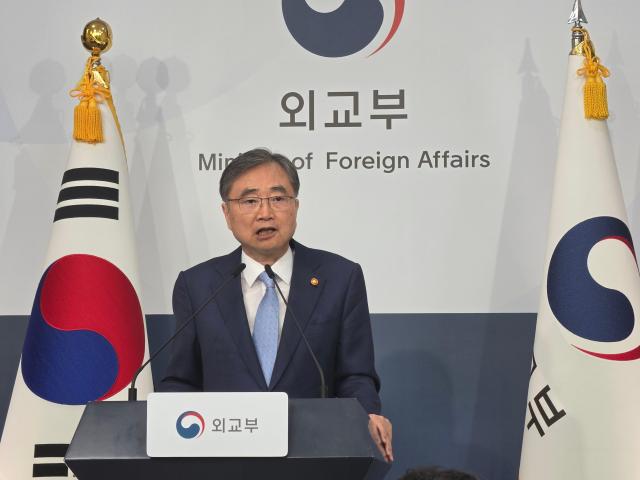
SEOUL, August 05 (AJP) - South Korea will spend the fall looking for a way to talk to North Korea and does not expect to get one, Foreign Minister Cho Hyun said Wednesday, hours after the president told the officials who run the policy that the work will feel like shouting and hearing no echo.
Asked whether the two governments might meet face to face at the United Nations General Assembly in September, Cho said the chance remains uncertain and that the North's conduct points one way.
"Judging by North Korea's attitude so far, I think it will probably avoid such an opportunity," he said. "But the government is doing everything it can to break the current deadlock, so we will not miss occasions such as the General Assembly, or APEC in the fall."
No official channel has opened between the two governments since President Lee Jae Myung took office in June 2025. The Ministry of Foreign Affairs, in the written report it submitted to the president the same day, lists North Korea's refusal to talk or exchange as the first obstacle to its own Korean Peninsula policy.
Cho spoke at a post-briefing session at Government Complex Seoul at 3 p.m., after the ministry delivered its half-year report at the presidential Blue House alongside the ministries handling unification, defense and veterans affairs.
The report set out where Seoul has been knocking. Through the first half of the year, the ministry worked with third countries and international bodies to reach Pyongyang, naming Singapore, Viet Nam and Sweden along with the United Nations. It also pressed Beijing on peninsula stability at the January summit and during the prime minister's visit in June, and secured a Security Council sanctions exemption for humanitarian aid to the North.
For the second half, it plans to keep working multilateral meetings that North Korea actually attends, including UN settings and unofficial dialogues that mix government officials with academics, while pulling China and Russia toward what it calls a constructive role.
The substance on offer is a denuclearization sequence that begins with a freeze. The ministry describes it as halt, then reduce, then dismantle, and says progress on the first step is what it will pursue in talks with Washington.
Pyongyang has been moving the other way. It claims status as a nuclear weapons state, continues to build out its nuclear and missile programs, and has drawn closer to Moscow while repairing ties with Beijing, according to the ministry's assessment. It has also widened its own diplomacy, hosting the Vietnamese and Singaporean foreign ministers in May and naming new ambassadors to posts including Indonesia and Sweden, while keeping open the possibility of conditional talks with the United States.
Chinese Foreign Minister Wang Yi is expected in Seoul later this month, and Cho said North Korea will be at the front of that conversation.
"This is an important issue for settling peace on the Korean Peninsula, so I will take it up with Wang Yi as the top priority," he said. He added that he does not expect Beijing to arrive holding a card it intends to reveal.
On reports that North Korea is sending additional troops to Russia, Cho said the matter needs further confirmation and that Seoul is watching closely.
"We are looking at how the situation develops with concern, and with a very grave view given the seriousness of this matter," he said.
The rest of the report was an accounting of a year the ministry believes went well.
Diplomacy ranked first among the areas the public rates positively in the president's performance, according to a Gallup Korea survey released on July 24. A separate evaluation published on June 7 by the Public Policy Evaluation Association and the Segye Times placed national-interest-centered foreign and security policy first among the administration's governing goals.
Since the government took office, it has held more than 100 leader-level engagements with over 50 countries, producing roughly 700 follow-up items the ministry is now tracking. Thirty-two foreign ministers had visited South Korea as of July 16.
When war broke out in the Middle East, the ministry helped about 1,500 South Koreans get out by land, charter flight, military transport and commercial aircraft, and its missions in the region stayed open through the fighting. Of 26 South Korean vessels caught in the Strait of Hormuz, 24 got clear by July 16.
Confinement cases involving South Koreans caught in scam operations in Cambodia fell from 225 in the first half of last year to 14 in the same period this year, a drop of 94 percent, after the ministry adjusted travel advisories, built a standing channel with local police and pushed for the repatriation of suspects.
The ministry also ran the first comprehensive survey of grievances from Korean communities abroad, collecting about 2,800 submissions across two rounds through all 173 overseas missions. Of the 1,438 received in the first round, 989 have been resolved.
Cho relayed one instruction from the president that came without numbers attached. Lee told the room that foreign policy becoming a target of domestic politics is not desirable, and that it is heading that way regardless.
"Rather than any argument, he spoke about practice," Cho said. "My own reading is that it was a remark reflecting deep insight into the fact that diplomacy is reality, and that it happens inside that reality."
---
AJP Takeaways
● Foreign Minister Cho Hyun said North Korea will probably avoid a face-to-face opportunity at the United Nations General Assembly in September, while committing to work that occasion and APEC in the fall regardless.
● The Ministry of Foreign Affairs named Singapore, Viet Nam, Sweden and the United Nations as the channels it used to reach Pyongyang in the first half of the year, and listed the North's refusal to talk or exchange as the first obstacle to its own peninsula policy.
● Cho said North Korea will be his top priority when Chinese Foreign Minister Wang Yi visits Seoul later this month, and that he does not expect Beijing to arrive holding a card it intends to reveal.
● The Ministry of Foreign Affairs disclosed a denuclearization sequence of halt, then reduce, then dismantle, and said it will pursue progress on the first step in talks with Washington. The sequence appears in the written report and slide deck submitted to the president, not in the briefing.
Copyright ⓒ Aju Press All rights reserved.
