

SEOUL, August 11 (AJP) - A South Korean research team has shown that gas atoms trapped inside a porous solid can be made to line up in a regular pattern, the way atoms line up in a crystal, instead of scattering wherever they land. The finding, so far demonstrated only in computer simulations, points to a different way of designing the materials that separate one gas from another.
Korea Advanced Institute of Science and Technology said Tuesday that a team led by Kim Ji-han in its Department of Chemical and Biomolecular Engineering had identified the effect, which the researchers call a gas lattice, and then used artificial intelligence to design new materials that produce it on demand.
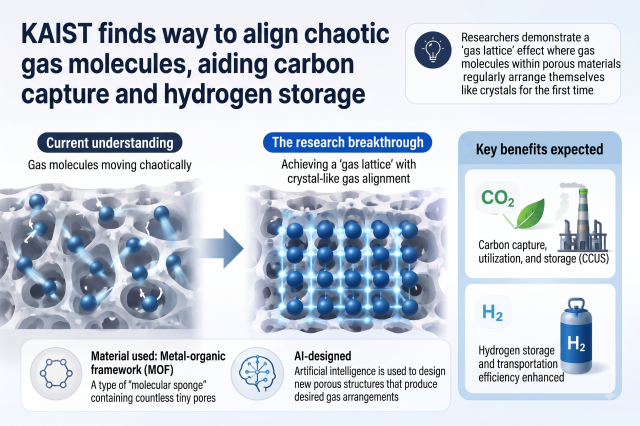
Porous materials have been studied for decades on one question above all, which is how much gas they can hold. The atoms and molecules that go inside were assumed to stick anywhere there was room. Korea Advanced Institute of Science and Technology (KAIST) said the team found that under the right conditions the host material behaves like a mold, steering the gas into fixed positions.
The materials in question are metal-organic frameworks, built by linking metal clusters with organic molecules into a rigid scaffold shot through with pores far too small to see. Chemists often describe a metal-organic framework (MOF) as a molecular sponge, because it soaks up gas the way a kitchen sponge soaks up water.
Why the arrangement matters comes down to cost. Pulling one gas out of a mixture is among the most energy-hungry jobs in industry, and the team tested its idea on one of the hardest cases. Xenon, a noble gas used in medical imaging, anesthesia and satellite thrusters, makes up about 0.087 parts per million of the atmosphere, roughly one atom in every 11 million. It is recovered as a byproduct when air is chilled until it liquefies and then distilled. The same process yields krypton, about 13 times more common in air, and separating the two afterward takes a second round of distillation at cryogenic temperatures.
Screening a large database of known frameworks, the researchers found one in which simulated xenon stopped behaving like a gas. Inside a cobalt-based structure called Co-CAU-36, the atoms settled into what physicists call a body-centered cubic arrangement, meaning one atom at each corner of an imaginary cube and one more at its center, repeated through the pore. The team's own comparison is a box of balls. Poured in, they land anywhere. Set down one at a time, they form a pattern.
The reason is geometry. The pore walls carry a repeating series of spots where a xenon atom sits most comfortably, and once enough atoms are inside, those spots dictate the arrangement. Crystallizing a gas normally demands extreme cold or crushing pressure. Here the ordering came from the shape of the container.
A stranger result came when the team put xenon and krypton in together. Instead of mixing, the two gases divided by position. Xenon formed an ordered shell against the pore walls, and krypton collected in the space at the center.
That is a different mechanism from the one the field normally relies on. Conventional separation materials work by gripping one gas more tightly than the other. In the simulations, the split came from where each gas ended up rather than how firmly it stuck.
The team then turned the question around. Rather than picking a material and watching what the gas inside it does, the researchers specified the arrangement they wanted and let software hunt for a structure that would deliver it. They paired machine learning with a genetic algorithm, a method that breeds and mutates candidate designs over many generations and keeps whichever ones score best.
The approach produced framework designs that order xenon into the body-centered pattern and into a face-centered one, where the extra atoms sit at the center of each cube face instead of in the middle.
"This study is the first case of lining gas up like a crystal inside a porous material," Kim said. "We have moved past thinking only about how much gas a material can hold, and opened the possibility of designing the arrangement itself."
Several steps stand between the paper and any industrial plant. Everything reported was done on a computer. Nobody has yet loaded xenon into Co-CAU-36 in a laboratory and measured the lattice, and the frameworks the software designed have not been built. Co-CAU-36 itself is real and was first reported in 2018, but the new structures exist as designs. The team has also not tested the concept on carbon dioxide or hydrogen, the two gases with the largest commercial stakes, and both are molecules rather than single atoms, which behave differently in a tight space.
"Applied to carbon dioxide and other molecules, this could be used to design separation and storage materials suited to a specific purpose," Kim said.
Kim Young-hun and Kim Do-hoon, both doctoral candidates at KAIST, were joint first authors, and Kim Seung-woo, a master's student, and Lim Yun-sung, who holds a doctorate, were second authors. The paper, "Framework-templated gas lattices in metal-organic frameworks," was published online in Nature Communications on June 23.

Copyright ⓒ Aju Press All rights reserved.
