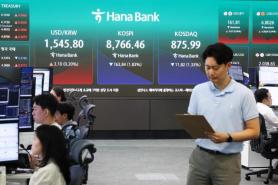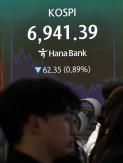
The index shed 273.08 points to close at 6,562.72.
South Korea was hit harder than Japan and China because it faced two shocks at the same time. Dubai crude, widely used by South Korean refiners, jumped US$7.78 to $98.60 a barrel Tuesday, putting it several dollars above Brent. Sovereign bond yields also rose worldwide after Japan's benchmark 10-year yield touched 3 percent for the first time since 1996.
Foreign investors sold a net 1.91 trillion won or $1.40 billion, on the main board. Institutions sold 2.04 trillion won or $1.49 billion. Individuals bought 2.30 trillion won or $1.68 billion.
The selloff was concentrated in large cap shares. The KOSPI 200 fell 4.1 percent, more than the broader market, while the small cap KOSDAQ dropped 2.1 percent to 803.98.
Samsung Electronics fell 4.0 percent to 250,500 won or $183 while SK hynix fell 4.7 percent to 1,613,000 won.
SK square, the holding company whose main asset is its stake in SK hynix, dropped 8.0 percent to 982,000 won. That was roughly twice the fall in the chipmaker itself.
Carmakers were hit harder than either chipmaker. Hyundai Motor lost 5.6 percent to 378,000 won. Kia lost 5.2 percent to 124,400 won.
Banks were the exception. Shinhan Financial Group slipped 0.5 percent to 110,500 won. KB Financial Group fell 1.2 percent to 169,100 won. Traders treated higher yields as support for lending margins.
In Tokyo, the Nikkei 225 closed down 2.9 percent at 64,325.64. SoftBank Group fell 6.4 percent to 4,924 yen and Tokyo Electron fell 3.4 percent to 53,110 yen. The composite index in Shanghai edged lower.
The won firmed against the dollar to 1,367.60 won, strengthening by 7.90 won from the previous session.
Foreign investors had sold less than 1 trillion won worth of stocks for five straight sessions through Tuesday, but their selling nearly doubled on Wednesday as oil prices in the Gulf, rather than the chip cycle, drove the market
Copyright ⓒ Aju Press All rights reserved.