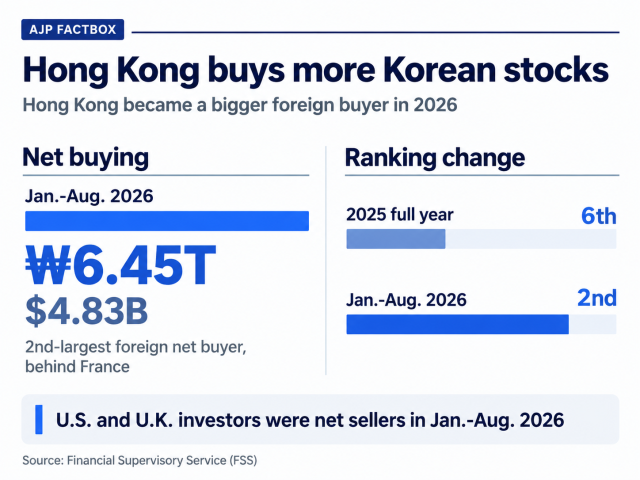
Hong Kong ranked as the second-largest source of foreign net buying in Korean listed stocks in the first eight months of 2026, behind France, with net purchases of 6.45 trillion won ($4.83 billion), according to the Financial Supervisory Service (FSS). It ranked sixth for the whole of 2025. U.S. and British investors, meanwhile, were net sellers during January-August.
Easier access helped bring Hong Kong investors into a market riding an extraordinary semiconductor rally. The KOSPI gained 76 percent in 2025 and climbed another 110 percent to its June peak, driven largely by expectations of higher earnings from artificial intelligence demand.
The reversal has been punishing.
The KOSPI rebounded 3.29 percent to 5,735.66 on Wednesday but remained about 37 percent below its June 22 record close of 9,114.55, according to Korea Exchange data. It finished Thursday 3.5 percent lower.
For Korean brokerages courting Hong Kong clients, the challenge is now to turn an appetite for two chipmakers into an investment relationship that can outlast their rally.
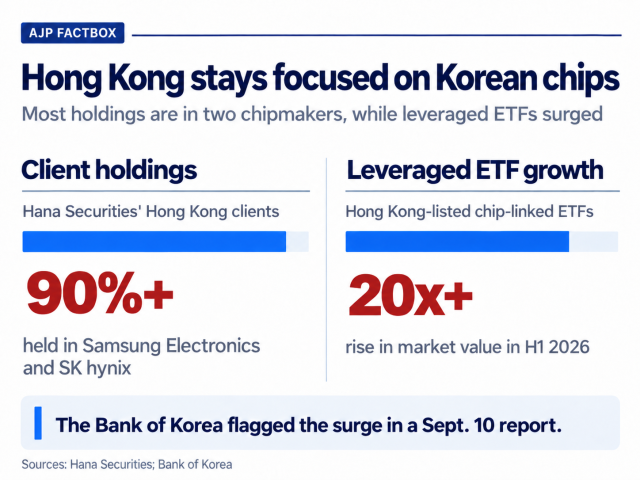
About 3,500 Hong Kong retail investors have entered the Korean market through an account service launched by Hana Securities and its local partners in October 2025, according to the brokerage. Initially used mainly by wealthy clients, the service has since attracted ordinary retail investors.
More than 90 percent of those clients’ Korean equity holdings are concentrated in Samsung Electronics and SK hynix.
The two chipmakers account for roughly half of the KOSPI’s market capitalization, leaving both the benchmark and investors heavily exposed to shifts in the outlook for AI spending.
An easier route into Seoul
The value of Korean listed shares held by Hong Kong investors reached 44.89 trillion won at the end of August, up more than 90 percent from the end of 2025, FSS data showed. That increase reflects both new purchases and changes in the value of existing holdings.
Kim Dae-jong, a professor of business administration at Sejong University, attributed the growing interest primarily to improving semiconductor earnings and expectations of further growth in AI demand.
“Unlike U.S. and British investors who have been taking profits or rebalancing their portfolios, Hong Kong investors appear to be focusing on the relatively attractive valuations and growth potential of Korean semiconductor stocks,” Kim said.
He cited rising memory-chip prices and demand for high-bandwidth memory, a key component in advanced AI processors, as factors supporting earnings expectations for Samsung Electronics and SK hynix.
Access has also become simpler.
Foreign investors once had to register with South Korean regulators and complete lengthy paperwork before opening local brokerage accounts. South Korea abolished the registration requirement in December 2023, although direct investment still required an account with a domestic brokerage.
Foreign omnibus accounts allow overseas clients to trade Korean shares through their existing brokerages, removing the need for separate local accounts.
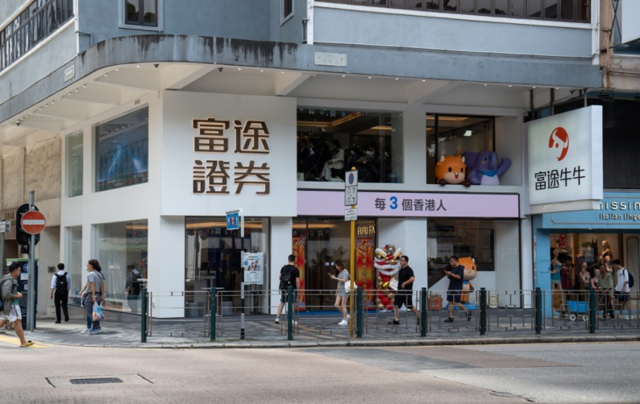
Hana Securities became the first Korean brokerage to offer the service through a partnership with Hong Kong’s Emperor Securities in October 2025. It extended the service to Futu Securities, a major Hong Kong online brokerage, in July 2026.
Samsung Securities also provides access through U.S.-based Interactive Brokers, which operates in Hong Kong. Mirae Asset Securities launched its MAPS stock-trading platform in June, allowing Hong Kong individuals to trade Korean equities.
Shinhan Securities is preparing a similar omnibus account service with CICC International, the Hong Kong-based international arm of China International Capital Corporation. Chief Executive Lee Sun-hoon visited Hong Kong in September to discuss the partnership.
“Foreign omnibus accounts have helped attract overseas capital by simplifying account-opening and trading procedures,” Kim said.
He cautioned, however, that easier access alone could not explain the buying. Expectations of stronger chip earnings and further share-price gains also played an important role.
Hana is now seeking to broaden its clients’ exposure to other AI-related sectors, including energy and construction.
Leveraged bets amplify the swings
Hong Kong’s appetite for Korean chips has extended beyond shares to products that multiply their daily returns.
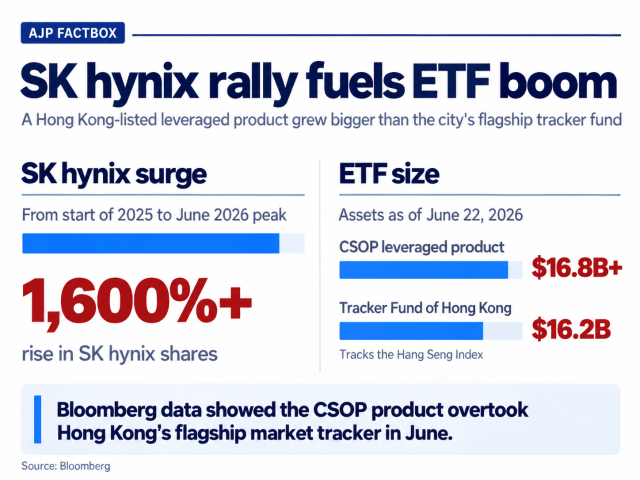
SK hynix shares surged about 1,600 percent from the start of 2025 to their June 2026 peak. A leveraged exchange-traded product targeting twice the stock’s daily return, managed by Hong Kong-based CSOP Asset Management, became the city’s largest ETF by assets in June.
The product held more than $16.8 billion as of June 22, surpassing the $16.2 billion held by the Tracker Fund of Hong Kong, which tracks the Hang Seng Index, according to data compiled by Bloomberg.
The growth has drawn scrutiny from the Bank of Korea (BOK). In its Sept. 10 monetary and credit policy report, the central bank said the combined market value of Hong Kong-listed leveraged ETFs linked to Samsung Electronics and SK hynix had increased more than twentyfold in the first half of 2026.
Although the products trade in Hong Kong, their effects can reach Seoul. Financial institutions buy and sell Korean stocks or futures to manage their exposure, and adjustments to maintain targeted daily returns can add to market pressure.
Kim said such rebalancing could reinforce market movements, generating additional buying as prices rise and selling as they fall.
“When investment is concentrated in Samsung Electronics and SK hynix, growing leveraged bets can significantly affect short-term trading in both stocks,” he said.
“Share prices can move excessively because of short-term capital flows, regardless of corporate earnings,” Kim added. “Investors and financial regulators need to watch market volatility closely.”
The impact depends on the size of the funds and how financial institutions hedge their exposure, he said.
Authorities in both markets have moved to contain the risks.
South Korea’s Financial Services Commission raised the minimum cash deposit for retail investors in single-stock leveraged products from 10 million won to 30 million won, effective July 31. It also suspended new listings of single-stock products and tightened investor protection measures.
Following regulatory guidance in Hong Kong, CSOP adopted a flexible leverage structure on Aug. 3, allowing its Korean chip-linked products to adjust exposure between 1.1 and two times daily returns instead of maintaining a fixed twofold target.
The BOK has called for closer monitoring of leveraged investment and overseas products linked to Korean stocks, warning that trading abroad can create risks at home.
Reasons to stay beyond chips
Despite the surge in buying, Hong Kong accounted for only about 2 percent of foreign-held Korean listed equities at the end of August, up from 1.7 percent at the end of 2025, according to the FSS.
A broader range of investment products is emerging. CSOP launched a KOSPI 200 ETF on June 18 and a KOSPI 200 covered-call active ETF on July 31, extending its offerings beyond individual chipmakers.
But a wider menu alone may not be enough to keep investors interested as the market struggles to recover.
Kim said automobiles, shipbuilding, defense, biotechnology and finance could attract more foreign capital if companies demonstrate sustainable growth and profitability.
“Korean companies need to improve shareholder returns and corporate governance, while providing stable dividends and predictable management policies,” he said.
Better access to corporate information would also help investors look beyond a handful of familiar names.
“It is particularly important to improve transparency so global investors can easily compare Korean companies’ earnings and shareholder-return policies,” Kim said.
“Financial authorities should also expand English-language disclosures and improve foreign investors’ access to information on dividends, taxes and corporate performance,” he added, calling for further improvements to omnibus account services.
The chip boom brought Hong Kong investors to Seoul. Whether they stay through the bust may depend on what Korea can offer beyond its two semiconductor giants.

Copyright ⓒ Aju Press All rights reserved.