
Journalist

Lee Hugh
=
-
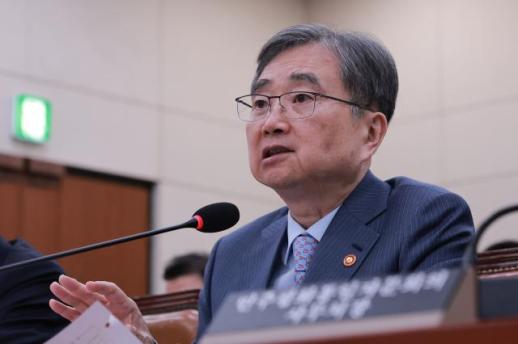 South Korea's Cho Hyun, Jordan foreign minister discuss Middle East reconstruction cooperation South Korean Foreign Minister Cho Hyun spoke by phone on Tuesday with Jordanian Foreign Minister Ayman Hussein al-Safadi at Jordan’s request, exchanging views on bilateral ties and recent developments in the Middle East, the Foreign Ministry said. Cho expressed condolences over damage suffered by Jordan amid the war in the Middle East and said he hoped peace and stability in the region would be restored soon, noting the impact of regional stability on global security and economic conditions, the ministry said. Al-Safadi thanked Cho for the message and asked for South Korea’s continued support and attention toward stability and peace in the Middle East. He also said he hoped the two countries would cooperate on regional reconstruction projects, the ministry said. The ministry said the two ministers agreed to stay in close communication on related issues. * This article has been translated by AI. 2026-05-06 20:36:13
 -
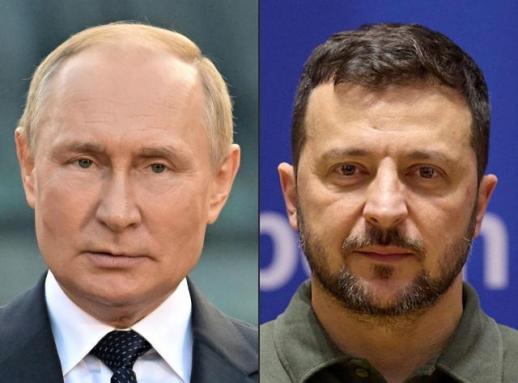 Zelenskyy Vows ‘Same Response’ After Russian Strikes Ahead of Victory Day 러시아의 제2차 세계대전 승리기념일(5월 9일)을 앞두고 러시아와 우크라이나가 공방을 계속 이어가고 있다. 6일 연합뉴스와 AFP통신 등에 따르면 우크라이나 당국은 휴전 발효 시점인 키이우 시간 6일 0시 이후에도 러시아군이 자포리자의 기반 시설을 공격했다고 밝혔다. 이고르 클리멘코 내무부 장관은 이날 공격으로 28명이 사망하고 최소 120명이 다친 것으로 파악됐다고 언급했다. 러시아 국방부는 전술기, 공격용 무인기(드론), 미사일, 포병대 등을 동원해 우크라이나의 고정익 드론 조립공장, 연료 저장소, 우크라이나군 및 외인 용병 주둔지 등을 타격했다고 밝혔다. 앞서 지난 4일 러시아 국방부는 전승절을 맞아 8~9일 휴전하겠다는 계획을 발표했으나, 우크라이나는 러시아가 휴전 발효 이후에도 공격을 이어갔다고 주장했다. 볼로디미르 젤렌스키 우크라이나 대통령은 성명에서 "우크라이나는 러시아가 모스크바 열병식 기간 휴전을 촉구한 것을 고려해 우리도 같은 방식으로 대응할 것임을 분명히 밝힌 바 있다"며 "우리는 러시아가 휴전 체제를 위반했음을 확인하며 군과 정보기관의 저녁 보고를 바탕으로 향후 조치를 결정하겠다"고 말했다.* This article has been translated by AI. 2026-05-06 20:33:16
 -
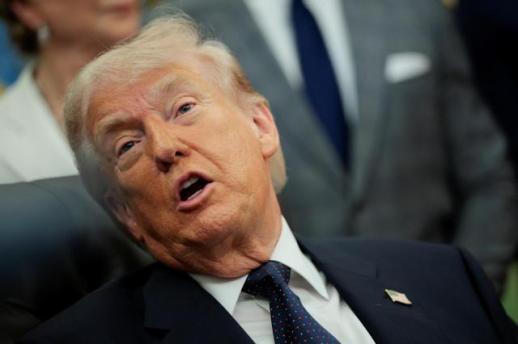 U.S., Iran Near One-Page MOU on Nuclear Enrichment Pause and Steps to End War The United States and Iran are said to be close to a one-page memorandum of understanding outlining positions on the nuclear issue as part of efforts to end the war. According to Yonhap News Agency and U.S. online outlet Axios on the 6th, the draft MOU contains 14 items setting basic principles for ending the war and for detailed nuclear talks. The White House is waiting for Iran’s response on key issues within 48 hours. While a final agreement has not been reached, the two sides are reported to have come to terms since the war began in February. The MOU includes a temporary moratorium on Iran’s nuclear enrichment; U.S. relief from sanctions on Iran and the partial release of frozen funds; a gradual easing of Iran’s restrictions on passage through the Strait of Hormuz; and a gradual easing of the U.S. maritime blockade of Iran. The talks are seen as gaining momentum after President Donald Trump abruptly suspended the “liberation project” in the Strait of Hormuz. Trump said on his social media platform Truth Social on the 5th that he would temporarily halt the project, citing “requests from Pakistan and other countries,” what he called “tremendous military achievements” during operations against Iran, and “big progress” toward a “complete and final agreement” with an Iranian delegation.* This article has been translated by AI. 2026-05-06 19:39:14
 -
 KOSPI Tops 7,000, Extends Record Run Over Past Year A level once dismissed as out of reach became reality as South Korea’s benchmark KOSPI pushed past 7,000, extending a streak of record-setting gains despite external headwinds including war in the Middle East and worries about a global slowdown. According to the Korea Exchange, the KOSPI opened on May 6 at 7,093.01, up 156.02 points (2.25%) from the previous session, marking the first time it crossed 7,000. The move came just 47 trading sessions after it first topped 6,000 intraday on Feb. 25. The index has been breaking through higher levels faster as it climbs. It took 18 years and four months for the KOSPI to rise from 1,000 to 2,000 (March 1989 to July 2007). It then took 13 years and five months to move from 2,000 to 3,000 (July 2007 to January 2021), and four years and nine months to reach 4,000 (January 2021 to October 2025). By contrast, it cleared 5,000 in three months and 6,000 in about a month. The KOSPI’s gains also outpaced major global markets. Investing.com data showed the KOSPI posted a 186.39% return over the past year, the highest among major global indexes. Taiwan’s TAIEX rose 98.11%, South Korea’s KOSDAQ gained 66.21%, and Japan’s Nikkei 225 advanced 61.81%. The market’s size has surged as well. The KOSPI’s market capitalization reached a record 6,058 trillion won on May 6, nearly triple the roughly 2,107 trillion won level a year earlier. Large-cap chipmakers dominated: Samsung Electronics was valued at 1,555 trillion won and SK hynix at 1,141 trillion won, for a combined 2,696 trillion won — about 44.3% of the KOSPI’s total market cap. Exchange-traded funds, another driver of the rally, expanded quickly. The number of ETFs listed on the KOSPI rose to 1,099 from 973 a year earlier, and their market value climbed to 452 trillion won, topping 450 trillion won for the first time. That was more than double the 192 trillion won recorded a year earlier. More stocks have been setting new highs. As of the May 4 close, 76 stocks — including preferred shares — had hit 52-week highs over the past year based on closing prices. On a trade-price basis, 55 stocks did so. Investor money has also flowed in. The Korea Financial Investment Association said the number of active stock-trading accounts stood at 105.22 million as of May 4, up about 17% from 89.92 million a year earlier. Investor deposits, a measure of cash waiting to enter the market, jumped to 125 trillion won from 56 trillion won over the same period. * This article has been translated by AI. 2026-05-06 19:03:17
 -
 KOSPI Nears 7,400 as Analysts See Room for 8,000 to 9,000 on AI, Chip Boom The KOSPI’s ceiling appeared to give way as the benchmark surged to just below 7,400. The index was up nearly 450 points from the previous session, extending a rally that has accelerated since it closed above 6,000 on Feb. 25. That move came about 50 trading days ago. Despite headwinds cited by the market — war in the Middle East, a weakening real economy and concerns about an AI bubble — brokerage research chiefs said the rally could continue into the second half, with some projecting the KOSPI could move beyond 8,000 and even approach 9,000. "KOSPI could go as high as 9,000" On the 6th, Ajou Economy conducted an emergency survey of research heads at seven brokerages: Korea Investment & Securities, NH Investment & Securities, Samsung Securities, Kiwoom Securities, Shinyoung Securities, Yuanta Securities and SangSangIn Securities. Several respondents said further upward revisions were likely, and some said a top-end scenario could reach 9,000. Choi Hyun-jae, head of research at Yuanta Securities, said, “Under the best-case scenario, there is room up to 8,100,” adding, “In terms of market capitalization, above 9,000 is also possible.” Yoon Seok-mo, head of research at Samsung Securities, said he raised his previous annual band top to 8,400 from 7,200, based on “a 12-month expected ROE of 19.6% and an appropriate P/B of 2.2 times.” Baek Young-chan, head of research at SangSangIn Securities, said he plans to raise his forecast from 7,540 and that 8,000 is possible, citing profit growth at Samsung Electronics and SK hynix as “the key driver.” Others said they also need to revisit forecasts after the unprecedented run-up. Lee Jong-hyeong, head of research at Kiwoom Securities, said that while the firm previously suggested a 5,200 to 7,300 range, “given the current price level and earnings momentum, an upward revision is needed,” adding that a trend in which semiconductor demand overwhelms supply “will continue for some time.” Yoo Jong-woo, head of research at Korea Investment & Securities, said the firm is presenting 7,250 as the upper end but could raise it further in the second half, explaining that rising EPS is driving the index higher. Kim Hak-kyun, head of research at Shinyoung Securities, said it is difficult to set a ceiling and argued the market remains undervalued. “This is a phase where the power of semiconductors is showing up dramatically,” he said, adding that the market is hard to view as a bubble. He said Samsung Electronics and SK hynix are trading at about six times earnings, while the overall KOSPI is below eight times. Kim said it is better to keep an open mind “until upward revisions to earnings estimates start to fade.” AI value chain and the power of semiconductors Research chiefs broadly pointed to AI and semiconductors as the main reasons they expect the rally to persist. They said the KOSPI is in a phase of restructuring its earnings base around AI and chips, prompting a reassessment of index levels. Cho Soo-hong, head of research at NH Investment & Securities, said, “More than the number itself, the AI cycle is key,” adding that the semiconductor industry is being reshaped from consumer-led demand to infrastructure-led demand. Choi said that next year Samsung Electronics could post the largest profit in the global semiconductor industry, adding that a profit structure “similar to Nvidia’s, or even higher,” is possible. Baek said the second-half outlook should consider conditions and Middle East variables, but added that next year the index could reach the mid-8,000s. For the second half, most respondents said leadership is likely to remain concentrated in the AI value chain centered on semiconductors. Some also cited brokerage and defense sectors as potential gainers. Lee said the AI value chain, along with power equipment, brokerages and defense, would lead. Choi said earnings estimates are barely rising outside semiconductors and IT, adding, “In a major uptrend, market leadership does not change.” He also cited power equipment, nuclear power and materials tied to data centers. Yoo said industrials such as energy, power machinery and robots, along with the AI value chain, are key. Yoon said that with global liquidity expanding, Samsung Securities is maintaining a preference for the AI value chain — including semiconductors, power equipment, nuclear power and robots — and also holds a positive view on industrials and financials. Baek cited solar power, secondary batteries, brokerages, construction and optical communications and fiber as leading groups. Cho said the rally is spreading from semiconductors to AI infrastructure, power equipment, nuclear power, defense and brokerages. * This article has been translated by AI. 2026-05-06 18:34:42
 -
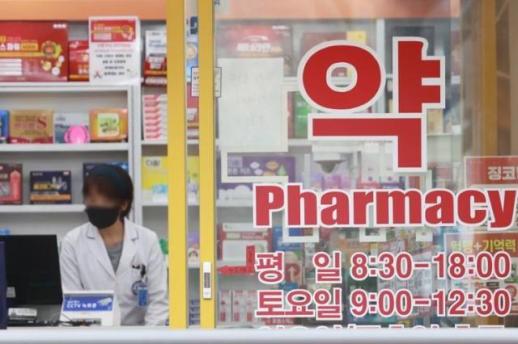 Korea’s Big Drugmakers Post Strong Q1 Gains, but Face Price-Cut Pressure in H2 South Korea’s leading traditional drugmakers are extending solid growth in the first quarter, with operating profit rising by double digits from a year earlier. Industry officials said Tuesday that Yuhan Corp., GC Biopharma and Chong Kun Dang Pharmaceutical Corp. each posted double-digit operating-profit growth in the January-March period from a year earlier. Yuhan reported consolidated first-quarter revenue of 526.8 billion won and operating profit of 8.8 billion won, up 7.2% and 37.3%, respectively. The company missed market expectations because milestone revenue tied to its lung cancer drug, Lazertinib, was not booked in the quarter. Chong Kun Dang, on a separate basis, posted revenue of 447.7 billion won and operating profit of 17.6 billion won, up 12.2% and 36.9%. The company benefited from steady sales of established prescription drugs such as Godex and Dilatrend, along with a co-marketing boost from the obesity drug Wegovy. Prescriptions for Wegovy have been expanding in the domestic obesity-treatment market, contributing more meaningfully to sales, the report said. Among the traditional drugmakers, GC Biopharma is drawing the highest expectations. Securities-industry consensus forecasts put its first-quarter revenue at 439.2 billion won, up about 14% from a year earlier, with operating profit expected to jump about 40% to around 12.2 billion won. A key driver is Aliglo, a blood product that has gained traction in North America. Aliglo is estimated to have generated about $21 million (about 31 billion won) in first-quarter sales, helped by expanding prescriptions in the United States. The company also benefited from strong sales of the obesity drug Mounjaro, distributed through its affiliate GC Wellbeing. Daewoong Pharmaceutical Co., which has yet to report results, is also expected to post growth. Analysts forecast first-quarter revenue of 388.3 billion won and operating profit of 44.2 billion won, up about 8.9% and 14.2%. They cited rising global sales of the botulinum toxin product Nabota and steady domestic prescriptions for the gastroesophageal reflux disease drug Fexuclu. The bigger concern is the second half. Companies face continued cost pressure from global supply-chain instability, including the Middle East war, and a government push to cut drug prices. The Ministry of Health and Welfare plans to issue an administrative notice this month on a revision to its standards for setting and adjusting drug prices. The revision is expected to include changes to generic pricing formulas, tighter criteria for stepwise price cuts, and measures related to policy add-ons and support for so-called exit-prevention drugs. The government is aiming for implementation in August. “Companies got through the first quarter with new-drug sales and efficient cost control, but government pricing policy and rising global logistics costs are external variables management cannot control,” an industry official said. “In the second half, performance gaps will become clearer between companies with strong new-drug portfolios and those without.” The official added that with profitability likely to shrink as prices fall, failure to expand R&D and overseas sales could lead to a downturn in results. * This article has been translated by AI. 2026-05-06 18:33:18
 -
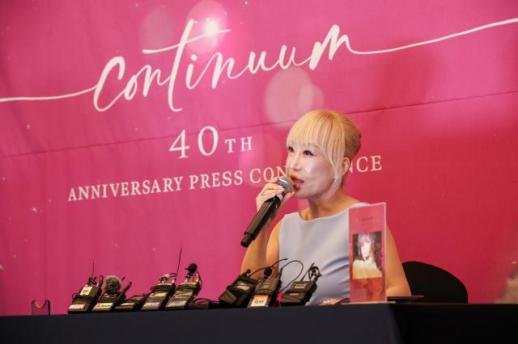 Jo Sumi marks 40th anniversary debut with vision for young artists SEOUL, May 06 (AJP) - World-renowned soprano Jo Sumi marked the 40th anniversary of her international debut Wednesday, outlining a forward-looking vision focused on nurturing young artists while expanding her musical scope through new collaborations. The milestone signals a strategic shift for South Korea's most iconic classical figure as she integrates her legacy with modern entertainment structures. "What I can do now is share what I have with as many people as possible," she said at a press conference held at InterContinental Grand Seoul Parnas in Seoul. The event featured the signing of an exclusive recording contract with SM Classics, a classical label under SM Entertainment, bridging the gap between classical and mainstream music. Jo Sumi, who debuted in 1986 at Italy's Teatro Verdi, has performed at leading global venues including La Scala, the Metropolitan Opera and the Salzburg Festival. She is widely regarded as the first South Korean classical musician to establish a dominant global presence at a time when Asian vocalists were rare on major opera stages. She was also recently named the recipient of the Samsung Ho-Am Prize in the Arts, one of South Korea's most prestigious honors. The award ceremony is scheduled for June 1. The soprano's remarks focused primarily on supporting the next generation rather than her own historical achievements. "It is not just about discovering talented singers, but about creating real opportunities for them to perform," she said. "I want to help young musicians sustain their careers." This philosophy drives the second Sumi Jo International Singing Competition, scheduled for July at the Chateau de la Ferte-Imbault in France's Loire Valley. The inaugural competition drew 500 applicants from 47 countries, while this year's edition has attracted participants from 55 nations. The event coincides with the 140th anniversary of diplomatic relations between South Korea and France. Jo Sumi emphasized that she hopes young musicians will grow into "artists who serve as messengers of peace." Her 40th-anniversary project includes a special album titled CONTINUUM, which she described as one that looks ahead rather than back. "I am still in progress," she said. "I wanted to reinterpret my life and experiences through a new musical language." Lee Sung-soo, chief administrative officer of SM Entertainment, said the partnership carries broad significance for South Korea's music industry. He noted that Jo Sumi introduced South Korean music to the global stage long before the international rise of K-pop. "We hope this collaboration becomes a meaningful convergence of classical music, K-pop and the broader cultural industry," Lee Sung-soo said. He added that bringing Jo Sumi on board as an exclusive recording artist represents a symbolic step for the country's cultural ecosystem. The album features a duet with Suho of the K-pop group EXO, whom Jo Sumi described as a "very stable artist." She praised his dedication and focus throughout the recording process. A nationwide tour will kick off on Saturday in Changwon, followed by performances in more than 20 cities including Seoul, Busan and Gwangju. Jo Sumi chose Changwon as the opening venue as a tribute to her late parents. "Although they are no longer with me, I wanted them to hear this music first," she said. Throughout the event, she repeatedly identified "freedom" as the defining value of her artistic life. "For an artist, the most important thing is freedom," she said. 2026-05-06 18:18:46
 -
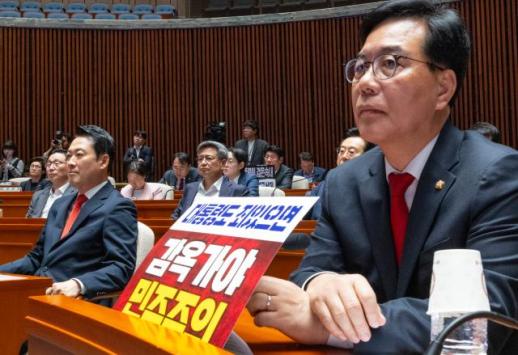 People Power Party Opposes Ruling Party’s Special Counsel Bill on Dropping Charges, to Skip Constitutional Vote The People Power Party on May 6 adopted a resolution opposing the Democratic Party’s proposed “special counsel bill on dropping charges.” After a party lawmakers’ meeting at the National Assembly, floor deputy chief whip Yoo Sang-beom told reporters, “At today’s meeting, People Power Party lawmakers resolved to oppose the unconstitutional and illegal special counsel aimed at dropping charges.” The resolution calls for: opposition to the Democratic Party’s bill; opposition to “all unconstitutional and illegal attempts” to drop charges against President Lee Jae-myung; joint action with political parties, civic groups and citizens who oppose dropping charges against the president; urging the judiciary to immediately resume the president’s five trials; and a pledge to fight what it called the ruling party’s effort to turn South Korea into a “republic of criminals.” The party also said it plans to boycott a National Assembly vote on a constitutional amendment scheduled for May 7. Yoo said most lawmakers believed it would be inappropriate to take part because the Democratic Party was pushing the process unilaterally to align with local elections, without sufficient discussion and deliberation. Responding to criticism that the party did not gather enough views, Yoo said the party line was not formed all at once and that there had been “sufficient discussion” among many lawmakers over a considerable period. * This article has been translated by AI. 2026-05-06 18:13:42
 -
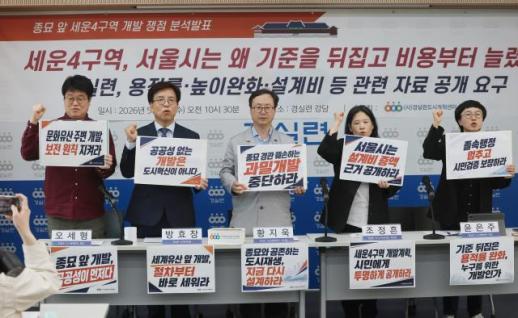 Civic Group Urges Seoul to Disclose Why It Raised Height Limits for Sewoon 4 Redevelopment The Citizens' Coalition for Economic Justice on Tuesday urged the Seoul city government to disclose how and why it changed height standards for the redevelopment of Sewoon District Zone 4, near Jongmyo Shrine in Jongno-gu. The group said it filed a freedom-of-information request seeking internal review materials, reports, alternative-plan reviews and approval documents that would show the basis for raising height limits along Jongno and the Cheonggyecheon stream in Zone 4. It also filed an information request with the Seoul Housing & Communities Corp., known as SH Corp., seeking the reasons for an increase in design fees and the basis for calculating the total design cost. According to documents including the "Sewoon 4 project implementation approval application" provided to the group by the office of Seoul Metropolitan Council member Lim Jong-guk, the redevelopment height was raised compared with the previously set building plan: along Jongno, from 54.3 meters to 98.7 meters; along Cheonggyecheon, from 71.8 meters to 144.9 meters. Citing a full redesign, the design fee was increased by 16.748 billion won, bringing the total to 52.083 billion won. The group said the project had been pursued under height-management principles meant to protect the historic and cultural landscape near Jongmyo. It said a recent draft change to the district's redevelopment promotion plan loosened that system, raising concerns that principles for protecting views, scenery and cultural heritage near the shrine could be weakened. It said the draft explains the height relaxation by citing measures such as securing open green space and providing more publicly accessible space than required, adding that the issue is not only how much taller buildings would be. The key question, it said, is what administrative judgments and procedures led to changes in long-standing management principles and whether preservation of the historic and cultural environment was sufficiently reviewed. The group also said the design-fee increase tied to the height change is a key indicator of the financial burden of the plan revision, suggesting the decision could lead to substantial additional costs. It called for separate review not only on heritage preservation and landscape management but also on cost efficiency and accountability in project execution. The group said the Seoul city government and SH Corp. should transparently explain to the public the grounds for the height relaxation, the process behind the plan change, the reasons for the design-fee increase, public contributions and measures to protect tenants. If they delay disclosure and avoid a responsible explanation, it said, suspicions of preferential treatment and public distrust will only grow. On March 25, the group said the Sewoon 4 case accepted the risk of damaging the landscape near a World Heritage site by raising the floor-area ratio, creating a structure that allowed about 551.6 billion won in additional development gains. It urged authorities to immediately halt administrative procedures related to the high-rise, high-density plan near Jongmyo and to fully disclose how the floor-area ratio and height limits were relaxed and how public contributions were calculated. A Seoul city document titled "Overview and progress by zone in the Sewoon District" shows that among the district's 34 zones, the floor-area ratio for 11 completed zones ranges from 660% to 940%, while seven zones under way were raised to 1,000% to 1,550%. An analysis of development gains from the floor-area ratio increase in Sewoon 4 put the figure at 551.57 billion won. * This article has been translated by AI. 2026-05-06 18:12:17
 -
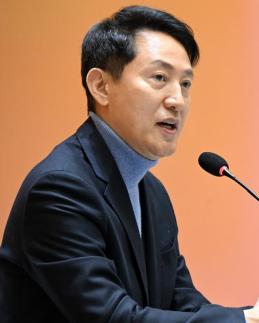 Seoul Mayor Candidate Oh Se-hoon Blames Lee Jae-myung Government, Democrats for Housing Woes Oh Se-hoon, a candidate for Seoul mayor, sharply criticized the Lee Jae-myung government and the Democratic Party’s real estate policies in a Facebook post on Tuesday. Responding to Democratic Party claims that the Seoul city government is to blame for recent instability in home prices and the monthly and long-term rental markets, Oh said, “The cause of this real estate hell is the Lee Jae-myung government and the Democratic Party.” Oh described the party’s approach as a “failed policy centered on suppressing supply and controlling the market.” He argued that Democrats created the conditions behind Seoul’s housing shortage, strains in the jeonse market and a slump in the villa market, then shifted responsibility to others. Political observers said the message went beyond a rebuttal and signaled an intensifying fight over who is responsible for housing conditions, a likely central issue in the Seoul mayoral election. Housing prices and rent are among the most sensitive pocketbook issues for Seoul residents. Oh focused his criticism on supply. He said large-scale cancellations of redevelopment zones during the tenure of former Mayor Park Won-soon are a root cause of today’s shortage. Seoul City under Park pursued a “New Town” and redevelopment exit strategy that lifted designations for many planned redevelopment areas, a move then justified as curbing speculation and protecting residents but, Oh argued, later produced a supply gap. “Redevelopment projects typically take 20 years, but the Democratic Party cut the roots and then asks why the tree won’t grow,” Oh wrote. He said that after returning to office he used the city’s “Rapid Integrated Planning” program to reduce project timelines from 20 years to about 12 years. Seoul City has recently pushed to speed up major reconstruction and redevelopment projects in areas including Apgujeong, Yeouido, Mokdong, Seongsu and Noryangjin, maintaining a supply-expansion stance that contrasts with the strict regulatory approach under the Moon Jae-in government. Critics in the real estate market have long argued that the Moon government’s tough measures distorted the market. They cite heavier taxes on owners of multiple homes, a stronger comprehensive real estate tax, tighter lending rules and the so-called three lease laws as policies that locked up listings and drove up jeonse prices. The three lease laws, implemented in 2020, are often cited as a major shock. With the introduction of a right to renew contracts and caps on rent increases, new jeonse supply fell sharply and apartment jeonse prices in Seoul surged. The government emphasized tenant protection, but critics said the side effect was the “disappearance of jeonse listings.” Oh also linked jeonse fraud to the period of rising home prices and aggressive gap investment under Democratic Party governments. “Gap investment continued as a rollover structure without sufficient capital, and then interest rate hikes and falling home prices overlapped, and jeonse fraud exploded,” he wrote. Large-scale jeonse fraud cases in Incheon’s Michuhol district and other parts of the Seoul metropolitan area have been widely analyzed as involving a mix of factors, including sharply higher villa prices late in the Moon administration, loose jeonse loan structures and inflated appraisals. Oh criticized recent Democratic Party moves to tighten regulations on multi-home owners and to reduce long-term holding deductions for nonresident owners of a single home, calling them policies that would shrink private rental supply. He also opposed expanding land transaction permit zones, saying it would effectively bind all of Seoul in a controlled economy and worsen market anxiety. Some in the industry have complained that prolonged permit requirements have reduced transactions and distorted the market. Oh said the dispute is not simply about prices but about who blocked supply and destabilized the market. “Citizens’ memory that when the Democratic Party takes power, home prices rise and rental crises repeat is no exception this time,” he wrote. * This article has been translated by AI. 2026-05-06 18:08:11