

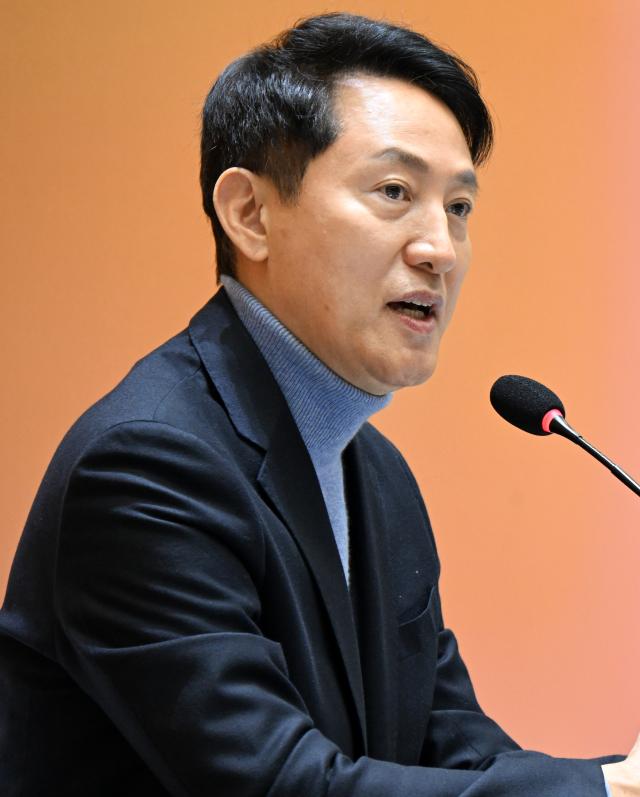
Oh Se-hoon, a candidate for Seoul mayor, sharply criticized the Lee Jae-myung government and the Democratic Party’s real estate policies in a Facebook post on Tuesday.
Responding to Democratic Party claims that the Seoul city government is to blame for recent instability in home prices and the monthly and long-term rental markets, Oh said, “The cause of this real estate hell is the Lee Jae-myung government and the Democratic Party.”
Oh described the party’s approach as a “failed policy centered on suppressing supply and controlling the market.” He argued that Democrats created the conditions behind Seoul’s housing shortage, strains in the jeonse market and a slump in the villa market, then shifted responsibility to others.
Political observers said the message went beyond a rebuttal and signaled an intensifying fight over who is responsible for housing conditions, a likely central issue in the Seoul mayoral election. Housing prices and rent are among the most sensitive pocketbook issues for Seoul residents.
Oh focused his criticism on supply. He said large-scale cancellations of redevelopment zones during the tenure of former Mayor Park Won-soon are a root cause of today’s shortage. Seoul City under Park pursued a “New Town” and redevelopment exit strategy that lifted designations for many planned redevelopment areas, a move then justified as curbing speculation and protecting residents but, Oh argued, later produced a supply gap.
“Redevelopment projects typically take 20 years, but the Democratic Party cut the roots and then asks why the tree won’t grow,” Oh wrote. He said that after returning to office he used the city’s “Rapid Integrated Planning” program to reduce project timelines from 20 years to about 12 years.
Seoul City has recently pushed to speed up major reconstruction and redevelopment projects in areas including Apgujeong, Yeouido, Mokdong, Seongsu and Noryangjin, maintaining a supply-expansion stance that contrasts with the strict regulatory approach under the Moon Jae-in government.
Critics in the real estate market have long argued that the Moon government’s tough measures distorted the market. They cite heavier taxes on owners of multiple homes, a stronger comprehensive real estate tax, tighter lending rules and the so-called three lease laws as policies that locked up listings and drove up jeonse prices.
The three lease laws, implemented in 2020, are often cited as a major shock. With the introduction of a right to renew contracts and caps on rent increases, new jeonse supply fell sharply and apartment jeonse prices in Seoul surged. The government emphasized tenant protection, but critics said the side effect was the “disappearance of jeonse listings.”
Oh also linked jeonse fraud to the period of rising home prices and aggressive gap investment under Democratic Party governments. “Gap investment continued as a rollover structure without sufficient capital, and then interest rate hikes and falling home prices overlapped, and jeonse fraud exploded,” he wrote.
Large-scale jeonse fraud cases in Incheon’s Michuhol district and other parts of the Seoul metropolitan area have been widely analyzed as involving a mix of factors, including sharply higher villa prices late in the Moon administration, loose jeonse loan structures and inflated appraisals.
Oh criticized recent Democratic Party moves to tighten regulations on multi-home owners and to reduce long-term holding deductions for nonresident owners of a single home, calling them policies that would shrink private rental supply. He also opposed expanding land transaction permit zones, saying it would effectively bind all of Seoul in a controlled economy and worsen market anxiety. Some in the industry have complained that prolonged permit requirements have reduced transactions and distorted the market.
Oh said the dispute is not simply about prices but about who blocked supply and destabilized the market. “Citizens’ memory that when the Democratic Party takes power, home prices rise and rental crises repeat is no exception this time,” he wrote.
* This article has been translated by AI.
Copyright ⓒ Aju Press All rights reserved.