
Journalist

Lee Hugh
=
-
 Trump, Putin Hold 90-Minute Call on Ukraine Ceasefire Idea and Iran U.S. President Donald Trump and Russian President Vladimir Putin. (Reuters/Yonhap) U.S. President Donald Trump and Russian President Vladimir Putin spoke by phone and discussed the war in Ukraine and the Iran issue. Putin said he was prepared to declare a ceasefire during the May 9 Victory Day period, and Trump said the call went well. Reuters reported that Trump said after the call that they discussed “a bit of a ceasefire” in Ukraine. Kremlin aide Yuri Ushakov said the conversation lasted more than 90 minutes. The Kremlin said Putin told Trump he was ready to announce a ceasefire during the Victory Day period, and Trump responded positively. The proposal appeared limited to a specific time frame rather than a full ceasefire or a broader agreement to end the war. Trump described the tone of the call as “good,” but said he told Putin that ending the war in Ukraine should come first. Iran was also discussed. Reuters said Putin offered ideas related to Iran’s enriched uranium issue. Trump said Putin wanted to be involved, but that he wanted to end the Ukraine war first.* This article has been translated by AI. 2026-04-30 10:56:07
 -
 Samsung Electronics Says It Will Seek to Avoid Disruptions if Union Strikes Samsung Electronics said Thursday on its conference call for 2026 first-quarter earnings that its labor union, following a rally at its Pyeongtaek site on April 23, has warned of a general strike from May 21 to June 7. "It is difficult to comment on a strike at this point, but even if a strike occurs, we plan to respond to the fullest extent possible within legal limits through a dedicated organization and response system so that production disruptions do not occur," the company said. Samsung added that, separate from strike preparations, it is responding "in good faith" to labor-management issues in line with laws and procedures and will prioritize talks with the union to reach an amicable resolution. The company also said a provision for performance bonuses is expected to be reflected in the second quarter. Samsung said discussions with the union are ongoing and that specific payment conditions and the amount have not been finalized. As a result, it was not reflected in this quarter’s results, and the company will decide whether to book the provision in the second quarter, and at what level, depending on the outcome of negotiations.* This article has been translated by AI. 2026-04-30 10:55:22
 -
 Hanwha Aerospace Q1 Operating Profit Rises 21% on Record Order Backlog Hanwha Aerospace said Wednesday that its first-quarter operating profit rose 21% from a year earlier to 638.9 billion won on a consolidated basis. Revenue increased 5% to 5.751 trillion won. In its ground defense business, revenue came to 1.2211 trillion won and operating profit totaled 208.7 billion won. Revenue rose 5% from a year earlier, while operating profit fell 31%. The company said its order backlog hit a record high. Reflecting contracts including a deal finalized in January to export the Chunmoo multiple rocket guided missile system to Norway worth about 1.3 trillion won, the backlog stood at about 39.7 trillion won. The aerospace business posted revenue of 661.2 billion won, up 25% from a year earlier. Operating profit jumped to 22.6 billion won from 3.6 billion won a year earlier, a 533% increase. The company cited higher defense volumes and a larger share of revenue from businesses with solid profitability. Hanwha Ocean reported revenue of 3.2099 trillion won and operating profit of 441.1 billion won. From a year earlier, revenue rose 2% and operating profit increased 71%. The company attributed the improvement to a higher share of high-value commercial ship projects such as LNG carriers, as well as the impact of a weaker won, lower material costs and productivity gains. A Hanwha Aerospace official said the company maintained steady growth in the first quarter, helped by strong results in the aerospace business and at Hanwha Ocean, and pledged to maximize shareholder value through continued order wins beyond the record backlog.* This article has been translated by AI. 2026-04-30 10:53:04
 -
 South Korea Arrests Mother Accused of Beating 8-Month-Old to Death With TV Remote A woman in her 30s has been arrested on suspicion of repeatedly striking her 8-month-old son in the head with a TV remote control, causing his death, police said. The Gyeonggi Nambu Provincial Police Agency said Thursday it had detained the woman, identified only as A, on suspicion of child abuse resulting in death under the Act on Special Cases Concerning the Punishment of Child Abuse Crimes. A is accused of assaulting her son, identified as B, at their home in Siheung around April 10, repeatedly hitting him in the head with a TV remote, police said. After the assault, A and her husband took the baby to a hospital in Bucheon, Gyeonggi Province, where medical staff found severe head injuries, including a skull fracture, and determined he needed to be hospitalized, according to police. Police said A did not admit the child and instead took him home. She later found him unconscious at the house. A returned to the same Bucheon hospital on the afternoon of April 13, and the child died several hours later on the morning of April 14, police said. Investigators began probing the circumstances of the death and reviewed footage from a home camera, which they said showed A and her husband repeatedly leaving the baby alone for hours at a time. A initially told police the child was injured after she dropped him while bathing him, but later admitted to the assault after questioning, police said. Police arrested A based on her statement. The National Forensic Service provided a preliminary verbal autopsy finding that the child was believed to have died from head injuries, police said. A was quoted as telling investigators she acted because the baby would not sleep and was fussy. Police said they are also questioning the child’s father as a witness to determine whether he neglected the child or aided the abuse. They said they plan to seek an arrest warrant for A later Thursday, citing the seriousness of the case.* This article has been translated by AI. 2026-04-30 10:51:49
 -
 LG Energy Solution: North America Grid ESS Demand Growing 30% a Year; Too Early to Call Oversupply * This article has been translated by AI. 2026-04-30 10:49:57
 -
LG Energy Solution Plans Step-by-Step ESS Output at Lansing, Honda and GM JVs; Targets 50 GW North America Capacity * This article has been translated by AI. 2026-04-30 10:49:31
-
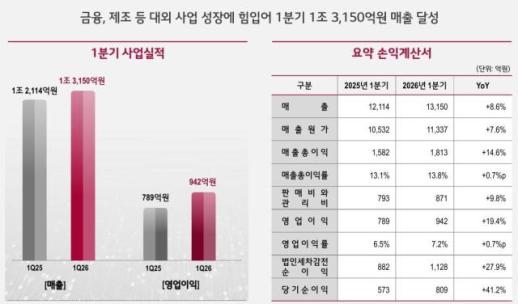 LG CNS Q1 Operating Profit Rises 19.4% to 94.2 Billion Won LG CNS said Thursday it posted broad first-quarter growth across its businesses, helped by expanding AI and cloud operations. The company said rising demand for AI transformation, along with growth in external projects, lifted both profitability and sales. LG CNS reported first-quarter revenue of 1.315 trillion won and operating profit of 94.2 billion won. Revenue rose 8.6% from a year earlier and operating profit increased 19.4%. Revenue from its AI and cloud business, a key growth driver, climbed 6.7% to 765.4 billion won, accounting for about 58% of total sales. The company said it expanded its AI transformation portfolio across industries including the public and defense sectors, finance, manufacturing, pharmaceuticals and biotech, shipbuilding and defense manufacturing. It also said it is expanding external business by providing agentic AI-based multi-agent services and has secured what it described as the largest number of AI transformation implementation cases in South Korea. LG CNS said it is also strengthening global partnerships, expanding cooperation beyond the three major global cloud providers to include OpenAI and Palantir as it targets the enterprise AI transformation market. It began supplying ChatGPT Enterprise in February and has secured about 10 corporate customers. With Palantir, it said dedicated teams are working together to identify high value-added AI transformation projects. In cloud, the company said it is boosting competitiveness through its data center design, build and operate (DBO) business. It said it won orders worth about 1 trillion won for the Samsong data center, reaffirming its position as a domestic DBO provider. It also introduced a modular AI data center that can be built within six months as it expands its infrastructure business. Revenue from its smart engineering business rose 10.4% to 227.8 billion won. The company said its smart logistics business grew on projects to build automated centers in beauty, food, fashion and defense manufacturing, and that it secured global references through its AI-based logistics optimization solution, “Mobile Shuttle.” Its smart factory business also maintained growth as projects won in defense manufacturing, shipbuilding, semiconductors and pharmaceuticals translated into revenue, the company said. It said its lightweight smart factory solution is spreading into new industries including food, medical, electronics and consumer goods, and that its agentic AI-based battery testing facility has received a positive market response. Revenue from digital business services increased 11.9% to 321.9 billion won. The company said performance was driven by next-generation system projects for major financial firms including NH NongHyup Bank, Mirae Asset Life Insurance and Shinhan Investment Corp. Looking ahead, LG CNS said it plans to expand into physical AI. It said it will pursue robot commercialization through a “full-stack RX (Robot Transformation)” service combining an industry-specific robot foundation model, hardware and a platform. It also said it has secured a broader robot lineup, including humanoids, through steps such as investing in U.S. robotics company Dexmate. The company is also expanding overseas business. It said it won an order in August last year for a hyperscale AI data center project in Jakarta worth about 100 billion won and is pushing to complete it by the end of 2026. The project is being carried out through “LG Sinar Mas,” a joint venture established with Indonesia’s Sinar Mas Group. LG CNS said it is stepping up efforts in Japan and the United States centered on enterprise solutions such as “PerfecTwin,” and is expanding its financial digital transformation business mainly across the Asia-Pacific region. 2026-04-30 10:48:19
 -
 Samsung Electronics to Supply First HBM4E Samples in Q2, Company Says Samsung Electronics said Thursday on its conference call for its 2026 first-quarter earnings that it plans to supply the first sample products of HBM4E, a high-bandwidth memory (HBM) chip, during the second quarter. The company said it will continue supplying AI-focused DRAM and NAND products, while actively responding to early memory demand for newly launched graphics processing units (GPUs) and central processing units (CPUs) expected in the second half.* This article has been translated by AI. 2026-04-30 10:47:11
 -
 Trump Says Administration Will Release More UFO Records Soon President Donald Trump said the U.S. government will again move to release as much information as possible on UFOs, also known as UAPs, or unidentified anomalous phenomena. Reuters reported that Trump said on April 29 (local time) that his administration would soon make public “as much information as possible” about UFOs. He had made similar remarks at an April 17 event in Phoenix, Arizona, saying he had found “many very interesting documents” during a review and that an initial release would begin soon. The comments reaffirm a disclosure plan he previewed in February. On Feb. 19, he said he would direct the Defense Department and related agencies to identify government documents on UFOs, UAPs and extraterrestrial life and begin the process for releasing them. The AP reported that he cited strong public interest at the time. Trump did not claim to have confirmed the existence of extraterrestrial life. He told the AP, “I don’t know if they’re real,” and said he had no opinion on the matter. The Pentagon’s past assessments have leaned against evidence of alien technology. Reuters said a 2024 Defense Department report found no proof of extraterrestrial technology in government investigations dating back to World War II, and concluded many sightings were misidentifications of ordinary objects or natural phenomena. In 2022, senior U.S. military leaders also said they had found no evidence that aliens had visited Earth or crashed here.* This article has been translated by AI. 2026-04-30 10:46:21
 -
LG Energy Solution Says It Began Supplying 46-Series Cells From Ochang, Eyes Arizona Shipments This Year * This article has been translated by AI. 2026-04-30 10:45:13