
Journalist

Lee Hugh
=
-
 Broadcast Media and Communications Commission Conditionally Renews 17 Radio Licenses; Allows Commercial Ads on tbs Traffic FM South Korea’s Broadcast Media and Communications Commission voted to grant conditional renewals to radio stations that fell short of the required score in license reviews, while also easing some rules to support management turnarounds. At its fifth plenary meeting of 2026, held April 29 at the Government Complex in Gwacheon, the commission approved three-year conditional renewals for 17 stations operated by three entities: 14 stations run by the Korean Broadcasting System, two stations run by MBC Gyeongnam Co., and Seoul’s media foundation tbs Traffic FM. The stations had scored below 650 points in earlier renewal evaluations, triggering a hearing process. The commission held hearings on April 22 to review causes of deficiencies and improvement plans before making the final decision. As renewal conditions, the commission ordered operator-specific corrective tasks, including expanded production and investment to strengthen public responsibility and local service, and steps to secure public interest functions. It said failure to meet the conditions could lead to cancellation of the renewals. For KBS’ 14 stations, the commission required tailored improvement plans for each station, including increased production and investment. For MBC Gyeongnam’s Jinju and Changwon Second FM stations, it required improvement plans and performance reports covering broadcast evaluations, disaster broadcasting, and production and investment. tbs Traffic FM was required to carry out a management normalization plan, improve its internal review system to strengthen fairness in broadcasting, and ensure transparency in the operation of donations. The commission also decided to allow commercial advertising on tbs Traffic FM, citing worsened finances since tbs was removed from Seoul’s list of funded institutions in 2024 and the need to diversify revenue raised during the hearing process. It said it could reconsider the advertising allowance if management conditions change, including any expansion of public support, to prevent harm to public interest and independence. Commission Chairman Kim Jong-cheol said the decision aimed to strengthen broadcasters’ public responsibilities while allowing flexibility to respond to changes in the business environment. He said the commission will continue to check compliance and take strict action under relevant laws if conditions are not met.* This article has been translated by AI. 2026-04-29 18:15:37
 -
 Samsung, LG bring Europe-tested heat pump boilers to South Korea market Samsung Electronics and LG Electronics are moving into head-to-head competition in South Korea’s heating market, leaning on heat pump technology already proven in Europe. Industry officials said Tuesday that LG Electronics plans to launch a new all-in-one heat pump system boiler in South Korea in May. With the outdoor unit integrated into the system, it can be installed without separate refrigerant piping work. The company said installation is also easier because it can use hot-water piping connected to existing boilers. Remote management through the LG ThinQ app is intended to improve convenience. Samsung Electronics earlier released a Korea-specific “EHS heat pump boiler.” Samsung said its heat pump solution showed a high seasonal coefficient of performance (SCOP) under a 35-degree outlet-water condition optimized for underfloor heating, and can supply thermal energy about five times the input power. The company said it provides stable heating even in temperatures as low as minus 25 degrees. Both companies have already posted tangible results in Europe, the largest market and a key base for heat pumps. Samsung has been strengthening the business with four global product lines tailored to climate-specific requirements across Europe. Its all-in-one product, offered only by Samsung, has been evaluated as maximizing operating efficiency by providing cooling, heating and hot water year-round. LG recently completed delivery of high-efficiency heat pumps to a new residential complex in the Eindhoven area of the Netherlands. It also won an order for a new housing complex in Ridderkerk and plans to begin supply from the second quarter. In the Netherlands, new homes are legally barred from connecting to the gas network, making heat pumps effectively essential infrastructure. In South Korea, wider adoption of heat pump boilers is expected to accelerate starting in 2029. The government recently announced a heat pump rollout program tied to its “2050 carbon neutrality” goal and plans to expand support to 3.5 million units by 2035. Starting this month, the government is implementing support programs in major local governments including Jeju, South Jeolla and South Gyeongsang, targeting households using coal briquette or kerosene boilers and areas not supplied with city gas. Support per household will cover up to about 70% of purchase and installation costs. * This article has been translated by AI. 2026-04-29 18:14:29
 -
 South Korea seeks ways for its ships to transit Strait of Hormuz, Foreign Ministry says South Korea’s Foreign Ministry said Tuesday it is working to find ways for South Korean ships to pass through the Strait of Hormuz, including through consultations between the South Korean and Iranian governments, after a Japanese oil tanker made the passage for the first time with Iranian approval. A ministry official said the government’s position is that, under relevant international norms, freedom of navigation and safety should be ensured as soon as possible for all vessels in the strait, including South Korean ships. “Based on this basic position, we are actively seeking ways to break the current situation, including consultations between the South Korean and Iranian governments,” the official said. The official added that the government is communicating and cooperating with related countries in various ways, while considering ship safety and the positions of shipping companies. Since the outbreak of the Iran war, 26 ships linked to South Korea have remained in the Strait of Hormuz. Chung Byung-ha, the foreign minister’s special envoy to Iran, met with Iranian Foreign Minister Seyed Abbas Araghchi and requested Iran’s cooperation to allow vessel navigation in the strait. Iranian media reported that a Panama-flagged very large crude carrier owned by a Japanese company, carrying 2 million barrels of crude, left the Strait of Hormuz on Tuesday after receiving approval from Iranian authorities. Japanese media, citing a senior Japanese government official, reported that no transit fee was paid and described the passage as “the result of negotiations by the Japanese government.” * This article has been translated by AI. 2026-04-29 18:13:39
 -
 Shinsegae Group Overhauls Strategy Office, Puts Unit Under Chairman Chung Yong-jin Shinsegae Group said it is moving to overhaul its Management Strategy Office, the group’s control tower, as it seeks faster and bolder innovation amid rapid changes in the retail environment. The company said on the 29th that it has begun practical procedures for a broad reorganization of the office to turn it into an innovation unit with stronger execution and a focus on identifying future growth engines. It said the central aim is to deliver “faster and more accurate innovation.” Shinsegae said it plans to reshape the office into an organization that drives bold internal challenges while presenting a new vision to lead South Korea’s retail market, adding that the goal is ultimately to increase customer satisfaction. As part of the restructuring, Shinsegae said it has ended Lim Young-rok’s dual role as head of the Management Strategy Office and CEO of Shinsegae Property. Lim will now focus fully on his post at Shinsegae Property, where he will concentrate on major projects including Starfield Cheongna and Hwaseong Starbay City, the group said. Until the reorganization is completed and a new strategy chief is formally appointed, Shinsegae said it will run the Management Strategy Office under Chairman Chung Yong-jin and ensure the control tower carries out its core functions.* This article has been translated by AI. 2026-04-29 18:10:19
 -
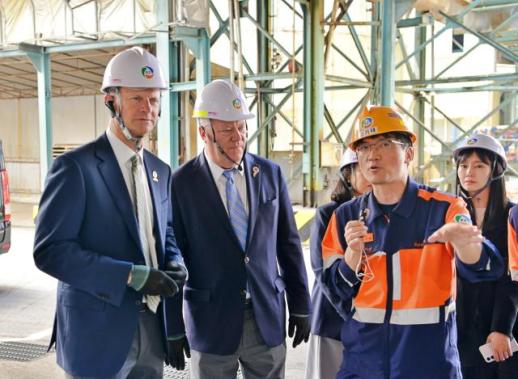 Korea Zinc, Tennessee Step Up Cooperation on U.S. Smelter Project Crucible Korea Zinc said cooperation with the state of Tennessee is accelerating as the company moves ahead with “Project Crucible,” its plan to build an integrated smelter in the United States. The company said Tennessee officials, including Lt. Gov. Stuart McWhorter, visited Korea Zinc’s Onsan smelter on April 28 and discussed ways to strengthen cooperation. Korea Zinc described the Onsan facility as a model for the planned U.S. project. Korea Zinc said the visit was arranged to help state officials better understand smelting operations and to discuss additional cooperation needed to keep Project Crucible on track. McWhorter met with Korea Zinc officials, including Kim Seung-hyeon, vice president and head of the Onsan smelter, to hear about the plant’s technology and its operating approach on environmental management and safety. The two sides also shared the company’s vision for the U.S. integrated smelter, Korea Zinc said. McWhorter said Project Crucible is expected to have a positive impact on the local economy, including job creation, and could also serve as an important opportunity to strengthen the South Korea-U.S. partnership and bolster supply chains for critical minerals to improve economic security. During the meeting, the sides discussed administrative procedures, the project schedule and operating plans needed for smooth execution, Korea Zinc said. McWhorter pledged full administrative support going forward, the company said. In comments to reporters, McWhorter again cited stronger bilateral partnership, economic security and job creation as the project’s core significance, saying it carries added weight because it is being pursued under the leadership of both governments and because stronger critical-mineral supply chains can play a major role in economic security. Asked about environmental and safety concerns raised in Tennessee, McWhorter said Korea Zinc has decades of smelting technology and operating experience. He also said the company’s silver and copper products use 100% recycled feedstock and received certification last year from global certification body SGS. McWhorter said Tennessee is working on infrastructure beyond the smelter itself, including power supply, housing for Korean personnel and training programs for local workers. He said the state holds weekly meetings with Korea Zinc and that permits under the Trump administration would allow the project to move quickly, shortening the timeline from construction to commercial operations. He added that he viewed smooth communication as a major strength in working with Korea Zinc and said he was confident the project would be carried out successfully. During the tour, Tennessee officials reviewed production processes for base metals such as zinc, lead and copper, as well as critical minerals including indium, Korea Zinc said. At a site slated for a new germanium plant, the officials expressed expectations for expanded cooperation between the two sides, the company said. McWhorter said he has held ongoing meetings with Chairman Choi Yoon-beom and other executives and again cited Korea Zinc’s communication as a strength. He said the visit broadened his understanding of the smelting industry and increased his expectations for Project Crucible. He said the state government would look for ways to actively support the project, including securing electricity and helping with administrative procedures, and expressed hope that the effort to build another world-class facility in the United States, like the Onsan smelter, would proceed successfully. Kim said that if the Onsan smelter — which he described as the world’s only facility capable of producing zinc, lead and copper as well as critical minerals — is replicated in the United States, it could become a catalyst for innovation across the smelting industry. He said the U.S. integrated smelter is planned as a smart smelter applying Onsan’s technology along with artificial intelligence and automation, and he expects the technology to be applied back at Onsan as well, creating synergy. Project Crucible is set to begin site preparation work this year and aims for completion in 2029, Korea Zinc said. After completion, the facility is expected to produce zinc, lead and copper first, followed by 13 nonferrous metals including 11 types of critical minerals designated by the U.S. government, such as indium and gallium, as well as semiconductor-grade sulfuric acid.* This article has been translated by AI. 2026-04-29 18:09:37
 -
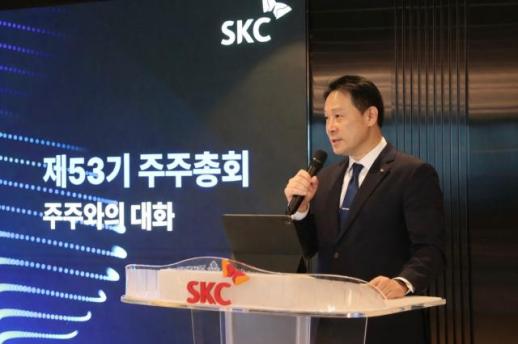 SKC Posts First Positive EBITDA in 10 Quarters as Semiconductor, Chemical Units Rebound SKC said it rebounded on improved results in its semiconductor and chemical businesses. The company said Tuesday that first-quarter consolidated revenue totaled 496.6 billion won, while it posted an operating loss of 28.7 billion won. The loss narrowed sharply from the previous quarter, and earnings before interest, taxes, depreciation and amortization came to 10 billion won, turning positive for the first time in 10 quarters. Kim Jong-woo, who took office in November, got off to a strong start, the company said. Its semiconductor materials unit posted first-quarter revenue of 68.3 billion won and operating profit of 23.6 billion won. The operating margin reached 34.5%, helped by higher sales of high-value test sockets as demand grew for AI data centers. SKC said it was the unit’s best quarterly performance on record. The chemical business also returned to profit, with first-quarter revenue of 270.8 billion won and operating profit of 9.6 billion won, its first profit in 13 quarters. SKC cited a windfall from the war in the Middle East and an expanded sales strategy for high-value propylene glycol. SK Nexilis, the battery materials affiliate led by Kim as CEO, also supported the turnaround, SKC said. The company said it benefited from reshaping its business around North America and the energy storage system market. It also pointed to efforts after Kim’s appointment to clear one-off costs and cut manufacturing costs by expanding operations at its Malaysia plant during the first quarter. SKC said preparations for mass production of semiconductor glass substrates, a future growth driver, are proceeding as planned. It has begun making samples for customer evaluations, aims to complete reliability tests within the year, and plans to diversify applications by reviewing new projects with multiple global big-tech customers in the second quarter. Separately, SKC said its planned 1 trillion won rights offering to fund new businesses and improve its financial structure drew strong internal demand, with employee subscription demand reaching 132% of the amount offered. * This article has been translated by AI. 2026-04-29 18:08:48
 -
 Indonesia’s Sinar Mas revises bid terms to buy Hyundai LNG Shipping as industry opposes sale Hyundai LNG Shipping’s long-stalled sale process has reached a turning point after Indonesia’s Sinar Mas Group presented revised terms that reflect domestic concerns, according to the investment banking industry. Still, whether a deal can be completed remains unclear as the government and the shipping industry are moving to block an overseas sale of a Korean carrier, citing energy security. On 29, the investment banking industry said Sinar Mas recently reintroduced conditions in negotiations to acquire Hyundai LNG Shipping, including employment succession and maintaining the company’s status as a Korean-flag carrier. The move was seen as an effort to address concerns raised earlier about potential damage to energy security. An IMM Private Equity consortium began the sale process in November last year, seeking to transfer Hyundai LNG Shipping to Sinar Mas for about 3.8 trillion won. Hyundai LNG Shipping traces its roots to the liquefied natural gas carrier business unit of Hyundai Merchant Marine. It is South Korea’s largest liquefied gas shipping specialist, operating 12 LNG carriers and six liquefied petroleum gas carriers. Through long-term transport contracts with Korea Gas Corp., it carries about 25% to 30% of the gas imported into South Korea. The shipping industry voiced immediate opposition after reports of an overseas sale. Industry officials have warned that a foreign sale of Hyundai LNG Shipping, which is closely tied to stable energy supply, could lead to the outflow of strategic transport assets and specialized personnel, the loss of LNG shipping know-how and other national wealth, and difficulties requisitioning ships in a national emergency. Against that backdrop, Sinar Mas has again emphasized its intent to ensure operational stability after an acquisition and to keep the existing business structure, highlighting guarantees on employment succession and maintaining Korean-flag status. Major hurdles remain. With tensions continuing in the Middle East, the need for energy-related strategic merchant shipping has again come into focus. A key variable is whether the Ministry of Trade, Industry and Energy approves the sale. The ministry is reviewing, through its Foreign Investment Review Committee, whether the transaction involves a company deemed to hold national core technology. If it is classified as such, a separate approval process by the industry minister would be required, potentially delaying the deal significantly. In 2023, European shipping companies also showed interest in Hyundai LNG Shipping, but the government blocked the sale on energy security grounds and it fell through. “Now is a time when stable energy supply and demand matters more,” a shipping industry official said. “Given the role of a Korean LNG carrier, it is preferable to find a buyer at home rather than sell overseas.”* This article has been translated by AI. 2026-04-29 18:07:33
 -
 BMW M Sets 14th Straight Global Sales Record, Leads Korea’s Premium High-Performance Segment BMW’s high-performance brand BMW M set a global sales record for the 14th consecutive year, industry officials said. The brand also held onto the top spot in South Korea’s premium high-performance market, extending its position as a technology leader. According to the industry on Tuesday, BMW M sold 213,457 vehicles worldwide last year, up 3% from a year earlier. BMW M accounted for a record 9.8% of BMW’s total sales last year. BMW M’s best-selling model was the BMW X3 M50. Among M high-performance models, the BMW M2 and M3 posted their highest-ever sales totals last year, with 71,500 units sold. BMW Korea sold 5,541 BMW M models last year, ranking No. 1 for the second straight year in domestic premium high-performance vehicle sales. The BMW M340i sedan led the lineup with 613 units, followed by the M850i xDrive Gran Coupe (572), M2 (436), X7 M60i (349) and XM (315). BMW M remained No. 1 in the first quarter, selling 1,334 vehicles, up 7% from the same period a year earlier. A BMW Korea official said the company would “further solidify leadership in the premium high-performance market by strengthening the value of the BMW M brand.”* This article has been translated by AI. 2026-04-29 18:06:27
 -
 Hyundai Motor shifts robotics lab under AVP unit, steps up Nvidia physical AI push Hyundai Motor Group is reshuffling its organization to strengthen its competitiveness in physical artificial intelligence, while accelerating efforts to build a physical AI alliance with Nvidia. According to industry sources on April 29, Hyundai Motor will move its Robotics Lab — currently under the R&D division focused on vehicle hardware development — to the Advanced Vehicle Platform (AVP) division, which oversees future mobility technologies. The Robotics Lab will be led by Park Min-woo, president and head of the AVP division. Park joined Hyundai Motor Group in January after building experience at Nvidia and Tesla in autonomous driving, AI models, computer vision, sensor fusion and machine learning. A Hyundai Motor official said the change is intended to strengthen synergy among robotics, autonomous driving and AI technologies and to improve cross-organization collaboration efficiency. Analysts said the reshuffle signals Hyundai’s push to shift more decisively toward physical AI. They said a leadership change was needed to commercialize products developed by the Robotics Lab, including the industrial robot “X-ble Shoulder” and the small mobility platform “MobED.” Hyun Dong-jin, an executive director who has overseen Robotics Lab development for the past 12 years, is reported to be stepping down. Separately, the day before, Hyundai Motor Group Executive Chairman Chung Euisun met with Madison Huang, senior director of Omniverse and robotics product marketing at Nvidia and the eldest daughter of Nvidia CEO Jensen Huang. They discussed ways to strengthen a next-generation physical AI partnership spanning semiconductors, mobility and robot platforms. Hyundai and Nvidia have recently expanded their technology alliance from software-defined vehicles to humanoid robots, in what the industry views as a strategic move to secure an early lead in physical AI standards. Hyundai is adopting Nvidia’s DRIVE Hyperion platform to build an integrated autonomous driving architecture that can scale from Level 2 and above advanced driver-assistance systems to Level 4 robotaxis. Affiliate Boston Dynamics has installed Nvidia’s robotics AI computing platform, Jetson Thor, on its humanoid robot Atlas. The companies are also developing a robotics foundation model aimed at enabling robots to understand and follow human language and actions without programming. In the meeting, Huang was also reported to have explored a practical cooperation model combining Nvidia’s Omniverse robot simulation platform with Hyundai’s robot hardware.* This article has been translated by AI. 2026-04-29 18:05:08
 -
 South Korea Forecast: Clouds in Central Regions; Rain Possible in Jeju and Parts of the South The Korea Meteorological Administration forecast that Thursday the central region will see intermittent clouds, with rain possible in some areas. In a briefing Wednesday, the agency said the central region will be “cloudy at times,” while the southern region and Jeju Island will be mostly overcast. It said rain is expected in parts of Jeju from noon to 6 p.m. From 3 p.m. to 6 p.m., rain is forecast in southern North Chungcheong Province and in parts of eastern Jeolla and the Gyeongsang region, it said. The agency added that, depending on conditions, a trace of drizzle of less than 0.1 millimeter could fall in parts of the southern coasts of South Jeolla and South Gyeongsang from midnight to 6 a.m. Morning lows are forecast at 9 C in Seoul, 8 C in Suwon, 9 C in Incheon, 13 C in Busan, 11 C in Ulsan, 11 C in Daegu, 10 C in Gwangju, 8 C in Jeonju, 9 C in Daejeon, 9 C in Cheongju, 10 C in Gangneung, 6 C in Chuncheon and 10 C in Jeju. Afternoon highs are expected to reach 23 C in Seoul, 22 C in Suwon, 21 C in Incheon, 18 C in Busan, 18 C in Ulsan, 21 C in Daegu, 20 C in Gwangju, 21 C in Jeonju, 22 C in Daejeon, 22 C in Cheongju, 19 C in Gangneung, 22 C in Chuncheon and 16 C in Jeju. Fine dust and ultrafine dust levels are forecast to be “moderate” nationwide in both the morning and afternoon.* This article has been translated by AI. 2026-04-29 18:04:09