
Journalist

Lee Hugh
=
-
 Seoul Area to Offer 13,400 Public Housing Units in First Half, Up 43% The Ministry of Land, Infrastructure and Transport said Tuesday it will sell a total of 13,400 public housing units in the Seoul metropolitan area in the first half of this year, up about 43% from 9,400 units a year earlier. Of the total, 5,700 units will come from third-phase new town developments. According to the ministry, Korea Land and Housing Corp. (LH) and Gyeonggi Housing and Urban Corp. (GH) will issue tenant recruitment notices on Wednesday for 3,100 units in major districts including Incheon Gyeyang and Goyang Changneung. By district, the offering includes Namyangju Wangsuk2 (1,498 units), Goyang Changneung (494), the Anyang Gwanyanggo area (404), Siheung Hajung (400) and Incheon Gyeyang (317). The ministry said supply is accelerating following earlier offerings totaling 1,300 units, including Magok 17 and Incheon Gajeong 2. In May, 3,500 units are scheduled for sale in areas including Hwaseong Dongtan2 and Seongnam Naksaeng. In June, 5,500 units are set to be offered, centered on Goyang Changneung and Bucheon Yeokgok. The ministry said the newly announced sites are expected to draw strong interest from end users due to their locations. Incheon Gyeyang’s A-9 block, a newlywed-focused “Hope Town” project, is adjacent to green space about four times the size of Yeouido Park. Namyangju Wangsuk2’s A-1 and A-3 blocks are planned as a station-area complex within walking distance of Ilpae Station (tentative), on a future extension of Seoul Subway Line 9. Goyang Changneung’s S-1 block also includes plans for an elementary school site within the complex. Sale prices are expected to be set at around 90% of nearby market levels. Exact prices will be released in individual notices, and applications will be accepted starting May 11 on a district-by-district schedule. Kim Yeong-guk, head of the ministry’s Housing Supply Promotion Headquarters, said, “This year, the volume of units for sale in the Seoul metropolitan area is richer than usual, so the public will be able to directly feel the housing supply,” adding, “We will continue to push ahead with housing supply policy at speed.”* This article has been translated by AI. 2026-04-29 13:01:16
 -
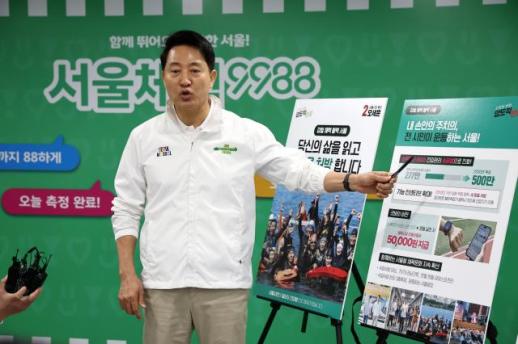 Seoul Mayor Candidate Oh Se-hoon Unveils First Pledge to Cut Health Gaps Oh Se-hoon, the People Power Party’s candidate for Seoul mayor, on Tuesday unveiled his first campaign pledge: “Iron stamina, vibrant Seoul.” He said he would build an environment where residents can manage their health anytime and anywhere, aiming to narrow health gaps tied to income and where people live. Speaking at the Dobong District Public Health Center in Ssangmun-dong, Seoul, Oh said, “A warmer city and a healthier quality of life in Seoul will be the most important policy in the next term.” As part of the plan, he said the city will upgrade its health management platform, Sonmok Doctor 9988, into an artificial intelligence-based health app. The core idea is to use exercise data tracked through the platform and health screening results held by the National Health Insurance Service to predict risks of chronic and serious diseases. Oh also pledged a major expansion of community sports infrastructure. “I will create a ‘10-minute fitness zone city’ where people have a place to exercise within 10 minutes of home,” he said. He said the number of “Seoul Fitness Centers,” where residents can take fitness tests in their neighborhoods, would increase to 100 from 27. He also said the city would expand “Fun Stations” — running and fitness-focused facilities now operating at subway stations including Yeouinaru, Ttukseom and Gwanghwamun — to 25 from six. He also promised to expand exercise spaces for older adults. Oh said the city will create 120 new “Neighborhood Vitality Recharge Stations” by 2030, using public facilities such as welfare centers and libraries for senior-focused leisure and health programs. He also said each district would have at least one “Senior Playground,” which he said can help prevent dementia. Oh said he chose to announce the pledge in northern Seoul to underscore his message on inequality. “If health gaps arise because of income and assets, it can create a gap in overall happiness,” he said, adding, “The gap between rich and poor, or income gaps, must not lead to health gaps.” He said health is the top concern for residents and vowed to “take the Seoul healthy city project — built through policy investment over the past five years — to the next level and decisively complete the changes so far.” 2026-04-29 13:00:13
 -
 Democratic Party recruits Ha Jeong-woo, taps Jeon Eun-su for June 3 by-elections The Democratic Party has recruited Ha Jeong-woo, a former senior presidential secretary for AI future planning, and selected Jeon Eun-su, a former presidential spokesperson, ahead of the June 3 National Assembly by-elections. The party is widely seen as putting figures from the Lee Jae-myung administration at the forefront to rally its base. At a recruitment ceremony at the National Assembly on the 29th, party leader Jeong Cheong-rae said Ha, nicknamed “HaGPT,” was “a talent I wanted to bring in no matter what,” adding he would have made repeated appeals to do so. Jeong described Jeon as “a capable person” who grew up outside the capital region and has a strong commitment to balanced development, noting she had been recruited ahead of the 22nd general election. He urged both to “win,” signaling they would receive nominations. The party said it is using three tracks for strategic nominations in the by-elections: outside recruitment, internal selection and redeploying existing figures. Ha falls under outside recruitment, while Jeon was chosen internally, it said. Ha is being mentioned as a candidate in Busan’s Buk-gu Gap district, and Jeon in South Chungcheong Province’s Asan Eul. Byun Sung-wan, head of the party’s Busan chapter, and Lee Jung-moon, head of its South Chungcheong chapter, attended the event. After Jeong’s remarks, Ha said he would return to his “warm hometown of Busan” and deliver development, calling the moment a “golden time” for major change and a leap forward. “If we use physical AI, Busan can become the very center of global maritime AI,” he said. Jeon said she had stayed connected to people through her work as a teacher, lawyer and spokesperson. “Now I will face the public directly and solve difficulties on the ground,” she said. The party has already made strategic nominations for Kim Nam-jun, a former presidential spokesperson, in Incheon’s Gyeyang Eul, and Kim Nam-kuk, a Democratic Party spokesperson who previously served as a digital communications secretary, in Gyeonggi Province’s Ansan Gap. If Ha and Jeon are confirmed, the number of figures from the Lee administration fielded by the party would rise to four. The by-elections will be held in 14 districts and are being dubbed a “mini general election.” Vacancies include five previously confirmed seats and nine additional openings due to reasons including President Lee’s inauguration, the resignation of presidential chief of staff Kang Hoon-sik, and rulings that voided election wins, as well as seats vacated by runs for metropolitan mayor and governor posts. Of the 14 districts, 13 were previously held by the Democratic Party. 2026-04-29 12:19:14
 -
 Seoul to Host Free Palace Walk on May 31; 5,000 Spots Available First Come, First Served A global cultural walking event tracing Seoul’s palaces and traditional streets will be held in the heart of the city. Aju Media Group (Aju Business Daily, ABC and AJP) said on the 29th it will hold the “2026 Seoul Foreign Residents Palace Walk” on May 31 at the Gwanghwamun Square play yard. Registration opened on the 28th. Participation is free, and all participants will receive a summer T-shirt, a hat and a brunch set. The event is open to foreign residents in Korea, international students and tourists, as well as local residents. Organizers said it is designed as a downtown festival where people of different nationalities and generations can walk together through major palaces and other traditional cultural sites. Registration is available through a dedicated application page on the Aju Business Daily website. Applicants are instructed to enter through the main-page banner rather than a direct address. The walk will accept 5,000 participants on a first-come, first-served basis, with no entry fee. In addition to the T-shirt and hat, organizers said participants will receive a brunch set and bottled water. “We prepared it so people can join without 부담, even in light clothing,” the organizer said. The route is about 7 kilometers, looping from Gwanghwamun Square past Gyeongbokgung, Bukchon-ro and Jeongdok Library, then Changdeokgung, Changgyeonggung and Jogyesa, before returning to Gwanghwamun Square. Organizers said the course blends Joseon-era palaces, hanok neighborhoods, a Buddhist temple and modern city scenery, offering a single walk through Seoul’s past and present. In addition to the walk, the event will include cultural performances and K-culture photo zones, organizers said. “Early summer in Seoul is the best season for walking,” the organizer said, adding that participants can expect “a special experience that naturally carries you across time and history” as they follow the palace and downtown route. The organizer said it hopes the event will help share Seoul’s cultural depth with people from around the world. The “Seoul Foreign Residents Palace Walk” is scheduled to start at 9 a.m. Participants can register on site starting at 8 a.m. on the day of the event. * This article has been translated by AI. 2026-04-29 12:18:19
 -
 Climate Ministry to Step Up Ozone Controls, Inspect 643 Emission Sites May-August The government will begin an intensive effort from May through August to cut ozone-forming pollutants and protect public health ahead of the season when high ozone levels are most likely. The Ministry of Climate, Energy and Environment said Tuesday it will push an “intensive management plan for the high-ozone period (May-August),” focusing on reducing nitrogen oxides and volatile organic compounds — key precursors of ozone — and strengthening public guidance on how to respond. Ozone formed near the ground in the troposphere is created when nitrogen oxides (NOx) and volatile organic compounds (VOCs) react under strong sunlight. High ozone concentrations can irritate the eyes, nose and respiratory system, and can have a greater impact on vulnerable groups such as children, older adults and people with respiratory illnesses. With climate change contributing to higher temperatures, stronger sunlight and more stagnant air, high-ozone episodes have continued. The number of days ozone advisories were issued rose from 59 in 2017 to 67 in 2021, and stood at 60 in 2025. The government will designate intensive management zones centered on areas with concentrated NOx and VOC emissions and on high-ozone areas, and will focus inspections on major sources based on emissions and their contribution to ozone formation. During the high-ozone period, it will strengthen inspections of 643 large-scale facilities that emit or handle large volumes of relevant substances. It will also provide technical support to 273 sites, including facilities with weak controls on fugitive emissions and gas stations equipped with vapor recovery systems. Starting this year, 63 environmental surveillance officers will be newly designated at regional environment offices. The ministry said it will use advanced measurement equipment and an intelligent monitoring system using artificial intelligence and big data to quickly crack down on facilities suspected of illegal emissions. Vehicle emissions controls will also be tightened. The government will expand on-site checks using vehicle emissions measurement equipment and enforcement cameras, and will conduct special inspections of 300 to 400 private vehicle inspection centers jointly with the ministry, the Ministry of Land, Infrastructure and Transport, and local governments. For about 1,000 major NOx-emitting facilities in sectors such as power generation, steel and petrochemicals, the government will strengthen total emissions management. The total allowable emissions cap for this year is 176,000 tons, about 5.4% lower than last year. Support for early scrappage of older vehicles will also be revised. The government will end purchase support for gasoline and gas vehicles and shift support toward electric, hydrogen and hybrid vehicles, with a plan to supply 337,000 vehicles this year. To reduce VOCs from everyday sources, the government will require low-emission painting methods, such as using rollers, at facilities used by sensitive groups including children and older adults. It will also prepare guidelines for the public sector on purchasing and using environmentally friendly organic solvent products. The government said it will strengthen scientific management by introducing an integrated forecasting system that combines existing numerical models with AI, aiming to raise ozone forecast accuracy from 63% to 71%. To improve accuracy, it will apply integrated prediction information that combines numerical modeling and AI to ozone forecasts. For areas without air-quality monitoring stations, it will provide an ozone estimated concentration image service using satellite data starting next month. It also plans to invest 3.6 billion won through 2030 in projects to identify ozone causes and develop reduction technologies. The government will also expand guidance on how to respond to high ozone for schools, daycare centers, facilities for older adults and outdoor workers. It said it will provide ozone advisory and warning information quickly through the AirKorea mobile app. “From May to August, when sunlight is strong and temperatures are high, the risk of high ozone levels is elevated,” Kim Jin-sik, director general of the ministry’s Air Environment Bureau, said. “We will do our utmost to protect public health by intensively managing precursors such as nitrogen oxides and volatile organic compounds and by providing ozone forecast information quickly.”* This article has been translated by AI. 2026-04-29 12:10:59
 -
 Samsung’s SSAFY Program Highlights Career Shifts, Faster Workflows and a Tokyo Startup Samsung Electronics’ youth software training program, SSAFY (Samsung Youth SW·AI Academy), is being cited as more than a job-prep course, with graduates describing it as a turning point that led to career changes, overseas entrepreneurship and jobs at Samsung affiliates. Samsung said April 29 it published its first collection of essays from SSAFY graduates, titled ‘In the Era of the AI Great Transformation, the Start of Junior Talent: SSAFY.’ The company held an essay contest for about 6,000 people, including graduates from the program’s first through eighth cohorts and their families, and compiled selected entries into a book. The collection includes accounts of participants who became software and AI talent despite barriers such as nontechnical backgrounds, age and personal circumstances. Heo Ye-ji, a cohort 8 graduate who previously worked as a marketer at a large company, said she applied on her last eligible chance at age 29, switched to software development and is now preparing to expand overseas. “SSAFY is not just a place that teaches skills; it proved the potential inside me,” she said. Kim Jeong-hwan, a cohort 1 graduate, said he used algorithms learned at SSAFY to cut a customer information processing task at work from 20 minutes to about 20 seconds, and later founded an IT company in Tokyo. Kim Beom-seok, a cohort 8 graduate, joined Samsung SDS after completing SSAFY and earned 16 certifications, including an advanced cloud credential that is rare in South Korea. Samsung said SSAFY has helped young people find new direction beyond employment support. Since launching in 2018, the program has produced 10,125 graduates, and 8,566 have found jobs, for an employment rate of about 85%. A Samsung official said the challenges and growth described in the essays show the program’s “true value,” adding the company will continue support so more young people can develop into software and AI talent.* This article has been translated by AI. 2026-04-29 12:10:19
 -
 Climate Ministry Begins Talks to Overhaul Power Oversight for 100GW Renewable Era The government is launching talks on overhauling its power oversight system to match the expansion of renewable energy. Working with civil society groups, it plans to discuss how to reshape power-market governance and speed up institutional changes for the energy transition. The Ministry of Climate, Energy and Environment said Tuesday it will hold a forum titled “Power Regulation Governance Forum for the 100GW Renewable Energy Era” on Wednesday morning at the HJ Business Center in Jongno-gu, Seoul, together with six civil society groups: the Energy Transition Forum, Climate Solution, Energy and Space, the Green Energy Strategy Institute, the Public Renewable Energy Forum and the Green Consumers Network. The forum follows up on the government’s “Energy Grand Transition Implementation Plan for the People’s Sovereignty Government,” released on April 6. The government is seeking to shift the energy system from fossil fuels to renewables to strengthen future national competitiveness, aiming for what it calls an “electro-state.” The ministry said the transition is not just a change in generation sources but a restructuring of how electricity is produced and used — from a centralized, one-way system to a distributed, two-way one. It said that makes an overhaul of power oversight increasingly necessary to improve transparency and fairness in the electricity market. A ministry official said the government will push to revise the Electric Utility Act based on views presented at the forum and, through consultations with relevant ministries and discussions in the National Assembly, build an institutional foundation for the energy transition.* This article has been translated by AI. 2026-04-29 12:09:47
 -
 Korea Fair Trade Commission Fines Bodyfriend 40 Million Won for Incomplete Subcontract Documents South Korea’s Fair Trade Commission said on the 29th it will fine Bodyfriend 40 million won for issuing written manufacturing subcontract agreements that omitted required items, including signatures and delivery deadlines. The FTC said Bodyfriend signed 58 manufacturing subcontract contracts with four subcontractors from May 2021 to June 2024 for products including bed-type massage devices. Of the 58 contracts, 41 were issued in writing without the signature or name-and-seal of both parties. In eight cases, the written documents omitted the delivery deadline for the goods. In nine cases, both the signature or name-and-seal and the delivery deadline were missing. The FTC said the conduct violated Article 3 of the law requiring issuance of written documents. It ordered corrective steps to prevent a repeat and imposed the 40 million won penalty. An FTC official said the action is expected to help improve unfair subcontracting practices and protect subcontractors’ rights, adding that the agency will continue monitoring violations and take strict action in line with the law and principles when illegal conduct is found.* This article has been translated by AI. 2026-04-29 12:09:20
 -
 Korea Q1 Daily FX Trading Hits Record $102.65 Billion as Volatility Spurs Hedging Seasonal factors and heightened exchange-rate volatility pushed South Korea’s average daily foreign-exchange trading above $100 billion in the first quarter, the largest level on record. The Bank of Korea said Tuesday that average daily FX trading by foreign-exchange banks — including spot transactions and FX derivatives — totaled $102.65 billion in the first quarter of 2026. That was up $18.03 billion, or 21.3%, from the previous quarter’s $84.62 billion, the highest since the statistics were revised in 2008. A BOK official said trading rose due to seasonal factors, increased foreign investors’ trading in domestic securities, and greater demand for hedging against currency risk as volatility widened. Trading typically slows in the fourth quarter because of year-end book closing and then picks up in the first quarter. Foreign investors’ trading in South Korean securities surged to a monthly average of 855 trillion won in the first quarter from 475 trillion won in the fourth quarter of last year. As volatility increased, both spot and derivatives trading rose. The exchange rate showed high volatility due to the U.S.-Iran war. The won-dollar exchange-rate fluctuation widened to 0.60% in the first quarter from 0.37% in the fourth quarter of last year. By product, average daily spot FX trading came to $42.39 billion, up $8.8 billion, or 26.2%, from the previous quarter. Average daily FX derivatives trading was $60.27 billion, up $9.23 billion, or 18.1%. Average daily forward trading increased $3.65 billion, or 23.9%, to $18.94 billion, led by non-deliverable forward, or NDF, transactions. NDF trading rose $3.38 billion to $15.55 billion. The BOK said the increase reflected more forward and FX swap transactions, mainly by companies and institutional investors, seeking to lock in future prices to reduce uncertainty from exchange-rate swings. An NDF is a type of forward contract in which only the difference between the agreed exchange rate and the spot rate at maturity is settled. It is often used by foreign investors for currency hedging.* This article has been translated by AI. 2026-04-29 12:08:52
 -
 Korea FTC Names Coupang Chair Kim Beom-seok as Controlling Person; Conglomerate List Rises to 102 South Korea’s antitrust regulator has designated Coupang Inc. Chairman Kim Beom-seok as the company’s “same person,” the individual deemed to ultimately control a business group. The Fair Trade Commission said it concluded Kim’s younger brother, Kim Yu-seok, a Coupang vice president, effectively took part in management and exercised influence. The FTC also said the number of disclosure-designated business groups — conglomerates with total assets of at least 5 trillion won — will rise by 10 to 102. Line among 11 newly designated conglomerates; Kyobo Life, Daou Kiwoom moved up The FTC said April 29 it will designate, effective May 1, 102 business groups with assets of at least 5 trillion won, covering 3,538 affiliated companies. That compares with 92 groups last year. Newly designated groups are Line, Korea Teachers’ Credit Union, Woongjin, Shieldus, Daemyung Chemical, Toss, Kolmar Korea, Heesung, Orion, QCP Group and Iljin Global. Youngone was removed after its total assets fell. Among the conglomerates, 47 groups with assets of at least 12 trillion won — equal to 0.5% of the latest finalized nominal gross domestic product figure of 2,408.7 trillion won — were designated as cross-shareholding-restricted groups. That is up by one from last year. Kyobo Life Insurance and Daou Kiwoom were moved up, while E-Land was moved down to the conglomerate category. The FTC said rapid growth in industries tied to K-beauty and K-food helped push Kolmar Korea and Orion into the conglomerate list. It also cited a strong stock market as a factor in Daou Kiwoom’s upgrade and Toss’ designation. With geopolitical tensions boosting demand for defense products, the rankings of groups with defense affiliates — including Hanwha, Korea Aerospace Industries and LIG — rose, the FTC said. It added that higher precious-metal prices and a weaker won helped bring in Heesung and Iljin Global. Starting May 1, affiliates of conglomerates will be subject to Fair Trade Act requirements including disclosure obligations and a ban on providing unfair benefits to related parties. Cross-shareholding-restricted groups face additional limits, including bans on cross-shareholding and circular shareholding, restrictions on debt guarantees, and limits on voting rights for financial and insurance companies. FTC cites Kim Yu-seok’s management role; Kim Beom-seok designated after five years The FTC designated Kim Beom-seok as Coupang’s controlling person. Since Coupang was first included as a conglomerate in 2021, Kim had avoided the designation because he is a U.S. citizen and, the FTC said, relatives were not participating in management. Questions grew last year after it became known that his brother was serving as a Coupang vice president. The FTC said it conducted an on-site inspection of Coupang ahead of this year’s designations and concluded the group did not meet the enforcement decree’s exception requirements. It said Kim Yu-seok holds a near-top internal rank comparable to the level of CEOs at major affiliates. Choi Jang-gwan, director general of the FTC’s Corporate Group Monitoring Bureau, said Kim Yu-seok’s annual pay is in line with the average for registered executives at the same level and that he received treatment comparable to a registered executive, including being assigned a secretary. Choi said Kim Yu-seok hosted “hundreds” of regular and ad hoc meetings on logistics and delivery policy and “effectively exercised influence” over specific directions for executing key business matters. With Kim Beom-seok designated, Coupang will be required to disclose the status of its overseas affiliates. If overseas affiliates directly or indirectly hold shares in domestic affiliates, the company must also disclose the controlling person’s shareholdings in those overseas affiliates. Responding to criticism that the FTC’s view differs from past decisions, Choi said conglomerate designations are based on company-submitted materials and that the agency has pursued accountability after the fact when false submissions or other problems are found. He said issues were raised during a Coupang hearing and a report was received alleging Kim Yu-seok’s management participation, leading the FTC to identify matters it had not previously found. Unlike Coupang, Dunamu met the enforcement decree’s exception requirements, so the corporate entity Dunamu remained the controlling person, the FTC said. For Jungheung Construction, the FTC said it will change the controlling person to Vice Chairman Jung Won-ju, the eldest son, following the death of former controlling person Chairman Jung Chang-sun. Choi said the designation aligns the person who effectively controls a business group with the individual ultimately responsible for compliance, reducing gaps between authority and responsibility. He said the FTC will sequentially release information based on more advanced analysis of the designated groups to provide useful information to market participants.* This article has been translated by AI. 2026-04-29 12:08:13