
Journalist

Lee Hugh
=
-
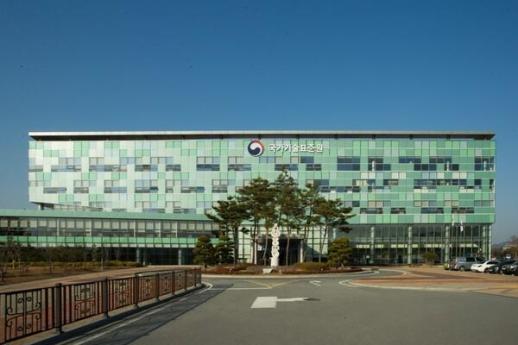 Korea to Put 30% of New Standards R&D Budget Into De Facto Standards, Agency Says The Ministry of Trade, Industry and Energy’s Korean Agency for Technology and Standards said on the 29th it held a “2026 De Facto Standardization Forum kickoff briefing and strategy meeting” to review the status of de facto standards work and discuss strategy. De facto standards are developed as companies voluntarily form groups such as forums and consortia and create standards in line with market demand and technological change. The agency said it has supported Korean companies’ responses to de facto standards through last year’s “measures to strengthen responses to de facto standards” and the “6th National Standards Master Plan” announced in March this year. It has also set up domestic response committees by sector to provide systematic support for Korean companies’ participation and activities in de facto standardization bodies in advanced industries. This year, it plans to invest more than 30% of the budget for new standards research and development projects in de facto standards to move to secure an early lead. Standardization experts attending the meeting shared sector-by-sector strategies and updates on their work. They also exchanged views on how Korean companies can strengthen global competitiveness by taking the lead in de facto standards in advanced industries. Kim Dae-ja, head of the agency, said, “De facto standards quickly reflect market needs in line with the pace of technological change,” adding, “We will continue to expand support for developing the de facto standards our companies need to lead advanced industries.”* This article has been translated by AI. 2026-04-29 11:10:46
 -
 South Korea Industry Ministry Maps 2026 R&D Budget Focus on Regional Growth, Manufacturing AI and Supply Chains The Ministry of Trade, Industry and Energy on Tuesday held its second 2026 Strategic Planning and Investment Council meeting to discuss next year’s research and development budget, chaired by Vice Minister Moon Shin-hak. The ministry has been drafting its 2026 R&D budget plan with priorities that include fostering “5 poles and 3 special zones” growth engines, expanding the Manufacturing AI Transformation initiative (M.AX), and strengthening the industrial ecosystem. To concentrate R&D spending, it said it screened new projects after reviews that included input from private-sector experts by field and internal deliberations. It also carried out performance-based restructuring of ongoing projects while integrating fragmented small-scale programs. For the “5 poles and 3 special zones” initiative, the ministry said it will launch new projects next year to provide package support by region for technology development, infrastructure and workforce training. The plan includes the 5 poles and 3 special zones growth-engine project, technical support to help regional advanced industries respond to green-transition regulations, and development of manufacturing AI models that use tacit know-how. Other proposed projects include core technology development for full-stack AI factories that optimize entire manufacturing processes, AI-based manufacturing safety systems to protect workers, and industry-specific R&D to boost productivity using AI in sectors such as shipbuilding, bio and distribution. To strengthen the industrial ecosystem and competitiveness in advanced and key industries, the ministry listed projects such as next-generation battery technology for humanoids, localization of core materials and parts for advanced aircraft engines, and core technologies to shift the chemical industry toward high value-added specialty products. The ministry also said it will respond to supply-chain issues linked to the recent Middle East war. New projects include technology and process development for preprocessing medium-to-heavy crude to support feedstock diversification in refining and petrochemicals, alternative materials technology to stabilize supplies of inputs such as naphtha, and “Industry GX Plus” to support development and demonstration of carbon-reduction technologies for high-emitting industries. “Industrial technology competitiveness is emerging as the foundation of the national economy and security, while global competition for technological supremacy is intensifying,” Moon said. “For our industries to secure a competitive edge, the public and private sectors must strategically choose areas and invest boldly and quickly.”* This article has been translated by AI. 2026-04-29 11:09:49
 -
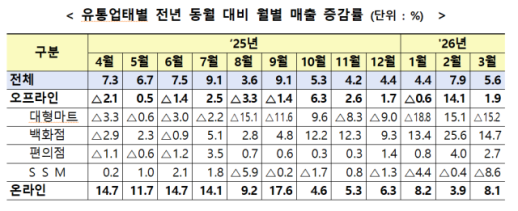 Online Sales Keep Rising; Department Store and Convenience Store Revenue Up for 9th Month Online sales extended steady growth in March, while among offline retailers, department stores and convenience stores stayed in positive territory. Big-box discount stores, however, returned to a decline after a one-month reprieve. According to the Ministry of Trade, Industry and Energy’s report on March 2026 sales trends at major retailers released Tuesday, combined sales at major retailers rose 5.6% from a year earlier. Offline sales increased 1.9% year over year. By format, department stores climbed 14.7% and convenience stores rose 2.7%, while big-box discount stores fell 15.2% and mid-sized retailers declined 8.6%. Department store and convenience store sales have risen for nine straight months since July last year. The ministry attributed department store gains largely to higher foreign tourist traffic and demand tied to spring outings and the new school term, which boosted sales of well-known overseas brands. Convenience stores posted growth in processed and ready-to-eat foods, tobacco and miscellaneous goods. Big-box discount stores weakened as spending continued to shift online, with most categories — including food and daily necessities — underperforming, pushing sales back into negative territory. Mid-sized retailers extended their slide to a fourth consecutive month. On a quarterly basis, big-box discount stores have been sluggish for eight straight quarters since the second quarter of 2024, and mid-sized retailers for three straight quarters since the third quarter of last year. Online sales rose 8.1% from a year earlier, continuing a sustained uptrend since the government began compiling the data. In addition to strong performers such as cosmetics (up 15.8%), food (up 10.6%) and home and household goods (up 9.5%), sales also increased for appliances and electronics (up 11.1%), children and baby products (up 10.7%) and books and stationery (up 4.1%). By sales share, online accounted for 60.6%, followed by department stores at 15.4%, convenience stores at 13.9%, big-box discount stores at 8.1% and mid-sized retailers at 2.0%. Compared with last year’s annual shares, online rose 1.6 percentage points while offline fell 1.6 points. * This article has been translated by AI. 2026-04-29 11:05:48
 -
 Korea Standards Agency Holds Forum on Industrial Measurement Strategy for Advanced Industries South Korea’s Korean Agency for Technology and Standards, under the Ministry of Trade, Industry and Energy, said Tuesday it held a policy forum on industrial measurement to support the advancement of high-tech industries. The agency said it used the forum to discuss strategies with industry officials in sectors including semiconductors, aviation, defense, and nuclear power. Industrial measurement refers to the infrastructure that ensures accuracy and reliability in measurements across industrial processes, enabling better quality control, improved safety, and more credible testing and certification. The agency said its importance is growing in advanced industries such as semiconductors, biotech and defense, where nanometer-level precision is required. It also said cases are increasing in which buyers, when importing aircraft and defense products, demand not only the product but also a “measurement and calibration package” that includes measurement equipment and calibration systems. The agency said such requirements are being viewed as a key factor in export competition between countries. The agency said South Korea’s industries remain heavily dependent on overseas suppliers for advanced measurement equipment and core metrology and measurement technologies, and that measurement management systems across industry have not been sufficiently upgraded. It said this could become a structural constraint on global competitiveness. At the forum, participants presented cases of applying ultra-precision metrology and measurement technologies in industrial settings and outlined the government’s policy direction. Experts from industry, academia and research institutes, including Korea Aerospace Industries (KAI), Hanwha Aerospace and Korea Hydro & Nuclear Power, discussed development strategies to meet rising demands for precision in advanced industries. The government said it plans to foster industrial measurement as a national priority by expanding related research and development and building regional support centers, while continuing to broaden field-focused support. “Industrial measurement is no longer a supporting technology but a core infrastructure that determines the competitiveness of advanced industries,” KATS Administrator Kim Dae-ja said. “We will further strengthen our industries’ global competitiveness by securing precise measurements and reliable data.” * This article has been translated by AI. 2026-04-29 11:04:59
 -
 South Korea’s Oceans Ministry to Pay $100,000 in Bonuses for Busan Move, UN Ocean Summit Bid South Korea’s Ministry of Oceans and Fisheries will pay a total of 100 million won in special performance bonuses to civil servants credited with visible achievements, including the ministry’s relocation to Busan and winning the right to host the first UN ocean conference in Asia. The ministry said Tuesday it will hold its first special performance bonus awards ceremony for 2026 on Wednesday. A ministry review committee decided to award a combined 100 million won to 39 employees who carried out eight high-performing assignments. The Busan relocation task force, led by Director General Kim Seong-won and including Director Kim Han-ul, was recognized for overseeing the entire process — selecting a temporary office site, drawing up the relocation plan, moving the organization and staff, and supporting settlement conditions — and completing the move of about 800 employees and their families in about six months. Director Seo Jin-hee and Deputy Director Lee Chan-mi were credited with securing South Korea’s bid to host the fourth UN Ocean Conference, the largest and highest-level international meeting in the ocean sector. The conference is scheduled for June 2028 and would be the first held in Asia, the ministry said. Director Lee Jeong-ro and Deputy Director Lee Eun-jae were recognized for building an LTE-class high-speed internet environment about 50 times faster than existing shipboard internet, improving working conditions and welfare on board. The ministry said they reached an agreement to support high-speed internet service for 300 national essential vessels and designated international vessels starting in February. Other initiatives selected for special recognition included lifting restrictions on nighttime fishing in coastal waters off Incheon and improving navigation aids by repurposing unused lighthouses. Minister Hwang Jong-woo said the achievements were meaningful because they produced changes the public and people in the field can feel. He said the ministry will continue working to identify and improve issues so policies lead to better quality of life.* This article has been translated by AI. 2026-04-29 11:03:56
 -
 Hyundai Mobis to Launch Limited Auror x Monami Car Care Special Edition Hyundai Mobis is teaming up with Monami, a widely recognized Korean stationery brand, to pitch a new take on car life through its in-house car care brand Auror. The company said Tuesday it will begin limited sales next month of an “Auror × Monami edition” through online and offline channels, adding Monami collaboration goods to Auror’s interior kit. Hyundai Mobis said the partnership is part of a marketing push to position car care items as lifestyle products and broaden customer touchpoints. Auror is Hyundai Mobis’ own vehicle care brand, featuring practical components and a modern design. The name, which the company said means “fragrance, promise and hope” in Spanish, reflects its aim to add a pleasant scent to vehicles while delivering reliable quality. Hyundai Mobis said it chose Monami to lower barriers to entry for Auror by partnering with a familiar household brand and building broader appeal. The two companies share a simple black-and-white design sensibility and used the key message, “When you need a memo in your car,” to link vehicle care with everyday life. The Auror interior kit includes a cleaner for interior use, a dedicated towel, and a limited-edition pen case and writing set reflecting Monami’s identity. The product will be sold through the official Hyundai Mobis online store. It will also be available during May at Monami’s Starfield Suwon store and its Seongsu store. Hyundai Mobis has recently stepped up accessories marketing centered on its online B2C channels, expanding brand exposure and content promotion online and connecting that effort to offline distribution to diversify brand experiences. “The auto accessories market is evolving beyond function toward a lifestyle focus that combines design and storytelling,” a Hyundai Mobis official said.* This article has been translated by AI. 2026-04-29 11:03:18
 -
 HD Hyundai Site Solution Deploys Unmanned Autonomous Excavator to Job Site for First Time HD Hyundai Site Solution, the intermediate holding company for HD Hyundai’s construction machinery business, has deployed an unmanned autonomous excavator to an active construction site for the first time. The company said Tuesday it delivered the excavator, developed with AI-based autonomy firm Gravis Robotics, to a site operated by European construction company KIBAG. The machine is a 22-ton, mid-size excavator from HD Construction Equipment fitted with the “Real X” solution, combining HD Hyundai Site Solution’s smart platform with Gravis’ AI technology. It is set to work at a construction site in Tuggen, Switzerland, carrying out civil engineering work autonomously on a project measuring 3 meters (10 feet) deep, 12 meters (39 feet) wide and 1 kilometer (0.6 miles) long. The company said the Real X-equipped excavator can operate toward preset targets without being affected by operator fatigue or lapses in concentration, delivering average productivity of about 120% compared with manned operation. The delivery follows an “autonomous construction equipment cooperation project” between HD Hyundai Site Solution and Gravis Robotics. The two companies have continued technical collaboration since signing an MOU at BAUMA 2025 in Germany on demonstrations of autonomous construction equipment. HD Hyundai Site Solution said it plans to expand global partnerships and gradually increase deployments of unmanned autonomous construction equipment, building on earlier European demonstrations and the Swiss site supply. “This project is a first step in implementing unmanned autonomous construction equipment technology at a real job site,” said Kim Pan-young, an executive director at HD Hyundai Site Solution. He said it would help improve safety and productivity and serve as a turning point that brings forward the future of the global construction machinery industry.* This article has been translated by AI. 2026-04-29 10:56:50
 -
 Amorepacific Group Q1 Operating Profit Rises 6.9% on Derma Beauty, Overseas Growth Amorepacific Group said it posted solid first-quarter results, helped by momentum in its derma beauty brands and a broader mix of global channels including North America and Japan. The company said consolidated first-quarter revenue rose 5.0% from a year earlier to 1.2227 trillion won, while operating profit increased 6.9% to 137.8 billion won. Flagship affiliate Amorepacific also reported gains, with revenue up 6.4% and operating profit up 7.6%, supporting the group’s overall improvement. In South Korea, revenue climbed 9% to 626.4 billion won and operating profit surged 65% to 81.5 billion won, the company said, citing a sharp improvement in profitability. Sulwhasoo posted higher sales across both online and offline channels on the back of Lunar New Year gift demand. Hera logged double-digit growth in multibrand stores and online channels, led by its cushion and lip categories. Aestura recorded its highest-ever sales at Olive Young, reinforcing its position as the top derma brand in the domestic market. Mise-en-scene entered cross-border channels through TikTok Shop, opening a new sales route. Overseas revenue rose 6% to 497.1 billion won. The company said it achieved double-digit sales growth in Western markets, Japan and the Asia-Pacific region, but operating profit fell 18% to 56.7 billion won due to aggressive marketing investment to expand newer brands globally. In Greater China, where efficiency measures are underway, revenue declined as offline channels were scaled back, though the company said it maintained a focus on protecting profitability. The group highlighted Aestura, Cosrx and Laneige as key performers abroad. In North America, Cosrx returned to sales growth on expanded sales of its RX line and PDRN line and strong Amazon promotions. Aestura posted triple-digit growth led by its A-Cica line, and IOPE entered Sephora in North America as it stepped up efforts in premium, high-performance skin care. Aestura also expanded into 17 European countries, while Cosrx posted strong growth in major U.K. channels. Premium brand Laneige strengthened its presence in Japan and other major Asian markets with new products including the Neo Cushion and the Juice Pop Box lip tint. Osulloc said it improved sales and profitability by reinforcing its position as a luxury tea brand and expanding product offerings that reflect current dessert trends. By contrast, other beauty subsidiaries — including Innisfree, Etude, Espoir and Amos Professional — saw results slip somewhat amid offline channel restructuring, the company said. An Amorepacific Group official said the company will focus companywide capabilities on delivering its mid- to long-term vision, “Create New Beauty.” To execute that vision, the group said it will accelerate five core strategic initiatives: 집중 육성 of key global markets, strengthening integrated beauty solutions, developing anti-aging offerings based on biotechnology, agile organizational innovation, and an AI-based shift in work processes. * This article has been translated by AI. 2026-04-29 10:55:51
 -
 Samsung Bioepis Expands Open Innovation Partnership With China’s Atlatl Innovation Center Samsung Bioepis said on the 29th it signed a memorandum of understanding with China-based biotech R&D platform Atlatl Innovation Center to step up its global open-innovation efforts. Atlatl Innovation Center is described as Asia’s largest biotech incubation hub linking research partnerships between biotech startups and global companies. It provides shared labs and office space, as well as contract research organization services, in major biotech clusters including Beijing, Shanghai, Singapore and Australia. Under the agreement, Samsung Bioepis plans to screen promising biotech companies and support their early growth by helping them move into Atlatl’s facilities and carry out research activities. The company said the partnership is aimed at expanding beyond its biosimilar-focused business to identify and nurture early-stage new-drug technologies. Samsung Bioepis said the deal is its first open-innovation project with an overseas specialized organization. Seo Min-jeong, vice president and head of the open innovation team at Samsung Bioepis, said global cooperation is essential for biotech innovation and that the partnership will help accelerate the discovery and research of next-generation biotech technologies.* This article has been translated by AI. 2026-04-29 10:55:03
 -
 IBK Industrial Bank of Korea to Cut Online Loan Rates for SME Workers by Up to 0.6 Points IBK Industrial Bank of Korea said Tuesday it has launched a new online loan interest-rate reduction program for employees working at small and midsize enterprises, ahead of Labor Day on May 1. Eligible borrowers are workers employed at SMEs as of the application date. The bank will offer a basic rate cut of up to 0.4 percentage points depending on length of employment. It will provide an additional 0.1 percentage point discount for workers at companies outside the Seoul area and another 0.1 percentage point for young workers age 34 or younger, for a maximum reduction of 0.6 percentage points. The discounts apply to the bank’s online loan products: i-ONE mortgage loans, i-ONE jeonse loans and i-ONE interest-subsidized credit loans for workers’ living stability. With the maximum discount, the bank said that as of Tuesday its mortgage loan rate would be about 3.36% a year and its jeonse loan rate about 3.09%. The program will run through Dec. 31. Details are available at branches and on the bank’s website. A bank official said the program is intended to provide practical financial support for SME workers and that the bank will continue to introduce preferential support measures to help ease SMEs’ labor shortages.* This article has been translated by AI. 2026-04-29 10:54:19