
Journalist

Lee Hugh
=
-
 Yeosu Soje District’s First Presale Draws 12,000 Visitors to Model Home The first presale project in Yeosu’s Soje District, the “Yeosu Soje Jungheung S-Class Umi Lin,” is drawing heavy traffic to its model home, boosting expectations for strong sales. The Soje District is a planned housing area intended to improve residential stability and living conditions for workers at the Yeosu National Industrial Complex. Jungheung To-gun, part of Jungheung Construction Group, and Umi Construction said April 28 that about 12,000 people visited the model home after it opened April 24, over the following three-day weekend. The project is being supplied in Soho-dong, Yeosu, South Jeolla Province. The model home was crowded even on its weekday opening day with visitors checking floor plans and design. It remained busy over the weekend with prospective buyers seeking subscription consultations and reviewing contract terms. Visitors cited the project’s status as the Soje District’s first presale offering and a “reasonable” price set under Korea’s housing price cap system as key advantages. The site’s potential sea views from some units also drew attention, reflecting expectations of an “ocean-view premium.” The complex will include community facilities such as an indoor golf practice range, fitness center, climbing zone, small library, sea-view yoga zone and guesthouse. The developers also said features aimed at convenience, including donating a school bus, were viewed positively. A sales official said, “As the first presale project in the Yeosu Soje District, it has symbolic value, and the price was set at a reasonable level compared with nearby market prices, which appears to have driven the turnout.” The official added, “Because subscriptions are open nationwide with no residency restrictions, inquiries are continuing not only from Yeosu but also from Gwangju, Suncheon and Gwangyang in the Jeonnam region, as well as from the Seoul metropolitan area.” The development will be built on A3 and A4 blocks near 828 Soho-dong, with five basement levels and up to 25 stories above ground. It will comprise 21 buildings and 1,679 households. Units will be offered in 84, 109 and 135 square meters, centered on small and mid-sized homes with some larger options. The subscription schedule begins with special supply on May 4 and May 6, followed by first-round applications on May 7 and second-round applications on May 8. Winners will be announced May 14 for the A3 block and May 15 for the A4 block. Standard contracts are scheduled for May 26-28. Subscriptions are open nationwide with no residency restrictions. Financial incentives include interest-free interim payments covering 60% of the price, a 5% down payment, and a fixed first down payment of 10 million won. Move-in is planned for June 2029 for the A3 block and April 2029 for the A4 block.* This article has been translated by AI. 2026-04-29 09:24:25
 -
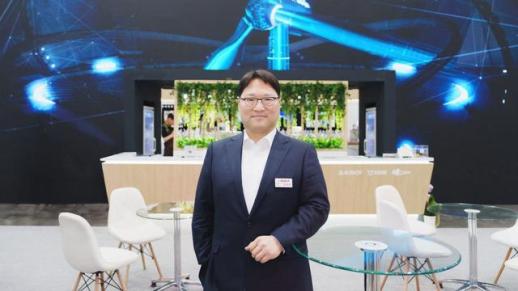 KORLOY Marks 60th Anniversary at SIMTOS 2026, Calls Itself a 'Trusted Partner' Cutting-tool maker KORLOY, led by CEO Lim Jeong-hyeon, held events at SIMTOS 2026 to mark its 60th anniversary. KORLOY took part in SIMTOS 2026, held April 13-17 at KINTEX in Ilsan, and set up an exhibition booth themed around its 60th anniversary ahead of its June 11 founding anniversary. The booth featured a 60th-anniversary emblem installation and graffiti-style design elements. Inside, the company also created a history zone highlighting key milestones by year, presenting its growth as a cutting-tool specialist and its brand identity to visitors. On the second day of the exhibition, KORLOY held a product seminar for overseas customers. It presented its latest cutting-tool technologies and application cases, and shared industry-specific machining solutions and strategies for responding to global markets. On-site consultations were also run with a practical focus. R&D staff joined booth meetings to answer technical questions based on customers’ machining environments and to explain how products could be applied. The company said it strengthened expert consultations so customers could obtain more detailed technical information. After the second day ended, KORLOY hosted a dinner for overseas customers. The program included a performance by a traditional Korean music band and a screening of a 60th-anniversary video, introducing Korean culture alongside the company’s history. Lim said it was meaningful to mark the 60th anniversary with long-standing partners and customers, calling the event a chance to reflect on shared time and trust. He said the company would further strengthen quality and technological capabilities in the cutting-tool industry and maintain stable supply amid changing conditions. He added that KORLOY would continue innovation and product improvements to raise customers’ productivity and value, and remain a trusted partner.* This article has been translated by AI. 2026-04-29 09:23:42
 -
 LS Electric Signs $220 Million Power Distribution Supply Deal With Bloom Energy LS Electric said April 29 it signed a power distribution solutions supply contract worth about $220 million, or 319 billion won, with global power company Bloom Energy. Under the deal, LS Electric will supply key distribution systems — including switchgear and transformers — for a power infrastructure project for a hyperscale data center being built in New Mexico for a major big-tech company, the company said. LS Electric has recently won a series of large power infrastructure projects in North America. It said the latest contract follows an additional order after securing a 170 billion won project this month to build power solutions for a major big-tech data center. The order momentum has carried into results. LS Electric posted first-quarter consolidated revenue of 1.3766 trillion won and operating profit of 126.6 billion won, its best first-quarter performance on record. The company is expanding its direct current power distribution business aimed at next-generation data centers. It said DC distribution can improve energy efficiency by reducing power conversion steps, helping cut operating costs and carbon emissions at AI data centers that consume large amounts of electricity. LS Electric said it plans to move early to capture the market, citing its low-voltage direct current distribution, or LVDC, solutions and operating know-how from its “DC Factory” at its Cheonan site. “The U.S. data center market is seeing distribution infrastructure investment expand rapidly as AI spreads and power demand rises,” an LS Electric official said. “We will expand large-scale orders in North America and further accelerate growth by strengthening local supply chains and partnerships and leveraging core technology capabilities such as next-generation DC solutions.”* This article has been translated by AI. 2026-04-29 09:23:01
 -
 Lee Dong-gun in Talks to Join JTBC’s ‘Divorce Consideration Camp’ After Jin Tae-hyun Exit Actor Lee Dong-gun has been offered a role on JTBC’s “Divorce Consideration Camp” and is reviewing the proposal, according to reports. If he joins, he is expected to fill the spot left by actor Jin Tae-hyun. DongA.com reported on the 29th that Lee was initially said to have completed the show’s first recording last Saturday, but it was later confirmed he has only been approached to appear. His agency, W Plus Entertainment, said, “It is true he received an offer to appear on ‘Divorce Consideration Camp,’” adding, “He is considering it.” The program previously featured Jin and actor Park Ha-sun as “home investigators,” a supporting role in which they represented couples’ perspectives, showed empathy and offered blunt advice alongside the show’s panel. On the 27th, the show announced Jin’s departure, saying, “Jin Tae-hyun will be leaving the program,” and calling it a decision made “to bring change” after about two years on the show since 2024. Jin explained his exit the next day on social media. In a handwritten letter, he said, “There is still a lot of footage left to air, but since the article came out first, I’m saying goodbye in advance.” He added that he heard the production team’s explanation and decision through his manager and that he left the program after his final recording in early April. “My experience is limited and subjective, so I always wondered whether it was helpful,” he wrote. “Though I was lacking, I approached it with more sincerity than any other shoot.” He also thanked Seo Jang-hoon, saying he was grateful to “Jang-hoon hyung” for recommending him to join. Jin added that he would now live with his wife even more as an “encouragement-for-marriage couple,” with gratitude and love. Seo and Park will remain on the show. Lee married actor Jo Yoon-hee in 2017 and they had a daughter, but they divorced by mutual agreement in 2020. He has since pursued various activities, including running a cafe on Jeju Island. “Divorce Consideration Camp” airs Thursdays at 10:30 p.m. 2026-04-29 09:22:20
 -
 President Lee Jae-myung to Host Lunch With Minor-Party, Independent Lawmakers President Lee Jae-myung will host a lunch meeting April 29 at Cheong Wa Dae with lawmakers from minor parties and independents. It will be the first time Lee has invited all lawmakers from non-negotiating parties to such a meeting. Earlier this month, on April 7, Lee held a meeting and lunch of the ruling-opposition-government consultative body on the people’s economy with Democratic Party leader Jung Cheong-rae and People Power Party leader Jang Dong-hyeok. Cheong Wa Dae said 21 people will attend the April 29 meeting, including lawmakers from five non-negotiating parties — the Rebuilding Korea Party, the Progressive Party, the Reform New Party, the Basic Income Party and the Social Democratic Party — as well as independents. Cheong Wa Dae attendees will include Chief of Staff Kang Hoon-sik, political affairs adviser Cho Jung-sik and Senior Secretary for Political Affairs Hong Ik-pyo. Lee is expected to urge bipartisan cooperation on issues affecting people’s livelihoods. Cheong Wa Dae described the meeting as reflecting Lee’s “inclusive commitment to communication,” extending outreach beyond negotiating parties to include minor parties and independents.* This article has been translated by AI. 2026-04-29 09:21:29
 -
 Saemaul Geumgo Foundation to Provide 400 Million Won to Social Welfare Facilities Nationwide MG Saemaul Geumgo Regional Hope Sharing Foundation said Tuesday it provided 400 million won this year through its “MG Warmth Sharing Event Support Program” to help expand community culture and strengthen solidarity with local communities. The program is the foundation’s flagship, locally focused social contribution effort, providing operating funds so social welfare facilities can run programs they plan themselves based on needs in the field. Supported projects include special meals for Family Month and Parents’ Day, summer camps for low-income children, performances in culturally underserved areas, and outings for people with severe disabilities. The foundation said the support is intended to go beyond providing goods by offering new experiences and emotional lift. The foundation said it ran the program last year, providing 390 million won to 78 social welfare facilities nationwide. This year, it provided 5 million won each to 80 organizations last month, enabling facilities to operate tailored programs reflecting participants’ needs and local conditions. Chairman Kim In said the program is meaningful because it is built on needs identified by local welfare facilities. He said the foundation will continue practical support for neighbors in need through a range of community-based sharing activities.* This article has been translated by AI. 2026-04-29 09:17:00
 -
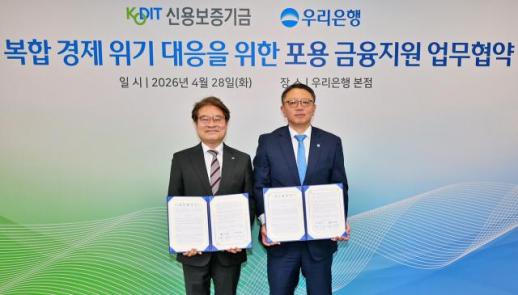 Woori Bank, Credit Guarantee Fund to Provide 240 Billion Won in Support for Small Firms Woori Bank said Tuesday it will work with the Korea Credit Guarantee Fund to provide 240 billion won ($2400억원) in financial support to help small and medium-sized businesses weather a crisis. The bank and the fund signed a business agreement Monday on inclusive financial support to respond to a complex economic downturn. The program is aimed at easing financing burdens for SMEs facing difficulties from a global slowdown and increased volatility in financial markets, while supporting a stable recovery in the real economy. Woori Bank will contribute a total of 6 billion won ($60억원) to the fund, enabling about 240 billion won in support. Eligible firms include small businesses and vulnerable industries tied to oil and price stabilization; companies involved in supply-chain management, including materials, parts and equipment; businesses directly or indirectly affected by changes in external conditions such as the war in the Middle East; and exporters, importers and companies expanding overseas. Participating firms will receive higher guarantee coverage, raised to 100% from 85%, and support equivalent to 0.7 percentage points of guarantee fees. Separately, Woori Bank said it signed another agreement with the fund on April 10 to provide 310 billion won ($3100억원) in stage-by-stage financing for innovative-growth sectors and export-leading small and mid-sized companies. The bank said it plans to expand cooperation with policy finance institutions to bolster resilience and growth for small and mid-sized firms. Woori Bank CEO Jeong Jin-wan said the latest agreement will help improve access to financing for SMEs struggling to raise funds. He said the bank will expand what it called productive finance, in close cooperation with the fund, to support normal operations and sustainable growth for small and mid-sized companies.* This article has been translated by AI. 2026-04-29 09:16:12
 -
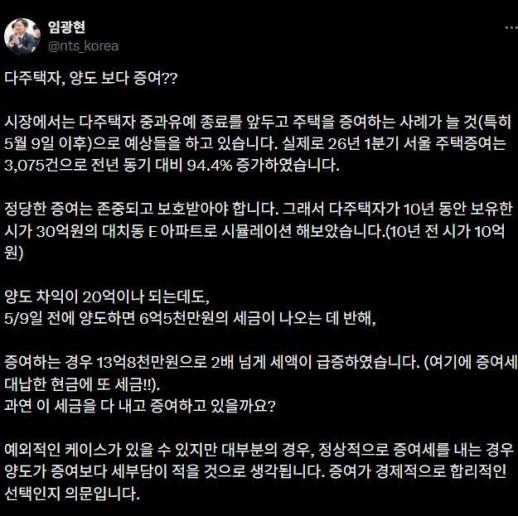 NTS chief warns multi-homeowners gift tax can top capital gains tax as surcharge break ends Lim Gwang-hyeon, commissioner of South Korea’s National Tax Service, warned multi-homeowners not to rush into gifting homes ahead of the end of a temporary suspension of heavier capital gains taxes, saying the tax burden is often higher for gifts than for sales. In posts on X (formerly Twitter) and Facebook on Tuesday, Lim said the market expects more home gifts before the suspension ends, but “when you calculate the actual tax burden, gifting is often more disadvantageous.” He added that people should not consider “schemes” aimed at avoiding taxes. Home gifts in Seoul totaled 3,075 cases in the first quarter of this year, up 94.4% from a year earlier. Lim cited a simulation: For an apartment in Seoul’s Daechi-dong with a market price of 3 billion won that has been held for 10 years and was bought for 1 billion won, a sale before May 9 would generate about 650 million won in taxes. A gift, he said, would result in about 1.38 billion won in taxes — more than double. He also cautioned that if someone else pays the gift tax on the recipient’s behalf, additional taxation may apply. Assuming taxes are paid properly, he said, taxpayers should consider whether gifting is economically reasonable. Lim warned against improper gifting practices, including gifting a home with a loan and then having parents repay it, or undervaluing a property below market price. Such actions could amount to tax evasion, he said, adding that the NTS plans to conduct a full review. In those cases, he said, penalties of up to 40% could be imposed on top of the original tax due. “Tax justice is a very important value,” Lim said, adding that the agency will provide guidance and consultations so taxpayers can make reasonable decisions before the suspension ends. * This article has been translated by AI. 2026-04-29 09:15:18
 -
 Genesis Magma Racing Finishes Surprise Hypercar Debut at 2026 WEC Imola 6 Hours Genesis said Tuesday that its Genesis Magma Racing team successfully finished its first top-class Hypercar entry at the season-opening 2026 FIA World Endurance Championship (WEC) Imola 6 Hours. Unlike most motorsports, which typically last one to two hours and reward the fastest finish, WEC races emphasize durability, with events commonly run over six hours and sometimes eight or 24 hours. Over races that can last up to 24 hours, cars must withstand heavy loads from high-revving engines, brakes that heat up under repeated stopping, and thermal management demands on hybrid motors and batteries. Each car is shared by three drivers, with six drivers rotating across the team, as they manage changing weather, tire wear and other variables while battling for position. Genesis Magma Racing entered its first event with a mix of veterans and newcomers: Andre Lotterer, Pipo Derani, Daniel Juncadella, Mathys Jaubert, Mathieu Jaminet and Paul-Loup Chatin. Midrace, Lotterer moved up to 11th before pitting. Jaubert then took over and made a clean pass on an Aston Martin. After Derani got in as the third driver, the team briefly climbed as high as ninth. Ferrari driver Nicklas Nielsen, who was chasing Jaubert, expressed surprise over team radio, saying, “I don’t understand why that car is faster than us in the corners.” After six hours, the team’s two hypercars averaged 177.97 kph and 176.23 kph around the 4.909-kilometer Imola circuit, finishing 15th and 17th. Cyril Abiteboul, head of Hyundai Motorsport and team principal of Genesis Magma Racing, said the new entrant focused less on the absolute result and more on reliability and execution. “The most important thing we confirmed this weekend is the solid foundation and potential of our team,” he said. Genesis Magma Racing is scheduled to race next month at the season’s second round, the Spa-Francorchamps 6 Hours in Belgium.* This article has been translated by AI. 2026-04-29 09:12:15
 -
 KAI, Bell Textron sign MOU on South Korea’s next-generation high-speed utility helicopter Korea Aerospace Industries, or KAI, said April 29 it signed a memorandum of understanding with U.S. aircraft maker Bell Textron on April 27 (local time) to jointly develop a solution for South Korea’s next-generation high-speed medium utility helicopter, known as HSMUH. The signing ceremony was held at Bell Textron’s headquarters in Fort Worth, Texas. Attendees included Cho Jeong-il, head of KAI’s rotorcraft business division, and Jeff Schloesser, senior vice president for strategic business at Bell Textron, the company said. KAI said the agreement is aimed at a joint response to South Korea’s HSMUH program, aligned with U.S. government priorities and policy, based on the MV-75 being developed by Bell Textron in cooperation with the U.S. Army as a next-generation vertical lift aircraft. The MV-75 was officially selected for the U.S. Army’s Future Long-Range Assault Aircraft, or FLRAA, program and is now in system development at Bell Textron. Bell Textron announced on April 15 (local time) that the aircraft’s official name will be “Cheyenne II.” The companies said their partnership reflects a shared vision for a next-generation vertical lift aircraft based on the MV-75, with major improvements in speed, range and maneuverability to deliver top-tier tiltrotor performance. They said they will also review solutions that use a Modular Open Systems Approach, or MOSA, to enable rapid and cost-effective upgrades to weapon systems, and will explore broader industrial cooperation opportunities as the project is further defined. “This cooperation will be an opportunity to make a major leap in the South Korean military’s next-generation aviation operational capabilities,” Cho said. He said KAI will combine its proven system development capabilities with Bell Textron’s advanced technology to help the military secure a flexible and powerful weapon system able to respond quickly to a rapidly changing battlefield. Schloesser said the MV-75 is “a platform that showcases the essence of next-generation vertical lift technology.” He said South Korea’s HSMUH program will be an important opportunity to expand those capabilities into the global market and strengthen interoperability between the United States and its allies.* This article has been translated by AI. 2026-04-29 09:11:10