
Journalist

Lee Hugh
=
-
 More Than Half of South Korea’s Farm, Forestry and Fishing Population Is 65 or Older More than half of South Korea’s farm, forestry and fishing population is now 65 or older, as household sizes continue to shrink rapidly. According to the National Data Policy Agency’s preliminary results of the “2025 Census of Agriculture, Forestry and Fisheries” released on the 28th, the farm, forestry and fishing population totaled 2,576,000 people as of last December, living in 1,276,000 households. That compares with about 2.38 million people and 1.06 million households in the 2020 census — increases of about 196,000 people and 216,000 households. The agency said the rise reflects an expanded statistical scope as more people moved to rural areas and additional administrative records — including farmland ledgers, fisheries registration lists and forestry management databases — were added to the survey coverage. The share of residents ages 65 and older in farm, forestry and fishing households rose to 51.0% in 2025 from 41.9% in 2020, up 9.1 percentage points. That is more than 2.5 times the share in the overall population, which stood at 20.3%. By sector, the elderly share was 51.3% for farm households, 48.2% for fishing households and 47.9% for forestry households. In farm households, the share of working-age residents (15-64) was 45.8% and the share of children (0-14) was 2.9%, down 23.7 percentage points and 7.3 percentage points, respectively, from the overall population. The median age was 65.3, or 18.6 years higher than the national figure. Smaller households also became more common. One-person households accounted for 27.2% in 2025, up from 20.0% in 2020, an increase of 7.2 percentage points. The share of three-person households fell to 11.6% from 14.3%, and four-person households dropped to 7.4% from 11.9%. Two-person households made up 53.8% last year, the largest share, meaning one- and two-person households accounted for more than 80% of all farm, forestry and fishing households. By area, the share living in “dong” neighborhoods rose to 32.4% in 2025 from 27.5% in 2020, while the share in “eup” and “myeon” areas fell to 67.7% from 72.5%. The shift reflects a move toward dong areas, where medical care, transportation and education are generally more accessible than in eup and myeon communities. 2026-04-28 12:10:16
 -
 South Korea Mortgage Rates Rise for Sixth Month to 4.34%, Highest in 2 Years Mortgage rates in South Korea rose for a sixth straight month, reaching their highest level in 2 years and 4 months. According to the Bank of Korea’s “weighted-average interest rates of financial institutions” data released on the 28th, the average rate on new mortgage loans at deposit-taking banks in March was 4.34% a year, up 0.02 percentage points from the previous month. It was the highest since November 2023 (4.48%). Lee Hye-young, head of the BOK’s financial statistics team, said the increase reflected a sharp rise in long-term benchmark rates, including the five-year bank bond yield. Rates on general unsecured loans also rose, up 0.04 percentage points to 5.57%, turning higher for the first time in three months since January. The overall household loan rate climbed 0.06 percentage points to 4.51%. Across household and corporate lending, the overall bank loan rate fell 0.06 percentage points to 4.20%, as corporate loan rates declined on support such as preferential rates aimed at expanding corporate credit. Rates for large companies (4.11%) and small and midsize firms (4.17%) fell 0.02 and 0.11 percentage points, respectively. The share of fixed-rate mortgages dropped sharply over the month, falling 10.3 percentage points to 60.8% from 71.1%. The fixed-rate share of all household loans also slid to 35.5% from 43.1%, the lowest since September 2022 (33.6%). The average rate on new savings deposits fell 0.01 percentage points to 2.82% a year, reversing course after a month. Rates on time deposits and other pure savings deposits (2.79%), as well as market-linked products such as financial bonds and certificates of deposit (2.98%), also slipped 0.01 percentage points each. With loan rates falling more than deposit rates, the gap between new loan rates and savings deposit rates narrowed by 0.05 percentage points to 1.38 percentage points. However, the gap based on outstanding balances, rather than new lending, widened 0.01 percentage points to 2.27 percentage points.* This article has been translated by AI. 2026-04-28 12:09:12
 -
 General Insurance Association of Korea Launches Consumer Protection Council The General Insurance Association of Korea said on the 28th that it held a launch ceremony and first meeting for its “General Insurance Consumer Protection Council.” The council was formed — the first of its kind in the financial sector — as regulators step up consumer-protection efforts. The association said the group will work to strengthen consumer rights and advance a “consumer-centered transformation” of the nonlife insurance industry. It is expected to propose industrywide consumer-friendly improvement tasks and directions, with the goal of boosting trust in the sector. Lee Byeong-rae, chairman of the association, said it was meaningful to launch a self-regulatory body to lead fundamental change in response to growing demands for stronger financial consumer protection. He said the industry needs to move away from responding after issues arise and instead identify and resolve improvement tasks from the consumer’s perspective. He added that he hopes the council will help restore trust in the nonlife insurance sector and support sustainable growth by strengthening competitiveness. The association said the council will pursue practical change through a four-step process: agenda discovery, in-depth discussion, task implementation and follow-up management, rather than limiting its work to collecting opinions. It said it will actively reflect views raised by the council. For matters requiring legal revisions or policy support, it will consult closely with relevant agencies. For steps that can be implemented immediately at the industry level, it plans to urge swift action through meetings of chief consumer protection officers, or CCOs.* This article has been translated by AI. 2026-04-28 12:08:25
 -
 Climate Ministry to Train ESG Specialists, Issue Scope 3 Guides for Petrochemicals and Steel The government will move ahead this year with a program to train ESG professionals and will release guidance on calculating Scope 3 greenhouse gas emissions for the petrochemical and steel industries, aiming to strengthen companies’ ability to respond to environmental, social and governance rules. The Ministry of Climate, Energy and Environment said April 28 it will run an ESG management professional training program from May through November to help companies build capacity for sustainable management. The ministry said the program was designed to help companies develop practical response capabilities as sustainability disclosures expand internationally and product-based environmental regulations tighten. Companies face growing pressure as ESG disclosure requirements and environmental rules such as carbon border adjustment mechanisms strengthen rapidly in global markets. Securing hands-on staff who can collect and analyze relevant data and apply it to management strategy has emerged as a key challenge. The government plans to shift away from theory-heavy instruction and expand training built around practice and case studies. It also plans to broaden “on-site training” tailored to regional demand to improve access for companies outside the capital area. The curriculum will focus on strengthening capabilities for carbon neutrality, with expanded practical content on carbon-reduction technologies and renewable energy transitions to help companies respond to mandatory sustainability disclosures and global carbon regulation trends. Courses will be offered monthly, with notices to be posted in early and mid-month. Separately, the government will support companies in calculating Scope 3 emissions, an area it said is among the most difficult for businesses. Scope 3 covers not only a company’s direct emissions but also indirect emissions across its supply chain, making the boundary broad and data difficult to secure. The ministry has published Scope 3 calculation guides since 2023 reflecting the characteristics of major export industries. This year it will newly release tailored guides for petrochemicals and steel. The petrochemicals guide includes calculation methods reflecting a complex value chain from raw material procurement through product use and disposal. The steel guide includes methods based on key raw materials by process and standard processes, along with examples of using circular resources to improve applicability in the field. The guides were developed through a consultative body involving the ministry, the Korea Environmental Industry & Technology Institute, major companies by sector and industry associations, and present practical, sector-specific guidelines. The guides will be available starting April 29 on the ministry’s official website and the Environmental Responsible Investment Integrated Platform. An English translation of last year’s guide for the semiconductor and display industries will also be released. Jeong Seon-hwa, the ministry’s director general for green transition policy, said, “Amid international ESG regulations and the trend of carbon regulation, securing companies’ practical response capabilities is more important than anything.” She added, “We will systematically support responses to international sustainability disclosures and carbon regulations by linking professional workforce training with the provision of calculation standards.”* This article has been translated by AI. 2026-04-28 12:07:26
 -
 South Korea raises minimum antitrust fines for cartels to 10%, seeks full recovery for unfair support The Fair Trade Commission will sharply raise the minimum rates used to calculate administrative fines for violations of South Korea’s Fair Trade Act, including a steep increase for cartels and tougher penalties for unfair support and private-benefit schemes. The FTC said on the 29th it will enforce revised fine guidelines starting on the 30th. Violations that ended before the effective date will be handled under the previous guidelines. Under the act, the FTC calculates fines based on sales related to the violation, multiplied by a rate that varies by the seriousness of the conduct. The revision significantly raises the minimum rate applied across violation types. For cartels, the minimum rate will rise to 10% from 0.5%. For serious cartels, it will increase to 15% from 3%, and for very serious cartel conduct, to 18% from 10.5%. For unfair support and private-benefit schemes, where fines are based on the amount supported or provided multiplied by a rate, the minimum rate will rise to 100% from 20%. That allows the FTC to recover the full amount of support or provision as a fine regardless of the assessed seriousness. The maximum rate will also jump to 300% from 160%, enabling punitive-level fines. Surcharges for repeat offenders will be strengthened. Currently, a company with one violation in the past five years faces an increase starting at 10%, rising up to 80% depending on the number of violations. Under the revision, a single prior violation can trigger an increase of up to 50%, and the increase can reach up to 100% depending on the number of violations. For cartels, any prior record of an order to pay fines within the past 10 years can lead to an increase of up to 100%. The FTC will also remove or narrow discretionary reductions. Companies that cooperate during the investigation and deliberation stages can currently receive reductions of 10% at each stage, up to 20% total. Under the revision, a reduction of up to 10% will be available only when a company cooperates consistently from the investigation through the end of deliberations. The maximum reduction for voluntary corrective action will be cut to 10% from 30%, and a 10% reduction for minor negligence will be eliminated. The FTC said the revision is intended to end the practice of treating fines as a routine cost of doing business and to strengthen fair competition. It added that the new rules provide a basis for strong sanctions against cartels that harm people’s livelihoods and said it expects cartel conduct to be dramatically curbed.* This article has been translated by AI. 2026-04-28 12:06:32
 -
 Korea to Tighten Oversight of Green Claims in Online Platform Ads With Industry Training The Ministry of Climate, Energy and Environment and the Fair Trade Commission will provide training to strengthen oversight of environmental labels and advertising in the online retail market, aiming to improve the credibility of green claims. The ministry and the FTC said on April 28 they will hold an “environmental labeling and advertising” training session on April 29 at the Korea Environmental Industry & Technology Institute auditorium in Eunpyeong-gu, Seoul, for major mail-order brokerage operators and sellers on online distribution platforms. As green consumption spreads and interest in eco-friendly values grows, labels and ads highlighting the environmental benefits of products and services have increased rapidly. In online platform sales involving many sellers, the accuracy and consistency of environmental information has become a key factor affecting consumer trust and market integrity. Environmental labeling and advertising are overseen by the climate ministry under the Environmental Technology and Environmental Industry Support Act and by the FTC under the Act on Fair Labeling and Advertising. Industry has called for clearer, more unified guidance on how the rules are interpreted and how investigations are conducted. The training was designed to meet that demand by improving companies’ understanding of the system and strengthening practical compliance capabilities. The Korea Environmental Industry & Technology Institute and the Korea Online Shopping Association will run the program. The agenda includes trends and key issues in the mail-order brokerage system, an overview of environmental labeling and advertising rules, major review cases under the labeling and advertising law, and guidance on proper environmental claims. To allow participation by sellers nationwide, the session will be offered both in person and via live online streaming. The two agencies also plan to prepare and distribute a joint guideline on environmental labeling and advertising by the end of the year. The guide is intended to provide integrated direction on the standards used by both agencies, support companies’ understanding and compliance, reduce unfair green claims, and strengthen consumer protection and market trust. Jeong Seon-hwa, the climate ministry’s director general for green transition policy, said, “We hope this training helps companies accurately understand the environmental labeling and advertising system and use it properly,” adding that the agencies will continue working together to improve consistency and effectiveness in oversight. Information Reum, director general of the FTC’s Consumer Policy Bureau, said the session was arranged so companies do not face difficulties from legal and institutional uncertainty as they pursue “environmental management.” She said the government plans to strengthen monitoring while improving rules on environmental labels and advertising that are closely tied to people’s everyday consumption. * This article has been translated by AI. 2026-04-28 12:05:23
 -
 South Korea Renames ‘Job Basic Skills’ as ‘Job Common Skills,’ Cuts Framework to Seven Areas The Ministry of Employment and Labor and the Human Resources Development Service of Korea said on 28일 they will rename “job basic skills” as “job common skills” and overhaul the framework into seven areas. The ministry described job common skills as core competencies all workers need regardless of occupation, such as communication, numeracy and problem-solving. The broader system consists of three parts: job-specific skills under the National Competency Standards (NCS), job common skills and general foundational competencies. NCS and job common skills are used as key indicators for human resources development. Introduced in 2003, the framework has not been revised for more than 20 years, prompting calls to update it. The government said it will pursue a major restructuring after gathering feedback from workplaces. The ministry said the name change is intended to avoid the misunderstanding that the framework measures only basic academic ability and to clarify that it covers universal competencies required of all workers. The existing structure of 10 areas and 34 sub-skills will be reorganized into seven areas and 21 sub-skills. Items seen as less useful amid labor market changes will be eliminated, while new areas will be added, including artificial intelligence use, digital responsibility and industrial safety and health awareness. The seven areas are communication, numeracy, problem-solving, self-management, interpersonal skills, digital skills and work ethics. Sub-skills include: communication (written, oral and foreign-language communication); numeracy (calculation, use of statistics and use of charts); problem-solving (problem analysis, identifying alternatives and decision-making); self-management (career development, adaptive learning and time management); interpersonal skills (collaboration, leadership and conflict management); digital skills (digital use, AI use and digital responsibility); and work ethics (work ethic, workplace community awareness and industrial safety and health awareness). The ministry said it will also expand field-oriented learning content. It plans to produce and distribute instructor guides and learner workbooks within the year, reflecting demand for practical materials. It will also develop video lectures to allow learning regardless of time and place and release them through the Korea University of Technology and Education’s STEP portal. “In the AI era, companies want talent with job common skills that can flexibly adapt to rapidly changing technology and see essential problems through to the end,” said Pyeon Do-in, director general for job skills policy at the ministry. He said the government will quickly distribute the revised standards and related content and “fully support” job seekers so they can strengthen fundamentals and remain competitive in the workplace.* This article has been translated by AI. 2026-04-28 12:04:17
 -
 South Korea to Pay ‘Fair Allowance’ to Short-Term Public Workers, Ban Sub-1-Year Contracts The government will introduce a new “fair allowance” for short-term fixed-term workers in the public sector after a survey found that about half of such workers were hired on contracts of less than one year. The plan also calls for, in principle, banning fixed-term contracts shorter than one year and tightening rules to prevent abuse of ultra-short-hour workers. The Ministry of Employment and Labor reported the measures at a Cabinet meeting on the 28th as part of a “public-sector nonregular worker treatment improvement plan.” The ministry said it had confirmed unfair practices such as repeated sub-one-year contracts used to avoid paying severance, along with concerns over low pay and allowances. After launching a joint interagency task force on nonregular workers late last year, the government surveyed about 2,100 public entities — including central government agencies, public institutions and local governments — on contracts and wages. The survey found about 146,000 fixed-term workers in the public sector, including 73,000 on contracts shorter than one year. Workers on sub-one-year contracts earned less than fixed-term workers overall, and they were less likely than regular employees to receive welfare points, meal allowances and holiday bonuses. Wage gaps also varied by institution. As a “model employer,” the government said it would pay fair compensation to reflect labor value and job insecurity. Under the plan, public institutions will pay a flat “fair allowance” equal to 10% to 8.5% of a base amount to fixed-term workers employed for less than one year. The base amount is set at 118% of the minimum wage, reflecting the average living wage. The plan applies higher compensation rates for shorter contracts. Based on next year’s 기준, payments would be 382,000 won for 1-2 months of work; 846,000 won for 3-4 months; 1.26 million won for 5-6 months; 1.622 million won for 7-8 months; 2.055 million won for 9-10 months; and 2.488 million won for 11-12 months. To narrow wage gaps within the public sector, the government will also pay an “appropriate wage” and include a one-time budget item in next year’s budget proposal so workers whose monthly fixed pay falls below that level can receive support. The appropriate wage is also set at 118% of the minimum wage. A ministry official said using the average living wage set by local ordinances would have the effect of partially raising and leveling pay for low-wage workers. The ministry said it will also review and gradually improve benefits and allowances, including meal costs, welfare points and holiday bonuses. To establish fair hiring practices, the plan would, in principle, prohibit contracts shorter than one year. Exceptions would require a prior screening process for public-sector nonregular hiring, and the government plans to require outside members on screening committees to strengthen the system. For work that is routine and ongoing, the government said workers should be hired as regular employees. It will also provide guidance to institutions that have not made conversion decisions under the 2017 regularization guidelines. As of this month, 52 public institutions had not made such decisions. To curb misuse of ultra-short-hour fixed-term workers — those working fewer than 15 hours a week — the government will restrict such hiring. Where unavoidable, employers must undergo a necessity review and meet conditions such as additional proportional payments, including weekly holiday pay, to prevent hiring for cost-cutting purposes. The government will conduct regular surveys to track employment and wage conditions for nonregular workers in the public sector. If unfair practices are found during surveys — such as 364-day contracts aimed at avoiding severance — it will guide institutions to guarantee a one-year contract. To ensure implementation, the government will strengthen nonregular employment indicators in management evaluations of public institutions and local public enterprises. A ministry official said detailed evaluation items and indicators will be prepared based on the results of an ongoing research project. The government also plans to draft and expand a tentative “guideline for improving treatment of nonregular workers.” With a committee for public-service workers set to be established starting in September this year, further discussions on public-sector treatment improvements will be handled through that body. Labor Minister Kim Young-hoon said the public sector should take the lead in correcting unfair hiring practices affecting nonregular workers and set an example through reasonable improvements in treatment. He said the government would work to ensure the public sector’s progress spreads to the private sector so all working people are respected and treated in line with the value of their labor.* This article has been translated by AI. 2026-04-28 12:03:18
 -
 Jipyeong Soju expands offline retail reach with Lotte Mart listing SEOUL, April 28 (AJP) - Jipyeong announced that its premium distilled spirit Jipyeong Soju has secured shelf space at Lotte Mart, expanding its offline retail footprint after an earlier listing at E-Mart. Unlike conventional rice-distilled spirits, the company explained that Jipyeong Soju blends three grains — rice, barley and sorghum — in what is described as an optimized ratio, yielding a layered flavor profile that balances the spice of sorghum, the nuttiness of barley and the clean finish of rice. The product has drawn strong interest among younger consumers, the company said, particularly for use in highballs — a cocktail format gaining traction in South Korea. "Through our entry into Lotte Mart, more consumers will be able to experience the depth of flavor that sets Jipy eong Soju apart," said a company spokesperson, adding that the brand aims to establish itself as one of the top three players in the domestic premium distilled spirits segment. 2026-04-28 12:01:05
 -
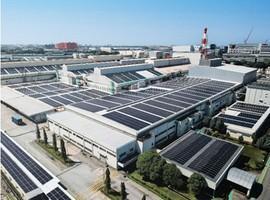 Nippon Electric Glass Installs Large Rooftop Solar System at Malaysia Site Nippon Electric Glass said April 27 that it installed a solar power system on the rooftop of a building at its subsidiary Nippon Electric Glass in Selangor state, Malaysia, and began operating it March 17. It is the subsidiary’s first solar installation, with a maximum output of 7.6 megawatts-peak (MWp). All electricity generated will be used on-site, and the company expects it to cut carbon dioxide (CO2) emissions by 6,900 tons a year. Local solar company Samaiden Group participated as a partner, handling design and construction of the facility, the company said. In 2024, Nippon Electric Glass signed a virtual power purchase agreement, or VPPA, with LSS Hijau, a special-purpose company established by Malaysian renewable power developer Ditrolic Energy. The company said the new rooftop system is expected to further accelerate its use of renewable energy.* This article has been translated by AI. 2026-04-28 12:00:12