
Journalist

Lee Hugh
=
-
 BTS Comeback D-50: How Korea's folk songs and heritage turned cool—and global SEOUL, January 30 (AJP) — BTS has long stood for K-pop stardom, polished choreography and messages of resilience and love. But as the group matures, its center of gravity is shifting. The world’s most influential idol group is digging deeper into its Korean roots—and the global audience is following along. In the countdown to their long-awaited comeback, every move by the seven members is read as a cultural signal. Where they go, what they reference, even what they casually post now carries symbolic weight. RM’s recent visit to the National Folk Museum of Korea is a case in point—one quiet stop that set off a ripple effect far beyond museum walls. Interest in Korea’s traditional music and folk culture has been building steadily, fueled by BTS’s creative choices around comeback themes, song titles and locations. The museum itself leaned into that momentum. On Jan. 23, it announced a series of hands-on programs tied to a special exhibition on the cultural history of horses, running Jan. 24–25 and Feb. 7–8. The programs go well beyond passive viewing. Visitors can experience live performances of the Mongolian morin khuur (horse-head fiddle), make badges once used by secret royal inspectors of the Joseon dynasty, and practice calligraphy using brushes made from horsehair. In total, six interactive programs invite audiences to touch, hear and participate in history rather than simply observe it. To extend the experience online, the museum is also giving away a 2026 horse-themed calendar to the first 200 visitors who post photos of their visit on social media through Jan. 31—another nod to how heritage now travels through digital platforms. Attention surged after RM’s visit, drawing younger audiences who might not otherwise have stepped into a folk museum. The episode underscores a broader shift: when K-pop icons engage with traditional culture, museums stop feeling distant or static. Heritage becomes something you encounter, share and remix in everyday life. That same dynamic is at work in BTS’s decision to title its upcoming full-length album Arirang. The choice is more than nostalgic symbolism. It signals that Korea’s most iconic folk song—one shaped by migration, separation and endurance—is ready to speak in the language of global pop. The Guardian described the move as a cultural statement that places Korean tradition squarely on the world stage. Just as Arirang has been sung, adapted and reinterpreted across generations, Korea’s museums and cultural institutions are reactivating tradition through contemporary lenses. Rather than freezing the past behind glass, they are turning it into living content—experienced through performance, participation and platforms. As BTS’s comeback nears, tradition itself appears to be entering a new phase: preserved, reimagined and consumed globally. What began as a folk song or a museum visit now travels effortlessly across borders, proving that heritage, when given the right rhythm, can be as dynamic—and as global—as pop itself. 2026-01-30 15:26:15
 -
 Coupang's interim CEO appears for questioning over massive data breach SEOUL, January 30 (AJP) - Harold Rogers, e-commerce giant Coupang's interim chief in South Korea, appeared for questioning in Seoul on Friday over allegations related to a massive data breach detected late last year. Rogers arrived at the Seoul Metropolitan Police Agency in Jongno, central Seoul, at around 2 p.m. and said, "Coupang has fully cooperated and will continue to fully cooperate with all investigations." But he declined to comment further, despite a barrage of questions by reporters. Rogers is accused of obstructing official duties by allegedly destroying evidence during an internal investigation into the data leak, which is estimated to have affected over 3,000 users and exposed their sensitive personal information. He has also faced allegations of covering up several industrial accidents. His appearance comes after he failed to appear for two previous summonses, as he had left the country early this month and only returned last week. Police are expected to question him about why the company conducted an internal probe instead of involving official authorities, and how it contacted a former employee who is suspected as a suspect. They are also expected to investigate whether there were any attempts to destroy evidence. Ahead of Rogers' appearance, union members and other workers gathered to protest, calling on Coupang to "sincerely apologize" to South Koreans and to the families of workers who died while working. 2026-01-30 15:09:08
 -
 Hyundai Rotem posts record profit on K2 tank exports to Poland SEOUL, January 30 (AJP) - South Korea's Hyundai Rotem surpassed 1 trillion won in annual operating profit for the first time, driven by strong export contracts including K2 battle tanks for Poland. In a regulatory filing on Friday, the company said revenue rose 33.4 percent from a year earlier to 5.84 trillion won, while operating profit surged 120.3 percent to 1.01 trillion won. Fourth-quarter revenue increased 12.8 percent to 1.6 trillion won, and operating profit climbed 65.4 percent to 267.4 billion won. Hyundai Rotem said growth was supported by higher production in its defense and rail businesses, reflecting strong domestic and overseas demand. The rail division ramped up output for South Korea’s high-speed rail projects, Uzbekistan’s high-speed rail system and Australia’s Queensland train program. The defense unit saw higher sales as the company produced K2 tanks for Poland and mass-produced wheeled command post vehicles for the domestic market. Orders rose across all business divisions, lifting Hyundai Rotem’s order backlog to 29.77 trillion won at the end of last year, up 58.7 percent, or about 11 trillion won, from a year earlier. The rail division recorded a record 6 trillion won in new orders, including 2.2 trillion won for double-deck electric multiple units in Morocco and 424.9 billion won for a rail project in Taichung, Taiwan. The defense unit logged 9.5 trillion won in orders, led by a second K2 tank export contract with Poland worth 8.7 trillion won. Orders at the eco-plant division totaled 516.4 billion won, down 20 percent, though the company said contracts from external customers increased, including an automated guided vehicle project at the Port of Busan. Hyundai Rotem said its financial position remained solid. As of the end of last year, its debt ratio stood at 206 percent, or 58.5 percent excluding advance payments. Borrowings totaled 109.9 billion won, while cash and cash equivalents amounted to 908.4 billion won, which the company said effectively supports a debt-free structure. * This article, published by Aju Business Daily, was translated by AI and edited by AJP. 2026-01-30 14:57:27
 -
 Kazakhstan launches nationwide environmental movement to promote ecological culture SEOUL, January 30 (AJP) - The government of Kazakhstan has implemented a large-scale national environmental campaign titled Taza Kazakhstan, or Clean Kazakhstan, following an initiative by President Kassym-Jomart Tokayev. The movement aims to improve the environmental state of the country while fostering a culture of nature conservation and civic responsibility among its population. The campaign serves as a central pillar of the country's social policy, focusing on both immediate physical cleanup and long-term behavioral change. It operates as part of a broader strategic framework, the Taza Kazakhstan Concept for the Development of Environmental Culture for 2024 to 2029, which was approved by the government in October 2024 to define state priorities in sustainable development. During 2025, the campaign resulted in 1,250 environmental events held across the nation. Participants planted more than 18 million trees and cleaned over 1 million hectares of land. According to official data, the initiative successfully collected more than 800,000 tons of waste with the participation of approximately 6.5 million people. A significant portion of the program focuses on the removal of illegal dumping sites. Authorities used satellite monitoring and 1,300 mobile groups to identify 3,833 illegal landfills, approximately 80 percent of which have been cleared. To facilitate public involvement, the government launched a Telegram chatbot that has processed more than 24,000 requests regarding waste removal and urban improvement. The initiative also includes infrastructure development for waste management. Eight new solid waste landfills have been commissioned, and 22 projects for waste sorting and recycling are currently underway. these projects represent a total value of 89.4 billion tenge, or approximately 180 million USD, with an additional 40 projects currently in the development phase. Educational programs have been integrated to support these environmental goals. Under the Adal Azamat program, which translates to Honest and Responsible Citizen, environmental education now reaches 87.2 percent of schoolchildren. Furthermore, 35 universities in Kazakhstan are training environmental specialists, supported by 2,358 state grants allocated for the 2025 to 2026 academic year. The campaign aligns with the goals set in the 2024 Presidential State-of-the-Nation Address. Moving forward, the Kazakh government identified waste management, energy efficiency, and resource-saving technologies as potential areas for bilateral cooperation between Kazakhstan and the Republic of Korea. 2026-01-30 14:56:07
 -
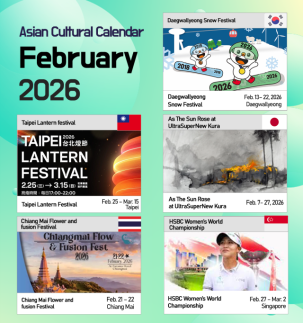 Asian Culture Calendar SEOUL, January 30 (AJP) - South Korea Feb. 13 – 22 Daegwallyeong Snow Festival Feb. 2 – 4 Tamnaguk Ipchun Gut Nori Feb. 4 – 8 Gongju Gunbam Festival Japan Feb. 7 – 27 As The Sun Rose at UltraSuperNew Kura Feb. 3 Setsubun Festival Japan Jan. 20 – Feb.8 Kobe Luminarie Thailand Feb. 21 – 22 Chiang Mai Flower and fusion Festival Feb. 11 – 15 Singha Park chiangrai International Ballon Fiesta Feb. 15 Kyoto Marathon Singapore Feb. 27– Mar. 2 HSBC Women’s World Championship Feb. 11 Thaipusam 2026 Taiwan Feb. 25 – Mar. 15 Taipei Lantern festival 2026-01-30 14:54:40
 -
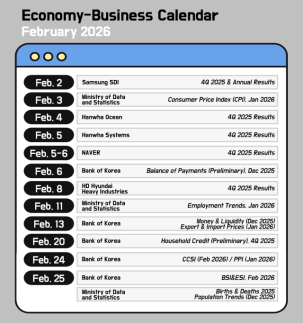 Korean Economy/Business Calendar SEOUL, January 30 (AJP) - Feb 2 (Mon) 4Q 2025 & Annual Results - Samsung SDI Feb 3 (Tue) Jan. 2026 Consumer Price Index (CPI) - Ministry of Data and Statistics Feb 4 (Wed) 4Q 2025 Results - Hanwha Ocean Feb 5 (Thu) 4Q 2025 Results - Hanwha Systems Feb 5–6 (Thu–Fri) 4Q 2025 Results - NAVER Feb 6 (Fri) Dec. 2025 Balance of Payments (Preliminary) - Bank of Korea Feb 8 (Sun) 4Q 2025 Results - HD Hyundai Heavy Industries Feb 11 (Wed) Jan. 2026 Employment Trends - Ministry of Data and Statistics Feb 13 (Fri) Dec. 2025 Money & Liquidity / Jan. 2026 Export & Import Prices - Bank of Korea Feb 20 (Fri) 4Q 2025 Household Credit (Preliminary) - Bank of Korea Feb 24 (Tue) Feb. 2026 CCSI / Jan. 2026 PPI - Bank of Korea Feb 25 (Wed) Feb. 2026 BSI & ESI - Bank of Korea Annual 2025 Births & Deaths / Dec. 2025 Population Trends - Ministry of Data and Statistics 2026-01-30 14:46:13
 -
 South Korean destroyer heads to India for fleet review, naval exercise SEOUL, January 30 (AJP) - A 4,400-ton destroyer will take part in an international fleet review to be held in India next month, the Navy said on Friday. The destroyer dubbed Gang Gam-chan departed from a naval base in Jeju on Friday, weeks ahead of the fleet review scheduled for Feb. 17-19 in the coastal city of Visakhapatnam, which will feature warships from 20 countries including Australia, Japan, the U.K., and the U.S. A week later, the vessel will also participate in various maritime drills as part of the multinational naval exercise "Milan," now in its 13th year since its launch in 1995. South Korea first joined with a 1,200-ton frigate in 2022, and this will be its second participation. Meanwhile, Rear Adm. Kim Gyeong-cheol will attend this year's Indian Ocean Naval Symposium (IONS) slated for Feb. 20 as an observer. The biennial meeting brings together littoral states of the Indian Ocean region, and this will mark South Korea's first participation. 2026-01-30 14:14:49
 -
 Korea's finance minister touts AI, new growth sectors in talks with Moody's SEOUL, January 30 (AJP) - South Korea’s Deputy Prime Minister and Finance Minister Koo Yun-cheol met with a delegation from Moody’s Investors Service on Friday, outlining the country’s plan to bolster medium- and long-term competitiveness through artificial intelligence and new growth industries. Koo met the Moody's team, which included Anushka Shah, a director overseeing sovereign ratings, at the Government Complex Seoul to discuss recent economic developments and the policy outlook. Outlining the government’s growth strategy, Koo identified semiconductors, the defense industry and K-culture as core sectors, while citing “physical AI” and power semiconductors as next-generation growth engines. He said fostering new industries would be critical to sustaining and expanding the country’s competitiveness. “The government is providing broad-based support, including workforce training, capital supply and regulatory easing,” Koo said. Responding to questions from Moody’s on the impact of artificial intelligence on employment, Koo said opinions vary but that AI-driven transformation across key industries, along with the emergence of new sectors, could generate new jobs built on core technologies. On geopolitical risks, Koo said the Lee Jae Myung administration has worked to maintain peace and stability on the Korean Peninsula since Lee took office, adding that conditions have remained broadly stable. Koo also addressed the management of national debt over the medium to long term, ministry officials said. * This article, published by Aju Business Daily, was translated by AI and edited by AJP. 2026-01-30 14:12:53
 -
 A number ticks down at the family table SEOUL, January 30 (AJP) -In "Number One", Ha-min (Choi Woo-shik) notices something unsettling: each time he eats his mother’s cooking, an invisible number drops. When he understands that zero would mean the end of his mother, Eun-sil (Jang Hye-jin), the meals become acts of love—and resistance—against time itself. Set for release on Feb. 11, the film draws from a tender premise by Japanese writer Uwano Sora. Adapted from the short novel There Are 328 Times Left to Eat My Mother’s Home‑Cooked Meals, the story weaves a gentle fantasy into the most familiar of rituals. At the mother’s table, minutes are measured in bites, and distance inside a family is felt in what goes unsaid. At the event, director Kim Tae-yong appeared with the cast, including Gong Seung-yeon. For Choi, the film is a homecoming twice over: a reunion with Kim 12 years after Giant, and a return to a mother-son bond with Jang following Parasite (2019). Here, that bond is quieter—and heavier—counted not in years, but in the meals they still have left. 2026-01-30 14:05:09
 -
 KG Mobility's cumulative sales in Turkey top 50,000 vehicles SEOUL, January 30 (AJP) - South Korean automaker KG Mobility (KGM) said on Friday that cumulative vehicle sales in Turkey, one of its key export markets, exceeded 50,000 units through last year. The company said it maintained strong momentum through improved product competitiveness and aggressive marketing, exporting 11,122 vehicles to Turkey in 2024 and 13,337 in 2025. Turkey was KGM’s largest export market over the 2024–2025 period and accounted for 19 percent of its total exports last year. EV models led the growth, including 6,722 units of the Torres EVX and 1,000 units of the Musso EV, alongside 2,630 units of the internal-combustion Musso, the company said. KGM exported a total of 70,286 vehicles last year, up 12.7 percent from 62,378 a year earlier, marking its strongest export performance since 2014, when shipments reached 72,011 units. By region, Western Europe accounted for 22,496 vehicles, or 32 percent of total exports, followed by Eastern Europe with 19,064 units, or 27.1 percent, and the Middle East with 17,231 units, or 24.5 percent. By country, Turkey ranked first, followed by Hungary with 9,508 vehicles and Germany with 6,213. KGM said Turkey’s strong preference for sport utility vehicles reflects practical considerations such as road conditions, housing environments and family travel patterns. Demand for eco-friendly vehicles, including electric cars, is also rising as consumers seek to reduce fuel costs. To sustain growth in Turkey, the company plans to launch the new Musso and expand offerings tailored to local demand, including adding telematics features to electrified models such as the Torres EVX and Musso EV. * This article, published by Aju Business Daily, was translated by AI and edited by AJP. 2026-01-30 13:33:43