

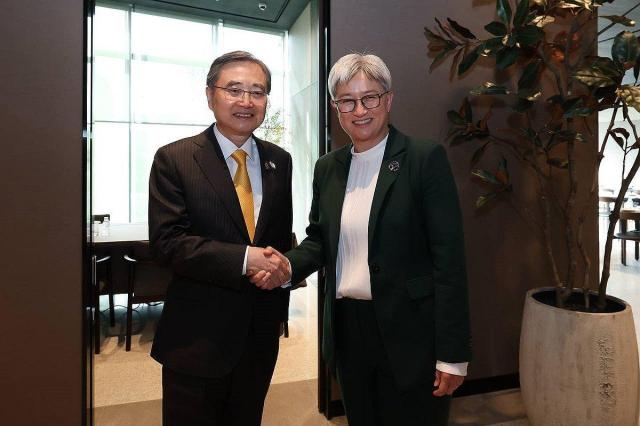
SEOUL, April 27 (AJP) - In a bid to exit the current energy bottleneck caused by the war in the Middle East and diversify the country's energy sources, South Korea's foreign minister Cho Hyun will host his Australian counterpart, Penny Wong, in Seoul this Thursday. The April 30 summit comes as Seoul grapples with the fallout of the war in Iran and the subsequent closure of the Strait of Hormuz, a blockade that has effectively stranded the fossil fuels required to power the world's tenth-largest economy.
According to February's trade data, Australia has already solidified its position as South Korea's top supplier of liquefied natural gas, providing 1,085,668 tons, representing 24.1 percent of the nation's total imports, even before the traditional supply lines from the Persian Gulf were paralyzed on February 28.
The upcoming talks represent the structural component of a "Total Energy Diplomacy" offensive by the Lee Jae Myung administration to protect an economy that remains 100 percent dependent on foreign fossil fuels. By elevating Australia from a commercial provider to a primary security guarantor, Seoul is attempting to permanently decouple its industrial survival from the volatility of the Middle East. This strategic shift marks a transition from simple market diversification to the construction of a blockade-proof energy corridor within the democratic Pacific.
This diplomatic push is coordinated with an emergency procurement drive led by the Presidential Chief of Staff Kang Hoon-sik. While Cho builds a long-term Pacific safety net, Kang Hoon-sik recently concluded a series of missions to the United Arab Emirates, Saudi Arabia, Kazakhstan, and Oman to secure immediate industrial lifelines. Kang's "shuttle diplomacy" focused on the urgent acquisition of crude and naphtha, successfully negotiating a priority supply of 24 million barrels from the Emirates to address critical shortages. The April 30 meeting is intended to complement these emergency measures by securing the long-term reliability of the Australian supply chain.
The trade partnership between the two nations has evolved from a historical exchange of Australian iron ore and coal for South Korean heavy industry into a broader strategic alliance. As the "Hormuz Trap" threatens the national power grid, Australian gas has increasingly displaced volumes from more volatile regions, with the two nations now exploring expanded cooperation in critical minerals such as lithium and nickel. These resources are viewed as essential for the next generation of industrial growth as the government seeks to mitigate future shocks to the fossil fuel supply chain.
The Ministry of Foreign Affairs confirmed on Monday that the two ministers will discuss high-level exchanges, economic security, and defense industrial cooperation. The session is expected to conclude with a joint press conference following a working dinner.
Copyright ⓒ Aju Press All rights reserved.
