
Journalist

Lee Hugh
=
-
 Grand Korea Leisure Named a “Life Guardian” in 2026 Cheonmyeong Project Grand Korea Leisure (GKL) said Monday it has been appointed a “Cheonmyeong guardian” for the government’s “2026 Cheonmyeong Project,” overseen by the Office for Government Policy Coordination’s Life Guardian Promotion Headquarters. The project name, “Cheonmyeong,” carries a double meaning: “1,000 lives” and a person’s innate lifespan, or destiny (天命). A total of 44 organizations, including GKL, were selected as guardians and are expected to play a central role in spreading a culture of respect for life. GKL President Yoon Doo-hyun said the company will “actively participate in the nationwide effort to expand a culture of respect for life,” adding that it will fulfill its role as a public enterprise by helping ease social isolation among marginalized neighbors and supporting their recovery of the will to live. GKL said it is also running a range of community programs, including the “3-Go” initiative supporting at-risk households outside the formal welfare system, a recovery program for residents of Seoul Station’s jjokbang neighborhoods, the “Pyeolchyeodeurim” program for youth in education-vulnerable groups, and training environmental leaders through ESG partnerships. The company said it has been named a recognized community-contribution company for seven consecutive years since 2019. 2026-04-27 10:10:23
 -
 Lino Industrial Shares Slide More Than 14% on News of Major Shareholder Stake Sale Semiconductor test socket maker Lino Industrial’s shares were down more than 14% on Monday, a move widely attributed to news that its largest shareholder plans to sell a sizable stake. According to the Korea Exchange, Lino Industrial was trading at 106,500 won as of 9:55 a.m., down 14.39% from the previous session. The company said late April 24 that CEO Lee Chae-yoon plans to sell 7 million common shares through after-hours block trades over 30 days from May 26 to June 24. The sale would amount to 9.18% of total shares outstanding and was valued at 863.1 billion won based on the April 23 closing price of 123,300 won. Lino Industrial said the actual price per share could differ, adding that the purpose of the transaction is “asset management through the sale of shares held.” Some in the securities industry have also suggested the plan could be part of preparations to fund gift taxes for transferring shares to his children, citing Lee’s age of 75. Lino Industrial ranks sixth by market capitalization on the KOSDAQ and posted its best-ever annual results last year. On a consolidated basis, revenue rose 33.9% from a year earlier to 372.5 billion won, while operating profit increased 42.5% to 177.0 billion won. Its operating margin climbed 2.9 percentage points to 47.5%, an unusually high level for the industry.* This article has been translated by AI. 2026-04-27 10:09:51
 -
 NH NongHyup Bank launches KOSPI 200-linked ELD deposit with rates up to 10% NH NongHyup Bank said April 27 it will launch “Equity-Linked Deposit (ELD) 26-2,” a principal-protected product designed to offer additional returns. The one-year deposit uses the KOSPI 200 index as its underlying asset and comes in three types: Stable I, Return I and Return II. At maturity, principal and interest are guaranteed. Early termination carries fees and could result in a loss of principal. The deposit can be used as collateral for a loan and is covered by deposit insurance. The Stable I type has no knock-out feature and pays, for individual customers, an annual return of 2.6% to 3.2% (2.45% to 3.05% for corporate customers) if the index at maturity rises 0% to 5% from its initial level. The Return I type offers individuals an annual return of 2.6% to 5.6% (2.47% to 5.47% for corporate customers) if the index rises 0% to 30%. If it rises more than 30%, the return is fixed at the minimum rate. The Return II type offers individuals an annual return of 2.3% to 10.0% (2.17% to 9.87% for corporate customers) if the index rises 0% to 25%. If it rises more than 25%, the return is also fixed at the minimum rate. All quoted returns are annual, before tax. Subscriptions will be accepted through May 6 at branches nationwide and via NH All One Bank and NH Smart Banking. “ELDs are products that guarantee principal at maturity while offering the potential for additional returns,” an NH NongHyup Bank official said, adding the bank will continue to introduce products that meet customer demand. 2026-04-27 10:09:17
 -
 Trump Says Iran Should Call to Negotiate, Not Expect U.S. Delegation U.S. President Donald Trump is increasing pressure on Iran, saying he may pursue negotiations by phone rather than in-person talks. He also argued that maritime blockades are working and claimed Iran’s oil pipelines could soon suffer internal explosions, extending what he described as economic pressure. In a phone interview with Fox News on April 26 (local time), Trump said he would not send “people” on an 18-hour trip as a U.S. negotiating team. “We’ll do it by phone. So if they want, they can call us,” he said. Referring to a call the previous day with Pakistan, Trump said, “We’re not going to do this anymore,” adding, “We have all the cards.” He said Pakistan would continue to stay involved, underscoring that it would keep its mediating role. “They know what has to be in the (final) deal,” Trump said. “They can’t have nuclear weapons. Otherwise there’s no reason to meet.” The remarks came as Trump weighs whether to resume face-to-face talks with Iran after saying he would keep a ceasefire in place until negotiations end. The United States had planned to send a delegation to Pakistan for talks, but has held off after Iran showed what the article described as a passive stance toward negotiations. Trump’s comments about “phone negotiations” were interpreted as a message aimed at pressuring Iran while reducing reliance on the talks. On the war with Iran, Trump said, “We’ve done a great job, and we’re going to have a big victory.” He added, “I hope they act smart, but even if they don’t, we’re going to win anyway.” On blockade measures targeting Iran-linked vessels in places including the Strait of Hormuz and the Pacific, Trump called them “incredibly effective,” claiming it means Iran “can’t make a lot of money anymore.” He said that when a pipeline carrying large volumes of oil can no longer keep loading containers or ships and the line becomes blocked, “the pipe mechanically explodes internally underground.” He claimed it had happened to Iran and said the blockade left it without ships. “It just explodes,” Trump said, adding that “they say they have only three days left” before that happens. He said that once it explodes, it cannot be restored, and even if it were repaired it would reach only about 50% of its current scale. Trump also complained about the North Atlantic Treaty Organization, saying it “didn’t help us properly.” He said the United States had “poured trillions of dollars” into supporting NATO for a long time, but “when we needed a little help, they weren’t there,” adding, “So we have to remember that.” On China’s role, Trump said he did not think it had helped much. “It could help, but I don’t think there’s a lot they can do,” he said, adding that China could have acted “much worse,” but he did not think it had done so. Trump also said he had “good conversations” with Russian President Vladimir Putin and Ukrainian President Volodymyr Zelenskyy, without specifying when. “We’re trying to solve the Russia-Ukraine situation,” he said. “I hope we can do it.”* This article has been translated by AI. 2026-04-27 10:06:16
 -
 KTO, Aero K Aim to Raise Foreign Passenger Share at Cheongju Airport to 35% by 2028 Korea Tourism Organization and Aero K Airlines are teaming up to develop Cheongju International Airport as a new gateway for “K-tourism,” aiming to spread inbound travel beyond the Seoul metropolitan area. The two sides said they plan to lift the share of foreign passengers using Cheongju Airport to as high as 35% by 2028, more than triple the current level. ◆ Deal targets inbound growth via regional airport KTO said it signed a memorandum of understanding with Aero K on April 24 at its Seoul Center to expand foreign visitor arrivals through Cheongju Airport and boost regional tourism. The agreement is intended to diversify entry routes for visitors to South Korea by using regional airports and to generate demand for travel outside the capital region. Cheongju Airport, a hub for central South Korea, was cited as having strong growth potential. In the first quarter of this year, international passengers at Cheongju Airport jumped 67.6% from a year earlier, KTO said. However, foreign travelers accounted for only about 11% of total users, leaving room for further growth. KTO plans to work with Aero K, which operates about 70% of Cheongju’s international routes, to expand key Asia routes and step up efforts to attract overseas visitors. ◆ Joint marketing to focus on Taiwan, Japan and Southeast Asia Under the agreement, the organizations said they will pursue joint marketing through 2028, including developing region-specific tour products linked to air routes, supporting charter flights and Cheongju-linked packages, hosting familiarization tours for overseas travel companies, and offering airfare discount promotions. They also outlined route-specific strategies. For the Taipei, Taiwan, route, which has a relatively high share of foreign passengers, they plan to strengthen promotions that bundle flights and lodging. In Japan, they will look beyond Tokyo and Osaka by seeking charter flights from smaller regional cities and running familiarization tours to develop new demand. They also plan to attract more visitors from Southeast Asia by linking promotions to a new Manila route scheduled to launch in September. Aero K recently secured traffic rights for 13 weekly flights across four China routes: Beijing (four per week), Shanghai (three), Chengdu (three) and Hangzhou (three), the organizations said. “By increasing foreign visitor inflows through regional airports, we will spread tourism flows that are concentrated in the capital region across the country,” KTO President Park Seong-hyeok said. He added that KTO will strengthen cooperation with airlines to support growth in inbound demand despite external changes such as high oil prices. 2026-04-27 10:05:01
 -
 LG Electronics to spin off 4 in-house ventures in AI, robotics; offer up to 400 million won in funding LG Electronics said its in-house ventures are preparing to become independent startups, with four teams selected to spin off from the company after developing business-to-business technologies in artificial intelligence, robotics and advanced materials. The company said Monday it recently held a “Studio341 Demo Day” and chose four teams that have met the requirements for a final spin-off. Studio341 is an internal venture program launched in 2023 to carry forward the challenge-and-innovation spirit of GoldStar, LG’s predecessor. The name comes from 341 Yeonji-dong, Busanjin-gu, Busan — GoldStar’s first address. LG Electronics works closely with startup accelerator Bluepoint Partners from selection and mentoring through the spin-off process. This year’s selected teams are: Seka, an AI solution that detects errors in hardware design data; MachineFlow, an enterprise AI coding agent aimed at improving code quality; PreKitchenLab, a kitchen automation robot and operations management B2B solution; and Atomer, a fabless-based design solution for advanced flame-retardant materials. The teams advanced to the final round in July last year after a competition of about 12-to-1, then completed mentoring and passed a final review. The final panel included officials from LG Electronics, startup development specialists and venture capital firms, and assessed business value as well as team composition and capabilities. Depending on the review results, each team will receive up to 400 million won in initial investment, LG Electronics said. The company plans to complete the spin-off procedures in July. LG Electronics said it will continue providing support for a period after the spin-offs to help the startups establish themselves in the market, while also seeking synergies in AI automation solutions, robotics and advanced materials. The first startups spun off in 2024 have been selected for South Korea’s TIPS tech startup support program and the DIPS “super-gap” startup initiative, the company said, and have been recognized for business performance and technology across areas including AI, robotics, materials and platforms. Since last year, LG Electronics has also expanded the program to pursue open innovation with external startups that have solutions aimed at creating new customer experiences. Kang Sung-jin, head of partnerships at LG Electronics, said that as the era of “physical AI” arrives, partnerships among companies with strengths in different technologies and solutions are becoming more important. He said LG Electronics will continue supporting Studio341 spin-offs so they can grow into reliable partners for the company. * This article has been translated by AI. 2026-04-27 10:04:08
 -
 Hotel Shilla hits 52-week high on Q1 earnings surprise, Lee Boo-jin share purchase plan Hotel Shilla shares rose more than 4% in early trading Monday after the company reported stronger first-quarter results and said President Lee Boo-jin would buy company stock. According to the Korea Exchange, Hotel Shilla was trading at 64,900 won as of 9:44 a.m., up 2,600 won, or 4.17%, from the previous session. The stock climbed as high as 67,800 won intraday, a 52-week high. The move reflected expectations for improved earnings and stronger management accountability. Hotel Shilla said in a filing on April 24 that its consolidated operating profit for the first quarter was provisionally tallied at 20.4 billion won, swinging to a profit from an operating loss of 2.5 billion won a year earlier. Revenue rose 8.4% to 1.0535 trillion won, and net profit also returned to the black at 6.0 billion won. Lee will buy about 20 billion won worth of the company’s shares on the open market from Monday through April 30. The company previously disclosed the plan on March 26, saying it reflected a commitment to responsible management and enhancing shareholder value. Mirae Asset Securities analyst Bae Song-yi said the company is in a period when investors can hold higher expectations for results from the second quarter and beyond. She said inbound demand is growing structurally, bringing the peak season forward compared with past years, and that duty-free market conditions have already begun to improve meaningfully since March. * This article has been translated by AI. 2026-04-27 09:58:05
 -
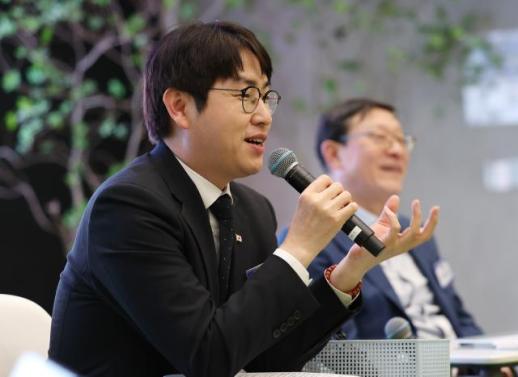 Ha Jung-woo Expected to Decide This Week on Running in Busan Buk-gap By-Election Ha Jung-woo, the presidential office’s senior secretary for AI (artificial intelligence) Future Planning, is expected to announce this week whether he will run in the National Assembly by-election in Busan’s Buk-gap district. The presidential office said Monday that Ha is likely to state his position soon after accompanying President Lee Jae-myung later in the day for talks at the presidential office with Demis Hassabis, co-founder and CEO of Google DeepMind. Ha is reported to be leaning toward entering the race after last-minute deliberations. Under the Public Official Election Act, a public official must resign by May 4 — 30 days before the vote — to run in the by-elections. Democratic Party leaders have repeatedly urged Ha to run in the Busan Buk-gap contest. Party leader Jung Cheong-rae met Ha the previous day and formally asked him to enter the race. Ha did not attend a sports event held by the alumni association of Gupo Elementary School in Busan’s Buk District, where other opposition-aligned contenders for the Buk-gap by-election were present, including Park Min-sik, a former minister of patriots and veterans affairs, and Han Dong-hoon, a former People Power Party leader. Separately, presidential spokesperson Jeon Eun-su is widely seen as the leading candidate for a strategic nomination in the by-election in Asan-eul, South Chungcheong Province. The seat became vacant in June last year when then-lawmaker Kang Hoon-sik was appointed presidential chief of staff as the Lee administration took office. Meanwhile, a Realmeter survey commissioned by Energy Economy Newspaper and conducted April 20-24 among 2,509 adults nationwide found Lee’s job approval rating at 62.2%, down 3.3 percentage points from the previous week. Realmeter said that despite positive signals such as outcomes from summits with India and Vietnam and the Kospi reaching a record high, the rating appeared to fall as the Middle East war pushed up oil prices and inflation, increasing pressure on household finances. The poll was conducted by automated response system (ARS) calls using randomly generated mobile numbers (100%). The response rate for the presidential job-approval question was 5.4%, with a margin of error of plus or minus 2 percentage points at the 95% confidence level. For party support, the response rate was 4.3%, with a margin of error of plus or minus 3.1 percentage points at the 95% confidence level. More details are available on the website of the National Election Survey Deliberation Commission.* This article has been translated by AI. 2026-04-27 09:57:16
 -
 Shift Up’s ‘Goddess of Victory: Nikke’ tops Google Play revenue in South Korea and Japan after 3.5-year update Shift Up’s “Goddess of Victory: Nikke” has continued to post No. 1 revenue rankings on major app marketplaces at home and abroad with each major update, reinforcing its position as a long-running hit intellectual property, the company said. Shift Up said on the 27th that on the day of its 3.5-year anniversary update, the game ranked No. 1 in revenue on South Korea’s App Store and has since maintained the No. 1 revenue spot on Google Play in both South Korea and Japan. The company attributed the performance to content management built on story development accumulated over the service period, along with high-quality in-game content aligned with the update’s main “idol concept” theme. During the same period, Nikke stayed within the top 10 in revenue in Taiwan and continued steady results in other major markets globally, including North America. With each major update, Nikke has reclaimed top revenue rankings and has been positioned as a leading long-running South Korean subculture game IP. The title combines character collection with gun-shooting gameplay and has built a global fan base with polished content, an immersive story, and music. For the 3.5-year update, the game released an event story titled “STAR ANIS,” centered on the popular early character “Anis.” Additional content includes a 3D visual performance, a special animation and full voice dubbing, drawing strong user response. Shift Up director Yoo Hyeong-seok said, “As we have prepared the 3.5-year update for a long time, we are deeply grateful for users’ enthusiastic response,” adding, “We will continue working to showcase Nikke’s unique appeal.” * This article has been translated by AI. 2026-04-27 09:52:03
 -
 CU to Raise International Parcel Shipping Rates 7% as Fuel Surcharges Jump CU convenience stores will raise prices for their international parcel delivery service, citing a sharp rise in air fuel surcharges as global oil markets remain unsettled in the wake of the war between the United States and Iran. According to industry officials on the 27th, CU Post, which operates CU’s parcel service, will increase international shipping rates by about 7% starting May 1. A CU official said, “International parcel rates will rise from the first of next month due to higher fuel surcharges imposed by our partner express carrier as international oil prices climb.” CU’s partner carrier DHL has sharply increased its air fuel surcharge in recent months. The surcharge was 28.75% in early February but surged in April. It rose to 39% for April 1-12, then to 46% for April 13-19 and 47.75% for April 20-26. For April 27-May 3, it reached 48%. DHL plans to keep the surcharge high at 47% for May 4-10. That is an increase of nearly 20 percentage points in about three months. International parcel services at convenience stores have been popular with office workers who cannot visit post offices or courier branches during business hours, allowing customers to send items overseas at nearby stores 24 hours a day. The service has drawn strong demand from families of international students and overseas direct-to-consumer sellers. The rate hike is expected to increase the perceived logistics burden for consumers who need to ship goods abroad. Rival GS25 is also said to be carefully reviewing a possible increase. A GS25 official said, “It is true that discussions about a rate increase are taking place with our partner, but we have not received an official notice confirming anything yet.” An industry official said air express delivery is among the sectors most sensitive to oil-price swings, adding that freight-rate pressure across the logistics industry could persist for some time as oil-producing countries maintain production cuts and military tensions in the Middle East intensify, driving volatility in global crude prices.* This article has been translated by AI. 2026-04-27 09:51:17