

The two sides said they plan to lift the share of foreign passengers using Cheongju Airport to as high as 35% by 2028, more than triple the current level.
◆ Deal targets inbound growth via regional airport
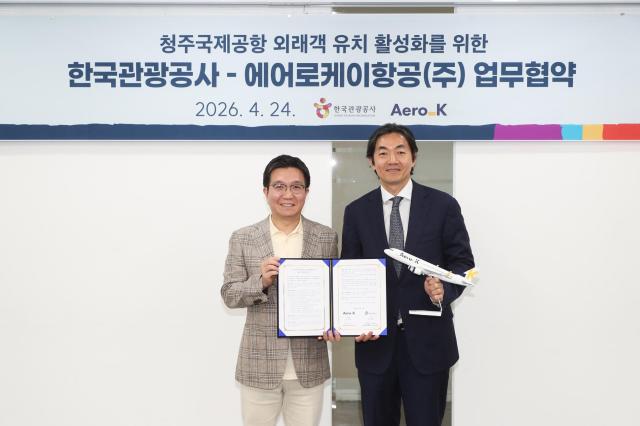
KTO said it signed a memorandum of understanding with Aero K on April 24 at its Seoul Center to expand foreign visitor arrivals through Cheongju Airport and boost regional tourism. The agreement is intended to diversify entry routes for visitors to South Korea by using regional airports and to generate demand for travel outside the capital region. Cheongju Airport, a hub for central South Korea, was cited as having strong growth potential.
In the first quarter of this year, international passengers at Cheongju Airport jumped 67.6% from a year earlier, KTO said. However, foreign travelers accounted for only about 11% of total users, leaving room for further growth.
KTO plans to work with Aero K, which operates about 70% of Cheongju’s international routes, to expand key Asia routes and step up efforts to attract overseas visitors.
◆ Joint marketing to focus on Taiwan, Japan and Southeast Asia
Under the agreement, the organizations said they will pursue joint marketing through 2028, including developing region-specific tour products linked to air routes, supporting charter flights and Cheongju-linked packages, hosting familiarization tours for overseas travel companies, and offering airfare discount promotions.
They also outlined route-specific strategies. For the Taipei, Taiwan, route, which has a relatively high share of foreign passengers, they plan to strengthen promotions that bundle flights and lodging. In Japan, they will look beyond Tokyo and Osaka by seeking charter flights from smaller regional cities and running familiarization tours to develop new demand.
They also plan to attract more visitors from Southeast Asia by linking promotions to a new Manila route scheduled to launch in September.
Aero K recently secured traffic rights for 13 weekly flights across four China routes: Beijing (four per week), Shanghai (three), Chengdu (three) and Hangzhou (three), the organizations said.
“By increasing foreign visitor inflows through regional airports, we will spread tourism flows that are concentrated in the capital region across the country,” KTO President Park Seong-hyeok said. He added that KTO will strengthen cooperation with airlines to support growth in inbound demand despite external changes such as high oil prices.
* This article has been translated by AI.
Copyright ⓒ Aju Press All rights reserved.