
Journalist

Lee Hugh
=
-
 Robots and R&D Draw Crowds at 2026 Korea Science and Technology Expo At KINTEX in Goyang, just outside Seoul, children stopped to gather around a dog-shaped robot, while a long line formed for photos in front of a boxing robot. Under the slogan, “Imagination becomes everyday life,” robots blended into a scene that no longer felt unusual. The Ministry of Science and ICT, the National Research Foundation of Korea and the Korea Foundation for the Advancement of Science and Creativity are holding the 2026 Korea Science and Technology Expo from April 24 to 26. Organizers said the event is built around four themes linking the past, present and future, and is expanding into a nationwide traveling science festival after stops in Busan and Daejeon. About 60 institutions are taking part, including 20 government-funded research institutes. The main National R&D zone highlights ongoing research results from the institutes, with displays organized by national strategic technologies such as aviation, bio and quantum science. The Korea Institute of Materials Science, or KIMS, and Hanwha Aerospace set up a joint booth to present technology aimed at localizing production of key aircraft engine parts. “Aircraft engines still have a structure with a high dependence on imported parts,” a KIMS official said, adding that the institute is working with Hanwha Aerospace to localize core components. One technology drawing attention was material for turbine blades. KIMS said it has developed a third-generation single-crystal superalloy designed to withstand high-temperature, high-pressure conditions and has entered the commercialization stage. The material is a key factor affecting engine output and efficiency, and performance verification tests are underway. KIMS is also developing precision casting prototype production technology, aiming to complete development this year. The institute said the process improves dimensional accuracy and defect control compared with existing methods. Related work includes developing cast rotor disk materials and improving thermal barrier coating performance. Students visiting on field trips offered immediate reactions. Cho Yun-chan, 11, from Yujeong Global School in Pocheon, Gyeonggi Province, said, “AI was fascinating, and the robot boxing was especially fun.” Another student from the school, Lee Yu-jin, also 11, said trying the robot exhibits made science more interesting and easier to understand in person. Some exhibitors, however, said expectations were mixed with concern because the event combines a public festival with business-oriented programming, making it hard to gauge attendance. “Events for kids and business-focused events are mixed together,” one booth official said. “The key will be how many citizens come in.” Before the expo opened, students also took part in a discussion on science and engineering career paths. Gu Hyeok-chae, first vice minister of science and ICT, met with students and answered questions on semiconductor research careers, software skills and study plans. He was reported to have emphasized the importance of strong fundamentals as AI rapidly changes the job environment. Gu said the science festival has been expanded nationwide starting this year so more people can experience science and technology firsthand, and that after Busan and Daejeon, events will be held sequentially in places including South Jeolla Province. “Science and technology are a core foundation that will shape South Korea’s future,” he said, pledging continued investment and expanded hands-on opportunities to broaden public engagement.* This article has been translated by AI. 2026-04-24 14:27:15
 -
 Hyundai Steel Q1 Operating Profit Falls 63.7% to 15.7 Billion Won Hyundai Steel said in a regulatory filing on Thursday that its first-quarter operating profit fell 63.7% from the previous quarter to 15.7 billion won ($11.3 million), while revenue rose 4.6% to 5.7397 trillion won on higher product sales volume. The company attributed the profit drop to a weaker won and higher raw material prices. It said operating profit is expected to gradually rebound from the second quarter as fewer low-priced imported products enter the domestic market, improving supply and demand, and as price increases for key products take effect. Hyundai Steel also said increases in borrowings and its debt ratio were temporary, citing investment spending for future growth, including capital contributions to its U.S. steel mill. Despite a challenging business environment, the company said it will prioritize profitability improvement this year and focus on securing new demand. It said it aims to win new orders and move early in the power infrastructure sector at home and abroad, respond to growing demand for energy storage systems, and build a response system for all transmission-tower products, including structural steel and heavy plate, in line with a government-led domestic power-grid infrastructure buildout. The company said it is expanding orders for steel used in transmission towers. Hyundai Steel said it is mass-producing low-carbon steel sheet that cuts carbon emissions by 20% and plans to lead the low-carbon market by pursuing additional steel-grade certifications to expand global sales. A Hyundai Steel official said the company will seek to capture new demand in the power infrastructure industry, actively respond to demand for low-carbon steel through an electric-arc furnace and blast-furnace hybrid process, and improve profitability.* This article has been translated by AI. 2026-04-24 14:21:12
 -
 TV Personality Boom Welcomes Second Daughter, Agency Says Mother and Baby Healthy TV personality Boom has become the father of two daughters. His agency, TN Entertainment, said on the 24th that Boom and his wife welcomed a healthy baby girl weighing 2.74 kilograms at 9:38 a.m. "Both the mother and baby are in good health," the agency said, adding, "Please send your support to Boom and his wife as they welcome a new member of their family." Boom married his partner, who is seven years younger, in April 2022 and welcomed their first daughter in March 2024. After winning the Entertainer of the Year award at the "2025 KBS Entertainment Awards" in December, Boom shared news of the pregnancy, saying, "When I won last time, we had our first child, and now our second is growing well in the womb."* This article has been translated by AI. 2026-04-24 14:20:43
 -
 HD Hyundai Marine Solution Q1 Operating Profit Rises 12.5% to 93.4 Billion Won HD Hyundai Marine Solution, HD Hyundai’s marine-industry solutions unit, said Thursday it posted first-quarter revenue of 574.6 billion won and operating profit of 93.4 billion won. Revenue rose 18.3% from a year earlier and operating profit increased 12.5%. The company said growth in its core aftermarket parts and services business, along with higher sales from its bunkering business, drove the gains. Aftermarket revenue climbed 21.4% from a year earlier, led by sales tied to large engines and its mid-sized HiMSEN engines, the company said. It also cited new orders, including a maintenance contract for power-generation facilities for Ecuador’s state power company. Its digital solutions business also extended steady growth, with revenue up 33.3% year over year on a broader product lineup, including an integrated control system (ECS) applied to Anduril’s unmanned surface vessel, it said. Revenue in the eco-friendly solutions business fell due to a base effect from large-scale retrofit work in the year-earlier period, the company said. An HD Hyundai Marine Solution official said the company plans to further strengthen competitiveness in high value-added aftermarket businesses such as engines, and to expand its eco-friendly and digital businesses to upgrade its portfolio. The official said the opening of a logistics hub in Singapore will help improve global supply-chain efficiency and strengthen customer responsiveness.* This article has been translated by AI. 2026-04-24 14:20:02
 -
 NH Investment & Securities to Decide Governance Overhaul, Likely to Adopt Co-CEO Structure NH Investment & Securities was set to decide on a governance overhaul at a board meeting on Thursday, with the company widely expected to shift to a co-CEO structure in which two chief executives each hold independent authority. The decision is also expected to accelerate a stalled process to pick the next CEO. According to the financial investment industry, the firm planned to convene another special board meeting Thursday, following one held the previous day, to discuss whether to proceed with the overhaul. A move to the independent co-CEO model has been viewed as the most likely outcome. The company plans to resume the CEO selection process once the governance structure is decided. The search has been clouded by uncertainty. Ahead of its regular shareholders meeting in March, the company decided to reconsider its governance model first and excluded the agenda item to appoint a CEO. As it reviewed multiple scenarios — including a single CEO, joint CEOs and independent co-CEOs — the selection process effectively paused. The executive candidate recommendation committee later re-examined and expanded the candidate pool, but with no decision on the governance direction, it remained unclear even how to narrow the list. Roles would differ depending on whether the company adopts a single-CEO or multi-CEO structure. Under a single-CEO model, an executive capable of overseeing business lines such as investment banking had been seen as a leading type of candidate. As the independent co-CEO option gained traction, a plan to split management support and business operations under separate CEOs emerged, widening the pool to include current and former executives. The company has cited as its official rationale “the need to upgrade risk management systems amid rapid changes in capital markets and the expansion of business scale,” saying the goal is more stable operations in a fast-changing market environment. Market participants, however, have largely viewed the move as more than a management strategy. NH Investment & Securities’ largest shareholder is NH NongHyup Financial Group, which is controlled by the National Agricultural Cooperative Federation. In the 2024 CEO selection process, Yoo Chan-hyung, a former vice chairman from the federation, was placed on the shortlist. This year as well, ahead of the March regular shareholders meeting, a figure seen as close to the federation was mentioned as a possible next leader, with the federation’s preferences seen as a variable in the selection. Against that backdrop, some interpret the governance overhaul talks as aimed less at efficiency and more at balancing interests. Some have also said that if the firm adopts the independent co-CEO structure, it could raise the chances of CEO Yoon Byung-woon being reappointed, since it could allow a compromise that places a federation-backed figure alongside an internal company executive.* This article has been translated by AI. 2026-04-24 14:11:09
 -
 South Korea’s Democratic Party Speeds Up By-Election Nominations Ahead of June 3 Vote The Democratic Party of Korea, after quickly wrapping up nominations for provincial and metropolitan chief executives for the June 3 local elections — ending with the announcement of its Jeju governor candidate on April 18 — is also moving fast to pick candidates for the by-elections being held the same day. With many of the contests taking place in districts previously held by the party, the DPK aims to complete nominations by the first week of May to maximize candidates’ time on the campaign trail. As of April 24, the party had made strategic nominations for attorney Jeon Tae-jin (Ulsan Nam-gu A), Song Young-gil (Incheon Yeonsu A) and Kim Nam-jun, a former Blue House spokesperson (Incheon Gyeyang B). Song and Kim, whose nominations were confirmed the previous day, attended an on-site Supreme Council meeting in Incheon’s Yeonsu district on April 24. Hwang Hee, chair of the party’s strategic nomination committee, told reporters at the National Assembly the previous day that “there isn’t much time until the election.” Secretary-General Cho Seung-rae said the party must finish nominations by the first week of May, adding that the committee would meet “almost every day” to narrow down and decide on candidates. The party said it is trying to move quickly while keeping screening careful, using three tracks: recruiting new talent, promoting from within and reassigning well-known figures. It described Jeon as a recruited talent, Kim as an internal pick and Song as a reassignment. Attention is also focused on possible nominations for Lee Kwang-jae, a former Gangwon governor; Ha Jeong-woo, senior secretary for AI future planning; Kim Yong, deputy head of the Democratic Research Institute; and party spokesperson Kim Nam-guk. Jeong has praised Lee’s “party first” spirit and said he should be given a chance, and has repeatedly urged Ha to run. Lee has been mentioned as a potential candidate in Gyeonggi’s Hanam A district, and Ha in Busan’s Buk-gu A district. Kim Yong has asked the party for a nomination, and Kim Nam-guk has said he intends to run in Ansan A. The by-elections are expected to be held in as many as 14 districts when vacancies tied to President Lee Jae-myung’s inauguration, the resignation of presidential chief of staff Kang Hoon-sik, districts where an election was invalidated, and additional seats vacated by lawmakers resigning to run in local elections are combined. Of those, 13 were DPK-held districts. Under the Public Official Election Act, first-half by-elections cover vacancies confirmed by April 30. Because the deadline for incumbent lawmakers to resign in order to run in local elections is May 4, some have suggested resignations could be delayed. However, Jeong has repeatedly asked eight people selected as the DPK’s provincial and metropolitan chief executive candidates to resign together on April 29. In the People Power Party, one of Reps. Choo Kyung-ho and Yoo Young-ha is expected to be confirmed as the party’s Daegu mayoral candidate on April 26, after a runoff. With Daegu considered a conservative stronghold, there is speculation the winner will resign before April 30. * This article has been translated by AI. 2026-04-24 14:10:12
 -
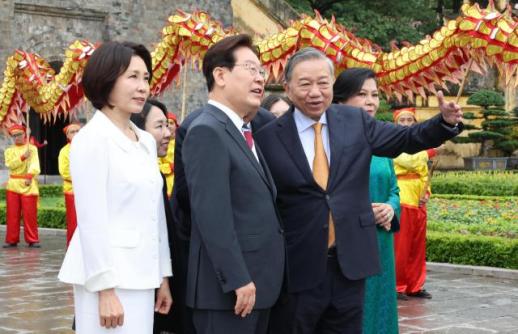 Lee Jae-myung Visits Hanoi’s Thang Long Imperial Citadel During Vietnam State Trip President Lee Jae-myung on April 24 (local time) visited Vietnam’s Thang Long Imperial Citadel, a cultural heritage site, with Vietnamese Communist Party chief and state president To Lam and his spouse as part of a friendship program. Lee, on a state visit to Vietnam, wore a tie featuring red and blue Taegeuk colors, while first lady Kim Hye-kyung wore a white two-piece outfit. The presidential office said the couple chose coordinated attire symbolizing a single Korean flag, expressing national pride and a desire to deepen friendship between the two countries. After arriving, Lee entered an artifacts exhibition hall, viewed traditional items and listened to explanations from citadel officials. He then moved with Lam to the rear garden of Kinh Thien Palace to watch performances, including a Vietnamese traditional lion dance troupe. In a briefing on April 23 at a hotel in downtown Hanoi, presidential office spokesperson Lee Kyu-yeon said the citadel, blending architectural styles from China, Vietnam and France, long symbolized Vietnam’s political center and was listed as a UNESCO World Cultural Heritage site in 2010.* This article has been translated by AI. 2026-04-24 14:07:27
 -
 Special counsel raids Joint Chiefs over alleged bid for second martial law deployment A special counsel team led by Kwon Chang-young, investigating unresolved questions after the 12·3 insurrection incident, launched its first compulsory investigation of the Joint Chiefs of Staff on Thursday, focusing on allegations of an attempted “second martial law.” The probe has gained urgency after new testimony suggested the military considered additional troop deployments even after the National Assembly passed a resolution demanding martial law be lifted. The team sent prosecutors and investigators to the Joint Chiefs headquarters in Seoul’s Yongsan district and to the homes of key suspects to conduct searches and seizures. Investigators are seeking to reconstruct command and reporting lines and how troops were managed before and after the martial law declaration. According to reports, the warrant lists four Joint Chiefs figures as suspects on charges of being key participants in an insurrection: former chairman Kim Myung-soo, former vice chairman Jeong Jin-pal, former Military Support Command chief Kang Dong-gil, and former operations chief Lee Seung-oh. The case is the special counsel’s “Case No. 1” opened by recognition. At the center of the investigation is whether additional forces were pursued after the Assembly approved the resolution. The special counsel said it recently obtained statements from current and former Joint Chiefs officials that “after the resolution passed, and before a Cabinet meeting voted to lift martial law, there was a request to the Joint Chiefs for additional troop deployments.” Investigators also reportedly detected signs that some units were asked to check whether deployments were possible. If confirmed, the findings could support allegations that Yoon Suk Yeol and others sought to keep martial law in place after the Assembly vote or to attempt a “second martial law.” A first-instance court previously recognized that Yoon instructed former Capital Defense Command chief Lee Jin-woo to the effect that “even if the resolution passes, you can declare martial law two or three times.” The special counsel is also focusing on the Joint Chiefs leadership’s role, which earlier investigators did not pursue in depth. A previous special counsel on the insurrection did not find concrete evidence of the Joint Chiefs’ involvement and effectively removed Kim and others from the investigative focus. The new testimony and indications of troop-deployment reviews could change that assessment. Investigators also reportedly obtained a statement that Kim, at a Cabinet meeting, asked whether a conclusion different from the Assembly’s could be reached. Kim is also accused of issuing a fragmentary order to the Special Warfare Command and the Capital Defense Command to “prioritize martial law duties.” At the same time, statements have also surfaced that Kim refused an actual request for additional troop deployments. The special counsel said it needs to determine whether orders were given and who bears responsibility, citing indications the Joint Chiefs checked troop availability, including rear-area units. After analyzing seized materials, the special counsel plans to summon Kim and other related figures for questioning in sequence. The raids are expected to sharpen scrutiny of the military leadership’s actions during martial law and whether a “second martial law” was attempted.* This article has been translated by AI. 2026-04-24 14:06:23
 -
 PPP Leader Jang Dong-hyeok Rejects Calls to Step Down, Vows to Face Voters’ Verdict Jang Dong-hyeok, leader of the People Power Party, on April 24 rejected calls within his party for him to resign, saying stepping down because circumstances have worsened is not what a responsible politician does. In a Facebook post, Jang said he has focused since taking the party’s top post on winning upcoming local elections. “People are saying a lot about my future,” he wrote, referring to the resignation talk. “That kind of politics is not Jang Dong-hyeok’s politics. I will do my best to finish the local elections and accept an honest evaluation.” Jang also said he would be judged by the results of his trip to the United States, adding that as opposition leader he did everything he could and needed to do. “With time, the results will also become visible,” he said.* This article has been translated by AI. 2026-04-24 14:04:43
 -
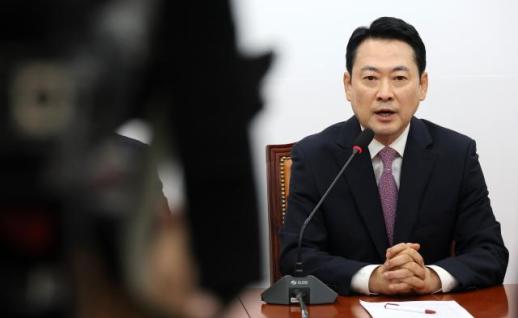 People Power Party leader Jang Dong-hyeok says he will weigh resignation amid 15% support Jang Dong-hyeok, leader of the People Power Party, said April 24 that internal divisions were a key reason the party’s support had fallen to a record low of 15%, rejecting calls for him to step down. Speaking at a news conference at the National Assembly, Jang said talk about his future and resignation had followed the polling, noting there were 40 days left until local elections. Referring to survey results released the previous day, he said one poll showed the party “stuck at 15%,” adding that the result differed somewhat from recent trends in other surveys. He said he would consider the various reasons for the party’s low support. Jang said internal conflict was among the causes, and said he would weigh whether resigning 40 days before the elections would truly fulfill his responsibility as party leader and whether it would help the party win. Jang also said the party would submit a motion urging the dismissal of Unification Minister Jeong Dong-young over allegations involving the leak of sensitive information. He said if President Lee Jae-myung continued to protect Jeong, the U.S.-South Korea alliance “cannot help but face even greater cracks.” He called for Jeong’s immediate dismissal and for the government to “reorganize” what he described as a self-reliant faction within the foreign and security policy line that he said was undermining the alliance. Jang said he met with four lawmakers the previous day with James Heller, the deputy chief of mission at the U.S. Embassy, to confirm Washington’s mood, saying the United States viewed the matter “very seriously.” He said information sharing, which he described as a measure of alliance trust, had been cut off, and argued that Jeong’s remarks had damaged the foundation of trust while Lee was accelerating its collapse. Calling it a “tragic situation” in which the president and a minister had become a security risk, Jang said the U.S. side believed that resuming information sharing would require firm assurances and promises that such an irresponsible leak would not happen again. He added that without restored trust, implementing a joint fact sheet would also be difficult, and said the U.S. side was repeatedly conveying the seriousness of the issue to Seoul, but that the Lee administration did not appear to recognize it. According to the National Barometer Survey released April 23 by Embrain Public, Kstat Research, Korea Research and Hankook Research, the People Power Party’s approval rating stood at 15%. The poll surveyed 1,005 adults age 18 and older by telephone interviews from April 20-22. The margin of error was plus or minus 3.1 percentage points at the 95% confidence level. (For details, refer to the website of the National Election Survey Deliberation Commission.)* This article has been translated by AI. 2026-04-24 14:03:20