
Journalist

Lee Hugh
=
-
 Financial Services Commission chief says IBK wins Vietnam banking license after 9 years Financial Services Commission Chairman Lee Eok-won, who accompanied President Lee Jae-myung on a state visit to Vietnam, said IBK Industrial Bank of Korea’s Vietnam unit has obtained a full local banking license after nine years. In a post on X on the 23rd, Lee said the president’s Vietnam trip “expanded the territory of K-finance,” and outlined financial outcomes reached in Vietnam. He highlighted IBK’s license as the most notable result, saying Vietnam’s central bank had not issued a new license to any bank, domestic or foreign, in nine years. Lee also noted that in January, the Hanoi branch of Korea Development Bank received local approval for the first time in seven years. He said three South Korean banks now operate in Vietnam, making South Korea tied with Malaysia for the most bank establishments in the country. Lee said cooperation on payment infrastructure is also accelerating, citing a “QR payment linkage agreement” between the Korea Financial Telecommunications & Clearings Institute and Vietnam’s NAPAS. He said Vietnam is the second most-visited travel destination for South Koreans and that, as in the earlier case of India, the linkage adds fee savings of about 2 percentage points per transaction, calling it a practical benefit that makes travel “lighter and more convenient.” He said the Korea-Vietnam Financial Cooperation Forum also shared examples of cooperation across insurance, capital markets, nonperforming loans and QR payments. Lee said he would work to further broaden bilateral financial cooperation, adding that the commission would serve as a “running mate” as K-finance expands globally.* This article has been translated by AI. 2026-04-24 13:57:27
 -
 Dongkuk Steel Group posts 21.4 billion won Q1 operating profit, returns to black Dongkuk Steel said it posted first-quarter 2026 revenue of 857.2 billion won, operating profit of 21.4 billion won and net profit of 6.2 billion won on a separate K-IFRS basis. In a regulatory filing on Thursday, the company said revenue rose 5.2% from the previous quarter, operating profit jumped 2,886.2%, and net income swung to a profit. From a year earlier, revenue increased 18.1%, operating profit rose 403.9%, and net profit climbed 153.3%. Dongkuk Steel said the earnings improvement reflected its strategy to expand exports globally. It said higher export volumes led to increased production and sales of long steel products. The company said it plans to adjust the share of export sales flexibly this year in response to shifts in domestic demand. Dongkuk CM reported first-quarter 2026 revenue of 494.4 billion won, operating profit of 11.2 billion won and net profit of 10.3 billion won on a separate K-IFRS basis. Revenue rose 7.4% from the previous quarter, and both operating profit and net profit returned to the black. From a year earlier, revenue fell 6.1% and operating profit declined 25.9%, while net profit increased 6.1%. Dongkuk CM, which has a high share of exports, said it returned to profit by improving earnings through price increases and cost controls despite worsening market conditions, high tariffs and stronger protectionism. It said it realized gains by reducing sales of low-margin products and expanding production and sales of premium materials such as Luxteel and Appsteel. Separately, the government this month approved provisional anti-dumping duties of up to 33.67% on galvanized and color steel sheets from China. The move is expected to curb inflows of low-priced Chinese products and increase the use of high-quality domestically made steel for construction materials. The decision follows anti-dumping duties on heavy plate and hot-rolled products and is significant for completing a broader protection framework across the domestic steel value chain, including upstream and downstream processes. 2026-04-24 13:55:13
 -
 BLACKPINK’s Jisoo wins rising star award at Cannes International Series Festival BLACKPINK’s Jisoo has won a rising star award at the 9th Cannes International Series Festival. Jisoo received the Madame Figaro Rising Star Award at the festival’s opening ceremony on April 23 (local time) in Cannes, France. In a statement posted on its website, the organizers said Jisoo is expanding her filmography by pursuing work across genres and formats while continuing her music career. Citing projects including the Netflix series “Monthly Boyfriend,” the festival said she was selected for her international influence, presence and artistic growth, calling her a promising figure drawing attention in Korea and the global entertainment industry. Jisoo debuted with BLACKPINK in 2016 and gained worldwide popularity with songs including “Whistle,” “Boombayah” and “Run.” She has also acted in dramas including “Snowdrop,” “Newtopia” and “Monthly Boyfriend.” “Monthly Boyfriend” is a romantic comedy about Mi-rae (Jisoo), a webtoon producer worn down by everyday life, who subscribes to and experiences romance through a virtual dating simulation. The series is directed by Kim Jung-sik, known for romantic comedies including “Work Later, Drink Now” and “No Gain No Love.” In the drama, Jisoo plays Mi-rae, an office worker too exhausted by real life to prioritize dating or love, while Seo In-guk plays Gyeong-nam, her co-worker and rival. After its release, “Monthly Boyfriend” topped global viewing rankings and drew strong support from drama fans. * This article has been translated by AI. 2026-04-24 13:54:30
 -
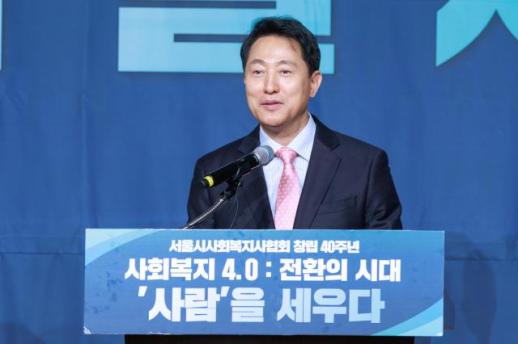 Seoul Mayor Oh Se-hoon Warns of ‘Soft Dictatorship,’ Urges Voters to ‘Protect Seoul’ People Power Party Seoul mayoral candidate Oh Se-hoon, the incumbent mayor, on Thursday urged voters to back him, saying it was important to “protect Seoul” to prevent what he called the possibility of “soft dictatorship” under the Lee Jae-myung government. In a TV Chosun YouTube interview that morning, Oh said that if the ruling party won a landslide in the local elections, it would become “like a runaway locomotive with no brakes.” Oh also warned that if the Democratic Party’s Seoul mayoral nominee, Jeong Won-oh, wins, Seoul’s economy and residents’ quality of life would decline. “I’m seeking a fifth term, and if I don’t win this time, Seoul’s upward international rankings and evaluations will be completely reversed,” Oh said, adding that he was running with a determination to hold the city. Oh cited an increase in Seoul’s debt during the tenure of former Mayor Park Won-soon, saying it rose from 3 trillion won to 10 trillion won, and argued the city’s finances would weaken again. He claimed that civic group figures who entered City Hall under Park funneled money to organizations they had belonged to, contributing to rising debt. Oh said many of those people are now positioned in Jeong’s campaign, and warned that a Jeong victory would recreate the pattern as “Park Won-soon Season 2.” Responding to Jeong’s criticism on a TV program the previous day that labeled Oh an “enlightenment leader” and “Yoon Suk Yeol Season 2,” Oh said, “I think he’s been a bit rattled, in today’s terms, because I defined him as Park Won-soon Season 2.” On the controversy over abolishing the long-term holding special deduction, Oh pressed Jeong to state a clear position after Jeong said it was undesirable to “stoke conflict and increase public anxiety.” “If Seoul apartments lose the long-term holding special deduction, people can lose hundreds of millions of won in taxes alone,” Oh said. “A mayoral candidate should clearly say whether they support or oppose such a serious issue.” Oh added that some view Jeong as likely to become “Lee Jae-myung’s yes-man,” and said Jeong’s response showed he could not escape that assessment. Oh also called on People Power Party leader Jang Dong-hyuk to show restraint and make a decision. “Candidates working in the field believe it helps if Chairman Jang is less visible,” Oh said. “With the lowest approval ratings since the party’s founding, I think the time has come for restraint or a decision as leader.”* This article has been translated by AI. 2026-04-24 13:51:09
 -
 Lee Jae-myung calls for scaling back tax breaks for nonresident homeownership President Lee Jae-myung said April 24 that tax relief tied to long-term homeownership should focus on people who actually live in their homes, not on owners who hold property as an investment. In a post on X, formerly Twitter, Lee said that to protect single-home owners, capital gains tax relief based on the period of actual residence is needed. But he said cutting taxes on the sale of expensive homes “just because someone invested for a long time without living there” is not a housing protection policy but “a policy that encourages housing speculation.” “Where there is income, there are taxes,” Lee wrote. “People pay earned income tax on money they work hard to make, so it is natural to pay capital gains tax on housing gains.” He also rejected claims of a “tax bomb,” saying it is abnormal to reduce taxes for those who “speculated for a long time” on homes they did not live in. “To properly protect housing for single-home owners, it would be right to reduce deductions for nonresident holding periods and increase deductions for resident holding periods by that amount,” he said. Lee again criticized what he called forces that promote real estate speculation, saying they appear to be active again after a lull. He pointed to speculation centered on Seoul’s Gangnam area, including the practice known as buying “one best home,” which he said spread speculation and triggered a chain of surges in home prices. He added that a bill proposed by some opposition lawmakers to limit the special long-term holding deduction is unrelated to the government, but is being portrayed “as if it were a bill proposed by the president” and used for attacks. On April 18, Lee rebutted claims by the People Power Party that abolishing the special long-term holding deduction for capital gains tax would amount to a “tax bomb,” calling the argument “a logical contradiction and an obvious false incitement.” He said the deduction sharply reduces capital gains tax “regardless of whether the owner lives there,” while a separate system provides tax relief for long-term residence. * This article has been translated by AI. 2026-04-24 13:46:12
 -
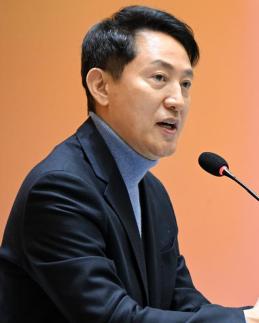 Seoul Mayor Oh Se-hoon Calls Lee Jae-myung a ‘Soft Dictator,’ Warns Checks and Balances Eroding Seoul Mayor Oh Se-hoon on Thursday labeled President Lee Jae-myung a “soft dictator” and criticized him directly. In an interview with TV Chosun released by the Seoul city government, Oh said Lee was “insulting the judiciary” while having “completely” taken control of the legislature and the executive branch. “If this continues, the separation of powers will collapse,” Oh said. “In that case, the likelihood of moving toward a ‘soft dictatorship’ is high.” Oh said that if a government keeps the outward form of democracy while effectively monopolizing lawmaking, controlling the administration and then moving to pressure the courts, “checks and balances will inevitably be neutralized.” He added that power would then “race like a runaway locomotive with no brakes.” Oh warned that if the Democratic Party wins by a landslide in the upcoming local elections, “that trend will accelerate,” and said “protecting Seoul” could become “the last pillar” for checking power. -“Soft dictatorship” warning, comparisons to Russia A soft dictatorship refers to a system in which elections and institutions remain, but power-sharing does not function in practice. It appears democratic, but legislative and executive power concentrates and the judiciary also comes under influence, undermining the balance of power. Internationally, Russian President Vladimir Putin and Turkish President Tayyip Erdogan are often cited as similar cases. Oh described the Seoul mayoral race as more than a local contest, calling it a turning point for the national balance of power. He said results in major cities such as Seoul and Busan would shape the future power structure, adding that “protecting Seoul” was most important. -Appeal to young voters, highlights activist and lawmaker background Oh also highlighted his resume. A lawyer by training, he worked with the civic group Korean Federation for Environmental Movement and later served as a broadcaster and a lawmaker. As a member of the National Assembly, he led efforts to enact the Political Funds Act, known as the “Oh Se-hoon law,” and legislation to improve air quality in the Seoul metropolitan area. He said air pollution was difficult to address without a legal framework, and that after he enacted the law, it took effect starting July 1, 2006, the day he took office as Seoul mayor. Oh said he both wrote the Seoul metropolitan air-quality law and oversaw its first implementation. Oh said that under the law, Seoul received central government budget support and carried out measures such as emissions-reduction policies for diesel vehicles, leading to a sharp improvement in air quality. “In the past, even wearing a dress shirt for one day would turn the collar and cuffs pitch-black,” Oh said. “Now it’s fine even after two or three days.” * This article has been translated by AI. 2026-04-24 13:45:19
 -
 Samsung to Hold Galaxy S26 Family Festa Promotion for May Samsung Electronics said on the 24th it will run a “Galaxy S26 Family Festa” promotion ahead of May, widely observed in South Korea as Family Month. For purchases of the Galaxy S26 series through May 10, all buyers will receive a 50,000-won discount coupon for game items usable in the Galaxy Store, the company said. Samsung said customers who buy the Galaxy S26 series on Samsung.com with a Samsung Card and join the “New Galaxy AI Subscription Club” will also be eligible for up to 55,000 won in additional cashback. The company is also expanding hands-on marketing. From the 24th through May 5, Samsung Electronics will operate a pop-up store for the popular RPG “Honkai: Star Rail” at Samsung Store Hongdae. The pop-up is designed as a game experience zone using the Galaxy S26 series, targeting family visitors with children and people in their teens, 20s and 30s, Samsung said. Visitors can take part in events and stamp missions in a space decorated with in-game settings and characters. During the pop-up period, Samsung said it will sell 2,000 limited sets of the “Galaxy S26 Ultra Kyrene Accessory Edition,” featuring in-game characters and including a magnet case, an acrylic music box and a smartphone stand. “We prepared a range of promotions that families can enjoy together for Family Month,” said Jeong Ho-jin, a vice president at Samsung Electronics’ Korea business. “We hope customers will enjoy not only the strong performance of the Galaxy S26 series, but also the additional purchase benefits.” * This article has been translated by AI. 2026-04-24 13:00:16
 -
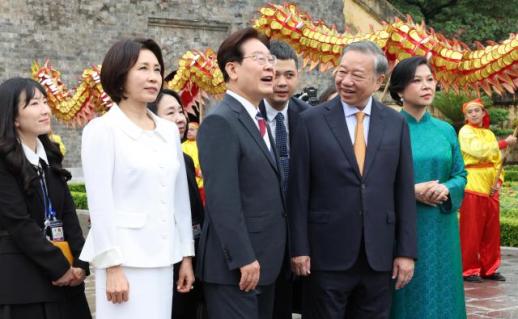 Lee’s tailored gifts to India, Vietnam highlight cultural ties and promote K-culture President Lee Jae-myung used what his office called “tailored gift diplomacy” during state visits to India and Vietnam, selecting items reflecting each leader’s cultural background, personal preferences and governing priorities. The presidential office said the gifts were intended to go beyond protocol, signaling cultural links and promoting Korean beauty and cultural industries. The presidential office on April 24 (local time) disclosed the gifts Lee presented to Indian Prime Minister Narendra Modi, Indian President Droupadi Murmu, and Vietnamese Communist Party chief and President To Lam and his wife. For Modi, Lee gave a bronze model of a pensive bodhisattva and an ink painting of a tiger. The office said the bodhisattva symbolizes cultural ties because Buddhist thought originated in India and later developed in Silla Korea, and it said Modi’s contemplative, philosophical reputation was considered. The tiger painting was chosen for symbolism shared by Korea and India, the office said. In Korea, the tiger represents authority, protection and good fortune, and in Hindu tradition it is also seen as a sacred protector. The office also cited India’s tiger conservation policy under “Project Tiger,” launched in 1973. Murmu received a Korean traditional meditation set and herbal skin care products. Citing her preference for meditation, the office said it selected a large cushion in the style of traditional patchwork cloth and hanji paper featuring a modern interpretation of dancheong patterns. The herbal skin care products were meant to showcase K-beauty, the office said, noting India’s growth potential as an emerging beauty market. In Vietnam, Lee presented Lam with a folk painting combining a haetae and a pine tree, along with a custom-made music frame. The office said the haetae symbolizes judging right from wrong and driving out injustice, while the pine represents strength and steadfast integrity, reflecting Lam’s governing emphasis on anti-corruption and clean government. The music frame is a speaker built into a picture frame featuring a caricature of Lam and his wife. It was specially made with Lam’s preference for classical music in mind, the office said. For Ngo Phuong Ly, Lee gave a set of National Museum of Korea goods, Korean beauty devices and a mother-of-pearl box decorated with butterfly and arabesque motifs. The office said it reflected her strong interest in official museum goods when she visited the museum during a state visit to South Korea in August last year. The mother-of-pearl box features butterflies symbolizing marital harmony and arabesque patterns symbolizing prosperity, the office said, adding it conveyed wishes for the couple’s health and happiness. The presidential office said it took special care in selecting the gifts to express friendship and trust between leaders. In a briefing at a hotel in Hanoi, presidential spokesperson Lee Kyu-yeon said, “On this trip as well, we expressed friendship and trust through thoughtful gifts for the leaders,” adding, “We prepared them with meaning, considering each leader’s disposition and governing priorities.”* This article has been translated by AI. 2026-04-24 12:57:20
 -
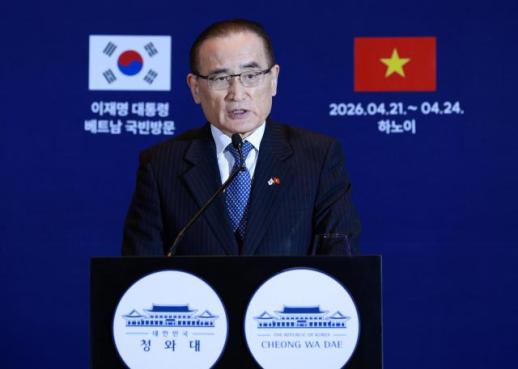 South Korea seeks quick return to normal U.S. cooperation after minister’s North Korea nuclear remarks Cheong Wa Dae said it is consulting with the United States to “return as soon as possible to a normal state of cooperation” following remarks by Unification Minister Jeong Dong-young about North Korean nuclear facilities. Wi, the national security office director, made the comments April 23 (local time) at a press center in Hanoi while meeting with the traveling press corps covering President Lee Jae-myung’s trip to India and Vietnam. Asked about the U.S. reaction to Jeong’s remarks, Wi said it could take time but the two sides should “sort out the current situation through communication.” Jeong said at a National Assembly Foreign Affairs and Unification Committee meeting on March 6 that North Korea is advancing its nuclear program and pointed to three locations — Yongbyon, Kangson and Kusong — as areas where uranium enrichment facilities are operating. The government and the International Atomic Energy Agency have officially confirmed Yongbyon in North Pyongan province and Kangson in Nampo, but Jeong also mentioned Kusong in North Pyongan. It has been reported that the United States viewed Jeong’s remarks as based on U.S.-provided intelligence and, in protest, partially suspended sharing satellite intelligence on North Korea. Lee defended Jeong in a post on X on April 20, calling the information “already widely known facts.” The main opposition People Power Party has said it will submit a motion recommending Jeong’s dismissal unless he is removed. Wi said Jeong has communicated directly with the United States and that he has also been in ongoing contact. He warned that if the issue becomes an excessive domestic controversy and political flashpoint, it could create obstacles to quickly stabilizing the situation and returning to the previous state. Wi described the dispute as a difference in perception. “The United States thinks he spoke using information they provided, and Minister Jeong says he obtained it from other open sources,” Wi said. He added that excessive controversy would not help and that it was important to consult, adjust and find a way forward. Still, Wi said coordination is necessary. “Some compare an alliance to a garden,” he said. “An alliance is a very close relationship, but it must be carefully coordinated and managed.” He again stressed that managing the U.S.-South Korea alliance requires avoiding turning issues into political disputes. Wi said Lee’s social media message was meant to reject arguments and debate based on the premise that Jeong “leaked information received from the United States.” Asked about limits on intelligence exchanges between the two countries after Jeong’s remarks, Wi said it was difficult to confirm or deny. Wi also suggested media coverage contributed to the issue escalating. He said the matter “became a big issue” after recent reporting, which drew political attention and prompted further statements, complicating the situation. Jeong, speaking to reporters after visiting Park In-jun, head of the Korean Conference of Religions for Peace, at Cheondogyo’s Suun Hall in Seoul’s Jongno district, criticized what he called the “intent” of those who “caused the problem.” He called it political maneuvering that harms the national interest. On the reported U.S. step to limit intelligence sharing on North Korea, Jeong said similar things had happened intermittently in the past without becoming public. “That’s the national interest — why stir up conflict?” he said. He did not identify who he meant by “those who caused the problem.” Wi also addressed a letter from 54 Republican U.S. lawmakers to Ambassador Kang Kyung-wha in Washington urging the South Korean government to stop what they called “discriminatory measures” against U.S. companies such as Coupang. Wi said it is true the Coupang issue is affecting security consultations between South Korea and the United States. He said the government has told the United States it will proceed on the Coupang matter “according to legal procedures” while advancing security negotiations separately. He added that security talks should resume quickly because the dispute does not help the alliance. Wi dismissed comments by the commander of U.S. Forces Korea and the Combined Forces Command about transferring wartime operational control by before the first quarter of 2029, calling them the commander’s personal view. Gen. Xavier Brunson told the U.S. House Armed Services Committee on April 22 (local time) that, in response to a question, “We submitted to the Department of Defense a roadmap to achieve those conditions before the second quarter of fiscal year 2029 (first quarter of 2029 by Korean standards)." On the timing of the transfer of wartime operational control, Wi said military considerations cannot be ignored but the transfer is ultimately a political decision. He said the leaders of both governments will decide and that South Korea will make its best efforts to complete the transfer as soon as possible without damaging the bilateral coordination framework. * This article has been translated by AI. 2026-04-24 12:06:30
 -
 Hyundai Unveils China-Only Ioniq V, Plans 20 New Models by 2030 Hyundai Motor is ramping up its electrification push in China with a China-focused model under its dedicated EV brand, Ioniq. The automaker said it will deepen strategic cooperation with local companies — including battery maker CATL and autonomous-driving firm Momenta — and plans an aggressive rollout of 20 new models over the next five years. Hyundai on April 24 unveiled the Ioniq V (IONIQ V) for the first time worldwide at the 2026 Beijing International Motor Show (Auto China 2026) at the China International Exhibition Center in Shunyi. The Ioniq V is the production version of the “Venus Concept” revealed April 10. Hyundai described it as the Ioniq brand’s first China-strategy model, tailored to Chinese customers’ lifestyles. The company said the vehicle reflects its electrification know-how, including a locally optimized platform and battery developed through technology cooperation with Chinese partners, and a quieter ride. Hyundai said it will add another electrified SUV by the first half of 2027 and, by 2030, introduce 20 new models — including extended-range electric vehicles, or EREVs — to build a midsize-to-large electrified lineup. It also said it will revamp the full ownership process, from purchase through use, to deliver an electrification experience tailored to China. ◆“20 new models by 2030 ... China is a core market” Hyundai also outlined its China strategy, centered on expanded investment, tailored product development and closer partner cooperation. The company said it and joint-venture partner Beijing Automotive Group last year jointly invested 8 billion yuan (about 1.73 trillion won) in Beijing Hyundai, aiming to build a system that can better tap China’s innovation-driven industrial ecosystem. Hyundai said it aims for annual sales of 500,000 vehicles at Beijing Hyundai and will broaden its lineup by launching 20 new models in China over the next five years. It also pledged to make China a core sales market and a long-term hub for strengthening global competitiveness by innovating EV sales and service and expanding cooperation with local technology partners. Jose Munoz, Hyundai Motor’s CEO, said China combines the fastest development pace, a strong battery supply chain, demanding EV consumers and an advanced innovation ecosystem. “China is an essential and core market,” he said. Munoz said Hyundai will “write the strongest, most ambitious and most anticipated new chapter” in China, citing large-scale investment in Beijing Hyundai, the 20-model rollout over five years, the official launch of the Ioniq brand in China and the unveiling of the Ioniq V. He said the company will work to define the future of mobility in China under its “In China, For China, To Global” strategy. ◆Sleeker, roomier Ioniq V adds advanced features Hyundai said the Ioniq V follows its new design language, “The Origin,” with a focus on delivering a strong first impression. It features a sporty hood line and edge lighting up front, a curved side silhouette with frameless doors and diamond-cut detailing, and thin rear lamps stretched horizontally to the far left and right edges. Hyundai said the cabin is larger, with overall dimensions of 4,900 mm in length, 1,890 mm in width and 1,470 mm in height, and a 2,900 mm wheelbase. It listed legroom of 1,078 mm in the front and 1,019 mm in the rear, and shoulder room of 1,502 mm in the front and 1,473 mm in the rear, calling it best-in-class interior space. Features include a Horizon head-up display (H-HUD), a Qualcomm Snapdragon 8295 chipset and a 27-inch 4K display. Hyundai said Dolby Atmos is standard, delivering spatial audio through eight speakers. ◆Co-developed with CATL, Momenta and other local partners Hyundai said the Ioniq V incorporates technologies developed with Chinese partners to better fit the local market and strengthen global competitiveness. It uses a platform co-developed with joint-venture partner Beijing Automotive, and a battery developed in cooperation with CATL. Hyundai said it expects more than 600 kilometers of range per charge under China’s CLTC standard. It also includes ADAS functions developed with Momenta. Hyundai said it will build standalone brand hubs in major cities and dedicated brand spaces inside dealerships, and introduce Ioniq specialists and an expanded service program to support customers from purchase through maintenance. It said it will adopt a “one price” policy across all sales channels to bolster trust, and accelerate expansion of charging infrastructure and its battery service network. Li Penggang, general manager of Beijing Hyundai, said unveiling the Ioniq V in China goes beyond introducing a new vehicle and reflects respect for the market and a firm commitment to the future. He said the Ioniq V and the new China strategy show Hyundai’s intent to set a new global mobility benchmark based on China’s innovation capabilities. Hyundai said it is operating a 1,816-square-meter (about 549-pyeong) booth at the Beijing motor show through May 3, displaying nine vehicles — the Ioniq V, the Venus concept, the Earth concept, the Elexio, the Palisade Hybrid, cutaway models of the Ioniq 9 and Ioniq 5 N — along with two Mobed models. 2026-04-24 12:05:17