
Journalist

Lee Hugh
=
-
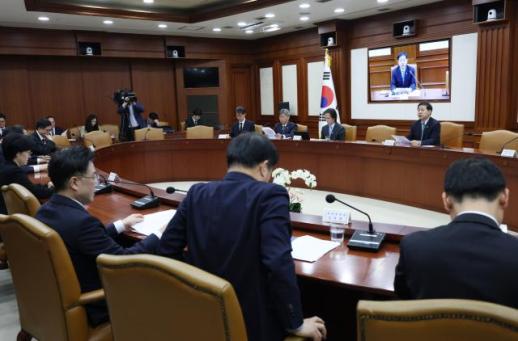
 South Korea to Ease Public Procurement Rules for Non-Capital Region Firms Companies outside the Seoul metropolitan area, especially those in depopulating regions, will face fewer hurdles in public procurement as the government expands negotiated contracts and preferential purchasing. Koo Yun-cheol, deputy prime minister and minister of economy and finance, announced the measures at an Emergency Economic Headquarters meeting and a National Startup Era Strategy meeting on the 24th. The plan aims to lower entry barriers and expand participation for non-capital region firms by widening the scope of small negotiated contracts for companies based in depopulating areas. For firms in those regions, the government will raise the ceiling for single-quote negotiated contracts to 50 million won from 20 million won, matching the treatment given to women-owned, disabled-owned, social enterprises and youth startups. For small negotiated contracts targeting companies in depopulating areas, the Public Procurement Service will act as a purchasing agent even when the amount is under 100 million won. The government will also revise the two-stage competition structure under the Multiple Award Schedule, or MAS, used for online shopping-mall listings. For products made by companies in depopulating regions, it will raise the threshold amount for two-stage competition, expanding exemptions and improving purchasing convenience. When requesting proposals for two-stage competition, the system’s automatic recommendations through the shopping mall will include two non-capital region companies. In concluding MAS contracts, authorities will give non-capital region firms priority review to speed processing and broaden early participation. In bid and award evaluations for goods and services, the government will introduce new bonus points favoring local companies and, when conditions are the same, will buy goods from local firms first to expand contract opportunities for non-capital region businesses. Separately from existing bonus points tied to the location of the ordering agency, the government will create new bid preferences for non-capital region companies, focusing on depopulating areas. It will add preferential items for non-capital region firms to credibility bonus points used in qualification reviews for goods and services and in MAS contracting. When bids are tied or performance-capability reviews produce the same results, the revised standards will give priority awards to companies in depopulating regions and other non-capital region firms. In MAS two-stage competition, companies in depopulating regions and other non-capital region firms will be selected ahead of lower-priced bidders. The government also plans to strengthen support for domestic and overseas sales channels for non-capital region firms. Working with local governments, it will focus on identifying innovative local products and will include outstanding products from depopulating-region companies among those eligible for extended designation periods. It will provide tailored consulting, especially for early-stage non-capital region companies, and expand participation by holding regional editions of innovative product exhibitions previously held in the capital area. Companies designated as promising firms for entry into overseas procurement markets under the G-PASS program will receive bonus points. If selected for support programs, their priority allocation share will rise to 60% from 50%. The government plans to revise the Enforcement Decree of the National Contract Act and the Public Procurement Service’s instructions and guidelines within the second half of this year. A ministry official said the government will build a legal framework to support a major shift toward a “local era” and prepare bold preferential policies for non-capital region firms, adding that it will gather sufficient opinions and conduct deliberations to finalize detailed implementation plans and move them into legislation and制度ization.* This article has been translated by AI. 2026-04-24 09:35:03
 -
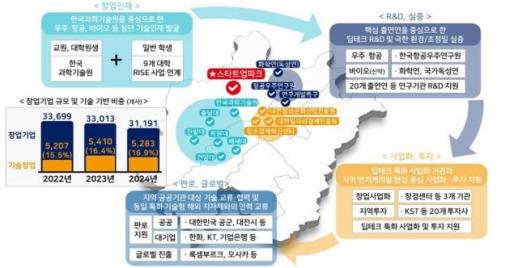 South Korea to Grant 10 Startup Cities Mega-Zone Regulatory and Funding Perks The government will roll out a broad package combining regulatory exemptions with fiscal, financial and talent support for 10 “startup cities” to be designated by next year, aiming to spur a nationwide startup boom and reshape local startup ecosystems beyond simple subsidies. The Finance and Economy Ministry announced the plan on the 24th at an emergency economic headquarters meeting and National Startup Era strategy session chaired by Deputy Prime Minister and Finance and Economy Minister Koo Yun-cheol. To build talent-driven startup hubs, the government will first select four cities this year that host science and technology institutes such as KAIST, DGIST, GIST and UNIST. It will add six more non-metropolitan areas by the first half of next year, for a total of 10 startup cities. The designated areas will receive “mega special zone” level regulatory easing to lower barriers for testing new technologies and business models. Sectors that previously had to go through separate regulatory sandbox procedures are expected to get faster permits and temporary regulatory waivers within startup cities. The government expects the changes to speed commercialization in strategic industries including AI, biotech and advanced manufacturing. Fiscal and financial support for startups in the regions will be expanded. Eligible firms will be offered up to 350 million won in commercialization funding, with follow-on investment linked through a newly created regional growth fund. The fund is set to launch this year at 450 billion won or more and expand to 2 trillion won by 2030. The government also plans tax and fiscal incentives for non-capital-area investment to draw more private venture capital. To strengthen exit options, the government will create a “venture capital brokerage platform” to support trading in unlisted startup shares and will pursue steps to expand venture investment by retirement pensions and public pension funds. The goal is a virtuous funding cycle from early-stage growth through exit. The government will also revise rules to help startups recruit talent. Approval time for professors and researchers to start businesses will be cut from up to six months to about two weeks, and startup-related leave will be allowed for up to seven years. For university students, restrictions on taking a leave of absence to start a business will effectively be eliminated. Plans also call for linking R&D with startup infrastructure. Startup cities will establish innovation startup institutes and deep-tech startup hub universities so technology development, commercialization and investment can be connected in one place. The package will include work space, testbeds and demonstration infrastructure, operating as a cluster linking “labs, companies and investment.” To better connect startups with local economies, the government will develop “glocal” commercial districts and local theme shopping areas near startup cities. Companies that attract investment will be eligible for additional support, including matching loans of up to 500 million won and about 200 million won in extra commercialization funding, to help local startups translate into sales and jobs. The government said the startup-city model is intended to disperse a capital-area-centered startup ecosystem and create conditions for technology-based startups to grow in the regions. A government official said startup cities are “comprehensive startup clusters” that simultaneously loosen constraints on regulation, funding, talent and infrastructure, adding that the government will build a foundation for unicorn companies to emerge outside the capital region.* This article has been translated by AI. 2026-04-24 09:34:07
 -
 South Korea to Add 200 Billion Won to ‘Startup for All,’ Name 10 Startup Cities The government said it will expand a nationwide, public-participation startup initiative and build technology- and region-based startup ecosystems, aiming to ease a growth structure centered on the Seoul metropolitan area and large conglomerates and shift toward a startup-driven economy. The Ministry of Finance and Economy announced the plan on April 24 after an emergency economic headquarters meeting and a National Startup Era strategy meeting chaired by Deputy Prime Minister and Finance and Economy Minister Koo Yun-cheol. The ministry said it sees “K-shaped growth,” in which gains concentrate in the capital region and big companies, as becoming entrenched, while automation is reducing structural employment. It said it will push a strategy to spread entrepreneurship to shift the jobs paradigm from “finding” work to “creating” it. As part of the effort, the government will expand the “Startup for All” project. Following the first nationwide idea contest now underway, it plans a second round later this year using a supplementary budget of about 200 billion won. Entrepreneurs will be selected through regional audition-style competitions, and the final winner will receive prize money of at least 1 billion won and support linked to follow-on investment. The government said it aims to run the project as a practical startup incubation program rather than a simple contest. The government will also develop 10 “startup cities” as hubs for technology-based entrepreneurship. It will designate four cities hosting KAIST, DGIST, GIST and UNIST later this year, then select six more, mainly outside major metropolitan areas, by the first half of next year. The startup cities will receive a package of support combining talent development, research and development, investment and startup space. Planned steps include creating innovation startup institutes at each science and technology institute, expanding deep-tech startup-centered universities, shortening approval procedures for faculty and student startups from up to six months to about two weeks, extending startup leave from three years to up to seven years, and removing limits on leaves of absence. Startups in these regions will be eligible for up to 350 million won in commercialization funding. The government said it will build a regional growth fund of at least 450 billion won this year and expand it to 2 trillion won by 2030. Support for entrepreneurship tied to local commercial districts will proceed in parallel. Under a “Local Commercial District for All” strategy, the government will foster 17 “glocal” commercial districts and 50 local theme districts. It will also expand the LIPS program, which provides matching loans of up to 500 million won and commercialization funds of up to 200 million won for companies seeking investment, to 450 firms from 300. An additional 40 billion won in supplementary funding will be投入 into support for everyday-technology development. To improve the broader startup ecosystem, the government said it will introduce a “three-part package” to encourage private investment: expanded incentives for venture investment outside the capital region, a new intermediary platform for venture capital to boost early-stage stock trading, and permission for retirement pensions and public pension funds to invest in venture capital. It also plans to strengthen funding support, including a 50 billion won “startup boom” fund and a “second-chance” fund totaling 1 trillion won by 2030. The government said it will introduce “mega special zones” to grant regulatory exemptions to startups in strategic industries, and provide up to 340 million won for open-innovation projects between large companies or public institutions and startups. It also plans to develop AI solutions using manufacturing-site data and apply them to 1,000 processes by 2030. It said it will institutionalize support for entrepreneurs seeking to try again after failure by introducing a “challenge resume” that datafies startup experience, expanding support for re-founders, and creating a youth startup challenge school, aiming to make failure experience an asset. “Startups are a jobs policy, a youth policy, and a strategy for balanced regional development and national growth,” Koo said. “We will do everything we can to create an environment where anyone can start a business anywhere with just an idea, open a ‘startup boom National Startup Era,’ and spread ‘Startup for All’ into ‘growth for all,’” he said. * This article has been translated by AI. 2026-04-24 09:33:22
 -
 Song Young-gil Says He Would Seek Defense Committee Seat if He Returns to Parliament Song Young-gil, former leader of the Democratic Party, said on Thursday that if he returns to the National Assembly, he would seek a seat on the Defense Committee. Speaking on KBS radio's "Jeongyeok Sisa," Song was asked whether the transfer of wartime operational control should be completed within President Lee Jae-myung's term. "I'll go to the Defense Committee and make sure it's handled properly," he said. On the transfer of wartime operational control, Xavier Brunson, commander of the U.S.-ROK Combined Forces Command and U.S. Forces Korea, said on April 22 (local time) that he submitted a roadmap to the Defense Ministry targeting the first quarter of 2029 for the handover. The Lee administration has said it plans to complete the transfer by June 2030, when Lee's term ends. Song said that if he joins the Assembly's Defense Committee, he would consult with the U.S. Forces Korea commander and U.S. Defense Secretary Hegseth to find an approach. Commenting on a poll showing the People Power Party at 15% support, Song said he felt more worried than pleased about the opposition's collapse. On Wednesday, Embrain Public, Kstat Research, Korea Research and Hankook Research released results of the NBS survey conducted April 20-22 of 1,005 adults ages 18 and older. The poll put support for the Democratic Party at 48% and the People Power Party at 15% (details available on the National Election Survey Deliberation Commission website). Song said the public is questioning whether the People Power Party is a normal political party, adding that it has no future unless it reflects and changes. He also said he met Daegu mayoral hopeful Kim Boo-kyum in Daegu and asserted Kim would win decisively with more than 10% of the vote. Song said the People Power Party should immediately dismantle the leadership of Chairman Jang Dong-hyeok and shift to an emergency leadership committee by recruiting new faces.* This article has been translated by AI. 2026-04-24 09:31:05
 -
 Won Weakens to 1,480s per Dollar as U.S.-Iran Tensions Lift Safe-Haven Demand Renewed military tensions between the United States and Iran pushed the won-dollar exchange rate back into the 1,480-won range in early trading. As of 9:12 a.m. on April 24, the won was trading at 1,482.9 per U.S. dollar in Seoul. The rate opened at 1,483.0, up 2.0 won from the previous session. With talks on ending the war failing, rising tensions between the two countries were seen boosting demand for safe-haven assets. Overnight, all three major U.S. stock indexes fell in New York. The Dow Jones Industrial Average closed down 179.71 points, or 0.36%, at 49,310.32. The S&P 500 ended down 29.50 points, or 0.41%, at 7,108.40, and the Nasdaq composite fell 219.06 points, or 0.89%, to 24,438.50. International oil prices also extended sharp gains. Brent crude futures for June delivery settled at $105.07 a barrel, up 3.1% from the previous session. U.S. West Texas Intermediate for June delivery closed at $95.85 a barrel, up 3.11%. U.S. President Donald Trump ordered forces to fire on and sink any vessel laying mines in the Strait of Hormuz. He also reiterated that the United States would continue its blockade of the strait until Iran reaches agreements related to ending the war and denuclearization. Iran, however, said it would not take part in negotiations as long as the U.S. maritime blockade continues, and said it is ready to respond to further threats. Investor sentiment was also affected by reports of hostile aerial activity in Tehran and the activation of air defenses, the first such report since the ceasefire with the United States. At the same time, foreign investors were net sellers of 154.4 billion won worth of shares on the benchmark KOSPI. Min Kyeong-won, an economist at Woori Bank, said the exchange rate is expected to move around the low-to-mid 1,480s amid a stronger dollar driven by higher oil prices and risk-off sentiment. She added that continued foreign selling in local stocks is likely to spur dollar demand and keep downward pressure on the exchange rate limited.* This article has been translated by AI. 2026-04-24 09:30:19
 -
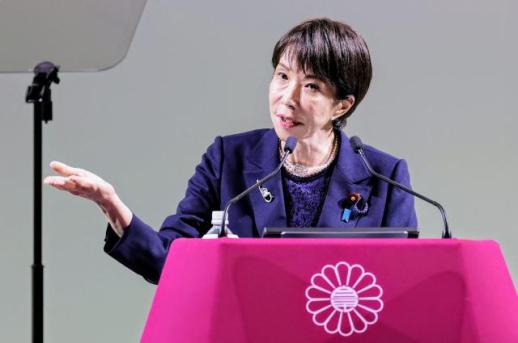 Leaders’ Sleep Deprivation: Badge of Honor or Risk to Decision-Making? A long-running myth in politics holds that leaders who sleep less and work more are more capable. Images of a leader reading briefs until dawn, making late-night calls and returning to the schedule after only a few hours of rest are often sold as proof of dedication and toughness. But running a country is not a test of personal grit. Because one person’s condition can affect the lives of millions, a leader’s lack of sleep can no longer be treated as a private habit. Japan Prime Minister Sanae Takaichi recently drew attention after saying she generally sleeps “two hours, at most four,” adding that she “would like to sleep a bit more.” She said her short sleep stems from policy reviews and a packed schedule, as well as family caregiving and housework. Some in Japanese politics have voiced concerns about worsening health, impaired judgment and weaker communication. U.S. President Donald Trump has also remained in the spotlight for predawn messages, sudden remarks and a punishing schedule. In a recent series of comments on Middle East developments, assessments said his frequently shifting messages caused significant confusion in markets and diplomatic circles. The core issue is not simply how many hours a leader sleeps. The concern is that sleep deprivation can degrade the quality of decisions. Medical and brain-science research has long warned that lack of sleep can be linked to reduced concentration, increased impulsiveness, failed emotional control and errors in judging risk. If that is dangerous for a corporate chief executive, it can be far more damaging for national leaders who make decisions on war and diplomacy, interest rates and disaster response. A leader’s day is unlike anyone else’s. Security crises, sudden market swings, major accidents and natural disasters can erupt at any hour, including in the middle of the night. If the person expected to make calm decisions is already exhausted, the country can pay unnecessary costs. A single remark can rattle markets, and one misjudgment can widen diplomatic conflict. Even so, politics still romanticizes “sleepless leadership.” All-night briefings, dawn meetings and overloaded schedules are packaged as evidence of responsibility. But that is closer to a leftover of outdated workplace culture. The ability to endure fatigue is not the same as the ability to govern. Staying awake longer does not make anyone wiser. More advanced leadership manages fatigue through systems. Staff members refine information, schedules are adjusted by priority, and leaders preserve their best condition for decisive moments. Governing is a marathon, not a contest in going without sleep. The idea that a leader must personally read every document and attend every meeting may look like diligence, but it often signals distrust of the organization and breeds inefficiency. South Korean politics is no exception. During presidential, parliamentary and local elections, candidates crisscross the country on little sleep, and after winning they cite early-morning arrivals and late-night reports as proof of sincerity. But the public wants a prepared leader, not an exhausted one — accurate judgment, not dark circles, and steady results, not photos of relentless travel. A leader’s health is private, but it is also a public asset. The condition of a president, prime minister or minister is tied to national risk. Adequate rest, transparent health management and reasonable division of work are not perks; they are responsibilities. Power without sleep should no longer be treated as a feel-good story. Sleep deprivation may be less a virtue than a warning sign. The more responsibility a leader carries, the more they must rest. The public needs not a weary hero, but an accountable decision-maker with a clear mind. 2026-04-24 09:21:48
 -
 Hyundai E&C Backs Local Safety Program for Elementary Schools in Jinhae, South Korea Hyundai Engineering & Construction said it is launching a site-linked community safety program to help protect children in disaster-prone areas. The company said Thursday that it held a ceremony April 22 at Angolpo Elementary School in Jinhae-gu, Changwon, South Gyeongsang Province, with the Construction Industry Social Contribution Foundation and Plan Korea to provide disaster safety education and deliver child-sized safety helmets. Attendees included Lee Hyeong-seok, head of Hyundai E&C’s Finance and Economics Division; Lee Jae-sik, secretary-general of the foundation; Lee Jae-myeong, a manager at Plan Korea; and officials from the Gyeongsangnam-do Changwon Office of Education. Hyundai E&C said it will distribute about 3,600 disaster-response safety helmets from this month through June to eight elementary schools in the Jinhae area, including Angolpo Elementary as well as Ungdong and Ungcheon elementary schools. It also plans structured disaster safety classes and hands-on evacuation drills for all students. The program includes practice sessions on wearing helmets and simulated evacuations to help students learn how to respond. Schools will also name student “disaster safety guardians,” or “Safe Captains,” to encourage participation. Hyundai E&C said it has focused its safety-related social contribution work on disaster-vulnerable areas over the past seven years and is expanding the effort this year to Jinhae-gu. It said it will support tailored safety programs linked to nearby elementary schools around local projects, including construction of the Busan Port Jinhae New Port container terminal (Phase 1-1), a southern breakwater and the Wasong district development project. A Hyundai E&C official said the company is continuing “effective safety activities” by combining equipment support with participatory education programs in disaster-vulnerable areas and plans to keep expanding disaster safety programs tied to communities near its worksites. * This article has been translated by AI. 2026-04-24 09:19:33
 -
 Even if Hormuz Reopens, the Global Order of Freedom of Navigation Is Fraying Even if the Strait of Hormuz reopens, the world will not return to the prewar status quo. What this crisis has exposed is not only the risk of a blockade, but a deeper strain on the international maritime order itself. The confrontation has already moved beyond the strait. The United States has expanded maritime interdiction beyond Hormuz into the Indian Ocean, seizing Iranian oil tankers and raising pressure. The issue is no longer control of a single chokepoint, but a widening contest for maritime control that reaches into the high seas. At the same time, Iran is using the strait as leverage and testing what it calls a “selective opening.” Under that approach, only some vessels are allowed to pass, while a de facto toll is imposed in the name of safety guarantees. Iran has officially said the fees were deposited into a central bank account, signaling a move toward institutionalizing the practice. That commercial logic is showing signs of spreading. When the possibility of tolls was raised for the Strait of Malacca, Singapore and Malaysia pushed back immediately, stressing that “the strait must be free for everyone.” The freedom of navigation long treated as a given is no longer assured. The fallout has also rippled to other routes. As demand surged for Panama Canal transits after the Hormuz disruption, the price of passage rights jumped as much as 10 times compared with before the war. Some shippers paid millions of dollars more to cut waiting times. The shift points to supply chains being reorganized away from pure efficiency and toward detours and redundancy. A more fundamental change is underway in energy and logistics planning. Countries are pursuing pipeline expansion to reduce reliance on the Middle East, developing alternative routes and diversifying energy import sources. With Hormuz — through which 20 million barrels a day once passed — losing some of its standing, volumes are being dispersed to other paths, but at higher cost and with greater inefficiency. In the name of “stability,” the cost structure of the global economy is rising. What is unfolding is not simply a geopolitical clash. The rules governing international sea lanes are shifting. Where straits were once treated as a public good with guaranteed passage, they are increasingly being redefined as sovereign spaces where states cite security and national interest to impose control and pricing. The longer-term costs could outweigh any short-term gains. Revenue or bargaining power from controlling a strait may be temporary, but the inflation, supply-chain distortions and trade contraction it triggers can spread worldwide. When private advantage is placed above the public interest, the costs tend to return to all. In such moments, the need is not a show of force but a restoration of principles. Coastal states and major trading nations should rebuild minimum shared rules that protect freedom of navigation, nondiscriminatory access and predictability. The Malacca Strait countries’ insistence that “no country can unilaterally decide passage rights” could be a starting point. For now, the world is not showing the steady leadership needed to design and uphold those principles. Governments speak of strategy, but not of order; short-term calculations are abundant, long-term responsibility scarce. Hormuz may reopen. But a “free sea” will not be restored on its own. If current trends continue, the world will face a costlier, more unstable and more fragmented system. * This article has been translated by AI. 2026-04-24 09:18:33
 -
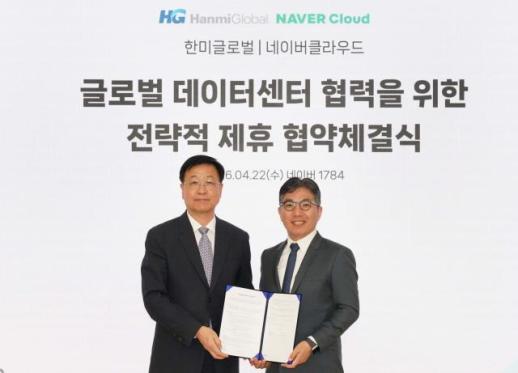 Naver Cloud, HanmiGlobal Partner to Pursue Saudi Data Center Projects 저 장 Naver Cloud and HanmiGlobal are teaming up to pursue data center opportunities in Saudi Arabia and other overseas markets. The companies said they signed a strategic memorandum of understanding on April 22 to jointly participate in large-scale data center projects. The agreement is aimed at meeting demand for digital infrastructure in the Middle East and other markets by combining cloud and AI technology with construction project management capabilities. Under the MOU, Naver Cloud will lead infrastructure technology strategy and service model design, drawing on its full-stack capabilities spanning data center construction and cloud and AI services. HanmiGlobal will handle project execution, including consulting on design and construction, schedule and cost management, and local licensing and permits in Saudi Arabia. Naver Cloud has expanded digital and AI cooperation in Saudi Arabia through “Naver Innovation,” a joint venture with the National Housing Co. (NHC), including work on digital twin development and a map-based super app. The company said the new partnership will extend that effort into infrastructure to strengthen its response to local digital transformation demand. HanmiGlobal has built experience in the region since entering the Middle East market in 2007, completing more than 50 projects, the company said. “Through establishing a local corporation and cooperating with key institutions, we have secured a foundation for execution,” Naver Cloud CEO Kim Yu-won said. “We will actively respond to demand for building digital infrastructure in the Middle East and emerging markets.” * This article has been translated by AI. 2026-04-24 09:13:53
 -
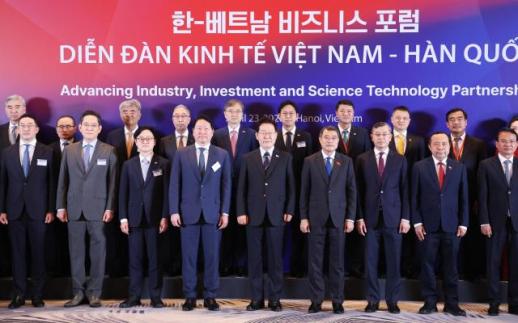 South Korea Urges Faster Supply Chain Overhaul for Rare Earths and Urea Solution Global supply chains are no longer just about efficiency; they are about survival. President Lee Jae-myung’s remarks in Vietnam calling for stronger cooperation on rare earths and urea solution supply chains were more than an economic message. They underscored South Korea’s industrial vulnerabilities and pointed to how the country must adapt to a new global order. The challenge now is not the direction but the design. The question has shifted from where to invest to how to build a resilient supply chain. South Korea already saw how damaging supply disruptions can be during the 2021 urea-solution shortage. Heavy reliance on a single country lowered costs in normal times, but in a crisis it became a shock that could paralyze entire industries. Since then, “diversifying supply chains” has become a central policy slogan. But it has too often remained a declaration. The task now is to build a working structure. Vietnam is clearly an important partner in that effort. But the strategy must avoid turning Vietnam from an alternative into a new single point of dependence. The goal is not dispersion for its own sake, but diversification that remains manageable. Excluding one country entirely or concentrating too heavily on another both carry risks. A layered approach is needed: use Vietnam as a key base for manufacturing and assembly, while diversifying rare-earth sourcing to Australia and Africa and spreading urea-solution feedstock supplies across the Middle East and Southeast Asia. The design should anchor on one hub while distributing risk across multiple pillars. Speed matters as well. Countries are racing to reshape supply chains, and delays can mean lost opportunities. Still, not everything can be solved quickly. Issues such as technology transfer require long-term trust and negotiation. That argues for a phased strategy: first, secure the physical base through relocation of production and expanded investment; second, raise capabilities through joint research and development and broader technology cooperation. Speed and sustainability are not opposites, but priorities that must be sequenced. Risk is the bigger test. Cooperation on energy infrastructure such as nuclear power plants and LNG facilities can be central to supply stability, but it also brings heavy capital demands and geopolitical exposure. Leaving that burden solely to private companies is unrealistic. If supply chains are treated as a national strategy, the state must share part of the risk. Tools such as policy financing, export credit guarantees and long-term purchase contracts can reduce corporate burdens and strengthen incentives. Companies pursue returns; governments secure stability. Clear roles are needed for the system to work. Governance will determine whether the overhaul moves beyond rhetoric. To make supply-chain restructuring enforceable and trackable, institutional mechanisms are needed, including a control tower to coordinate strategy and a national fund to secure strategic resources. Major projects should be pursued jointly by the public and private sectors, alongside a system to evaluate results and make corrections. The aim is to ensure investment plans lead to execution. The role of business must also evolve. Lee Jae-yong, Koo Kwang-mo and Chey Tae-won are already key players in global supply chains, and their investments increasingly intersect with national strategy. But companies cannot absorb all risks alone. Supply chains become more stable when government strategy and corporate execution align. South Korea now faces a choice between maintaining an efficiency-first model and shifting to a structure centered on stability and strategy. The argument is that even if costs rise, building a more secure supply chain offers greater long-term benefit and affects national sustainability. The Vietnam trip is only a starting point. What matters is follow-through. Supply chains are not rebuilt by declarations, but by design, investment and accountable execution. A strategy that balances concentration with diversification, matches speed with sustainability through phased steps, and shares risk between government and business is presented as essential — and urgent.* This article has been translated by AI. 2026-04-24 09:12:30