

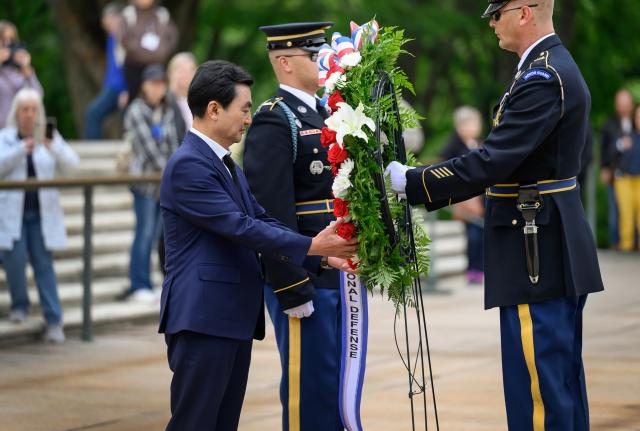
Seoul conveyed to Washington that it would “participate as a responsible member of the international community” and review “step-by-step contribution measures” related to the reopening and protection of maritime traffic through the strategic waterway, Ahn said in an online briefing on the Korea-U.S. integrated Defense Dialogue (KIDD) in Washington and talks with U.S. Defense Secretary Pete Hegseth at the Pentagon.
Ahn said possible forms of support discussed included diplomatic backing, personnel dispatch, intelligence-sharing and military asset assistance.
“We did not go deeply into specific discussions about expanding the participation of our military,” Ahn said, adding that any such move would also require procedures under South Korean domestic law.
The remarks mark Seoul’s clearest indication yet that it may expand its role in the multinational effort surrounding the Strait of Hormuz, a critical global oil shipping route, following the recent attack on the South Korean-operated cargo vessel HMM Namu.
The presidential office earlier strongly condemned the attack after a joint government investigation concluded that the fire aboard the vessel was caused by an external strike. Seoul also pledged to continue cooperating with international efforts to guarantee maritime safety and freedom of navigation.
Ahn also said Hegseth expressed understanding over Seoul’s push for an early transfer of wartime operational control (OPCON) under a conditions-based framework.
Ahn said he explained South Korea’s recent efforts to boost defense spending, secure key military capabilities and strengthen its ability to lead the defense of the Korean Peninsula.
“It was a meaningful opportunity to candidly discuss key alliance issues, including the OPCON transition and plans to pursue nuclear-powered submarines,” he said.
Ahn stressed Seoul’s commitment to accelerating the transfer of wartime operational control from the United States.
“Our position on pursuing an early OPCON transition is firm and unwavering,” he said. “If additional understanding and persuasion are needed, we will continue engaging with the United States.”
On Korea’s push to develop nuclear-powered submarines, which both governments previously agreed to explore, Ahn said security issues should be handled “on a different track from economic matters.”
He added that both sides shared the view that working-level discussions should begin promptly despite the ongoing conflict involving Iran.
According to South Korea’s Defense Ministry, the two ministers reaffirmed the importance of adopting a “realistic and practical approach” to modernizing the alliance, deterring threats and strengthening the combined defense posture.
The ministry said the two sides agreed to maintain close communication and expand cooperation in areas of mutual security interest ahead of this week’s Korea-U.S. Integrated Defense Dialogue (KIDD) meetings in Washington.
Ahn said no discussions took place regarding a reduction of U.S. Forces Korea or the strategic flexibility of U.S. troops stationed on the peninsula.
Copyright ⓒ Aju Press All rights reserved.
