

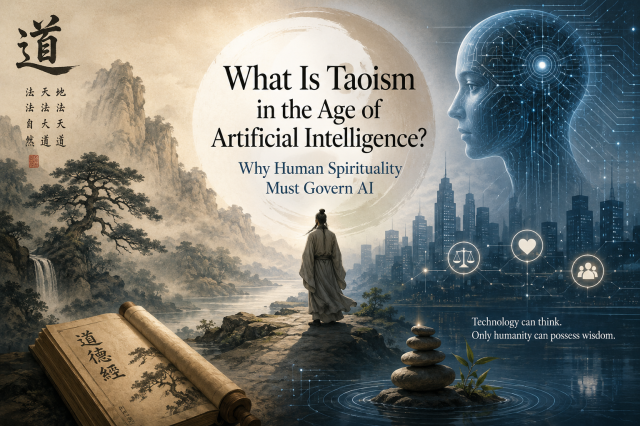
AI is no longer merely a machine for calculation. It understands language, composes music, generates images, assists in medicine, analyzes financial markets and increasingly participates in military strategy. Domains once believed to belong exclusively to human intellect and reason are now being steadily absorbed by intelligent systems.
Much of the world’s financial trading is already executed by algorithms. AI drafts news articles, supports medical diagnoses and reviews legal documents. Human beings are gradually losing their monopoly over cognition itself. This is not simply a technological development. It is a question about the meaning of human existence.
Yet amid the excitement surrounding AI, humanity risks forgetting a fundamental truth: artificial intelligence may imitate human logic and calculation, but it cannot fully command the realm of human spirituality.
Human beings are not merely thinking machines. We grieve, love, sacrifice and gaze toward heaven with longing and wonder. We ask why we exist. We wrestle with the meaning of life and death. That domain belongs not to intelligence alone, but to spirit.
The world today is consumed by the race for AI supremacy. The United States seeks to preserve its dominance through large-scale AI platforms. China is mobilizing national strategy to accelerate its rise. Europe emphasizes ethics and regulation.
Yet the most important question remains strangely neglected: Who will govern artificial intelligence?
If the darker impulses of humanity — greed, hatred, domination and obsession — merge with superintelligent systems, the consequences could become far more dangerous than the Industrial Revolution itself. Technology amplifies not only wisdom, but also human weakness.
Buddhism long ago warned of the destructive forces within the human mind: greed, anger and ignorance. The Diamond Sutra teaches, “Let the mind arise without attachment.” True wisdom emerges only when the spirit is free from compulsive desire. The Tao Te Ching similarly teaches that one who knows sufficiency cannot be humiliated by endless craving.
In the end, the central problem of the AI era is not technology itself. It is the condition of the human soul.
Modern people fear AI while simultaneously surrendering to it. We rely on AI to search, to think, to recommend, even to console. Convenience expands, but the capacity for contemplation quietly diminishes. Humanity risks becoming intellectually efficient yet spiritually hollow.
That is why the future cannot rest merely on the concept of “Human-Centered AI.” Important though it is, it remains incomplete. Human beings themselves are capable of violence, arrogance and destruction. The catastrophes of the 20th century — world wars, genocide, colonial exploitation and nuclear terror — were all products of human intelligence unrestrained by deeper moral consciousness.
The age ahead therefore requires something greater: “Spirituality-Centered AI.” This does not mean imposing a single religion upon society. Rather, it means recovering the ethical and spiritual foundations that make civilization humane: conscience, compassion, restraint, responsibility and reverence for life.
It is precisely here that Taoism regains extraordinary relevance. Taoism is often reduced to clichés about mysticism or passive harmony with nature. In truth, it is one of humanity’s great civilizational philosophies — a profound inquiry into the relationship between humanity, nature and cosmic order. The Tao Te Ching and the writings of Zhuangzi taught that human civilization survives only when it moves in balance with the deeper rhythms of existence. Excessive ambition and artificial force ultimately destroy themselves.
The Tao Te Ching declares:
“Man follows the earth.
The earth follows heaven.
Heaven follows the Tao.
The Tao follows nature.”
This is not merely poetic admiration for nature. It is a warning that civilization collapses when it loses harmony with the greater order of existence.
The same principle applies to artificial intelligence. If humanity no longer governs technology but instead becomes governed by technological appetite — by speed, surveillance, addiction and endless optimization — then civilization itself may lose equilibrium.
The signs are already visible. The digital age has produced unprecedented connectivity, yet also unprecedented loneliness. Human attention is fragmented. Communities weaken. Interior life becomes thinner. AI saves time while quietly emptying the human interior of silence and reflection.
For this reason, the AI era urgently requires a renewed ethical discipline. First, human beings must preserve moments of distance from technology. Every civilization of wisdom — Confucianism, Buddhism, Christianity and Taoism alike — understood the importance of stillness. The Tao Te Ching teaches that clarity and tranquility are the foundations of order. In an age of constant stimulation, silence itself becomes an act of spiritual resistance.
Second, AI must not become merely a tool for competition and domination. It should serve the preservation of human dignity and the strengthening of community — in education, medicine, elder care, environmental stewardship and the protection of the vulnerable.
Third, humanity must recover the ability to ask fundamental questions. AI may provide answers, but only human beings can ask why life matters. Spirituality begins not with information, but with inquiry.
Fourth, societies must rebuild communal ethics. The AI age may intensify radical individualism, yet the great spiritual traditions of Asia consistently remind humanity that human beings exist in relationship. Confucianism speaks of benevolence. Buddhism teaches compassion. Christianity teaches love. Korea’s Donghak tradition proclaimed, “The human being is heaven.”
Fifth, humanity must rediscover harmony with nature. Taoism understood that human beings are not masters standing outside creation but participants within it. Even in the age of AI, civilization still depends upon water, air, soil and sunlight. Technology cannot replace the ecological foundations of life.
This is where the idea of “AI Taoism” emerges.
AI Taoism does not mean simply applying AI to Taoist studies. It means recovering the wisdom of the Tao in order to guide technological civilization itself.
At its core, Taoism is a philosophy of balance and flow. It rejects coercive excess. It teaches that fullness comes through emptiness, strength through restraint and wisdom through humility. The AI era may become an age of astonishing speed, but human consciousness must deepen as technology accelerates.
The I Ching, or Book of Changes, teaches that while the world constantly changes, enduring patterns still govern transformation. AI is one of the great transformations of human history. Yet without a spiritual axis, humanity risks losing its center amid rapid change.
Korea’s ancient Cheonbugyeong declares: “Within the human being, heaven and earth become one.” Human beings are not merely producers of data. They carry within themselves the order of heaven and the spirit of the cosmos.
Ultimately, the defining question of the AI age is this: Will machines govern humanity?
Or will human spirituality govern technology?
The Taoism of the AI era offers an ancient Eastern answer to that modern question. Human beings must live in harmony with nature, with one another and with the deeper order of existence. Technology must remain a tool that serves that order rather than destroys it.
Technology can make humanity more powerful.
Only spirituality can make humanity truly human.
Copyright ⓒ Aju Press All rights reserved.
