
Journalist

Lee Hugh
=
-
 Google Joins OpenAI and Anthropic in Enterprise AI Push, Signaling Platform Battle Google has joined OpenAI and Anthropic in a push into the enterprise artificial intelligence market, as competition shifts from standalone models to agent-based platforms that tie together cloud services, data and automated tools. According to industry officials on the 23rd, Google used its annual tech conference, Google Cloud Next 2026 in Las Vegas, to declare the start of an “agentic enterprise” era. The company also said it will consolidate its AI products under the name “Gemini Enterprise.” Thomas Kurian, CEO of Google Cloud, said Gemini Enterprise has evolved into an end-to-end system for the agentic era and “will connect enterprise data and people, all applications and agents.” He added that Google Cloud will provide “an integrated stack” to support large-scale operations and maximize efficiency, and said the company aims to lead the new AI era. The move is widely seen as a response to OpenAI and Anthropic rapidly expanding their presence in business-to-business markets. Choi Byeong-ho, a research professor at Korea University’s Human-Inspired AI Research Institute, said Anthropic and OpenAI have quickly built monetization models in the enterprise market, pushing the center of AI competition toward B2B. He said Google is now moving beyond foundation-model competition to prove results in the enterprise market. The enterprise AI market is being reshaped around “agents” that automate work, rather than simple model adoption. A survey by venture capital firm Menlo Ventures found the enterprise AI market surged from $1.7 billion in 2023 to $37 billion, and now accounts for 6% of the global software-as-a-service market. By market share, Anthropic led with 32%, followed by OpenAI at 25% and Google at 20%, the survey said. With the B2B market still in an early stage, multiple players are competing within narrow margins. Industry officials expect Google’s entry to accelerate a broader platform contest that combines cloud, data and agents, rather than a race focused only on models. As AI agents increasingly make automated decisions based on corporate data, debate is also expected to grow over security and accountability. Critics warn that if AI linked to internal systems makes errors, responsibility could become unclear. Choi said AI agents are tightly connected to corporate data, security frameworks and existing systems, ultimately forcing companies to overhaul internal governance and work processes. He added that “consulting-style” business models — going beyond software sales to help solve problems on site — are likely to expand, and said big tech companies including OpenAI and Anthropic are strengthening customized deployments and operational support for major clients.* This article has been translated by AI. 2026-04-23 14:58:49
 -
 Hang Ten, Hang Ten Teens Launch ‘Hang Ten Cool Day’ Summer Sale With Expanded Online, In-Store Deals Branded Lifestyle Korea, which operates the casual brands Hang Ten and Hang Ten Teens, is running its first-half seasonal promotion, “Hang Ten Cool Day.” The promotion begins online on April 23, with offline stores rolling it out sequentially starting April 24. It is designed as an integrated campaign spanning both online and in-store channels. A summer-focused discount applies to all items, offering a 1+1 deal equivalent to 50% off. Product assortments and how the promotion is run may vary by channel. The fashion industry has been expanding large seasonal-transition sales and strategies that link online and offline purchasing. Ahead of summer, demand has been rising for basics such as T-shirts and shorts. Hang Ten, a casual brand rooted in surf culture, emphasizes comfort and practicality and is purchased by a wide range of age groups. For this event, it strengthened its short-sleeve T-shirt lineup, including styles with shirring details and graphic-focused designs. Layered-style short-sleeve T-shirts, which can be used across a range of outfits, have also seen steady demand on fashion platforms, the company said. Hang Ten Teens is built around products aimed primarily at teenagers. It is highlighting warm-weather items intended for everyday wear, including Bermuda denim pants and seersucker shirts. Additional benefits are offered for online shoppers, including coupon packs for members, extra discounts on select items, and a fixed-amount discount coupon for first-time buyers. The company is also running an event that provides a mobile gift certificate to customers who write a review after purchase. The brand said it assembled the promotion around basic items frequently worn in summer. Details are available on the official online mall and at stores nationwide.* This article has been translated by AI. 2026-04-23 14:58:19
 -
 Hormuz Strait Tensions Rise Despite Extended Ceasefire as Iran, U.S. Clash at Sea President Donald Trump’s decision to extend a ceasefire has, for now, averted a broader clash with Iran, but military tensions around the Strait of Hormuz appear to be rising. On April 22 local time, Iran’s state broadcaster IRIB reported that the Islamic Revolutionary Guard Corps Navy said it detained two container ships — the MSC Francesca and the Epaminondas — in Iranian waters to inspect cargo and related documents. The IRGC said the ships tried to leave the Strait of Hormuz without Iranian military permission. The IRGC alleged the MSC Francesca may have links to Israel and said both vessels repeatedly violated regulations and manipulated their automatic identification system, or AIS. Mehr News Agency separately reported that another container ship, the Euphoria, was also seized by the IRGC Navy while transiting the strait. The United States has also increased pressure at sea. Reuters, citing shipping and security sources, reported that U.S. forces in recent days blocked the movement of at least three Iranian-flagged tankers near waters off India, Malaysia and Sri Lanka and ordered them to change course. Confusion has persisted over the ceasefire extension. White House spokeswoman Karoline Leavitt said she was aware of media reports citing anonymous sources that mentioned a three- to five-day deadline. “That is not true. The president did not set a deadline for himself,” she said. Leavitt said there is “clearly a lot of division” inside Iran, calling it a fight between pragmatists and hard-liners, and said the president wants a unified response from Tehran. She added that while the ceasefire is holding on “military and physical strikes” as the U.S. waits for that response, “Operation Grand Rage” is continuing, as is a maritime blockade on ships traveling to and from Iranian ports. Fox News also reported that Trump, in an interview with the network, said there was “no time pressure” and that a three- to five-day deadline was not true. Iran’s leadership maintained a hard line. President Masoud Pezeshkian wrote on X that the Islamic Republic has always welcomed dialogue and agreements and will continue to do so, but said “malicious distrust, blockades and threats” are the main obstacles to real negotiations. Parliament Speaker Mohammad Bagher Ghalibaf, who leads Iran’s delegation for end-of-war talks, wrote on X that a full ceasefire is meaningful only if the maritime blockade and what he called holding the global economy hostage end, and if “Zionist forces” stop military provocations on all fronts. “As long as such blatant ceasefire violations continue, reopening the Strait of Hormuz is impossible,” he wrote, adding that “they” failed to achieve their goals through military attacks and will not succeed through pressure and threats either.* This article has been translated by AI. 2026-04-23 14:57:35
 -
 Oil Jumps on Hormuz Strait Risk, but Forecasts Point to Lower Prices Later The war in the Middle East is jolting global oil prices. Traders are watching the Strait of Hormuz more closely than economic indicators, but the picture could shift over the next six months. After a short-term spike, prices may retreat as supply recovers and demand cools. According to the International Energy Agency, the U.S. Energy Information Administration and Reuters on the 23rd, the key near-term variable remains when shipping through the Strait of Hormuz returns to normal. Markets have been most sensitive to the risk of supply disruptions. Reuters reported that Brent crude on the 22nd rose above $100 a barrel (about 159 liters). The EIA said that even if Hormuz traffic resumes gradually, the Brent-WTI spread could widen to $15 a barrel in April, as bottlenecks for Middle Eastern crude headed to Asia push up shipping rates and procurement costs. Some factors could still drive prices higher in the near term. Citi said global crude and petroleum product inventories could fall by about 900 million barrels by the end of June even if a U.S.-Iran ceasefire is extended and Hormuz shipping and production normalize by late June. The IMF warned that if supply disruptions exceed its baseline scenario, global growth this year could slow to 2.5% while inflation could rise to 5.4%. Conditions that could pull prices down become clearer in the second half of the year. Eight OPEC+ countries agreed to raise output by 206,000 barrels a day starting in May, and Saudi Arabia and the United Arab Emirates are increasing volumes through alternative export routes. If bottlenecks ease even partly, prices could give back gains driven by disruption fears. Demand forecasts, however, diverge sharply. In its report this month, the IEA said global oil demand this year would fall by an average of 80,000 barrels a day, reversing its forecast a month earlier for a 730,000-barrel-a-day increase. OPEC, by contrast, projected demand would rise by 1.4 million barrels a day. The split underscores how prices may be swayed less by supply-demand balances than by how far the war spreads and how long it lasts. Over the medium term, institutions are leaning toward lower prices. The IEA said global energy demand growth slowed to 1.3% last year, while electric vehicle sales topped 20 million, about 25% of new-car sales. Growth in global oil demand was just 0.7%. U.S. crude output is expected to rise to 13.61 million barrels a day in 2026 and 13.83 million in 2027. The EIA forecast Brent spot prices would average $115 a barrel in the second quarter, then fall below $90 in the fourth quarter as production disruptions ease. The IMF put oil at $82.22 a barrel in 2026 and $75.97 in 2027. Morgan Stanley projected Brent at $110 in the second quarter this year, $100 in the third quarter and $80 in 2027.* This article has been translated by AI. 2026-04-23 14:55:41
 -
 Hyundai Motor Says Raw Material Price Surge Cut Q1 Profit by 200 Billion Won Lee Seung-jo, head of planning and finance at Hyundai Motor Co., said April 23 during a question-and-answer session after the company’s first-quarter earnings release that a sharp rise in raw material prices since late last year reduced first-quarter results by about 200 billion won. He said Hyundai expects the impact of higher material costs in the second quarter to be similar to the first quarter and is preparing cost-cutting measures to offset it. 2026-04-23 14:55:14
 -
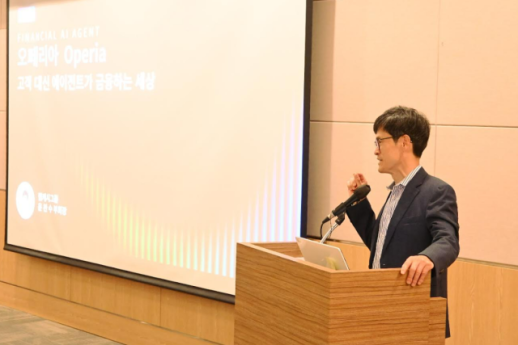 Webcash to Shift From Cash-Management Tools to Financial AI Agents First-generation South Korean fintech firm Webcash said it will move beyond basic cash-management software and reposition itself as a specialist in “financial AI agents” that can carry out banking tasks directly. Webcash on April 23 held the “Financial AI Agent Conference 2026” at FKI Tower in Seoul’s Yeouido district and outlined a commercialization strategy centered on its core technology, OPERIA. OPERIA is an “intelligent connector” that links general-purpose AI with financial institutions’ relational databases. It converts natural-language requests into standard query language, or SQL, then extracts data and executes tasks within banks’ information and core account systems, the company said. Webcash said the technology can be deployed while keeping existing systems in place, avoiding data migration and helping maintain security and stability. It also said internal tests showed about 99% accuracy. Based on OPERIA, Webcash said it will pursue three agent businesses: cash management, AI banking and management information. It plans to convert major products to an agent-based model in the first half of the year and apply natural-language AI to internet banking to enable “agent banking” that performs tasks such as inquiries, transfers and filings. At the event, Webcash introduced “Cash Management Agent V2” and disclosed use cases for key services including BranchQ. It said it is expanding deployments centered on NH NongHyup Bank and strengthening functions that analyze and forecast corporate cash flows. Webcash said it is conducting an agent-banking proof of concept with NH NongHyup Bank and running a management-information agent pilot with Gwangju Bank, expanding cooperation across the financial sector. Kang Nam-hoon, a vice representative director, said BranchQ has been upgraded to interpret the context of user questions and convert them to fit database structures, and that accuracy has been raised to about 99% by expanding validation data. He said the company has also adopted “context engineering,” moving away from coding-centered development to a prompt-based approach that reflects customer needs and allows faster creation and deployment of customized agents for each company. Vice Chairman Yoon said internet and mobile banking have led customers to handle tasks themselves, but the next shift will be to AI agents carrying out work based on natural-language instructions. “Adopting AI agents is not a choice but an inevitable trend,” he said.* This article has been translated by AI. 2026-04-23 14:54:20
 -
 Korea Expressway Corp. Launches Emergency Management to Address Fuel, Supply and Safety Risks Korea Expressway Corp. said it is shifting to an emergency management system to respond in advance to overlapping internal and external risks, including persistently high oil prices tied to the Middle East situation, instability in construction-material supplies and a seasonal rise in spring traffic accidents. The company said April 23 it has elevated its regular executive meeting to an emergency management meeting and formed an executive-led task force to review key management issues, activating a companywide crisis-response framework. It held an expanded executive emergency management meeting at its headquarters, chaired by the acting president, with heads of regional units nationwide taking part. Participants discussed steps aimed at easing the public’s economic burden, including stabilizing gasoline prices and ensuring steady fuel supplies at expressway service stations; temporarily waiving tolls for route buses and late-night freight trucks; coordinating the timing of material use among agencies to cope with supply uncertainty for items such as asphalt concrete; and continuously monitoring supply conditions to minimize construction delays. The meeting also reviewed specific measures to improve expressway safety, including operating a joint public-private accident investigation team to develop more effective traffic-accident prevention plans. Alongside headquarters-level steps such as the task force, the company said it will strengthen field-centered crisis management. It will assign headquarters executives as regional leads to directly inspect on-site safety and will keep a practitioner-led mobile inspection team operating at all times to closely manage customer-facing facilities such as rest areas and gas stations. Lee Sang-jae, acting president of Korea Expressway Corp., said, “With severe conditions driven by internal and external uncertainty, we must fulfill the responsibilities of a public institution based on strict public-service discipline.” He added, “Under the emergency management system, we will bring together our full capabilities to minimize inconvenience to the public and do our utmost to secure expressway safety and support people’s livelihoods.”* This article has been translated by AI. 2026-04-23 14:51:19
 -
 Wildfire Breaks Out in Taebaek; 4 Helicopters Deployed to Contain It A wildfire broke out in Jangseong-dong, Taebaek, in Gangwon Province, and forestry authorities are working to contain it. According to Yonhap, the fire started at about 1:43 p.m. Thursday in a national forest in Jangseong-dong. Fire and forestry officials, along with local authorities, deployed 49 personnel, 14 pieces of equipment and four helicopters to fight the blaze. Authorities said they plan to investigate the exact cause after the fire is brought under control.* This article has been translated by AI. 2026-04-23 14:48:32
 -
Hyundai Motor says supplier fire in Daejeon disrupts some production, seeks alternatives Hyundai Motor Co. said Thursday that a fire at an engine valve parts supplier in Daejeon has caused disruptions to some production. Speaking on a conference call after releasing first-quarter results, the company said it is conducting internal tests to qualify replacement parts and expects operations to gradually normalize starting in April. Hyundai Motor said it will also seek alternative parts in global markets and aims to normalize production through the second half of this year. * This article has been translated by AI. 2026-04-23 14:48:13
-
 Hyundai Motor profit falls sharply on cost surge, misses expectation SEOUL, April 23 (AJP) - Hyundai Motor, South Korea's largest automaker, posted a sharp drop in first-quarter earnings amid rising cost pressures from U.S. tariff barriers and Gulf-related shocks. Operating profit for the first quarter of 2026 came in at 2.51 trillion won, down 30.8 percent on year and in line with the market consensus of 2.4 trillion to 2.6 trillion won compiled by FnGuide. The underperformance reflects multiple headwinds for carmakers – sharp rise in oil prices, slumped consumer sentiment, and supply-chain disruptions from the outbreak of a war in the Middle East on top of tariff risks and volatile exchange rate. The Korean won's weakening to crisis-period levels drove a sharp increase in warranty-related costs, while tariff burdens and higher raw material prices further squeezed margins. Revenue totaled 46 trillion won, up 3.4 percent from a year earlier and down 1.9 percent from the previous quarter. 2026-04-23 14:45:38