
Journalist

Lee Hugh
=
-
 CATL Unveils Semi-Solid Battery With 1,500 km Range and 6-Minute Fast Charge Up to 1,500 km on a single charge, full charge in 6 minutes 30 seconds, sodium battery mass production within the year... CATL (Ningde Shidai), China’s top battery maker by global market share, on the 21st unveiled new battery technologies and a product roadmap as competition in electric-vehicle batteries intensifies. The company’s announcements were widely seen as an effort to widen its lead. According to Chinese media including 21st Century Business Herald, CATL held a “Super Tech Day” event on the 21st. The main highlight was a “condensed-state” version of its flagship Qilin battery. CATL described the technology as a high-performance semi-solid battery — widely viewed as a step just short of an all-solid-state battery. CATL said it applied its own semi-solid electrolyte technology, combining an ultra-high-concentration nickel cathode with a silicon-based anode. The company put the energy density at 350 Wh/kg, among the highest levels for mass-produced batteries. Gao Huan, CATL’s chief technology officer, said the company upgraded from a liquid electrolyte to a condensed-state electrolyte to address safety issues “at the root.” Using a condensed-state electrolyte instead of a liquid reduces leakage risk and can significantly lower the chance of fire, he said. In driving tests, CATL said a premium sedan equipped with the battery traveled up to 1,500 km on a single charge. CATL also said the battery pack weighs less than 650 kg and has a volume of 309 liters — about 400 kg lighter and 225 liters smaller than a lithium iron phosphate, or LFP, battery capable of about 1,500 km under the same conditions. The company said the battery retains more than 85% of its capacity at minus 20 degrees Celsius and supports ultra-fast charging at 10C output, allowing a charge to 80% in about 10 minutes. CATL said the condensed-state battery is slated for premium models such as the Nio ET9 and Huawei M9, with mass production planned from the third quarter of this year. It also said the pilot production line has achieved a yield of more than 95%. Industry observers described the announcement as a potential turning point as power-battery technology moves from liquid electrolytes toward solid electrolytes. They said higher energy density and longer range could accelerate adoption of premium EVs and broaden potential uses in emerging markets such as low-altitude aircraft and ultra-long-haul commercial vehicles. CATL also unveiled its third-generation Shenxing ultra-fast-charging battery. The company said it achieved a full charge in just six minutes at room temperature, setting a new benchmark for charging speed. That would be faster than the roughly nine-minute full charge claimed last month by rival Chinese automaker BYD for its second-generation Blade battery. CATL also announced plans to begin mass production of sodium-ion batteries within the year. Sodium batteries are seen as a next-generation technology that could reduce reliance on lithium, cobalt and nickel, drawing attention for cost stability and supply-chain considerations. CATL also said it will accelerate expansion of battery swapping and charging infrastructure. Working with Chinese automakers, it plans to build 100,000 charging and battery-swap stations by the end of 2028. CATL attributed its technology push to heavy research and development spending. Chairman Zeng Yuqun said the company invested more than 100 billion yuan in R&D over the past decade, including 20 billion yuan last year. He said CATL holds more than 60,000 patents and has ranked No. 1 for six consecutive years in patent application growth. 2026-04-22 12:27:19
 -
 Police Seek Arrest Warrant on Murder Charge in Cargo Truckers Union Death Police have launched a full investigation into a fatal incident at a rally by the Cargo Truckers Solidarity Division of the Korean Confederation of Trade Unions’ Public Transport Workers’ Union. South Gyeongsang Provincial Police said Tuesday that its major crimes unit applied for an arrest warrant for a nonunion man in his 40s, identified as A, on suspicion of murder after he drove a cargo truck into the crowd during a rally on April 20 in front of the CU Jinju Logistics Center (BGF Logistics Jinju Center) in Jinju’s Jeongchon-myeon. Police said one union member died and two others were injured. A was initially arrested on an emergency basis on suspicion of aggravated assault. Police later applied the murder charge after concluding there was implied intent, according to the report. Investigators reviewed video from the scene and analyzed the truck’s digital tachograph (DTG) data, it said. In questioning, A was quoted as saying the scene was chaotic and he drove to get out quickly, and that he did not intend to injure anyone. Police also applied for arrest warrants for two union members, identified as B, in his 60s, and C, in his 50s, on suspicion of offenses including obstructing official duties with violence. B is accused of driving a van during the rally and injuring some police officers. C is accused of using a weapon at the same rally site on April 19 to attempt self-harm or of threatening police by saying he would harm unspecified people.* This article has been translated by AI. 2026-04-22 12:18:17
 -
 FSS: More Financial Firms Put Consumer Protection on Board Agendas and KPIs Financial firms are increasingly adopting management practices that put consumer protection at the center, South Korea’s Financial Supervisory Service said. The watchdog said that, among 77 companies subject to its financial consumer protection assessment, 69 now report their consumer protection management strategy to their boards of directors. It also said 15 companies operate a consumer protection-related subcommittee within the board. The FSS said the biggest shift is the board’s role. The number of companies that directly report consumer protection strategies and policies to the board rose to 69 from 55, while those that set up a related board subcommittee increased to 15 from two. The agency said consumer protection is moving beyond day-to-day operations and into discussion at the top decision-making level. The FSS cited examples. Hana Securities runs a consumer risk management committee led by outside directors and regularly reviews related agenda items. Tongyang Life appointed an outside director with expertise in consumer protection policy and then created a Financial Consumer Protection Committee. The agency said boards are shifting from simply receiving reports to making judgments themselves. The standing of chief consumer officers, or CCOs, has also strengthened. The FSS said 64 companies granted CCOs the right to reach prior agreement on key matters such as KPI design and the authority to demand improvements. It said 51 companies now guarantee CCO terms of at least two years, giving consumer protection units a minimum level of authority to check sales-driven structures. Samsung Securities changed the appointment and dismissal of its CCO to a matter requiring a board resolution and put the CCO’s authority in writing, the FSS said. KB Card extended the CCO term to three years and arranged for an effective veto to apply in key decisions, it said. Changes are also spreading to performance and compensation systems. The FSS said 69 companies reflected consumer protection indicators in CEO KPIs, and some firms moved to expand related organizations and staffing. Still, the FSS said more work is needed for the system to take hold. It said 41 companies — about half — appointed directors with consumer protection expertise, and 45 reflected related indicators in employee KPIs. Follow-up actions managed through IT systems also fell short of half, it said. * This article has been translated by AI. 2026-04-22 12:05:36
 -
 Korea’s Resident Foreign-Currency Deposits Post Record $15.37B Drop as Won Slides Into 1,500s Resident foreign-currency deposits in South Korea posted their biggest monthly drop on record last month as the won-dollar exchange rate surged and moved in the 1,500-won range. The Bank of Korea said increased demand for currency exchange and outflows tied to overseas investment both weighed on balances. According to the central bank’s “Trends in Resident Foreign-Currency Deposits” released on April 22, resident FX deposits at foreign-exchange banks totaled $102.17 billion at the end of March, down $15.37 billion from a month earlier. Resident FX deposits refer to foreign-currency deposits held domestically by Korean nationals and companies, foreigners who have lived in South Korea for at least six months, and foreign companies operating in the country. The balance rose in November last year (+$1.7 billion) and December (+$15.9 billion), then fell in January (-$1.4 billion) and February (-$490 million). By currency, dollar deposits totaled $85.64 billion, down $10.36 billion. The central bank cited stronger corporate demand for won and larger currency conversions as the exchange rate rose to 1,530.1 won per dollar at the end of March from 1,439.7 at the end of February. It also pointed to declines in securities firms’ client deposits, overseas investment execution and payments for current transactions. Euro deposits fell $3.28 billion to $6.31 billion, reflecting settlement remittances to overseas parent companies. Yen deposits declined $1.49 billion to $7.82 billion due to securities firms’ client deposits and current-transaction payments. By holder, corporate deposits dropped $13.43 billion to $86.8 billion, while individual deposits fell $1.93 billion to $15.37 billion. By bank type, FX deposits at domestic banks decreased $11.36 billion to $87.24 billion. Deposits at local branches of foreign banks fell $4.0 billion to $14.93 billion.* This article has been translated by AI. 2026-04-22 12:04:47
 -
 Korea Fines SM Hwajin, Korea Cubic 2.6 Billion Won for Bid-Rigging Auto Interior Contracts South Korea’s Fair Trade Commission said Tuesday it issued corrective orders and fined SM Hwajin and Korea Cubic a combined 2.6 billion won ($1.9 million) for colluding in bids for surface treatment of vehicle interior materials. The two companies are suppliers to Hyundai and Kia and together hold a 100% share of the automakers’ bidding market for hydrographic transfer, a surface-treatment method used on interior materials, the commission said. The commission said the firms took part in Hyundai and Kia bids held from September 2020 to April 2023 to select contractors for interior surface-treatment work for five new models, including the Sportage, EV9, Santa Fe and EV3. According to the commission, the companies agreed in advance on the expected winners and bid prices. SM Hwajin was to win the interior surface-treatment volume for four models, including the Sportage and EV9, while Korea Cubic was to win the volume for the Palisade. The commission said the conduct violated Article 40(1) of the Monopoly Regulation and Fair Trade Act. It imposed fines totaling 2.591 billion won — 1.632 billion won on SM Hwajin and 959 million won on Korea Cubic — along with corrective orders. The commission said it will strengthen monitoring of collusion in intermediate goods and parts, citing the sector’s broad spillover effects across upstream and downstream industries, and will respond strictly when violations are confirmed.* This article has been translated by AI. 2026-04-22 12:03:27
 -
 South Korea’s February Births Rise 13.6% for 20th Straight Month, but Population Still Shrinks South Korea’s number of births in February rose 13.6% from a year earlier, extending an increase to 20 straight months, according to the National Data Center. Births increased in every province and major city, and the total fertility rate moved closer to 1.0. Still, the country’s overall population continued to decline for the 76th consecutive month. In its “February 2026 Population Trends” report released Tuesday, the agency said 22,898 babies were born in February, up 2,747 (13.6%) from the same month a year earlier. Births have been rising for 20 months since July 2024, when they increased 7.8%. The total fertility rate — the average number of children a woman is expected to have over her lifetime — was 0.93, up 0.10 from a year earlier. Births rose year over year in all provinces and major cities. By birth order, the share of first-born children rose 1.2 percentage points from a year earlier, while the shares of second-born and third-or-higher births fell 0.5 and 0.6 points, respectively. Deaths totaled 29,172 in February, down 1,069 (-3.5%) from a year earlier. Deaths increased in five provinces and major cities, including Busan and North Chungcheong, and decreased in 12, including Seoul and Daegu. With deaths exceeding births, the natural population change was minus 6,275. Natural decrease has continued for 76 consecutive months since November 2019, when it was minus 1,685. Marriages, often seen as a leading indicator for births, totaled 18,557, down 811 (-4.2%) from a year earlier. Divorces fell to 6,197, down 1,149 (-15.6%). In the first quarter, the number of people who moved was 1.792 million, up 2.3% (40,000) from a year earlier. The migration rate rose 0.3 percentage points to 14.3%. Net migration by province and major city showed net inflows in seven areas, led by Gyeonggi (11,946), Seoul (3,955) and Incheon (3,740). Ten areas posted net outflows, including South Gyeongsang (-5,707), Gwangju (-3,973) and North Gyeongsang (-3,480). By age, movers were most concentrated in their 20s (453,000) and 30s (378,000). Migration rates were highest among people in their 20s (32.6%) and 30s (23.0%). Last month, 609,000 people moved, up 11.0% from March 2025. The March migration rate — movers per 100 people — was 14.1%, up 1.4 percentage points from a year earlier. Moves within the same province or major city accounted for 61.2%, while moves between provinces and major cities made up 38.8%. From a year earlier, within-area moves rose 9.1% and between-area moves increased 14.5%. Net migration in March showed net inflows in seven areas, including Gyeonggi (2,165), Incheon (1,586) and North Chungcheong (1,533). Net outflows were recorded in South Gyeongsang (-1,648), Gwangju (-1,547) and Ulsan (-1,143). * This article has been translated by AI. 2026-04-22 12:03:00
 -
 USFK commander warns against 'political expediency' in wartime opcon transfer SEOUL, April 22 (AJP) - Gen. Xavier Brunson, commander of United States Forces Korea (USFK), warned Tuesday that “political expediency should not outpace the conditions” in discussions over the transfer of wartime operational control (OPCON), as Seoul pushes to complete the transition within the current administration. Testifying before the U.S. Senate Armed Services Committee, Brunson stressed that the focus should remain on meeting the necessary requirements rather than adhering to a fixed timeline. His remarks come as the government of Lee Jae Myung pushes to complete the wartime OPCON transfer within its term, with the timeline to be determined based on agreed conditions under the allies’ framework. “We’ve got to stay focused on the conditions because the United States is safer that way and the Republic of Korea is safer that way,” Brunson said. Under this framework, the OPCON transition hinges on three key conditions: South Korea’s military capability to lead combined defense; the alliance’s comprehensive ability to respond to North Korea’s nuclear and missile threats; and a security environment on the Korean Peninsula and in the broader region conducive to a stable transfer. Seoul’s five-year state policy plan, unveiled in August, includes the goal of reclaiming OPCON, with speculation that a target year for the transition could be proposed at the annual Security Consultative Meeting (SCM) in Washington in October. The USFK commander also reaffirmed his position that the focus of U.S. forces in Korea is shifting from troop levels to capabilities. “The Korean Peninsula is key strategic terrain vital to defending the American homeland and advancing American interests in the region,” he said, noting that USFK is undergoing modernization to address rapidly evolving strategic challenges. “That’s why my focus remains strictly on capabilities over numbers,” Brunson added, emphasizing that while forward deployment remains a baseline, understanding the shift from force size to operational capability requires prioritizing the specific capabilities needed on the peninsula. His remarks come amid broader discussions under the administration of Donald Trump on adjusting the global posture of U.S. forces in line with a new National Security Strategy, fueling speculation that some USFK units could be redeployed or restructured as part of efforts to counter China. Brunson also pointed to USFK participation in Indo-Pacific Command exercises, saying it demonstrates the potential to project capabilities from Korea to support deterrence across the region. His comments are seen as signaling a possible expansion of USFK’s role beyond deterring North Korea to contributing to broader efforts to counter China in the Indo-Pacific. On reports that a Terminal High Altitude Area Defense (THAAD) system had been moved to the Middle East amid tensions involving Iran, Brunson denied any such transfer. “We’ve not moved any THAAD systems. So THAAD still remains on the peninsula currently,” he said, marking the first public confirmation by a senior U.S. official. He added that munitions are being sent “forward” and are “sitting right now waiting to move,” though it remains unclear whether he was referring to THAAD-related components or general ammunition. 2026-04-22 11:57:30
 -
 South Korea Returns 12 Chinese Troops’ Remains From Korean War, Resumes Vice-Minister Ceremony South Korea’s Ministry of National Defense said it held the 13th handover ceremony for the remains of Chinese troops from the 6·25 War on the morning of April 22 at Incheon International Airport. The ministry said the event was co-hosted by Defense Vice Minister Lee Doo-hee and Xu Yao, a vice minister at China’s Ministry of Veterans Affairs. South Korea repatriated 12 sets of remains this year. From 2014 through last year, it returned a total of 1,011 sets, bringing the cumulative number repatriated to 1,023, the ministry said. The ceremony included the signing of documents for the transfer, a Chinese memorial service, the movement of the remains and placement aboard a military aircraft, and remarks by representatives from both sides. South Korea has held official events, including handover ceremonies, each year since 2014. It skipped public ceremonies for the 11th repatriation in November 2024 and for last year’s 12th repatriation, then resumed a vice-minister-level public event for the first time in three years. China Central Television reported that China’s delegation tasked with receiving the remains of Chinese People’s Volunteers soldiers in South Korea departed for South Korea on April 19 and was to take custody of the remains on April 22 before returning. CCTV said China deployed its newest large transport aircraft, the Y-20B, for the mission. * This article has been translated by AI. 2026-04-22 11:45:00
 -
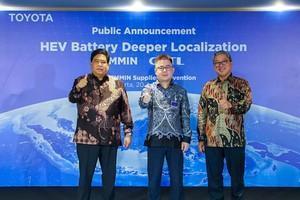 Toyota Indonesia Unit to Produce Hybrid Battery Cells, Modules With China’s CATL Toyota Motor Manufacturing Indonesia, Toyota Motor Corp.’s manufacturing unit in Indonesia, said on the 20th it will work with China’s automotive battery maker CATL to produce battery cells and modules for hybrid vehicles. TMMIN said it will invest 1.3 trillion rupiah (about 12.0639 billion yen) and plans to begin exports in the second half of this year. The cells and modules, now largely imported, will be made at a CATL plant being built in West Java. TMMIN currently packages batteries for hybrid versions of the multipurpose vehicle KIJANG INNOVA ZENIX, the small MPV VELOZ and the small SUV YARiS CROSS at its Karawang plant in the same province. By producing cells and modules locally, the company aims to raise the local content ratio, known as TKDN. TMMIN said the project will help develop Indonesian talent, reduce reliance on imports and strengthen Indonesia’s position as a production and export hub for vehicles and auto parts. CATL, through its subsidiary CBL, is also pursuing an integrated production project with Indonesian state-owned companies, including Indonesia Battery Corp., a holding company for automotive battery manufacturing, and mining firm Aneka Tambang Tbk. The project includes a nickel smelter and an electric-vehicle battery plant. Nickel is also used in hybrid-vehicle batteries.* This article has been translated by AI. 2026-04-22 11:40:16
 -
 AI Search Battle Intensifies in South Korea as Naver Faces New Rivals South Korea’s search market is entering a major turning point as the long-standing dominance of Naver is being tested by the spread of AI technology. Google has introduced “Gemini in Chrome” in the Korean market, while Naver has responded with an AI tab. Kakao has also joined the race by adding AI search inside KakaoTalk. For years, Korea’s search market has been shaped by local strengths. Naver has held an edge in Korean-language processing, local information, and links to everyday services such as cafes, blogs and shopping. Market research tallies have put Naver’s share in the 60% range, at times topping 70%, reflecting that foundation. But the rules of competition are changing in the AI era. Search is shifting from showing lists of links to understanding user intent and summarizing, comparing and recommending information. That shift helps explain the attention on Google’s push. Few companies control a search engine, browser, operating system and a global AI model at the same time. If AI is embedded directly into the Chrome browser so users can search, summarize and compare without switching services, user habits could change. The battleground would move from a portal homepage to the browser and operating system. Naver is not standing still. Its strategy of using an AI tab to pull together its large in-house ecosystem — including news, blogs and cafes — and expand into conversational search is a practical approach. Its Korean-language data and understanding of domestic users remain clear assets. Still, the company cannot rely on familiar market standing. Users want the most accurate, fast and convenient service, not simply the No. 1 provider by share. Kakao’s move also bears watching. If AI search becomes a routine feature inside KakaoTalk, the starting point for search could shift. Solving questions immediately during a chat is a different pattern from portal-based searching. It suggests the market is moving from competition on a single platform to competition across multiple daily-life platforms. The outcome matters beyond corporate rivalry, with implications for South Korea’s broader digital industry. If domestic companies fall behind in AI search, the effects could ripple through the advertising market, content distribution, data sovereignty and the ability to secure technical talent. If homegrown firms prove competitive, the Korean-language AI ecosystem could advance. Policymakers also have a role, with the priority on building fair conditions rather than protecting specific companies. Authorities should move quickly to clarify rules for data use, copyright, algorithm transparency and systems to address misinformation. Markets should compete through innovation, while the state supports order. Naver’s 70% share is a record of past performance, not a guarantee of the future. In the AI era, the search market is effectively back at the starting line, with the focus shifting from defending an old throne to building future competitiveness.* This article has been translated by AI. 2026-04-22 11:39:21