
Journalist

Lee Hugh
=
-
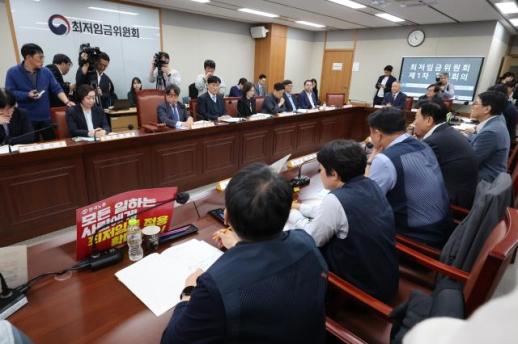 South Korea Minimum Wage Talks Begin as Labor, Business Clash Over 2027 Raise Labor and business in South Korea began formal negotiations over next year’s minimum wage, setting the stage for a sharp clash over how much it should rise. Labor groups say a sizable increase is needed after three years of raises below 3%. Business groups argue that growing uncertainty at home and abroad calls for a slower pace. The Ministry of Employment and Labor said the Minimum Wage Commission held its first plenary meeting Monday at the Government Complex Sejong. The commission selected Sookmyung Women’s University professor Kwon Soon-won as its new chair, received a wage-review request sent by Employment and Labor Minister Kim Young-hoon on March 31, and discussed the review schedule. During the meeting, members affiliated with the Korean Confederation of Trade Unions walked out in protest of Kwon’s appointment. The minimum wage system, introduced in 1988, has generally trended upward. The minimum wage for 2026, set last year, rose 2.9% (290 won) from the previous year to 10,320 won an hour, up 59.5% from 2017’s 6,479 won. Labor groups say the latest increase was the lowest for a first year under any administration, and they cite a decline in real wages. Over the past three years, the minimum wage rose an average of 2.4%, while consumer prices increased 2.7% over the same period, they said. Ryu Gi-seop, secretary-general of the Federation of Korean Trade Unions, said the minimum wage is failing to perform its basic role of income protection and redistribution. He also said the number of low-wage workers in the labor market has been growing each year, underscoring the need for an increase. Business groups pushed back, saying the burden on small merchants is heavy as domestic demand recovery remains delayed and uncertainty has intensified, including due to the war in the Middle East. They also pointed to severe debt levels among the self-employed and called for moderation. Ryu Gi-jeong, executive director of the Korea Employers Federation, said self-employed people already carry debt equal to 3.4 times their annual income as of the third quarter of last year. He said the economic shock from the Middle East war is spreading broadly and that the wage decision should reflect employers’ ability to pay. By law, the commission is supposed to finish deliberations within 90 days of the minister’s request, meaning by June 29. However, the deadline is advisory and is often missed, raising expectations that talks could run into early July this year as well. Kwon urged labor, management and the public interest members to keep talking through their differences. He called for intensive deliberations so the minimum wage can be set at a reasonable level despite sharply divided views.* This article has been translated by AI. 2026-04-21 17:52:34
 -
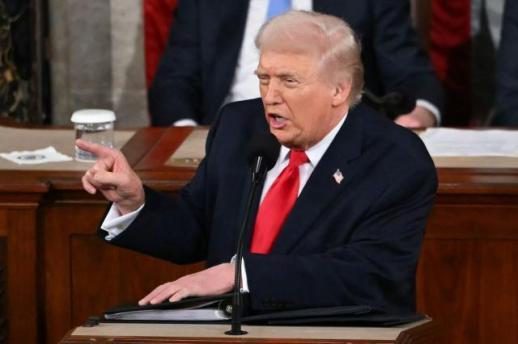 NBC Poll: Trump Approval Hits Second-Term Low as Inflation, Iran War Weigh President Donald Trump’s approval rating has fallen to its lowest level since the start of his second term, according to a new NBC News Decision Desk poll. The survey, released Sunday, put Trump’s job approval at 37%. That was down 2 percentage points from early February and down 8 points from April last year. His disapproval rating was 63%. Views were more negative on inflation and the cost of living. On Trump’s handling of rising prices and living costs, 32% approved and 68% disapproved, including 52% who said they “strongly disapprove.” The results were seen as reflecting growing pressure from higher oil and gasoline prices. The Iran war also appeared to be weighing on public opinion. NBC reports citing the poll said the war and inflation together helped drive down Trump’s approval. Trump said Sunday that gasoline prices would fall immediately after the Iran war ends, but administration officials also suggested the drop could come later. Support among core Republican voters has largely held, though positive views within the party slipped 4 points from the previous survey. Reuters said the combination of higher gasoline prices, inflation and the war is adding to the White House’s political burden ahead of the midterm elections. NBC News Decision Desk conducted the online poll with SurveyMonkey from March 30 to April 13 among 32,433 U.S. adults. The margin of error was plus or minus 1.8 percentage points.* This article has been translated by AI. 2026-04-21 17:51:47
 -
 Si Woo Kim Rises to No. 26 in World Golf Ranking, Matching Career High Si Woo Kim climbed to No. 26 in the men’s world golf ranking after finishing third at the PGA Tour signature event RBC Heritage, which had a $20 million purse. In the rankings released on the 20th (Korean time), Kim rose four spots from No. 30 last week. Kim posted a 16-under 268 total at the RBC Heritage, which ended on the 20th, finishing behind winner Matt Fitzpatrick of England and runner-up Scottie Scheffler of the United States, who both finished at 18-under 266. It was Kim’s third top-five finish and fifth top-10 result of the season. He matched his career-best world ranking of No. 26, a mark he first reached in February, returning to that position two months later. Kim is the only South Korean player inside the top 50. Im Sung-jae is No. 76, Kim Seong-hyeon No. 137 and Kim Ju-hyeong No. 139. The top two were unchanged, with Scheffler at No. 1 and Rory McIlroy of Northern Ireland at No. 2. Fitzpatrick jumped to No. 3 from No. 7 last week.* This article has been translated by AI. 2026-04-21 17:51:02
 -
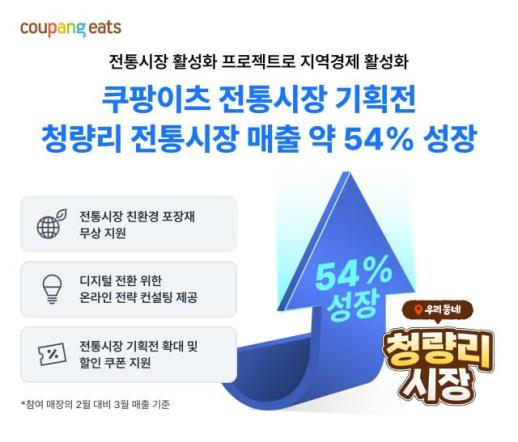 Coupang Eats Says Cheongnyangni Market Sales Rose 54% After March Promotion Coupang Eats said a promotion it launched to help revitalize traditional markets is showing measurable results. The company said Tuesday that sales at participating merchants on its platform rose about 54% in March from February, based on orders, after about 100 shops at Cheongnyangni General Market joined its “Our Neighborhood Traditional Market” campaign. Coupang Eats said the campaign was designed to promote products from small merchants at traditional markets, which it described as a backbone of local economies, and to encourage consumer spending. Cheongnyangni Market was selected as the first site, with participating businesses ranging from well-known food alleys — including fried chicken, jokbal and bossam, and soondae-guk and hangover soup — to grocery-style vendors selling side dishes, fresh fruits and vegetables, and seasonal seafood. A member of Coupang Eats’ store marketing team said the company offered Wow members a 2,000-won discount coupon during the promotion, helping customers buy market foods and groceries at lower prices, and that the benefit contributed to higher sales. Ohwadang, which sells Korean-style desserts at the market, said its sales jumped fivefold from the previous month as orders surged, adding that the increase helped introduce customers to items including butter glutinous rice cakes and other desserts. Yungane, a Korean restaurant that has operated at Cheongnyangni Market for 23 years, said orders and sales increased and that the coupon event was a major help. Gohyang Jokbal, which sells jokbal, said March is typically a slow period as the weather warms, but its sales nearly doubled as orders rose. Coupang Eats said it plans to run the “Our Neighborhood Traditional Market” campaign next at traditional markets in the Daegu area and expand it further. Kim Myeong-gyu, CEO of Coupang Eats Service, said the results at Cheongnyangni show traditional markets can strengthen their competitiveness through online channels, adding that the company will continue providing practical support so local markets can grow steadily.* This article has been translated by AI. 2026-04-21 17:50:12
 -
 Iran Military Says It Is Ready to Respond Immediately to Any U.S. Hostile Acts Iran’s military warned it is prepared to respond immediately and forcefully if the United States resumes what it called hostile actions, as expectations rise for a possible second round of talks between the two countries. Iran’s semiofficial Tasnim news agency reported that Ali Abdollahi, commander of the Khatam al-Anbiya Central Headquarters, which coordinates Iran’s armed forces, said in a statement on 21 (local time) that Iran’s military, “united with the government and the people,” is ready to deliver a “firm, decisive and immediate response” to threats and actions by the enemy, in line with the supreme leader’s guidance. He said Iran’s military remains in a position of advantage and would not be misled by what he called false claims and propaganda by the U.S. president aimed at distorting battlefield conditions, particularly regarding control of the Strait of Hormuz. He added that Iran would respond appropriately to any breach of agreements by the enemy. The United States and Iran, after entering a war on Feb. 28, accepted a “two-week ceasefire” proposal by Pakistan on the 7th of this month and held their first ceasefire talks in Islamabad, but failed to reach an agreement. The ceasefire was originally set to run through 21, but U.S. President Donald Trump extended it by one day, to the evening of 22 in U.S. Eastern time (23 in Iran). Despite the heightened tensions, reports say the two sides have again sent delegations, fueling expectations that a second round of ceasefire talks could be held in Pakistan on 22. Iran has not officially confirmed its participation, leaving uncertainty over whether the meeting will take place. * This article has been translated by AI. 2026-04-21 17:49:22
 -
 Budget Minister Park Hong-geun Says 'Vision 2045' Plan Due by Year’s End; Second Supplementary Budget Unclear Park Hong-geun, minister of the Ministry of Planning and Budget, said the government plans to report to the public by the end of this year on “Vision 2045,” a long-term national development strategy. On whether a second supplementary budget will be drafted, he said it was “too early to prejudge,” signaling caution. Speaking April 21 at the Government Complex Sejong in his first briefing with reporters since taking office, Park said he would prepare “a roadmap on a timeline” that would allow the government to present the 2045 plan within the year. “It is important to set a national vision early in an administration and, based on that vision, establish a medium-term fiscal strategy as well,” he said. Park was appointed March 25. It was his first official meeting with the press corps. The ministry passed its 100th day since its April 11 launch, but faced a leadership vacuum after its first minister-designate, Lee Hye-hoon, withdrew amid controversies. Park outlined three core agendas for the ministry: establishing a mid- to long-term national development strategy; strategic budgeting and allocation of financial resources; and fiscal management aimed at delivering tangible improvements in people’s lives. “We will set bold visions and goals, but push strategy based on concrete plans and the ability to execute,” he said. On Vision 2045, being prepared through a mid- to long-term strategy committee, Park said it differs from the 2006 “Vision 2030,” which he said was created near the end of the Roh Moo-hyun administration. This time, he said, work began early in the new government. He also said the effort is meaningful because it involves not only the government but also ministries, the National Assembly, private research institutions and the public. Park drew a line on the likelihood of a second supplementary budget for now. “This is the time to focus on swiftly executing the supplementary budget that was put together with difficulty, to maximize results and efficiency,” he said. Using a metaphor, he added, “The meal has been cooked and set on the table, but we haven’t even picked up the spoon yet. It’s not time to talk about the next meal.” Still, he did not rule it out entirely, saying that if an unexpected prolonged situation or worsening conditions occur, “it would be difficult for anyone to judge.” For next year’s budget, Park signaled aggressive spending cuts and restructuring. “We will boldly restructure unnecessary and non-urgent spending, and put the secured resources where they are needed for key state tasks and priority policies,” he said. He pledged to ensure that targets in the budget guidelines — a 15% cut in discretionary spending and a 10% cut in mandatory spending — do not end as “a flash in the pan.” He said he would consult with other ministries and pursue public discussion to carry out what he called an unprecedented restructuring. Park cautioned against excessive concern over the International Monetary Fund’s warning that South Korea’s national debt-to-GDP ratio could exceed 60% by 2030. “It’s not just whether the debt ratio is high or low; we also need to look at whether we have the capacity to bear it,” he said. He added that the IMF projection is only a forecast and has often overestimated outcomes, arguing that economic conditions, fiscal circumstances, policy responses and timing should be considered together. At the same time, Park acknowledged the need to manage the pace of debt growth. He said this year’s spending restructuring was the largest on record, and that the plan to cut mandatory spending by 10% next year reflects an intent to manage public finances strictly. He said it is important to create a virtuous cycle — as in Sweden or the Netherlands — by raising growth to expand GDP and, as a result, lower the debt ratio.* This article has been translated by AI. 2026-04-21 17:48:23
 -
 Yuyu Pharma Launches Prune-Based Probiotic Powder Sticks Yuyu Pharma said Tuesday it has launched “Janganehwaje Prunebiotics,” a probiotic product in powder stick form. The product combines prunes with four types of bifidobacteria and contains 100 million CFU of probiotics per stick, the company said. It is designed to be taken once a day, one stick at a time. Yuyu Pharma said it also includes six additional ingredients intended to support beneficial bacteria growth, including fructooligosaccharides, chicory dietary fiber and butyric acid bacteria. The company said it uses a synbiotic design that combines probiotics and prebiotics, and that the powder-stick format can be an option for consumers who have difficulty taking tablets or capsules. Woo Seung-pyo, head of Yuyu Pharma’s e-commerce division, said the product applies “easy-cut” packaging technology and offers a convenient way to help manage gut health.* This article has been translated by AI. 2026-04-21 17:40:38
 -
 Herbalife Korea Launches Limited-Edition 2026 Family Month Gift Sets Herbalife Korea said Tuesday it has launched a limited run of its “2026 Family Month Gift Set,” aimed at helping customers express appreciation to loved ones ahead of Family Month. The company said the sets reflect seasonal demand as outdoor activity increases in spring, with options focused on energy support, weight management and skin care. The packaging features a bright design intended for gifting. The flagship “Premium Triple Health Drink Gift Set” targets people who want help managing energy in busy daily routines. It includes 10 bottles of the “Triple Health Drink,” made with propolis, royal jelly and agaricus, for convenient energy support. The “NEW 7-Day Challenge Gift Set” includes the meal-replacement “Formula 1 Healthy Meal” in cookies-and-cream flavor, an “Herbal Beverage,” and a LocknLock Classic Mixer Shaker. The company said it is designed for people who prioritize routines such as balanced nutrition and hydration. Herbalife also introduced the “Firming and Moisturizing Inner-Outer Set,” combining inner beauty products and skin care. It includes collagen beauty powder, body lotion and cream, targeting spring demand for moisture and firmness care. Separately, the company is offering a gift box set that can hold “Formula 1 Healthy Meal,” expanding gift options. Jeong Seung-uk, CEO of Herbalife Korea, said Family Month is “an opportunity to share your feelings with the people who matter,” adding that he hopes the sets will help customers share everyday health with loved ones.* This article has been translated by AI. 2026-04-21 17:39:18
 -
 HiteJinro’s Premium Scotch ‘King Charles’ Rolls Out Nationwide at GS25 Convenience Stores HiteJinro’s British premium Scotch whisky brand ‘King Charles,’ which the company imports and distributes, is now available at neighborhood convenience stores. The company confirmed the product’s rollout to GS25 stores nationwide alongside a full package redesign, aiming to capture demand for what it calls “everyday premium whisky” through short-distance shopping channels. According to the liquor industry on the 21st, HiteJinro began selling ‘King Charles Blended Scotch Whisky’ this month at all GS25 locations nationwide. The move significantly expands distribution beyond liquor specialty shops to more than 10,000 convenience stores, widening consumer access. Timed with the convenience-store launch, the brand also refreshed its bottle design to reinforce its identity. To more clearly reflect the brand’s origin story honoring King Charles II—credited with leading a revival of British culture and the arts in the 17th century—the crown logo on the front label was changed to a more upscale, hand-drawn style. A silver-and-white Roman numeral “II” was applied consistently to the front and the cap, with gold accents added across the design. King Charles, for which HiteJinro has handled domestic distribution exclusively since November 2023, is made by blending selected premium malt spirits from Scotland’s Speyside and Highland regions with Lowland grain whisky in what the company describes as an optimal ratio. The product has also received international recognition, winning gold medals at the Global Scotch Whisky Masters in 2023 and 2025, and a gold badge at the International Spirits Challenge in 2024. “People who enjoy drinking at home and want to experience a premium blended whisky at a reasonable price will find it a top choice,” said Kwon Gwang-jo, HiteJinro’s premium area head.* This article has been translated by AI. 2026-04-21 17:38:32
 -
 LG Chem Launches Eutropin EcoPen 48 Growth Hormone Injector to Ease Self-Injection LG Chem said Tuesday it has launched Eutropin EcoPen 48, a replaceable-cartridge injector set for its Eutropin growth hormone, along with the dedicated injection solution, Eutropin Cartridge Injection 48IU. Unlike an all-in-one product, the EcoPen is designed for repeated use by swapping in a dedicated cartridge. Working with Switzerland-based Ypsomed, LG Chem applied a spring-driven, semi-automatic injection system to reduce the force needed to press by hand and make self-injection easier, the company said. The company also used metal materials to improve durability and added functions to set doses based on remaining volume and to check remaining volume in real time. The product uses a 48IU cartridge. LG Chem said it is the highest-capacity growth hormone product launched in South Korea, a feature intended to reduce replacement frequency and improve convenience. Kim Seong-ho, head of LG Chem's Specialty-Care business division, said the company has conducted an observational study of Eutropin in Korean children since 2012. "We will systematically build real-world data and present optimal treatment options," he said.* This article has been translated by AI. 2026-04-21 17:37:51