
Journalist

Lee Hugh
=
-
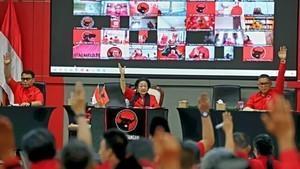 Indonesia’s Megawati urges revival of Bandung Conference amid global tensions Indonesia’s former President Megawati Sukarnoputri on the 18th called for the Asia-Africa Conference, known as the Bandung Conference, to be convened again so countries can renew solidarity, marking the 71st anniversary of the meeting that helped lay the foundations of the Non-Aligned Movement. Referring to U.S. attacks on Venezuela and Iran, she said “the international order is being shaken.” She said rising geopolitical tensions are “a wake-up call to the world,” and argued that countries should return to the principle of equality among nations set out in the “10 Principles of Bandung.” The Bandung Conference was held in April 1955 in Bandung, West Java, with 29 countries taking part. A joint statement issued afterward set out principles including respect for national sovereignty, noninterference in internal affairs and equality among states. Megawati is the eldest daughter of Sukarno, Indonesia’s first president and a “father of the nation.” She is chair of the Indonesian Democratic Party of Struggle (PDIP), the largest party in parliament. 2026-04-21 15:57:15
 -
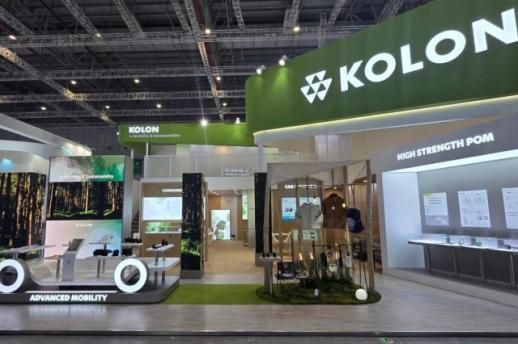 Kolon Industries to Showcase Sustainable Engineering Plastics at Chinaplas 2026 Kolon Industries is showcasing sustainable materials solutions at Asia’s largest chemical industry exhibition. The company said April 21 it is taking part in Chinaplas 2026, being held in Shanghai through April 24. Chinaplas draws about 4,000 companies worldwide and is considered one of the three major global chemical industry exhibitions, along with the U.S. NPE and Germany’s K-SHOW. Under the theme “e-Mobility & Sustainability,” Kolon Industries is exhibiting automotive engineering-plastics parts and high-strength POM (polyoxymethylene). It plans to highlight its sustainability capabilities with eco-friendly products such as PCR (post-consumer recycled) PA (polyamide) made with recycled plastics and bio-based POM. In automotive parts, the company is focusing on engineering plastics for electric vehicles. Its PA materials, citing high rigidity, dimensional stability, heat resistance and color stability, can be used for battery pack housings and charging door modules. Products using high-strength HS POM are also a key display item. The company said HS POM offers at least 10% higher mechanical strength and wear resistance than general POM and is used for auto window motor gears and seat belt parts. A dedicated display zone will be set up around the material. Kolon Industries is also presenting products for medical and consumer applications, including insulin pens, showerhead parts and cosmetic containers, to underscore quality competitiveness that meets global standards. As background, the company said it strengthened its high value-added portfolio by merging its engineering plastics subsidiary, Kolon ENP, into the parent company on April 1. It added engineering plastics to its mobility, specialty and chemical businesses as it accelerates a shift toward becoming a global specialty materials company. “Eco-friendly engineering plastics are an effective solution for building a sustainable industrial ecosystem,” said Jeong Hong-ryeong, head of Kolon Industries’ ENP Business Division. “We will continue to expand our eco-friendly product portfolio based on our technology.”* This article has been translated by AI. 2026-04-21 15:55:04
 -
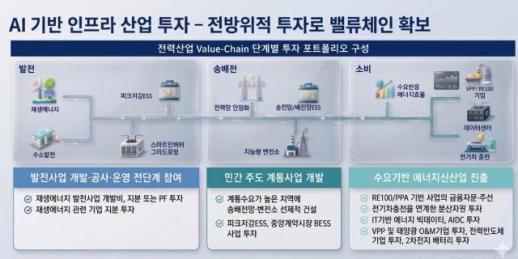 Samchully Asset Management Expands AI Infrastructure Investments in Power, Data Centers and Grids Samchully Asset Management is expanding integrated infrastructure investments across power generation, data centers and electric grids to meet demand in the artificial intelligence era. The firm said on the 21st it is pursuing a strategy that spans renewable power supply, a data center-centered infrastructure value chain, and next-generation grid investments such as CPOs (charging point operators) and VPPs (virtual power plants). To respond to surging electricity demand driven by wider AI adoption, the company said it is focusing on expanding a global renewable energy portfolio. It began in 2020 by forming a 200 billion won renewable-energy blind private equity fund and now manages four infrastructure PEFs totaling 396.1 billion won, along with multiple renewable-energy trust funds. It is investing a total of 1.55 gigawatts in projects in South Korea and in the United States, Australia and France, it said, to build a stable power-supply base. Samchully Asset Management is also accelerating efforts to secure a data center value chain. It said it is pursuing vertical integration, linking power production and supply to data center operations based on its own generation assets. In Yongin, Gyeonggi Province, it is investing to develop a 60-megawatt hyperscale data center and an urban edge data center. The company said it plans to combine external grid connections with its own generation facilities to ensure stable power supply. The firm said it is expanding investments aimed at building future power networks. On the physical side, it plans to build CPO infrastructure that includes electric-vehicle charging stations and energy storage systems. On the operational side, it plans to improve demand forecasting and efficiency through a VPP platform that integrates and manages distributed energy resources. The company said the goal is to optimize supply and demand and generate revenue through electricity sales. Samchully Asset Management said it has built broad investment experience from conventional energy to renewables, positioning itself as an energy-focused asset manager, and has expanded into alternative investments such as corporate finance and real estate. "We are expanding investments into a range of areas including AI-based infrastructure, secondary batteries and power semiconductors, and continuing proactive investment and management across the value chain," the company said. "We will lead investment trends and strengthen the foundation for future growth in a rapidly changing AI era." 2026-04-21 15:54:23
 -
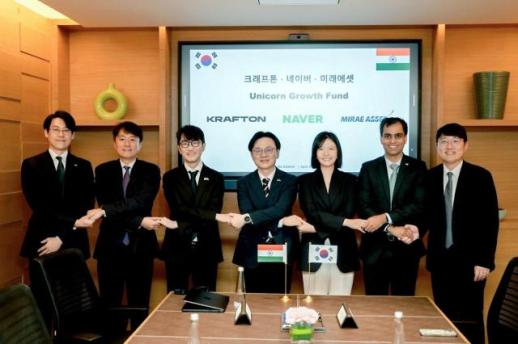 Naver, Krafton, Mirae Asset unveil India-focused tech fund during presidential visit SEOUL, April 21 (AJP) - South Korean internet giant Naver joined forces with gaming company Krafton and financial services firm Mirae Asset to hold a briefing in New Delhi on Tuesday to promote the Unicorn Growth Fund, a jointly established investment vehicle targeting up to 1 trillion won ($681 million) in high-growth technology companies across Asia with India at its core. The briefing was held on the sidelines of President Lee Jae Myung's three-day state visit to India, the first by a South Korean leader in eight years. South Korean Minister of Trade, Industry and Resources Kim Jung-kwan, who attended the briefing, said the initiative could serve as a bridgehead for Korean companies seeking to enter emerging markets. The fund, which began operations earlier this year with an initial pool exceeding 500 billion won, builds on the success of the Asia Growth Fund that Naver and Mirae Asset co-launched in 2018. That predecessor fund backed prominent unicorns including Indian food delivery platform Zomato and Southeast Asian ride-hailing giant Grab. Krafton CEO Kim Chang-han said the company would leverage its track record in India's gaming ecosystem to support promising firms through the fund. Separately, Naver has forged a strategic partnership with Tata Consultancy Services (TCS), the information technology arm of India's largest conglomerate, as it accelerates its foray into one of the world's fastest-growing digital economies. Naver said it signed a memorandum of understanding with TCS on Monday during the Korea-India Business Forum in New Delhi, hosted by the Federation of Korean Industries. Under the deal, the two companies will combine their capabilities in artificial intelligence, cloud computing and business-to-consumer services to pursue opportunities in AI transformation and digital transformation for Indian enterprises. The IT firm said it expects the partnership to unlock new revenue streams by pairing its platform technology with TCS's global service network and data assets. "As India is actively expanding its AI ecosystem with the goal of becoming an AI powerhouse, we expect to create new business opportunities through this partnership with TCS, leveraging collaboration in AI, cloud and B2C services," Naver CEO Choi Soo-yeon said. 2026-04-21 15:51:26
 -
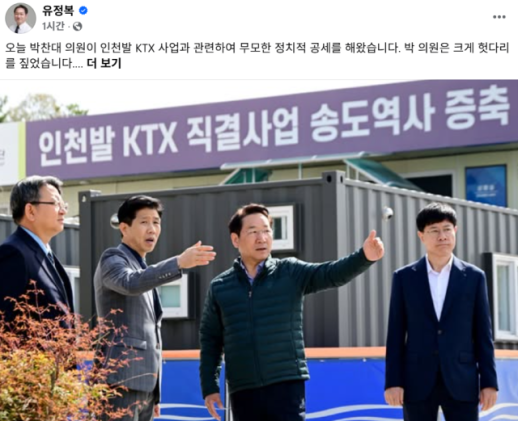 Incheon Mayor Yoo Jung-bok Rejects Lawmaker’s Criticism Over Incheon KTX Delays Incheon Mayor Yoo Jung-bok on April 21 pushed back against criticism from Rep. Park Chan-dae over delays to the Incheon KTX project. After Park raised the delay issue in a morning post on social media, Yoo responded in his own post following an inspection at Songdo Station. The Incheon KTX project is being pursued with a target opening in December 2026, and overall progress — including expansion work at Songdo Station — stands at about 71%. Yoo wrote that he had held back from talking about the project because it was “my biggest achievement,” but said Park’s mention of it gave him an opening to ask: “First, who came up with the Incheon KTX and who has pushed it forward; second, what role did the Democratic Party and Rep. Park play; and third, who interfered and delayed the Incheon KTX?” Yoo said he made the Incheon KTX his top campaign pledge when he ran for mayor in 2014, and that the project was pushed quickly with a 2021 opening target. He added that the transport minister at the time officially announced the opening would proceed without setbacks, and said he put the project “back on track” after returning as mayor in 2022. Yoo focused his criticism on the 2018 transition to the city’s seventh elected administration, writing that the incoming team for then-Mayor-elect Park Nam-choon announced a delay that “turned the 2021 opening goal into nothing,” leaving Incheon residents to bear the impact. In June 2018, Park’s transition committee said it expected the earliest possible opening to slip three years, from 2021 to 2024. The project was later delayed further through changes to the implementation plan. In 2025, the project’s completion date was adjusted again to December 2026, citing a cultural heritage excavation survey and measures to relocate legally protected species. Addressing Rep. Park, Yoo wrote that the Democratic Party had “stood by” during the confusion and delays under the seventh administration, and said Park — who Yoo wrote now intends to run for mayor — was trying to damage him without understanding the full context. Yoo added that Incheon residents already know where responsibility lies for the delay, and said Park should first apologize to the public. He also accused Park of political attacks, calling them “a self-defeating move” and “an own goal.” The Incheon KTX project includes building a new 3.19-kilometer connection line linking the Suin Line and the Gyeongbu high-speed rail line, and upgrading Songdo, Choji and Eocheon stations. Incheon City said during the site inspection that it plans to complete major work, including roadbed construction, by the first half of the year, begin integrated test runs in August, and aim for an opening by year’s end. At the site, Yoo called the Incheon KTX a key transport project that would significantly improve residents’ mobility, and urged thorough management to ensure safe, disruption-free construction. The city said it views the line as a core axis of regional transportation and is also pursuing plans to extend it to Incheon International Airport and to develop a mixed-use complex around Songdo Station.* This article has been translated by AI. 2026-04-21 15:51:22
 -
 South Korea Launches Global K-Founders Network in India to Expand Startup Cooperation South Korea's Ministry of SMEs and Startups said it held a launch ceremony Monday for the 'Global K-Founders Network in India' at the Global Business Center (GBC) in New Delhi. The Global K-Founders Network is an international project the ministry is starting this year to connect Korean entrepreneurs and investors working across the world. The ministry said it plans to step up efforts to help Korean startups expand overseas, including through high-level talks with the Indian Institutes of Technology (IIT). Starting with the India launch, the ministry said it will broaden exchanges to major regions including the United States, Europe and Southeast Asia, aiming to build a sustainable, private-sector-led framework for international cooperation. The ministry said it chose India as the first hub for supporting Korean startups abroad, citing the country's large domestic market and strong human resources. On Sunday, the ministry said it activated a Korea-India SME cooperation working group with India's Ministry of Micro, Small and Medium Enterprises and signed a memorandum of understanding to build a partnership to support small and midsize companies entering India. First Vice Minister Noh Yong-seok said, “If India's outstanding talent and Korea's innovative startup capabilities come together, it will create strong synergy, and we will further solidify cooperation between the two countries' startup ecosystems so that Korea's 'Entrepreneurship for All' can succeed on the global stage as well.” 2026-04-21 15:50:31
 -
 Anabuki-Backed JV to Manage Housing Complex at New Ho Chi Minh City Resort Condominium management firm Anabuki Housing Service said its Vietnam joint venture, Anabuki NL Housing Service Vietnam, in which it holds a 69% stake, signed an operations and management contract on the 18th with local company MDS for a housing complex being developed at a new resort in southern Ho Chi Minh City. The complex, LumiAn Village, is in the heart of the Dat Do resort area in the former Ba Ria-Vung Tau province. It will include townhouses and villas and feature gated shared amenities totaling 4,000 square meters, including a swimming pool, clubhouse, restaurant, pickleball courts, a golf practice range and an outdoor theater. Anabuki NL Housing Service Vietnam began managing LumiAn Village on the 10th of this month, covering 6.3 hectares. As of now, only the clubhouse, model home and swimming pool have been completed, and the residential area will be developed later. 2026-04-21 15:49:47
 -
 Samsung Compliance Chief Urges Caution as Union Plans Rally, Strike With a large rally by a Samsung Electronics labor union set for the next day, Lee Chan-hee, chairman of Samsung’s Compliance Monitoring Committee, urged caution, saying Samsung is viewed not simply as a private company but as a “national company.” He said many people are directly and indirectly connected to the company, including shareholders and investors, and the union should act more carefully. Lee made the remarks on April 21 before a regular meeting of the committee’s fourth term at Samsung Life Insurance’s Seocho building in Seoul. He said he hopes the labor-management conflict, which Samsung is facing for the first time, will be resolved “rationally and in an exemplary way” befitting the company’s standing. Samsung Electronics and the union remain deadlocked over wage talks, including a demand to remove the cap on performance bonuses, and negotiations have been suspended. Management proposed compensation that could exceed the cap on excess profit incentive pay, or OPI, through special rewards if the Device Solutions, or DS, division that runs the semiconductor business achieves the industry’s No. 1 position in South Korea. The union is demanding distribution of 15% of operating profit. The union plans to hold a large rally on April 23 at the company’s Pyeongtaek campus in Gyeonggi province and then strike from May 21 to June 7. The union claims a strike could cause losses of 20 trillion won to 30 trillion won if it leads to disruptions such as semiconductor line shutdowns. The company has asked a court for an injunction to bar what it calls illegal labor actions, citing the possibility of unlawful acts such as occupying worksites. A decision is expected soon. On the escalating dispute, Lee said reaching agreement through dialogue is most important, adding it was regrettable that the situation left room for the matter to move into criminal procedures. He said he agrees workers’ rights should be better protected, but added that human rights among workers should also be treated as a basic right. He said the union has not entered an illegal stage so far and added the committee is monitoring the situation to prevent any crackdown or violence driven by unlawful intent. The fourth-term committee, launched in February, has strengthened expertise in labor-management issues. It appointed Kim Kyung-sun, a labor and women’s policy expert, and Lee Kyung-mook, an expert in corporate organization and human resources management, as new members. Lee said the committee reorganized its labor subcommittee into a “Labor Rights Subcommittee” to match the expanded expertise. He said it will consult with a labor-management advisory group and set the committee’s direction based on expert advice. Lee also addressed prosecutors’ recent investigation into suspected insider trading involving Samsung Electronics and Rainbow Robotics. He said it is difficult to comment because the case is under investigation, but added the committee has reviewed the matter through affiliates. Prosecutors are investigating allegations that employees engaged in insider trading during Samsung Electronics’ acquisition of a stake in Rainbow Robotics. Last month, the Seoul Southern District Prosecutors’ Office’s joint financial and securities crime unit conducted searches and seizures at Samsung Electronics’ headquarters in Suwon, Gyeonggi province, and Rainbow Robotics’ headquarters in Yuseong-gu, Daejeon. Homes of employees at both companies who are subject to the probe were also included in the searches. 2026-04-21 15:48:54
 -
 Kim Sei-young Rises to No. 9 in Women’s Golf World Ranking After LA Championship Runner-Up Kim Sei-young, who finished second at the LPGA Tour’s JM Eagle LA Championship (total purse $3.75 million), moved up one spot in the women’s world rankings. In the rankings released April 21 (Korea time), Kim rose to No. 9 from No. 10 a week earlier. Kim led through the final day of the LA Championship, which ended April 20, but after finishing tied she lost in a playoff to Hannah Green of Australia. Im Jin-hee, who also went to the playoff and finished tied for second with Kim and Green, jumped eight places to No. 32. Yoon Ina, who posted her best finish since her LPGA Tour debut by placing fourth at the event, climbed 15 spots to No. 53. The top four were unchanged from last week: No. 1 Jeeno Thitikul of Thailand, No. 2 Nelly Korda of the United States, No. 3 Kim Hyo-joo and No. 4 Charley Hull of England. Green, the LA Championship winner, moved up to No. 5 from No. 8. Kim Min-sun, who won the KLPGA Tour’s Nexen·SaintNine Masters on April 19, jumped 29 places to No. 87. 2026-04-21 15:47:32
 -
 11st Launches 'Happy Family Week' Discounts for May Gift Shopping With high prices persisting, South Korean e-commerce platform 11st is rolling out a large-scale discount campaign aimed at shoppers feeling the pinch as they prepare gifts for May, a month marked by family holidays. 11st said Monday it will run its “Happy Family Week” promotion through May 8, offering special deals on gifts spanning all ages, from Children’s Day toys to Parents’ Day home appliances and budget-friendly health supplements. The event, held in collaboration with popular domestic and global brands, features price cuts, live-stream sales and exclusive free gifts, the company said. Among the headline deals, 11st will offer steep discounts on massage devices, a common gift for parents. On April 28, it will sell Bodyfriend’s healthcare robot “Legnum Robot” at a discount of more than 540,000 won off the list price. It will also bundle popular lines and official refurbished products from brands including “New Falcon” and “Da Vinci AI,” with discounts of up to 61%. For value-focused shoppers, 11st is also promoting health supplements priced in the 20,000- to 30,000-won range, including premium deer antler, black ginseng and black goat extract. Orders placed before midnight on weekdays will be delivered free the next day via its “Shooting Delivery” service, it said. Other discounted items include anti-aging cosmetics such as Sulwhasoo, luxury accessories including Louis Vuitton, and seasonal staples such as carnations and cash envelopes. For Children’s Day, 11st is partnering with Lego. It will host a Lego-themed live broadcast at noon on April 22, followed by a “Lego One-Day Big Deal” on April 23 offering up to 30% off selected sets, including Lego Harry Potter, City, Duplo and Super Mario Game Boy series products. The company is also issuing a daily first-come, first-served 4,000-won cart coupon for customers who spend at least 50,000 won in the toy category through the end of this month. During the event period running through April 26, the top spender on participating Lego items will receive a free gift valued at 250,000 won: a “Lego Technic McLaren Formula 1 Race Car.” “We will target the April-May gift market with ample inventory and benefits so customers can prepare gifts economically even amid high prices,” said Ko Kwang-il, head of 11st’s sales group. 2026-04-21 15:46:43