
Journalist

Lee Hugh
=
-
 Shinhan Bank Launches SOL Trip & J Debit Card With Japan Travel Perks Shinhan Bank said Tuesday it has launched the SOL Trip & J debit card with Shinhan Card, adding Japan-focused benefits to its travel card lineup. The card expands Shinhan Bank's SOL Travel debit card line and is billed as the financial industry's first debit card issued under the JCB brand, aimed at improving ease of use in Japan. It includes the existing SOL Travel benefits of 100% exchange-rate preferential treatment and waived overseas payment fees. Cardholders also receive 5% discounts at major merchants including Don Quijote and convenience stores in Japan, as well as at UNIQLO, MUJI and ABC Stores in Guam and Hawaii. Through JCB Special Offers, the card provides additional partner discounts, free access to JCB airport lounges and discounts at Hoshino Resorts, with no annual fee. To mark the launch, Shinhan Bank will run a promotion from Tuesday through May 29. Among customers who newly issue the card and apply for the event, the first 2,000 will receive 5,000 My Shinhan Points. Separately, 1,000 customers who make purchases of 10,000 won or more per transaction during the event period will be selected by drawing to receive a 10,000-won Olive Young gift card. A Shinhan Bank official said the card was designed to improve convenience and deliver practical benefits as demand for travel to Japan grows, adding that the bank will continue expanding travel financial services linked to overseas payments, remittances and partner offerings centered on the SOL Travel debit card.* This article has been translated by AI. 2026-04-21 14:46:46
 -
 Amazon’s New Anthropic Commitment Sharpens Split Market View Ahead of IPOs Market sentiment is sharply diverging over two AI giants expected to pursue IPOs, a split underscored by Amazon’s latest move involving Anthropic. Amazon has agreed to a conditional commitment of up to $25 billion in additional investment in Anthropic, according to the IT industry on Monday. The amount is more than triple Amazon’s existing $8 billion investment, but it is not a finalized disbursement. Investor demand for Anthropic has already become visible. In February, the company ran a $30 billion funding round that drew subscriptions more than six times its initial target, leaving demand outstripping supply. Some venture capital firms have also been reported to have approached the company with interest based on an $80 billion valuation. Driving the rush is competition to secure stakes ahead of a potential IPO. Anthropic is widely seen as likely to list on U.S. markets in the fourth quarter of this year. Goldman Sachs, JPMorgan and Morgan Stanley have been mentioned as potential underwriters, and Chris Liddell, described as a former Microsoft chief financial officer, has joined the board. The fundraising target is more than $60 billion; if completed, it would be the second-largest IPO on record after SpaceX, the report said. That prospect is pushing institutions to seek pre-IPO shares. OpenAI is also aiming for a fourth-quarter listing, but its internal situation differs. The report said there are disagreements between the CEO and CFO over timing, and some observers believe the IPO could slip to 2027. The market’s temperature toward the two companies is diverging most clearly on valuation. Industry sources said OpenAI would need a post-IPO valuation of at least $1.2 trillion to justify investment, while Anthropic’s current valuation is $380 billion. That implies OpenAI’s threshold for investors to recoup their money is more than three times Anthropic’s valuation. Signals from the private market have been more direct. Bloomberg reported on March 1 that about six large institutions, including hedge funds and venture capital firms, approached the over-the-counter market seeking to sell $600 million worth of OpenAI shares. Some of that stock was said to be difficult to sell. By contrast, demand for Anthropic shares has been described as close to unlimited. Amazon’s positioning adds another layer. Amazon, Anthropic’s largest shareholder since it began investing in 2023, also struck a deal in February involving a $50 billion investment in OpenAI and a $10 billion AWS cloud contract. The latest Anthropic commitment is being read not as a bet on a single model, but as an extension of a cloud strategy to capture AWS infrastructure demand regardless of which company wins. Anthropic, through the deal, has agreed to spend more than $100 billion on AWS over the next 10 years. 2026-04-21 14:45:59
 -
 The Cross Singer Kim Hyeok-geon Says He Had Articles Deleted After Paralysis Diagnosis The turbulent life story of The Cross vocalist Kim Hyeok-geon has been revealed. A video titled, “From a promising genius vocalist to becoming vegetative, Kim Hyeok-geon — what happened that day?” was posted Sunday on the YouTube channel “Special Report World - The Person From Back Then.” Kim, who was diagnosed with full-body paralysis after an unexpected traffic accident in 2012, shared an update on his life, saying he now relies on an AI system for assistance. He said he teaches social welfare courses at a university and works as a lecturer. Kim said he was preparing a comeback album after completing military service when he was in a traffic accident while traveling by motorcycle after practice. The crash damaged his cervical spine and left him paralyzed from the shoulders down. “Nothing moved, so I thought I’d become a vegetative person,” Kim said. “I was conscious, but I thought I’d have to live with my eyes open and unfocused, and I kept thinking, ‘Why did I wake up?’ I cried inside endlessly.” Kim said he hated the term “quadriplegia.” “I kept rejecting (my condition). I couldn’t accept it, and I called each newspaper and had all the articles deleted,” he said. “I tried everything I could. I even tried stem cell treatment six times. After trying everything, I came to accept it.” Kim said his father, who was diagnosed with stage 4 colon cancer, devised a machine to help his son sing again by pressing the abdomen to support diaphragmatic breathing. The device was built with help from a university research team, and Kim said he was able to sing again. He said the strong pressure from the machine also caused pain, including broken ribs and blood appearing in his urinary catheter. “I’m a rocker, so if I don’t sing, I don’t know what kind of person I am,” Kim said, describing his commitment to music.* This article has been translated by AI. 2026-04-21 14:45:06
 -
 Samyang Foods’ Buldak campaign music video tops 100 million YouTube views in two months Samyang Foods said Tuesday that the music video for its new global campaign, “Hotter Than My EX” (HTMX), has surpassed 100 million views within two months of its release on YouTube. The campaign features boy group BOYNEXTDOOR. The group reinterpreted its hit song “Earth, Wind & Fire” to fit the campaign concept and took part in producing the track, Samyang Foods said. The video reframes Valentine’s Day as a message about focusing on oneself, which the company said resonated with younger audiences. After the release, the music and concept drew positive reactions on social media and YouTube, prompting organic sharing by users, the company said. Samyang Foods said the 100 million-view milestone shows Buldak is moving beyond a food brand to become a cultural icon. The project also marks the first time the new character PEPPO has joined the Buldak universe. The company said PEPPO is helping expand touchpoints with global consumers through digital content such as music, challenges and memes. A Samyang Foods official said the campaign was designed to extend Buldak’s signature spiciness into “a means of confident self-expression.” The official said the company will continue to strengthen its position as a mega brand with innovative content that connects with global consumers’ lifestyles. 2026-04-21 14:44:31
 -
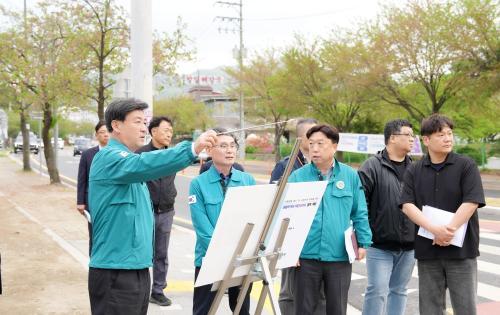 Gwangju Mayor Bang Se-hwan Vows Continued Push to Ease Traffic, Improve Living Conditions Gwangju Mayor Bang Se-hwan said Monday the city will keep working to ease traffic congestion and improve residents’ living conditions. Bang said the city has completed a roundabout project at Gwaneum Intersection, where Local Road 338 and National Support Local Road 88 meet, to address chronic congestion. The project targeted a stretch that repeatedly backed up on weekends and holidays as more vehicles headed from Toechon toward Yangpyeong. Construction began in December last year and was recently completed, Bang said. The project used 319.59 million won in provincial funding. The city converted the signalized intersection into a roundabout to reduce unnecessary stops, encourage slower speeds and improve traffic flow, while also lowering accident risk. During an on-site inspection, Bang said Gwaneum Intersection is a key link between Toechon and Yangpyeong and has repeatedly become a weekend bottleneck, causing major inconvenience. He said the roundabout will allow vehicles to pass without waiting for signals, improving conditions for residents and convenience for visitors. Bang said the city will continue identifying and fixing traffic trouble spots to create a safer, more comfortable road environment.* This article has been translated by AI. 2026-04-21 14:43:46
 -
 Lotte Chilsung Says It Cut Plastic Use by About 3,000 Tons Last Year Lotte Chilsung Beverage said Tuesday it reduced plastic emissions by about 3,000 tons last year by lowering the environmental impact of packaging across its production process under its ESG (environmental, social and governance) management approach. The company said its main strategy was to make containers lighter and expand the use of recycled materials. For bottled water, it introduced an ET-CAP with a lower bottle-neck height, cutting container weight by up to 12% and saving about 810 tons of plastic. It also expanded lightweighting to products including carbonated drinks, coffee, teas and soju, reducing preform weight by up to 5 grams per bottle. That led to a reduction of 1,650 tons, it said. For large-size products, it applied aseptic PET, cutting an additional 240 tons. Lotte Chilsung said it is also accelerating the shift to recycled inputs. In October last year, it launched what it called the country’s first PET bottle made with 100% recycled plastic for Chilsung Cider 500 mL. The company said the product cut plastic use by about 250 tons within two months of launch. This year, it is expanding the 100% recycled material to Pepsi Zero Sugar Lime 500 mL, Icis 500 mL and Saero 640 mL, it said. The company said it is working with the Korea National Park Service and the Korea Post’s postal service headquarters to build a “bottle-to-bottle” system that recycles used PET into food containers. Using clear PET collected at national parks as recycled feedstock, it said it has created a circular system of about 440,000 bottles a year, totaling 6.6 tons. A Lotte Chilsung Beverage official said the company is reducing environmental burdens through sustainable packaging technology while setting standards for the broader industry, and will continue linking ESG management to its business strategy to push its environmental transition. 2026-04-21 14:43:10
 -
 Hanwha Construction Partners With Mastern Investment Management on Real Estate Development Hanwha Construction said Tuesday it has partnered with Mastern Investment Management to expand its real estate development business. The companies signed a memorandum of understanding Monday at Hanwha Building in Janggyo-dong, Jung-gu, Seoul, to jointly pursue development projects. Attendees included Yoon Seong-ho, head of Hanwha Construction’s Development Business Division, and Park Kyung-bae, head of Mastern Investment Management’s Domestic Division 1. Hanwha said the agreement is aimed at moving beyond a construction-centered contracting model by combining financing and development. The partners plan to broaden cooperation in stages, from identifying new projects to establishing joint entities. The collaboration will cover the full development cycle, from early planning through post-completion operations. Hanwha said it will apply preconstruction services to review costs and schedules in advance and assess feasibility early, then take charge of design and construction to strengthen execution. Mastern will handle fundraising and investment-structure design, including securing project funding through investor recruitment and managing financial risks based on market conditions. After completion, it will also pursue value-up strategies to enhance asset value. Hanwha said it plans to build an integrated decision-making system spanning finance and construction, manage risks from the structuring stage and improve profitability. Over the longer term, it aims to secure a stable development pipeline and broaden cooperation with financial institutions to strengthen its base for sourcing new projects. “Based on the combination of finance and construction, we will strengthen our competitiveness in development and build a stable business structure,” Yoon said. Park said he expects “meaningful synergy” from combining real estate finance expertise with design and construction capabilities. Hanwha said it will sequentially expand cooperation with major financial institutions, including securities firms and asset managers, starting with this agreement. 2026-04-21 14:39:43
 -
 Masked Stepfather Who Tied 10-Year-Old Girl’s Hands Gets Suspended Prison Term A foreign man in his 30s who covered his face and tied up his stepdaughter’s hands has been given a suspended prison sentence. According to legal officials on the 21st, the Ulsan District Court’s Criminal Division 1 (Presiding Judge Bae On-sil) sentenced a Vietnamese national identified as A to one year in prison, suspended for three years, for violating the Child Welfare Act. Prosecutors said A entered the bedroom of his 10-year-old stepdaughter, identified as B, at their home in Yangsan, South Gyeongsang Province, in July last year. He concealed his face with a windbreaker and a neck warmer and wore work gloves. While the girl was looking at her phone, A repeatedly wrapped her hands and head with clear tape. The child fled the house, believing she was being kidnapped. The girl later suffered severe psychological shock and has been reported to fear being alone. A told investigators he did it “as a prank to play with the child.” The court said wrapping a 10-year-old girl’s body with clear tape “cannot be viewed as a prank.” It cited as mitigating factors that the tape was applied loosely enough for the victim to remove it herself, that A admitted wrongdoing, and that he is not meeting the victim.* This article has been translated by AI. 2026-04-21 14:39:03
 -
 Demand Deposits at Top South Korean Banks Drop Nearly 19 Trillion Won, Raising Loan-Rate Concerns Demand deposits at South Korea’s five major commercial banks fell by nearly 19 trillion won in the first half of this month, fueling concerns that lending rates could rise as banks’ funding costs increase. Financial industry data showed that as of April 16, demand deposits at KB Kookmin, Shinhan, Hana, Woori and NH Nonghyup Bank totaled 680.9236 trillion won. That was down 18.9845 trillion won from 699.9081 trillion won at the end of last month. Demand deposits can be withdrawn at any time and are widely viewed as cash parked on the sidelines. Because they pay little interest, their balances tend to move with capital-market sentiment. Market participants said the renewed decline suggests investors have shifted money back into financial markets, citing increased expectations for possible negotiations to end the U.S.-Iran conflict. A sharp outflow over a short period can raise banks’ funding costs. Demand deposits help keep average funding costs low because interest expenses are limited. When those balances shrink, banks may need to rely more on higher-cost funding such as issuing bank bonds or expanding higher-yield deposit products. That burden is likely to be passed on to borrowers, including companies, as higher funding costs can translate into higher loan rates. Corporate borrowing costs have already been rising as market rates, including government bond yields, have swung since the Middle East situation escalated. A Bank of Korea survey showed the weighted average interest rate on corporate loans at banks stood at 4.20% a year as of February, up 0.05 percentage point from the previous month. Rates rose to 4.13% for large companies, up 0.04 point, and to 4.28% for small and midsize firms, up 0.07 point. At the same time, demand for corporate loans to secure working capital has continued to grow. Corporate loan balances at the five banks totaled 859.7737 trillion won at the end of last month, up 15.0483 trillion won from the end of last year. In the Bank of Korea’s loan officer survey released that day, both large companies (14) and small and midsize firms (28) were expected to see higher loan demand as they seek liquidity amid rising domestic and external uncertainty. If Middle East-driven geopolitical risks persist and upward pressure on lending rates continues, companies’ financing burdens are expected to increase further. Concerns are growing that repayment strains could widen quickly, starting with smaller firms, and weigh on the real economy. “If the share of demand deposits falls, the average funding rate has to rise,” a financial industry official said. “Given domestic and external conditions, it is also difficult for the Bank of Korea to cut its policy rate, so upward pressure on lending rates is likely to persist for some time.” 2026-04-21 14:38:11
 -
 South Korea Supreme Court Upholds Acquittal of Lim Jeong-hyeok in Baekhyeon-dong Case Attorney Lim Jeong-hyeok, a former high prosecutors’ office chief accused of taking money in exchange for seeking to blunt an investigation into alleged corruption in the Baekhyeon-dong development case, has been cleared in a final ruling. According to legal officials on the 22nd, the Supreme Court’s Second Division (Justice Cheon Dae-yeop presiding) on March 12 upheld an appeals court decision acquitting Lim of violating the Attorney-at-Law Act. Lim was indicted after prosecutors said he received 100 million won in June 2023 from Jeong Ba-ul, chairman of Asia Developer and a private developer in the Baekhyeon-dong project. Prosecutors alleged the money was intended for cultivating ties with and lobbying public officials in connection with the corruption probe. The Baekhyeon-dong case centers on allegations that Seongnam city granted preferential treatment to a private developer, including raising land-use zoning by four levels at once and approving construction of apartments with a retaining wall. A trial court found Lim guilty and sentenced him to two years in prison, suspended for three years, and ordered forfeiture of 100 million won. The court said Lim’s alleged act of personally meeting senior officials at the Supreme Prosecutors’ Office to seek a noncustodial investigation for Jeong amounted to improper private contact by a former senior prosecutor turned attorney, and that taking a large sum in return for such a request fell outside permissible legal work. The appeals court overturned that ruling and acquitted Lim, rejecting the credibility of testimony by Lee Dong-gyu, former chairman of KH Real Estate Development, which had been central to the trial court’s conviction. The appeals court said Lee had a motive and likelihood to make false statements, citing indications he tried to align his account with investigators’ direction to claim cooperation and seek favorable consideration in his own case. It also noted that confirmed legal fees Jeong paid to more than 10 lawyers exceeded 2.8 billion won. Given Lim’s background as an attorney who had held senior prosecutorial posts and the public attention on Jeong’s case at the time, the court said it could not conclude that agreeing to a 900 million won success fee and receiving 100 million won as an initial retainer was so excessive that it could not be considered payment for normal legal representation. Lee’s own case was finalized at the Supreme Court in December 2024, when he received a three-year prison term and forfeiture of about 1.3 billion won. Another attorney, Gwak Jeong-gi, a former police superintendent indicted on similar allegations of taking money in return for seeking to blunt an investigation, was sentenced on appeal in December last year to two years and six months in prison, suspended for four years, and forfeiture of 50 million won. He has appealed.* This article has been translated by AI. 2026-04-21 14:37:20