
Journalist

Lee Hugh
=
-
 Young Women Are Transforming South Korea’s Pro Baseball Fan Culture Spring brings a familiar excitement in South Korea — not for cherry blossoms, but for baseball. Cheering sticks, coordinated chants, team merchandise and even dance routines once associated with K-pop fandom have moved into ballparks, reshaping the 45-year-old Korea Baseball Organization league in both scale and style. Last year, pro baseball drew a record 12.31 million spectators and generated more than 1 trillion won in annual economic impact. The KBO is aiming for 13 million fans this year. About 440,000 people attended exhibition games, and the league topped 1 million spectators in a record-low 55 games over 14 days, surpassing last year’s pace and raising expectations of another attendance record (12,312,519). With a surge of women entering the stands, pro baseball has further cemented itself as a national pastime. Women in their 20s and 30s accounted for 38.3% of ticket buyers last year, a shift analysts say is changing how fans watch, spend and participate. The change is visible before fans even reach the gates. On a mild weekend afternoon near Jamsil Sports Complex Station, a team chant echoed through the streets: “Seoul LG, let’s run toward our dream!” Fans streaming out of the subway moved in a steady flow toward the stadium, as if following a set route. Among the red jerseys, women in their 20s and 30s wearing character-collaboration uniforms stood out. Yoo Eun-seo, 23, an LG fan, filmed the chants and took photos with friends for social media. “It feels more like I came to hang out than to watch baseball,” she said. “Cheering, taking pictures — it’s a full-day course.” Ballparks are no longer just places to sit and watch. They have become venues built around experiences — and spending. The fastest changes have come in food and merchandise. Where boiled silkworm pupae and beer once dominated, fans now line up for mala skewers, fruit drinks and desserts. Team stores put key rings, photo cards and character goods front and center. Kiosks draw crowds of fans trying to print photo cards of specific players. Park Si-hyeon, 26, and Yoo Jeong-min, 24, both LG fans, said they buy multiple cards “until the player we want comes out,” adding that “the goods themselves are part of the fun.” A KBO official said the league has become “an experience-based leisure culture combining games with food and entertainment,” with more ways for fans to stay and spend regardless of the result. The official said teams and stadiums have also improved facilities such as restroom cleanliness and nursing rooms, focusing service on safer viewing environments, expanded amenities, and stronger merchandise and content. Under a “fan first” approach, the official added, clubs have stepped up fan service, narrowing the distance between players and supporters. Inside the stands, the new habits are already routine. In a packed stadium with 23,750 seats filled, fans sing along while recording video on their phones. Many stay after the final out to take photos with slogans and post them online. Baseball, for many, has shifted from a sport to watch into content to join and document. How fans follow players is changing, too. Interest now extends beyond performance to appearance, personal narratives and fan service, fueling player-centered fandoms. Waiting for players after games has become a common scene. A club official said players are “being consumed much like idols,” and that individual fandoms can translate into broader team popularity. Teams are responding with more aggressive marketing. Clubs have expanded “special days” and “players days” centered on specific athletes, while limited-edition goods often sell out immediately. KIA collaborated with fashion brand IAB Studio, and the LG Twins released an apparel collection with the YouTube-based brand “Bbodoners.” Kiwoom has sought to attract more women fans through special lectures at women’s universities and campus-linked events. The KBO has also strengthened strategies aimed at younger generations, including student marketer programs, pop-up stores and expanded social media content. The shift is spreading beyond the stadium. Coffee chains, convenience stores and food companies are releasing KBO collaboration products, extending the fan experience into daily life. The economic impact is also clear. Hyundai Research Institute estimated that, based on 2024 pro baseball consumer spending, nationwide production inducement totaled 1.1121 trillion won and employment inducement reached 9,569 people. Clubs’ gate receipts topped 200 billion won. Card company analysis found sales in major business categories near ballparks rose about 90% on game days compared with non-game days. By region, postgame dining sales increased 46% in Daejeon and 42% in Daegu. The league is evolving beyond a corporate-dependent model into a more self-sustaining industry, with some clubs posting profits and demonstrating new revenue streams. This season, games are also expected to feel faster and more immersive as stricter pitch clock rules speed up the pace of play. At the center of the changes are fans — especially women in their 20s and 30s. Their arrival is not only boosting attendance but also reshaping how pro baseball is packaged: viewing is more participatory, spending is more experience-driven, and the industry is leaning into partnerships and expansion. A second KBO official said, “The ballpark is not just a stadium now — it’s a platform,” adding that the experiences fans create have become core content. In that sense, the future of pro baseball is being built as much in the stands as on the field — in the chants, the photos and the merchandise purchases that now help drive the business. 2026-04-15 17:15:32
 -
 Biologics Shift From IV to Subcutaneous Dosing, Reshaping Prescriptions and Sales The biologics market, long dominated by intravenous (IV) infusions, is rapidly shifting to subcutaneous (SC) injections. The change is moving beyond convenience, with growing evidence that dosing method can reshape prescribing patterns and revenue, making formulation a key competitive factor. Industry officials said that in the U.S. market, an insurance billing code (J-code) began applying this month to Merck (MSD)’s SC formulation of its immuno-oncology drug Keytruda. With a J-code, administrative steps between hospitals and insurers are simplified, improving access to prescribing. The industry expects the shift to SC to accelerate further. Several products have already shown how formulation changes can translate into results. Janssen’s multiple myeloma treatment Darzalex reached about 90% of its sales from the SC version within three years of launch. Backed by that shift, 2023 sales rose more than 20% from the previous year, showing how the same drug can see prescriptions and revenue move together as dosing changes. Keytruda is also expected to follow a similar path. While the IV version posted $31.7 billion in sales last year, the SC version generated $40 million in sales just four months after launch, indicating rapid uptake. UBS forecast in a report that the U.S. market for Keytruda SC could grow to about $8 billion next year. Convenience and treatment efficiency are driving the broader shift. IV dosing typically requires a hospital visit and more than an hour for administration, while SC dosing can be delivered in under five minutes and may allow self-injection. SC formulations have been used mainly for autoimmune diseases, but they are increasingly moving into oncology, where clinician monitoring has traditionally been required. A biotech industry official described the trend as competition expanding beyond efficacy to include treatment continuity. The shift is also intensifying technology competition. As more efficient drug delivery begins to influence prescribing choices, securing SC conversion technology is emerging as a core advantage. Globally, competition is centered on companies with formulation-conversion technologies based on human hyaluronidase. U.S.-based Halozyme, through its Enhanze technology, has supported SC conversions of major blockbuster drugs, including Roche’s immuno-oncology drug Tecentriq and Bristol Myers Squibb (BMS)’s immuno-oncology drug Opdivo. In South Korea, Alteogen is seeking to catch up with its Hybrozyme platform, ALT-B4. The technology temporarily breaks down hyaluronic acid in the skin to create pathways for drug dispersion, enabling subcutaneous delivery even for high-volume antibody therapies. Eight global pharmaceutical companies are developing SC formulations using the platform, including deals signed with GlaxoSmithKline (GSK) in January and Biogen in March. Latecomers are also entering. Huons Lab, an R&D subsidiary of Huons Global, has developed technology to convert IV formulations to SC based on its HyDIFFUZ platform. Celltrion is also responding to the expanding SC market with Zymfentra. The company has applied SC conversion technology mainly to its own biosimilars, but plans to expand formulation-conversion services to outside drugmakers. Industry officials said SC conversion is likely to do more than change formulations, potentially reshaping competitive dynamics. “Now, it’s not only the drug itself but also the delivery method that determines competitiveness,” one industry official said. “As patient convenience and treatment efficiency become key standards, demand for SC formulations will grow further.”* This article has been translated by AI. 2026-04-15 17:09:00
 -
 BTS Earns American Music Awards Nods as ‘SWIM’ Hits 100M Views and Charts Stay Strong BTS has landed nominations at the American Music Awards, extended its Billboard run and pushed the music video for its new single “SWIM” past 100 million views on YouTube. According to the AMA nominees list released April 14, BTS was nominated for Artist of the Year. The group previously won the category in 2021 as the first Korean act to do so. BTS also earned nominations for Best Male K-Pop Artist and Song of the Summer, bringing its total to three. “SWIM,” the title track from the group’s fifth full-length album, “ARIRANG,” was nominated for Song of the Summer less than a month after its release. On Billboard’s latest charts released April 14, “SWIM” ranked No. 5 on the April 18 Hot 100. Other “ARIRANG” tracks also charted: “Body to Body” at No. 52, “2.0” at No. 67, “Hooligan” at No. 72, “NORMAL” at No. 82 and “FYA” at No. 90. Six songs from the album have now appeared on the Hot 100 for three consecutive weeks. The group also held No. 1 for a third straight week on Billboard’s Global 200 and Global Excl. U.S. charts with “SWIM.” All 13 vocal tracks placed within the top 50 of the Global 200 and the top 40 of Global Excl. U.S. Over the same period, BTS stayed atop the Billboard 200, Artist 100, Digital Song Sales and Top Album Sales charts for three consecutive weeks. A three-week run at No. 1 on the Billboard 200 is described as an unusual record for K-pop acts and for groups. The “SWIM” music video, released March 20, surpassed 100 million views on YouTube on the afternoon of April 15, adding another 100-million-view video to the group’s catalog. Shot against the sea in Lisbon, Portugal, the video features actor Lili Reinhart and was directed by Tanu Muino. The seven members appear as helpers aboard a ship cutting through waves, supporting a character who has faced setbacks and is trying to move forward. “SWIM” is an alternative pop track about pressing ahead through life’s waves. RM participated in writing the lyrics. The song debuted at No. 1 on the Hot 100 and has remained in the top five for three straight weeks. It has also held No. 1 for three consecutive weeks on Spotify’s Weekly Top Songs Global and continues a long-running No. 1 streak on Spotify’s Daily Top Songs Global. The American Music Awards will be held May 25 at the MGM Grand Garden Arena in Las Vegas. * This article has been translated by AI. 2026-04-15 17:06:09
 -
 New Books: Two Guides to Speaking With Confidence and Listening With Care The Language of Achievement: Calmly, Confidently=By Kim Seop, Apoint. “If your boss gives an unfair order, what would you do?” If that question freezes you, this book offers a way forward. It also speaks to everyday moments, such as when a partner suddenly texts, "Want to grab dinner?" and you feel tired, pressured and unsure how to respond. Kim asks readers to choose between simply talking and actually having a conversation. He argues that attitude matters more than sounding polished like a TV anchor. Clear diction and delivery are less important, he writes, than being able to state your thoughts plainly even if you stumble. He also points to the value of pausing to breathe when blindsided by a question and of reading the needs behind what someone says. The author’s resume is unusual: He passed a high-pressure interview at South Korea’s National Intelligence Service and a final interview at the BBC, which he says is hard to find even reviews of. He started as a YTN announcer, then worked as an NIS agent, and later as a reporter at MBC and the BBC. He now works as a PI consultant designing external communications for corporate CEOs. The book includes practical advice for job candidates, but it is not framed as a set of tricks for passing interviews or winning arguments. As its subtitle, "The power of my story to win someone’s heart," suggests, it emphasizes conviction, composure and room to think as the basis for trust and better relationships. Kim writes that people struggling with small talk, or treating negotiation as a fight to win, may find reason to reassess. He stresses listening as the starting point: "The power to open a closed heart begins with attentive listening," he writes, urging readers to listen closely, ask good questions and show empathy. The book’s editing is uneven, with typos such as "business sege" and an unnecessary symbol ([) where a period should be. "Technique alone can’t move anyone’s heart. Someone who truly speaks well is someone who can honestly put themselves out there. Don’t strain to speak like an announcer. It’s OK to be a bit rough. Speak in my voice, my intonation, my grain. The listener wants sincerity more than pronunciation." (p. 103) Listening With Love=By Park Su-in, Achimdal Park, a music scholar, ranges across the world of sound — classical music, melodies in subway stations, a father’s song from childhood memories, and the rhythmic cloth-beating her mother recalls — and views it through the lens of love. She writes that listening, or leaning in with the ear, is not meaningfully different from loving its object. Asked, "Why did we stop singing in the face of sorrow?" Park argues that song should continue even then. Through the sound of a grandmother’s cloth-beating remembered by her mother, she urges readers to notice what sounds surround them. She writes that readers may come to hear the world in finer detail while also discovering the self that listens, and to think about how love is cultivated. The essay collection includes sheet music to aid understanding and QR codes that link to excerpts of some of the pieces she mentions. "In the scenery of my childhood, sound was low and soft. The sounds between neighbors naturally seeped into one another, and they were both greetings and proof of existence. Now is a time when many things feel delicate, a time overly rigid, or a time of excessive consideration for one another. In crossing the threshold of that consideration, we easily bring in moral yardsticks. An age of tension has arrived, when even the small sounds that rarely intrude are hard to allow." (p. 60) 2026-04-15 16:48:18
 -
 Record 34 listed firms post over 1 trillion won in operating profit last year, report finds SEOUL, April 15 (AJP) - South Korea's top 1,000 listed companies saw their operating profits increase sharply last year, reaching the highest level since 2000, according to a report released by the Korea CXO Institute on Wednesday. Their combined operating profit stood at 189.23 trillion Korean won (about US$126.15 billion), up more than 40 trillion won or 27.7 percent, from 148.28 trillion won a year earlier, as the number of companies posting over 1 trillion won in operating profit hit a record 34. Some nine firms including Hanwha Ocean, HD Hyundai Heavy Industries, KT and SK Innovation, were newly added, while four companies including POSCO Holdings and SK Telecom dropped off the list. In particular, seven companies saw operating profit grow by more than 100 percent, with SK Innovation posting a 453.5 percent rise and Hanwha Ocean climbing 447.5 percent. The overall increase was largely led by improved results at SK hynix and Samsung Electronics. Excluding these two semiconductor giants, operating profits for the rest also rose 6.6 percent from a year earlier. Buoyed by both revenue and operating profit hitting record highs, their average operating margin came in at around 9 percent, marking only the third time it has reached that level, after 2004 and 2018. By company, SK hynix kept the No. 1 spot in operating profit for a second straight year, posting 44 trillion won, up from 21.33 trillion won a year earlier. The memory chip maker also ranked first in net profit for the first time with 42.69 trillion won, surpassing rival Samsung Electronics' 33.69 trillion won. "The combined operating profit of the top 1,000 listed companies is expected to exceed 200 trillion won this year as Samsung Electronics and SK hynix are projected to post 'record-high' operating profits," said Oh Il-seon, head of the corporate tracker. The figures were compiled based on their annual revenues from 2000 to 2025 and other financial data. 2026-04-15 16:41:39
 -
 Actress Moon Chae-won to Marry in June, Agency Says Actress Moon Chae-won has announced plans to marry. On 15일, her agency, Blitzway Entertainment, said Moon will hold her wedding in June and that her fiance is not a celebrity. The agency said the ceremony will be private, attended only by family and close relatives, and asked for warm congratulations as Moon begins a new chapter. Moon has discussed her ideal partner in past interviews. She said she dislikes people who lie and added that she would prefer someone who does not use social media. She also said she feels more comfortable with an introverted person than an outgoing one. In an interview after the January release of her starring film, "Heartman," Moon responded to a question about marriage by saying it is not something she can plan and that it would likely require a certain amount of fate. Moon debuted in 2007 in the SBS series "Run! Mackerel" and has played leading roles in dramas and films including "Painter of the Wind," "Shining Inheritance," "Good Doctor," "Flower of Evil," "Payback," "War of the Arrows," and "Feng Shui."* This article has been translated by AI. 2026-04-15 16:24:18
 -
 March COFIX for New Loans Slips to 2.81%, Easing Some Variable Mortgage Rates The COFIX (Cost of Funds Index), a key benchmark for variable-rate mortgage loans at South Korean banks, fell back into decline after a one-month rise. The Korea Federation of Banks said Tuesday that the March COFIX based on new loan issuance came to 2.81%, down 0.01 percentage point from the previous month. The index had dropped in January for the first time in five months, falling 0.12 percentage point, then turned higher in February before easing again in March. Over the same period, the COFIX based on outstanding balances held steady at 2.85%, while the “new outstanding balance” COFIX slipped 0.02 percentage point to 2.45%. COFIX is the weighted average interest rate of funds raised by eight domestic banks. It moves up or down as rates on major funding products such as deposits and bank bonds rise or fall. The federation said the new-loan COFIX reflects market-rate changes more quickly because it is calculated using funds newly raised during the month. It advised borrowers seeking COFIX-linked loans to fully understand how market-rate shifts affect the index before choosing a loan product. Commercial banks are set to apply the newly announced COFIX to variable rates on new mortgage loans starting Wednesday. At KB Kookmin Bank, the six-month variable mortgage rate tied to the new-loan COFIX will fall 0.01 percentage point to 3.98% to 5.38% from 3.99% to 5.39%. Under the same benchmark, the rate on jeonse deposit loans backed by the Korea Housing Finance Corp. will also edge down to 3.74% to 5.14% from 3.75% to 5.15%. At Woori Bank, the six-month variable mortgage rate tied to the new-loan COFIX will drop to 3.79% to 5.39% from 3.80% to 5.40%.* This article has been translated by AI. 2026-04-15 15:51:29
 -
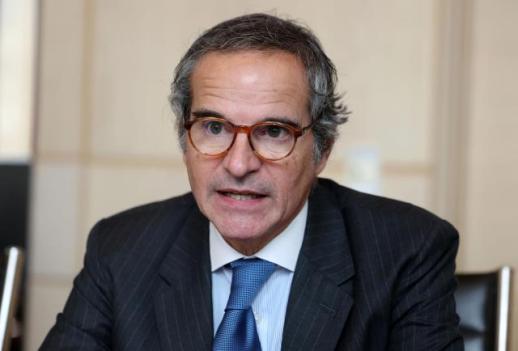 IAEA urges safeguard on Korea's nuclear submarine plan, verification on Iran SEOUL, April 15 (AJP) - South Korea must enter into a special safeguards arrangement with the International Atomic Energy Agency (IAEA) if it proceeds with nuclear-powered submarines to ensure that nuclear material is not diverted from propulsion use, its director general said Wednesday. “The use of nuclear technology to power submarines has a number of very important technical implications,” IAEA Director General Rafael Grossi said at a press briefing in Seoul, describing the visit as a “kickoff” for discussions with Seoul on its naval nuclear propulsion plans. As a signatory to the Nuclear Non-Proliferation Treaty (NPT), South Korea is subject to IAEA safeguards. However, Grossi noted that nuclear-powered submarines pose a unique challenge because fuel loaded into vessels on long missions falls outside routine inspections. “Because of the nature of these vessels, the nuclear material is not continuously accessible to inspectors,” he said, warning that large quantities of enriched uranium — potentially even highly enriched uranium — could remain outside direct oversight for extended periods. To address this, Grossi stressed the need for a tailored verification system between the IAEA and South Korea to ensure that nuclear material is not diverted for military purposes beyond propulsion. “We need technically sound arrangements so we can verify that the material remains where it is and is used only for propulsion,” he said, adding that such frameworks are being developed with countries including Australia and Brazil. He emphasized that “ironclad guarantees” are essential to ensure the program does not contribute to nuclear proliferation, noting that the process would involve coordination across government, military and shipbuilding sectors. Grossi also cautioned that developing nuclear-powered submarines is a long-term undertaking, likely to take many years, involving extensive research, construction and testing phases. On Iran, Grossi said the country has already mastered uranium enrichment technology and currently possesses roughly 440 kilograms of uranium enriched up to 60 percent, with most of the stockpile located at known sites such as Isfahan. He described any potential suspension of enrichment as a “political decision,” noting that the duration of a moratorium — whether five, 10 or 20 years — carries little technical difference but reflects levels of political trust. More importantly, he stressed that any nuclear agreement must include rigorous verification. “Without verification, any agreement is just a piece of paper,” Grossi said. “We must be able to check every gram of nuclear material and how it is used.” Turning to North Korea, Grossi said the IAEA has observed a continued expansion of nuclear activities, including operations at Nyongbyon and other facilities, despite the absence of inspectors since 2009. Recent assessments indicate a “significant increase” in Pyongyang’s nuclear capabilities, with estimates suggesting the country may have material sufficient for dozens of nuclear warheads. While there is no clear evidence of Russian military nuclear assistance, he said current cooperation between Moscow and Pyongyang appears limited to civilian nuclear projects. Grossi reiterated that pursuing nuclear weapons does not enhance national security, warning instead that it risks triggering a broader arms race. “Moving toward nuclear weapons would not give any country greater security,” he said. “It would encourage others to follow, leading to dangerous escalation.” Grossi also addressed his candidacy for the next United Nations secretary-general, highlighting what he described as a deepening crisis of confidence in the global body. “The world is going through a very difficult period marked by polarization and multiple conflicts,” he said, calling the upcoming leadership transition a critical moment to restore trust in multilateral institutions 2026-04-15 15:44:43
 -
 South Korea secures additional crude oil, naphtha through alternative routes SEOUL, April 15 (AJP) - South Korea has secured 273 million barrels of crude oil by the end of this year, presidential chief of staff Kang Hoon-sik said on Wednesday. At a press briefing at Cheong Wa Dae in Seoul, Kang, who just returned from a weeklong trip to Kazakhstan, Oman, Qatar and Saudi Arabia, said the country has reached a deal to secure additional crude oil, including up to 2.1 million tons of naphtha, by the end of this year. "Compared to consumption levels last year, the 273 million barrels of crude oil are sufficient to sustain more than three months without any additional emergency measures, and 2.1 million tons of naphtha are equivalent to about one month's supply," Kang said. "The procurement of additional crude oil and naphtha will be imported through alternative routes that would not be affected by whether the Strait of Hormuz is closed or reopened," he said, adding, "We expect this to help stabilize domestic supply and prevent supply disruptions." He also revealed that there were discussions about a plan to establish oil storage facilities outside the strait, a critical chokepoint for roughly one-fifth of the world's oil supply, to ensure a more secure supply chain. 2026-04-15 15:26:35
 -
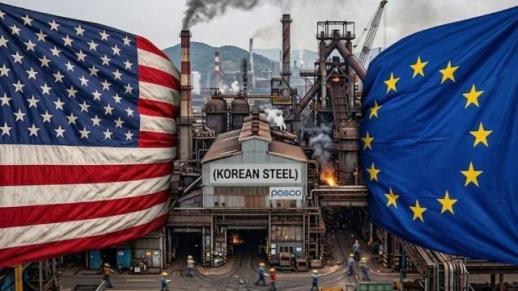 Double tariff whammy hits Korean steel as EU barriers pile on top of U.S. tariffs SEOUL, April 15 (AJP) - When it rains, it pours for South Korean steelmakers as they face collateral damage from higher trade tariffs in Europe on top of U.S. duties aimed at curbing cheap Chinese imports. The European Parliament and the Council of the EU hammered out a deal on Monday (local time) after late-night negotiations, setting tariff-free quotas at 18.3 million tons per year — nearly halved from about 35 million tons permitted under the current safeguard regime. Imports exceeding the cap will face a 50 percent duty, up from 25 percent. The measures, pending formal endorsement and a plenary vote expected in May, are set to take effect on July 1. The agreement also introduces a "melt and pour" traceability rule requiring importers to prove where raw steel was first smelted and cast — a provision targeting steel from overcapacity countries, chiefly China, routed through third-party processing. "We cannot afford to turn a blind eye to global overcapacity reaching critical levels," said EU Trade Commissioner Maros Sefcovic. Global steel overcapacity is projected to reach 721 million tons by 2027, more than five times the EU's annual consumption. Whether the target is primarily China, the blow nevertheless falls hard on South Korea. The EU bought $3.71 billion worth of South Korean steel in 2025, making it the country's largest export market — down from $4.48 billion in 2024, according to the Korea International Trade Association. South Korea shipped about 3.31 million tons to the bloc last year, of which about 2.58 million tons entered duty-free under country-specific quotas. EU posed as relief to the U.S. that has been imposing 50 percent levies on steel and aluminum imports from June last year. The new EU framework resets baseline quotas to 2013 import levels — well before the global oversupply cycle intensified — meaning Seoul's allocation is expected to shrink significantly. Korean steelmakers are still reeling from the U.S. blow. POSCO and Hyundai Steel, the country's two dominant producers, are estimated to have paid a combined $281 million in U.S. tariffs between March and December 2025. Korean steel exports to the United States have since plummeted after tariffs were doubled to 50 percent in June, with demand described by industry sources as "nearly depleted." The pressure compounds a longer-running squeeze from cheap Chinese steel flooding global markets. At home, Hyundai Steel ran two rounds of early retirement programs in 2025 and permanently closed half of its rebar capacity at its Incheon plant in January, shuttering a 90-ton electric furnace as the domestic construction slump deepened. In November 2025, the National Assembly passed the K-Steel Act, a 570 billion won support package to fund industry restructuring and bolster exports. But with the EU now confirming the tariff overhaul that had been under discussion since last October, pressure on Seoul to secure favorable quota terms has intensified. "Korean steel exports to the EU were already constrained within existing quotas, with limited room to expand," said Lee Jae-yoon, senior research associate at the Korea Institute for Industrial Economics and Trade. "With the U.S. market effectively shut and domestic demand still weak, the EU should have been a growth outlet — but these new protective measures, combined with the EU Carbon Border Adjustment Mechanism, are closing that window." The double tariff squeeze has nonetheless forced a strategic pivot toward the United States. POSCO acquired a 20 percent stake worth $582 million in Hyundai Steel's planned $5.8 billion electric arc furnace mill in Louisiana, with commercial production expected in 2029. POSCO has also signed a strategic partnership memorandum with Cleveland-Cliffs, the second-largest U.S. crude steel producer, though the company said in a March regulatory filing that no final decision on equity participation or investment size has been reached. The EU's move is driven by a broader structural strain. European steel capacity has shrunk by 65 million tons since 2007, with about half of that loss since 2018. The sector operates at around 67 percent capacity — well below the 80 percent considered healthy — while import penetration hit a record 29 percent in the third quarter of 2025. Lee said Korean steelmakers will ultimately need to pivot toward green steel to navigate the tightening trade environment. Building production facilities in Europe — unlike in the United States — holds little commercial appeal, given the continent's own supply glut. "The U.S. offers higher prices, high energy costs that keep out cheap imports, and insufficient domestic capacity — making it attractive for investment," Lee said. "Europe is the opposite. It already has overcapacity, so there is little merit in setting up local production just to avoid tariffs." The Korean government is also moving to cushion the blow. Seoul has been in continuous contact with Brussels since the European Commission first unveiled the proposal in October, and has maintained those channels since Monday's agreement. "We have been in constant dialogue with the EU since the initial proposal, and remain in close contact regarding the steel tariff and quota framework. No tangible agreement on Korea's specific allocation has been reached yet," a spokesperson for the Ministry of Trade, Industry and Energy said. 2026-04-15 14:36:45