

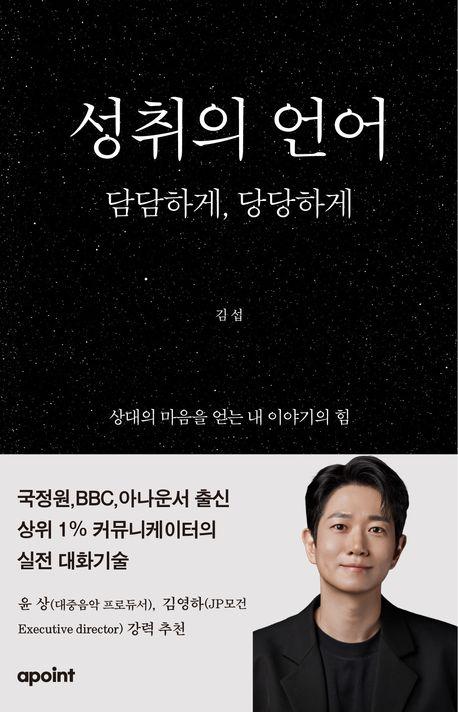
The Language of Achievement: Calmly, Confidently=By Kim Seop, Apoint.
“If your boss gives an unfair order, what would you do?”
If that question freezes you, this book offers a way forward. It also speaks to everyday moments, such as when a partner suddenly texts, "Want to grab dinner?" and you feel tired, pressured and unsure how to respond.
Kim asks readers to choose between simply talking and actually having a conversation. He argues that attitude matters more than sounding polished like a TV anchor. Clear diction and delivery are less important, he writes, than being able to state your thoughts plainly even if you stumble. He also points to the value of pausing to breathe when blindsided by a question and of reading the needs behind what someone says.
The author’s resume is unusual: He passed a high-pressure interview at South Korea’s National Intelligence Service and a final interview at the BBC, which he says is hard to find even reviews of. He started as a YTN announcer, then worked as an NIS agent, and later as a reporter at MBC and the BBC. He now works as a PI consultant designing external communications for corporate CEOs.
The book includes practical advice for job candidates, but it is not framed as a set of tricks for passing interviews or winning arguments. As its subtitle, "The power of my story to win someone’s heart," suggests, it emphasizes conviction, composure and room to think as the basis for trust and better relationships. Kim writes that people struggling with small talk, or treating negotiation as a fight to win, may find reason to reassess.
He stresses listening as the starting point: "The power to open a closed heart begins with attentive listening," he writes, urging readers to listen closely, ask good questions and show empathy.
The book’s editing is uneven, with typos such as "business sege" and an unnecessary symbol ([) where a period should be.
"Technique alone can’t move anyone’s heart. Someone who truly speaks well is someone who can honestly put themselves out there. Don’t strain to speak like an announcer. It’s OK to be a bit rough. Speak in my voice, my intonation, my grain. The listener wants sincerity more than pronunciation." (p. 103)
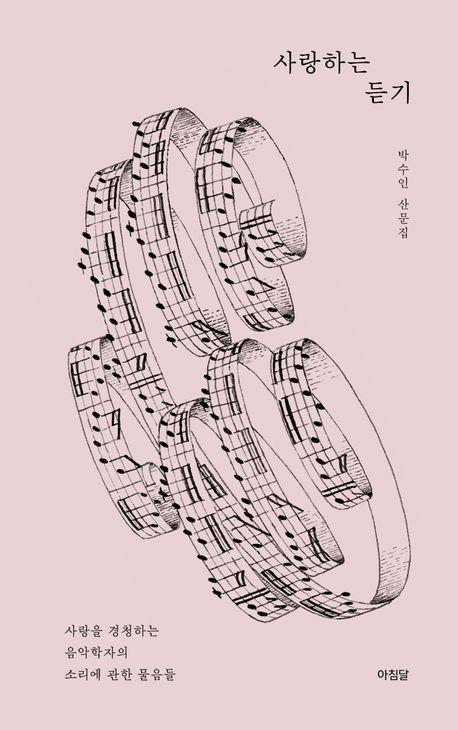
Listening With Love=By Park Su-in, Achimdal
Park, a music scholar, ranges across the world of sound — classical music, melodies in subway stations, a father’s song from childhood memories, and the rhythmic cloth-beating her mother recalls — and views it through the lens of love. She writes that listening, or leaning in with the ear, is not meaningfully different from loving its object.
Asked, "Why did we stop singing in the face of sorrow?" Park argues that song should continue even then. Through the sound of a grandmother’s cloth-beating remembered by her mother, she urges readers to notice what sounds surround them. She writes that readers may come to hear the world in finer detail while also discovering the self that listens, and to think about how love is cultivated. The essay collection includes sheet music to aid understanding and QR codes that link to excerpts of some of the pieces she mentions.
"In the scenery of my childhood, sound was low and soft. The sounds between neighbors naturally seeped into one another, and they were both greetings and proof of existence. Now is a time when many things feel delicate, a time overly rigid, or a time of excessive consideration for one another. In crossing the threshold of that consideration, we easily bring in moral yardsticks. An age of tension has arrived, when even the small sounds that rarely intrude are hard to allow." (p. 60)
* This article has been translated by AI.
Copyright ⓒ Aju Press All rights reserved.