

The final race for the Canadian Patrol Submarine Project, or CPSP, has increasingly narrowed into a competition between South Korea's "One Team" bid led by Hanwha Ocean and HD Hyundai Heavy Industries, and Germany's Thyssenkrupp Marine Systems, or TKMS, a long-established player in the diesel-electric submarine market.
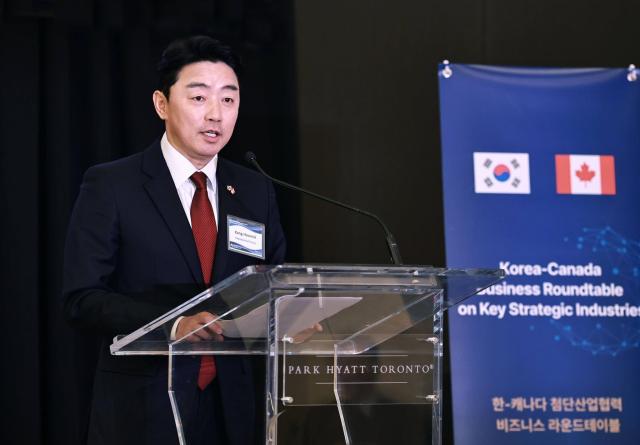
South Korea's push gained momentum this week as presidential chief of staff Kang Hoon-sik attended a business roundtable in Toronto, where companies from the two countries signed three memorandums of understanding in satellite communications, launch sites and defense vehicles.
German Defense Minister Boris Pistorius said TKMS could deliver four submarines to Canada by 2036 if it wins the bid, according to an interview with Canada's CBC News on the sidelines of CANSEC 2026, Canada's largest defense exhibition held in Ottawa last week.
"They say they can, and I have only had good experiences with them, so I trust them," Pistorius told CBC News. "They promise only what they can actually achieve."
TKMS has proposed its Type 212CD submarine, a model jointly developed by Germany and Norway. But the submarine remains in the design stage and has yet to enter operational service, raising questions over whether the German side could meet Canada's urgent delivery timeline.
Hanwha Ocean, by contrast, has emphasized from the early stages of the competition that it can deliver four KSS-III submarines to Canada by 2035.
That date is crucial for Ottawa, as the Royal Canadian Navy aims to retire all four of its aging Victoria-class submarines by 2035. Only one of the four is currently believed to be available for operations, making replacement an urgent priority.
Pistorius said Germany and Norway, both existing customers of the Type 212CD, had agreed to delay one submarine each from their own orders to allow Canada to receive earlier deliveries. The remaining two vessels, he said, could be produced at an accelerated pace by TKMS.
Marte Gerhardsen, state secretary at Norway's Ministry of Defense, also said bringing Canada into the program would strengthen the overall submarine fleet, even if Norway has to wait longer for one of its submarines.
"We do not think of the submarine fleet as a Norwegian fleet, a German fleet and a Canadian fleet," Gerhardsen told CBC News. "We think of it as a common fleet."
Germany has also offered a broader economic package tied to the submarine bid, including investments in military and non-military projects in Canada, according to CBC News. The proposals reportedly cover carbon capture, LNG exports, torpedo production and hypersonic missile development.
South Korea has also pledged similar industrial cooperation if it wins the contract, but Germany is seeking to differentiate its proposal by stressing that many of its projects could begin within two years.
Canadian Prime Minister Mark Carney and Defense Procurement Minister Stephen Fuhr have said both Germany's Type 212CD and Korea's KSS-III meet the Royal Canadian Navy's requirements, with a decision expected by the end of June.
Carney said last week that the decision goes beyond military requirements. "It is certainly about economic impact, the broader economic benefits," Carney told reporters.
Hanwha is seeking to frame its submarine bid as part of a wider defense and industrial partnership with Canada.
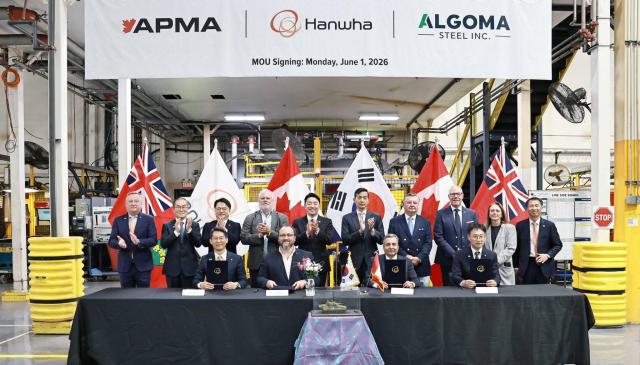
Representatives from Algoma Steel, Hanwha and Ontario-based auto parts makers recently signed an agreement at a Martinrea International facility near Toronto. Under the plan, Algoma would supply steel to a Canadian consortium if Hanwha wins the submarine contract.
Algoma joins Hanwha and the Automotive Parts Manufacturers' Association, which agreed recently to jointly develop and manufacture fighting vehicles for the Canadian Armed Forces and allies. In a separate pact, Hanwha has also agreed to invest in Algoma.
The proposed Canadian joint venture would be 51 percent Canadian-owned and use domestic steel and workers, with Hanwha providing expertise, technology and experience, as well as investment.
"They are not just interested in supplying submarines to Canada," Martinrea chairman Rob Wildeboer said. "They want to do much more in working with industry in Ontario and Canada to develop defense capabilities."
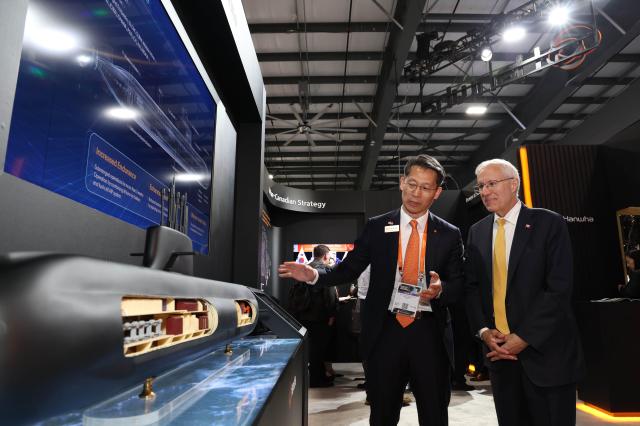
The Korean Navy's 3,000-ton Dosan Ahn Chang-ho submarine has also played a supporting role. After completing a 14,000-kilometer voyage across the Pacific, the submarine arrived at the Esquimalt naval base in Victoria, British Columbia on May 23.
The strategy has drawn attention in Canada, with local media quoting one Canadian naval official as comparing the experience of boarding the Korean submarine to switching from a 1999 Honda Civic to a new Tesla.
With the final decision approaching, the competition is increasingly becoming not only a submarine procurement race, but also a test of which country can offer Canada a broader strategic and industrial partnership.

Copyright ⓒ Aju Press All rights reserved.
