

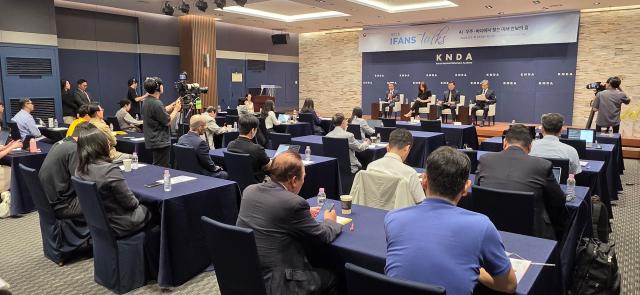
SEOUL, June 02 (AJP) - As artificial intelligence, space assets, and maritime competition reshape the nature of warfare, diplomacy is not becoming obsolete but is becoming more important in preventing conflicts from escalating and setting rules for emerging military technologies, security experts said Tuesday.
The remarks came during the 33rd Institute of Foreign Affairs and National Security (IFANS) Talks, a public lecture hosted by IFANS under the Korea National Diplomatic Academy, at the Korea National Diplomatic Academy, at the (KNDA) Hall in southern Seoul.
Held under the theme “Finding the path to future security through AI, space and the sea,” the event brought together Sohn Han-byeol, a professor at Korea National Defense University, Um Jung-sik, a professor at the Korea Air Force Academy, and Ban Kil-joo, a professor at IFANS.
During a Q&A session, the speakers addressed whether the rapid development of military technologies could weaken the role of diplomacy. Sohn said diplomacy will become more difficult, and more important, as advanced technologies lower the threshold for the use of force. “The role of diplomacy is not shrinking. It is becoming more difficult, and because it is becoming more difficult, it is becoming more important,” Sohn said.
He said military technologies may allow states to strike faster and more precisely, but they cannot resolve the political causes of conflict. “Military victory and political termination are different,” he said. “Diplomacy is what fills that gap.”
Sohn also said diplomacy in the AI era should focus on creating norms for new technologies, including autonomous weapons, AI-assisted targeting and drone attacks. “The empty space of norms is not the realm of the military or technology, but of diplomacy,” he said.
He said South Korea could contribute to space cooperation with the United States by strengthening space domain awareness in Northeast Asia, where ground-based monitoring assets remain limited.
“The United States is a global space power, but compared with other regions, ground-based space systems in Northeast Asia are relatively insufficient,” Um said. “South Korea can play a sufficient role in the alliance in ground-based space domain awareness.”
Um also stressed that South Korea needs to recognize space as an independent operational domain. “Public satellites and commercial satellites floating in space are assets that our military must protect,” he said. “Who protects our commercial satellites?”
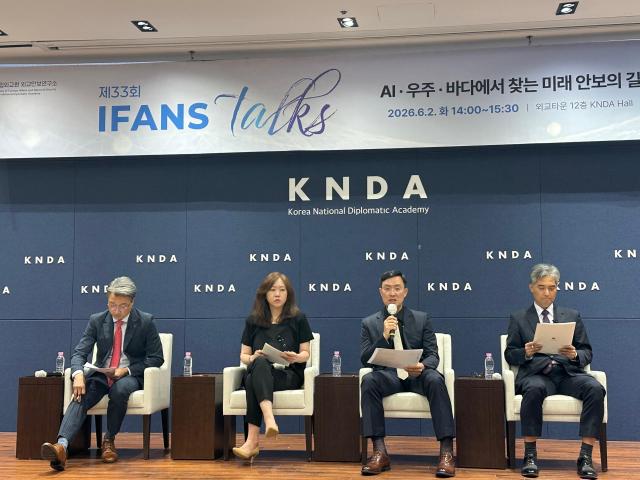
He said South Korea must distinguish between China’s gray-zone activities and North Korea’s military threats when shaping maritime security responses. “China’s and North Korea’s threats are not on the same line,” Ban said. “Their nature and categories must be separated.”
Ban said gray-zone threats at sea are not only a bilateral security issue but also a challenge to the rules-based maritime order. “Gray-zone threats weaken the rules-based order and the maritime rules-based order,” he said. “They need to be expanded to and handled by the international community.”
Turning to the broader question of diplomacy, Ban said modern warfare does not signal the end of diplomacy. “I see this not as an era of the end of diplomacy, but as an era in which diplomacy must work harder,” Ban said, adding that defense capabilities and diplomacy should reinforce each other. “Diplomacy and deterrence have mutual synergy,” he said. “A virtuous cycle is possible.”
Ban stressed that diplomacy is needed both during war and in peacetime. “Diplomacy is conducted even during war,” he said. “In the end, the end of a fight is diplomacy.”
The discussion underscored a shared view among the speakers: as war expands into AI, space and the sea, diplomacy is not losing relevance. Instead, it is moving into more complex domains where rules remain unsettled, escalation risks are higher and national security depends on norms, partnerships and public awareness as much as on military power.

Copyright ⓒ Aju Press All rights reserved.
