SEOUL, July 26 (AJP) — Bain Capital earlier this month has closed the book on one of the biggest private equity wins of the artificial intelligence era by fully exiting Japanese memory chipmaker Kioxia. SK hynix, however, is staying put.
The South Korean memory giant continues to hold an indirect 14 percent stake in Kioxia through a special-purpose investment vehicle established during Bain's 2018 acquisition of Toshiba Memory, underscoring that the investment has evolved from a financial holding into a strategic asset in the rapidly changing AI memory market.
Bain confirmed earlier this month that it had completed the sale of its remaining Kioxia shares after gradually reducing its ownership following the company's public listing. The eight-year investment reportedly generated profits exceeding $15 billion as AI-driven demand transformed Kioxia into one of Japan's highest-valued technology companies.
SK hynix has taken a markedly different path.
Unlike Bain, whose objective was to monetize its investment, the world's second-largest memory chipmaker appears to view Kioxia as an increasingly valuable strategic foothold in the NAND flash market, which has become an integral part of AI infrastructure alongside high-bandwidth memory.
SK hynix is the global leader in HBM, supplying Nvidia and other AI chip designers with premium memory used to process AI workloads. But as hyperscale data centers expand, demand is also surging for enterprise solid-state drives built on NAND flash memory to store and retrieve the enormous datasets that AI models require.
Industry analysts increasingly describe AI servers as consuming both "fast memory" and "massive memory" — HBM for computation and NAND for storage.
That changing dynamic has elevated NAND from a traditionally cyclical commodity business into another critical layer of AI infrastructure.
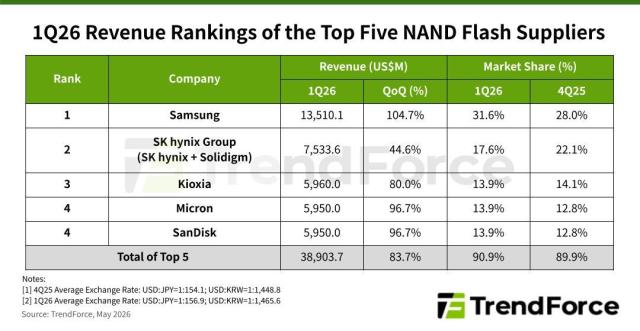
According to TrendForce, Samsung Electronics remained the world's largest NAND flash supplier in the first quarter with a 31.6 percent revenue share. SK hynix, including subsidiary Solidigm, ranked second with 17.6 percent, while Kioxia held 13.9 percent alongside Micron and SanDisk.
The ownership therefore gives SK hynix exposure to one of its largest competitors while broadening its reach across the AI memory ecosystem.
The holding also preserves strategic flexibility.
SK hynix originally participated in Bain's $18 billion acquisition of Toshiba Memory through convertible bonds and the special-purpose vehicle rather than as a conventional equity investor. Those securities could potentially provide opportunities to increase its economic interest should market conditions or strategic priorities change.
The investment comes as the NAND industry itself is undergoing structural change.
Years of oversupply and volatile pricing have prompted manufacturers to become more disciplined in production expansion, while AI data centers have created a new source of sustained demand for enterprise storage.
Industry forecasts expect enterprise SSD shipments to continue growing as cloud providers increase AI infrastructure investment, improving the long-term outlook for NAND producers.
TrendForce expects the NAND flash market to remain undersupplied throughout 2026 as AI infrastructure spending continues to outpace manufacturers' ability to expand production. Suppliers are relying largely on process migrations rather than building new fabrication plants because memory makers continue to prioritize more profitable DRAM and HBM capacity.
The research firm forecasts global NAND supply to remain 4-5 percent below demand this year, extending shortages that have supported pricing.
While supply growth is expected to accelerate in 2027 as Korean, U.S. and Japanese manufacturers upgrade existing production lines and Chinese suppliers ramp up new facilities, TrendForce does not expect market balance to return until the second half of next year.
Server shipments are projected to rise 17 percent this year as Intel's and AMD's next-generation platforms gain traction, with further acceleration expected in 2027 as agentic AI applications become commercialized and supply bottlenecks for CPUs and memory ease.
Servers now account for more than 40 percent of global NAND flash bit demand, surpassing traditional consumer applications as the industry's primary growth engine.
Although smartphones and notebook PCs together still represent nearly 40 percent of NAND consumption, both markets are expected to remain weak through 2027, reinforcing the growing importance of enterprise AI infrastructure in shaping industry profitability.
For SK hynix, retaining exposure to Kioxia also provides insight into a rival that remains Japan's sole global-scale NAND manufacturer, at a time when semiconductor supply chains are increasingly shaped by geopolitical considerations as much as market competition.
The contrast with Bain's exit illustrates two very different approaches to the AI boom.
For the private equity firm, Kioxia represented a spectacular realization of investment gains after the company's market value soared following its listing. For SK hynix, the stake appears to have become less about locking in profits than maintaining a strategic position across the full spectrum of AI memory technologies.
As AI spending shifts beyond processors to encompass the entire data-center stack, the value of controlling both computing memory and storage memory may ultimately outweigh the gains from simply cashing out.
Copyright ⓒ Aju Press All rights reserved.