
Journalist

Lee Hugh
=
-
 Red Velvet's Irene to roll out first solo studio album 'Biggest Fan' SEOUL, March 30 (AJP) -Irene, the leader of K-pop girl group Red Velvet, will release her first full-length solo album "Biggest Fan" on Monday, her agency SM Entertainment said. The album will be released at 6 p.m. (0900 GMT) through major music platforms, along with the music video for the title track of the same name. Red Velvet is a five-member South Korean girl group that debuted in 2014 under SM Entertainment. The dance-pop band is widely regarded as one of the leading acts of K-pop’s third generation. Red Velvet gained mainstream popularity with songs such as "Russian Roulette," "Psycho," "Feel My Rhythm," and "Cosmic." Irene, born March 29, 1991, is the leader, eldest member, and main rapper of the group. The 10-track album is led by the title song "Biggest Fan," alongside tracks including "Don’t Wanna Get Up," "Wasteland," "Black Halo," and "Million Miles Away." Irene described the album as a statement of self-belief, saying, "I am my biggest fan." Ahead of the release, Irene will host a special live broadcast at 5 p.m. through her official YouTube and TikTok channels. 2026-03-30 17:31:28
 -
 World Cup Rights Talks Stall in South Korea, Raising Concerns Over Public Access With about 70 days left until the 2026 North America World Cup, South Korea’s three terrestrial broadcasters and JTBC held talks over broadcast rights but failed to narrow their differences. The meeting on March 30 was chaired by Kim Jong-cheol, chairman of the Broadcasting Media Communications Commission, and attended by KBS President Park Jang-beom, MBC President Ahn Hyeong-jun, SBS President Bang Moon-shin and JTBC President Jeon Jin-bae. The two sides did not reach an agreement. JTBC said it had presented a final proposal on March 23, suggesting that the remaining rights fee — after subtracting revenue from digital resales — be split evenly between JungAng Group, which includes JTBC, and the three broadcasters. JTBC added that the three broadcasters’ “Korea Pool” has previously shared international sports rights costs at the same ratio, and said its proposal was a last offer made despite the prospect of “a large deficit,” citing concerns about universal viewing rights. A terrestrial broadcaster official who attended the March 30 meeting said there was “no progress” in negotiations for the 2026 World Cup rights. The official said the three broadcasters’ CEOs are demanding a “responsible position statement” from JTBC, which they say triggered the dispute. JTBC secured exclusive rights to the 2026-2032 Summer and Winter Olympics and the 2025-2030 World Cups in 2019, the report said, bypassing the Korea Pool consortium of MBC, KBS and SBS. It later sought to resell the rights to the three broadcasters, but the effort fell through. As a result, JTBC exclusively aired the 2026 Milan-Cortina Winter Olympics, but drew low ratings due to limited channels, fueling controversy over whether it infringed on the public’s universal right to watch major events. To protect that right, Democratic Party lawmaker Han Jeong-ae introduced an amendment to the Broadcasting Act on March 16 to guarantee universal viewing rights for events including the Olympics and the World Cup. The commission has also tried to mediate as negotiations have repeatedly stalled, including by holding an open public forum under the theme, “2026 North America World Cup broadcasts, listening to the public,” but has struggled to break the deadlock. While the March 30 meeting failed to bridge the gap, the terrestrial broadcaster official said working-level talks would continue, leaving open the possibility of a final deal. 2026-03-30 17:21:00
 -
 Global love for K-content hits new highs, but fatigue also on the rise SEOUL, March 30 (AJP) - That K-content is widely loved is no longer in doubt. With K-pop-themed animation sweeping the Grammys and Oscars, and Netflix livestreaming BTS’ comeback, the latest data only puts a number to the momentum: nearly 70 percent approval worldwide. According to data released Monday by the Ministry of Culture, Sports and Tourism and the Korea Foundation for International Cultural Exchange, 69.7 percent of respondents expressed favorable views toward Korean content in the 2026 Overseas Hallyu Survey. The halo effect extends beyond entertainment. South Korea’s national image drew positive responses from 82.3 percent of global respondents — the highest since the survey began in 2012. The surge is not just cultural, but economic. Content exports reached a record $14.08 billion in 2024, while inbound tourism rose to 18.9 million visitors in 2025, underscoring Hallyu’s growing weight as an export engine. Momentum remains strongest in Southeast Asia, with the Philippines, India, Indonesia and Thailand leading in favorability. But the more telling shift is in the West, where gains have been sharper in markets such as the United Kingdom, the United States and Spain — a sign that Hallyu is still expanding its geographic footprint. The wave itself has also broadened. While K-pop remains the core driver, consumption has spread across dramas, films, food and beauty — embedding Korean culture into everyday life rather than keeping it confined to entertainment. That deeper penetration, however, is beginning to invite pushback. Negative perceptions, unchanged at 37.5 percent, have risen steadily over the past five years, pointing to growing polarization as Hallyu becomes more visible — and harder to ignore. Kim Hyung-jun, a professor of cultural anthropology at Kangwon National University, said the backlash is no longer driven by content alone but by the breadth of Hallyu’s reach. “It is no longer confined to entertainment — it touches politics, the economy and social behavior,” he said. He noted that criticism now cuts across multiple fronts. “Concerns arise that young people are becoming less interested in local culture, while others point to excessive fan spending or changing social behaviors linked to fandom culture,” he said. Because these concerns span everyday life, they are easily amplified by different groups — from politicians and religious leaders to parents — allowing negative sentiment to spread beyond those directly engaged with Korean content, Kim added. Regional dynamics differ. In Southeast Asia, resistance is often tied to religious sensitivities and the financial burden of fandom consumption. In Western markets, it tends to center more on cultural influence and questions of relevance within established norms. At the same time, the industry faces a more structural challenge: fatigue. Im Jin-mo, a music critic and pop columnist, said K-pop may be approaching a turning point after more than a decade of global exposure. “K-pop has not shown enough variety or newness,” he said. “The style has become more predictable.” He warned that the genre may be entering a phase where it feels less fresh and less compelling to global audiences, with fewer new acts emerging to sustain momentum. “This year could be a decisive moment,” he said. “The quality of new releases will matter more than ever.” He also offered a blunt assessment of recent output from major acts. “The album felt somewhat boring — it lacked a strong hook,” he said, adding that some see it as an early sign of a broader slowdown. For now, Hallyu remains firmly in expansion mode. But as its reach widens, so too does the test of whether it can sustain not just scale, but staying power. 2026-03-30 17:18:07
 -
 HMM pushes ahead with move to Busan despite union protest SEOUL, March 30 (AJP) - South Korea's largest container shipping line HMM reportedly said its board of directors approved a charter amendment to relocate the company's headquarters from Seoul to the southeastern port city of Busan, setting the stage for a shareholder vote on May 8 that is all but certain to pass. The board convened an extraordinary session to endorse the revision to Article 3 of HMM's articles of incorporation, which currently designates Seoul as the registered seat. An extraordinary general meeting of shareholders will follow on May 8, where approval requires a special resolution backed by two-thirds of attending shareholders. With state-affiliated entities holding more than 70 percent of HMM shares — Korea Development Bank at 35.42 percent, Korea Ocean Business Corporation at 35.08 percent and the National Pension Service at 5.62 percent — passage is widely considered a foregone conclusion. The move is a centerpiece of President Lee Jae Myung's drive to transform Busan into a maritime capital, consolidating shipping administration, judicial functions and corporate headquarters in a city that already hosts the world's second-largest container transshipment port. Industry officials expect HMM to begin scouting office sites near Busan New Port in the second half of the year and to unveil relocation support packages for Seoul-based staff shortly after the vote. HMM's onshore labor union, however, struck a defiant tone. The union declared bargaining with management collapsed after the board acted without prior consultation and said it would move to secure the right to stage industrial action, raising the specter of a general strike before the May meeting. The union has argued the transfer could hollow out operational efficiency and trigger an exodus of seasoned employees whose work is embedded in Seoul's financial and logistics networks. Analysts say the Busan relocation could also accelerate the long-delayed privatization of HMM, as KDB seeks to shore up its capital adequacy by divesting its stake in the carrier. The headquarters shift follows the Ministry of Oceans and Fisheries' own relocation from the administrative capital of Sejong to Busan in December 2025, a move that prompted mid-sized bulk carriers SK Shipping and H-Line Shipping — both controlled by private equity firm Hahn & Company — to begin relocating to the port city earlier this year. 2026-03-30 17:08:02
 -
 Drone spectacle lights up Busan's Gwangalli Beach SEOUL, March 30 (AJP) - A spectacular drone show lit up the sky above Gwangalli Beach in the southern port city of Busan last Saturday. The 12-minute show featured mythical creatures and legendary guardians including dragons, white tigers, xuanwu (black tortoise), and vermillion birds, painting the night sky with a thousand lights, creating a stunning spectacle. The year-round show, which first began in 2022, takes place every Saturday evening twice per night — at 7 p.m. and 9 p.m. during the winter season (October to February) and at 8 p.m. and 10 p.m. during the summer months (March to September). 2026-03-30 16:57:56
 -
 South Korean researchers use light and air to make medicine ingredients SEOUL, March 30 (AJP) - A research team in South Korea has developed a way to produce essential pharmaceutical raw materials using only sunlight and ambient air, potentially slashing carbon emissions in the chemical industry. This breakthrough simplifies the manufacturing of complex drugs by replacing traditional, waste-heavy chemical processes with a sustainable loop that relies on natural elements. The Korea Advanced Institute of Science and Technology (KAIST) announced on March 30, 2026, that a team led by Professor Han Sang-woo of the Department of Chemistry successfully combined two different types of catalysts into a single system. The method integrates a solid silver-based catalyst with a liquid organic photocatalyst known as DDQ. In traditional chemical manufacturing, companies often have to choose between catalysts that are precise but disposable and those that are reusable but less efficient. The KAIST team bypassed this trade-off by creating a system where the two catalysts work together to drive reactions that were previously difficult to sustain. The researchers used this hybrid platform to create amines, which serve as the primary building blocks for various medicines. By relying on sunlight and air rather than harsh chemical additives or high-pressure environments, the process produces almost no waste other than water. Existing organic photocatalytic methods often require additional chemicals to reset the catalyst after each use, or they suffer from slow reaction speeds when exposed to oxygen. To solve this, the team designed a circular loop where the byproducts of the reaction naturally reactivate the catalysts. Sunlight provides the energy to start the reaction, while oxygen from the air acts as the agent that "recharges" the catalysts for the next cycle. This allows the system to run continuously without the need for constant chemical intervention. To prevent the two different catalyst types from interfering with each other, the researchers added lithium perchlorate (LiClO4). This additive stabilizes the silver particles and the organic molecules, ensuring the system remains active for longer periods. "This study is the first case of successfully applying inorganic photochemical loop technology to precision organic synthesis," Professor Han Sang-woo said. "By merging the advantages of different catalytic systems, we have made a significant step toward reducing the carbon footprint of the chemical industry." Professor Han Sang-woo noted that the breakthrough provides a new way to manufacture high-value compounds like pharmaceutical ingredients through more sustainable methods. The study, with KAIST researcher Baek Jin-uk as the lead author, appeared in the Journal of the American Chemical Society (JACS) on March 18, 2026. (Reference Information) Journal/Source: Journal of the American Chemical Society Title: Merger of heterogeneous and homogeneous photocatalysis for arene C–H Amination Link/DOI: https://doi.org/10.1021/jacs.5c20824 2026-03-30 16:56:43
 -
 Lee Dong-hwi Balances Acting Immersion and Producer Realities in 'Method Acting' Every production holds countless perspectives. The same place and time can feel different depending on where a director or actor stands. “Choi Song-hui’s B-Cut” looks beyond the “A-cut” on screen to the vivid record of what happened off camera. By weaving interviews with directors and actors, it reconstructs the “B-cut” moments that were often more intense than the finished frame. <Editor’s note> For actor Lee Dong-hwi, “Method Acting” is more than another credit. It is his first report card as a producer: He helped expand a friend’s short-film idea into a feature and took responsibility on set. Like the character who struggles to break out of a “comedy actor” label, Lee said he wanted to become someone who “creates opportunities” and pushed the project to completion. The film began with trust between two friends, actor Lee Gi-hyeok and Lee Dong-hwi. As the short’s job-specific premise was combined with the universal theme of “family,” the story took on the structure of a mainstream feature. “Director Lee Gi-hyeok was preparing another story at first, then decided to turn the short ‘Method Acting’ into a feature because it could be told in a more popular way,” Lee said. “If the short focused on the mood on set, the feature broadened with the keyword of family, in a direction that could draw more universal empathy. I thought it would be easier to play someone close to who I am, but once we started shooting, every day felt like homework. I had to keep adding layers so it wouldn’t look like a documentary or an observational variety show.” Caught between an actor’s immersion and a producer’s need for distance, Lee said he witnessed a chaotic “B-cut” reality. As the boundary between life and performance blurred, he decided he had to stay firmly inside the role. “When I saw Geum-sun’s back, it looked like my real mother, and the emotions rose too much,” he said. “I thought if it got too close to my life, it would be hard to endure. So for parts that didn’t completely overlap with my family’s story, I made them more fictional and approached them that way. In the end, I thought I had to treat it as a role. I had to act the details — an actor being mocked, an actor enduring that mockery and returning to set, and even the moment he becomes a king — so it was a set that gave me a real headache.” A monologue scene as a king in the historical drama “Gyeonghwasuwol” became the point where producer Lee and actor Lee clashed — and then reconciled. Under pressure from a 4 a.m. sunrise and budget constraints, he said he found “the king’s face” in just two takes. “We were in a rush because we were shooting at 4 a.m.,” he said. “The sun was coming up, and there was no time, so it was an anxious situation. We couldn’t do many takes. Since I was participating as a producer, the longer it took, the more the production cost. In the past, as an actor, I would have wanted to shoot more, but as a producer I strongly felt I had to complete the mission within the exact opportunity. After two takes, I looked up and the sun had risen.” Lee said watching actor Ma Dong-seok made him want a life that “gives someone opportunities.” He said he is now preparing a true transformation by portraying a character in harsher circumstances. “Watching Ma Dong-seok, I saw with my own eyes the new opportunities that appear when one person starts something,” Lee said. “I wanted to become that kind of person someday. If I’ve been thinking about what makes a mainstream film work, the story I want to make next is the opposite. A lonelier, harsher story of one person — for me, that kind of work feels like a real transformation.” On screen, Lee’s character obsesses over “method acting.” Off camera, Lee said he kept checking the clock. He held back an actor’s desire for more takes and wrapped the scene in two, weighing time and production costs. More striking than the king’s face in the “A-cut,” he suggested, was the producer’s posture in the moments before sunrise.* This article has been translated by AI. 2026-03-30 16:51:14
 -
 Busan's Yeongdo Island offers delight for palate with taste of sea BUSAN, March 30 (AJP) - Yeongdo, a small coastal island in the southern port city of Busan, South Korea, has long been known for its bountiful seafood. As dusk falls and fishing boats return, street-food tents light up one by one, a daily ritual unchanged for generations that reflects the island's life deeply rooted in the sea. Getting off at Nampo Station leads visitors to the island by crossing the city's iconic Yeongdo Bridge, which glows golden at night and connects Busan's mainland to the small town. Near the waterfront, fishing boats sit moored in the harbor as street-food tents and stalls begin to open for the evening. Once dusk settled, colorful plastic chairs lined the waterfront and grills fired up. Jogaetang, a clam soup, is often served first, a steaming pot filled with scallops, clams, and leeks in a milky, briny broth, the shells opening slowly as it bubbles away. Next up is grilled hagfish, coated in a sweet and savory sauce and topped with sesame seeds. Its chewy but tender texture goes perfectly with beer. For the adventurous, raw octopus is a must-try. Sliced and served with cucumber, green chili, sesame oil, and sesame seeds, the still-lively pieces cling to the chopsticks. Its texture is firm and slippery, with a clean, briny flavor that tastes of the sea. Tables are set with a variety of side dishes, often refilled without even being asked. These tents have long been a hangout where locals gather after work, as well as a spot for visitors who want to soak in the town's atmosphere. 2026-03-30 16:39:57
 -
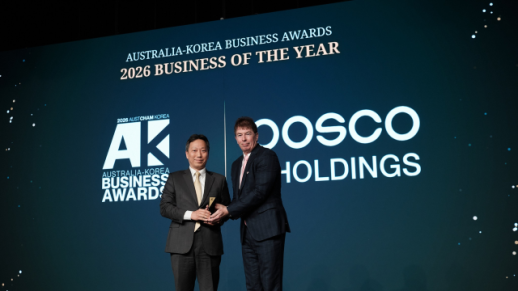 POSCO Holdings named Business of the Year at 2026 Australia–Korea Business Awards SEOUL, March 30 (AJP) - POSCO Holdings was named Business of the Year at the 2026 Australia–Korea Business Awards (AKBA) in Seoul on Friday, according to the Australian Chamber of Commerce in Korea (AustCham Korea). This year’s recognition of POSCO Holdings highlights the company’s long-standing investment in Australia’s resources sector and its growing role in future-facing industries shaping the bilateral partnership, including critical minerals, battery materials, and clean energy supply chains. “At a time of increasing uncertainty in global supply chains, the Australia–Korea economic relationship is taking on renewed strategic importance,” said Ross Gregory, Chaiman of AustCham Korea. The elevation of bilateral ties to a Comprehensive Strategic Partnership in December 2021 reflects this shift, establishing a framework for closer cooperation across strategic, economic, and technological domains. “Within this context, deepening trade, investment, and industrial collaboration between Australia and Korea plays a critical role in reinforcing supply chain resilience and supporting the long-term stability of key industries,” Gregory said. The Australia–Korea Business Awards is a flagship event hosted by AustCham Korea, recognizing companies and individuals that have contributed to trade, investment and industrial cooperation between the two countries. Since 2010, the awards have served as a key platform highlighting the strength of the bilateral economic partnership. Winners are selected based on an evaluation of the achievements and success stories of nominated companies. The ceremony was attended by senior government officials and business leaders from both countries, including Australian Ambassador to Korea Jeff Robinson and the Republic of Korea’s Deputy Minister for Trade Park Jung-sung. Their participation underscores the growing strategic dimension of the Australia–Korea relationship. “Long-standing business cooperation between Korea and Australia is something we see as highly meaningful,” Gregory said. “This year’s awards celebrate the fact that collaboration between the two countries is expanding into a broader range of future industries.” “POSCO Holdings, as this year’s Business of the Year, has helped underpin key industrial supply chains through its investments and partnerships across Australia’s mining and resources sectors,” he said. “These efforts demonstrate how collaboration between our two economies continues to evolve into new sectors,” he added. This year’s awards recognized companies and individuals across a wide range of industries, reflecting the continued expansion of bilateral economic cooperation. While collaboration has traditionally been centered on resources, financial services and technology, it has increasingly diversified into areas such as biotechnology, education, food and beverage, energy transition, healthcare, and tourism. 2026-03-30 16:20:36
 -
 Kim Hyo-joo wins Ford Championship for second straight year, sets new goals after two straight LPGA titles Kim Hyo-joo, who has won two straight LPGA Tour titles, said she has already achieved her season goal of two victories and will set a new target. Kim won the Ford Championship on March 30 (Korean time) at Whirlwind Golf Club in Phoenix, Arizona, finishing at 28-under 260 on the par-72 course. The tournament purse was $2.25 million, and she earned $337,500 (about 510 million won) in prize money. Kim, who won this event last year, captured the Ford Championship for a second consecutive year. At a news conference after the win, Kim said, "I feel so good I can’t even speak. Honestly, I still can’t believe it." She added, "It’s hard for a player to come in as the defending champion, but I brought last week’s good momentum and came to a course where I have good memories, and I’m happy I could win. I want to keep this feeling until tomorrow," she said with a laugh. Kim followed last week’s Founders Cup title with another victory, giving her back-to-back wins on the LPGA Tour. It was the first time she has won multiple times in a single season. Her LPGA Tour career total rose to nine wins, moving her into a tie for sixth among South Korean players in LPGA victories. She also moved into first in CME Globe points (1,268), season earnings ($939,640) and player of the year points (69). "My goal this season was two wins, and I’ve already done that. I think I need to set my goal again," Kim said. "Right now, I’m not thinking about anything. I’ll reset it tomorrow." She said her focus compared with earlier in her career has been playing more aggressively to make more birdies, and that approach has worked over the past two weeks. Kim also beat Nelly Korda of the United States in the final group for a second straight week. "I see and learn a lot playing with Korda. She’s a great player, and I gain a lot from competing with her," Kim said. "I think we both got good results because we pushed each other."* This article has been translated by AI. 2026-03-30 16:15:00