
Journalist

Lee Hugh
=
-
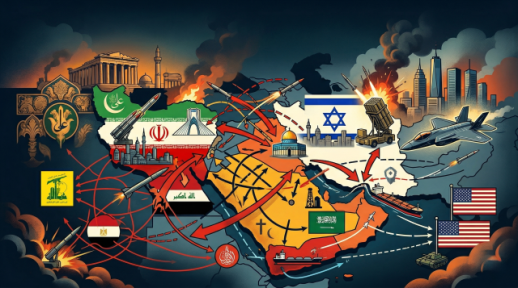 OPINION: The essence of the Iran war — beyond the wounds of religion and ethnicity, toward an order of coexistence SEOUL, March 29 (AJP) - When examining the war in the Middle East, the first instinct to resist is oversimplification. The ongoing Iran conflict may appear on the surface as a clash between Israel and Iran, but in reality it is a multi-layered war entangling U.S. military and diplomatic intervention, the strategic interests of Gulf states, the involvement of pro-Iranian proxies such as the Houthis and Hezbollah, and the mounting pressure surrounding the Strait of Hormuz and the global energy order. Recent developments alone paint a vivid picture. Gulf states have conveyed to Washington that a ceasefire is insufficient, demanding instead the degradation of Iran's military capabilities. Yemen's Houthis have formalized their offensive against Israel within the broader war effort. This is no longer a bilateral conflict. It is a simultaneous eruption of fissures that have long fractured the Middle East. Yet to view this war solely through the prism of missiles, airstrikes, crude oil and exchange rates is to see only half the picture. Beneath the surface lie deep geological strata of history and religion, ethnicity and collective memory. Iran, which claims the mantle of Shia leadership, has long competed with the Sunni-dominated regional order. Israel's security doctrine clashes with the broader Islamic world's grievances. Western historical intervention and the lingering memory of empire have together fueled today's volatility. The Sunni-Shia divide transcends doctrinal differences. It functions as a political axis along which Iran and Saudi Arabia contest leadership of the Muslim world. Religion serves as a banner, but what moves that banner is power, fear, memory, and mobilization. The medieval Crusades cast a historical shadow that persists to this day. They were military expeditions launched by Western Christendom under the banner of reclaiming the Holy Land and containing Islamic power. It would be reductive to frame today's Middle Eastern conflict as a mere repetition of the Crusades — nation-states have since emerged, oil and nuclear weapons have entered the equation, and international law and global finance now shape the landscape. Yet the ancient template of "politics waged in God's name" remains very much alive. Faith does not inherently breed violence. But when political power absolutizes faith, religion becomes the most potent language of mobilization. The tragedy of the Middle East has been repeated at precisely that juncture. To understand this war, one must confront a fundamental truth: Judaism, Christianity, and Islam all revere Abraham as a common ancestor of faith. They are Abrahamic religions. In other words, the faiths now training their weapons on one another are, at their core, siblings born from a single root. That they share the same origin yet exclude and deny one another represents, from the standpoint of universal human values, a painful paradox. The moment belief ceases to be a path for saving human lives and becomes an instrument of division, faith loses its original meaning and degenerates into the language of power. This paradox manifests with particular intensity in the Middle East, and nowhere more acutely than in Iran. Today's Iran is known as a Shia Islamic state, but its historical roots run far deeper. The ancient land of Persia was the heartland of Zoroastrianism — a faith widely assessed as having influenced the later development of Judaism, Christianity, and Islam. Moreover, Iran is a nation uniquely situated within the Middle East, using Persian rather than Arabic as its official language. Within this complex entanglement of religion, ethnicity, and language, conflict transcends territorial disputes and resource competition, escalating into a collision of identities. The Iran war is simultaneously a contest of "who is stronger" and a clash over "who we are." The Sunni-Shia rift is not, at its core, merely a theological matter. The schism that began with the seventh-century succession dispute within the Islamic community has solidified over the centuries into a foundation for state alliances, military networks, and identity politics. Iran has expanded its influence through Shia networks stretching across Lebanon, Iraq, and Yemen. Sunni-majority states have perceived this as a challenge to their own security and regional hegemony. This is why Gulf nations, even while not fully aligning with Israel, quietly hope for the diminishment of Iran's capabilities — revealing an ambivalence that lays bare a critical truth: though this war wears the garb of religion, its actual operating mechanism is the politics of the balance of power. Yet religion should not be dismissed lightly. The ambitions and prejudices of political leaders invariably exploit a people's collective memory and wounds. Religion ought to restrain the human impulse, but when fused with power, it readily becomes a tool of absolutism. Phrases such as "God's will," "the mission of a chosen people," and "the revenge of history" are among the most potent rallying cries for mobilizing the masses. In that moment, the adversary ceases to be a negotiating partner and becomes a target for elimination. War is no longer a border dispute but an existential struggle. This is precisely why the Middle East stands at such a dangerous precipice today. When one side defines the other not as an agent of flawed policy but as the very embodiment of evil, peace is no longer a strategic question — it becomes an act of betrayal. Ending the Iran war, therefore, cannot be achieved through military ceasefire alone. A ceasefire silences the guns but does not silence the narrative of enmity. Genuine resolution requires a simultaneous approach across three dimensions. The first is national security. Tangible safeguards must be established to halt strait blockades, missile strikes, and the deployment of proxy forces. The second is politics. The multilateral negotiating framework — entangling Iran, the Gulf states, Israel, its neighbors, the United States, and Europe — must be restructured. The third is the dimension of civilization and religion. Unless the mentality that views the adversary as a target for annihilation is dismantled, war will return in altered form. The Middle East's true affliction is that memories outlast weapons. Thus, the philosophical and religious language that addresses memory must re-enter the discourse. It is here that South Korea's experience offers food for thought. The Republic of Korea is among the rare nations where Buddhism, Protestantism, Catholicism, Won Buddhism, Confucian traditions, and folk beliefs have coexisted within a single society. The Korean Constitution guarantees freedom of religion and prohibits discrimination on religious grounds. Relevant studies have noted that Korean society exhibits comparatively high support for religious freedom and interfaith coexistence. This is not to suggest an absence of conflict. But the fact that the state has not absolutized any single religion, and that multiple faiths have accumulated an experience of competing yet coexisting within institutional frameworks, constitutes a tangible asset. At the deeper root of this Korean asset, the spirit of Hongik Ingan — "to broadly benefit humanity" — and the ideal of Jaesaei-hwa — "to harmoniously govern the world" — are frequently invoked. These ancient principles do not proclaim the supremacy of any single religion. They are closer to ethical maxims for sustaining both the individual and the community. To revere the heavens without harming nature, to value the community without abandoning human dignity — this is the soil in which religious coexistence can take root. Translated into today's language, it amounts to this: no one may trample another in the name of God, and neither state nor civilization may stand above human dignity. This is not a technique of interfaith compromise. It is the final principle that civilization must uphold. In this context, the thought of Daseok Ryu Young-mo also merits renewed attention. Rather than insisting on the absolutism of any single religion, Daseok sought conscience, life, and the will of heaven within the diverse traditions of human spirituality. What the Middle East has lost today is precisely this: the recognition that though beliefs may differ, human suffering is the same; that though the names of God may differ, the lives that must be saved are the same. The force that ends conflict does not lie in making the other entirely the same. It lies in recovering a shared humanity while acknowledging difference. Finally, it is worth recalling the words of the Bible, the Quran, and the Jewish scriptures together. The Bible says, "Blessed are the peacemakers" — that the practice of peace is the true mark of faith. The Quran says God created diverse peoples "so that you may know one another" — that difference is not a pretext for domination and extermination but a starting point for mutual recognition and respect. The Psalms sing, "How good and pleasant it is when brothers dwell in unity." These brief passages from different scriptures converge upon a single truth: God did not command humanity to sanctify hatred. He asked us to know one another, to live together, and to build peace. The essence of the Iran war can therefore be distilled into a single proposition. This is a war of guns and missiles, and simultaneously a war of memory and faith, ethnicity and power. That is why it is harder, and why it endures longer. But precisely because of this, the solution must also be multi-layered. Military deterrence and diplomatic compromise, economic interests and religious reflection, national security and human dignity — all must advance in concert. Elevating any single dimension collapses the rest. The Middle East's history has for too long attempted "the peace of the victor." The time has come to pivot toward "the peace of those who must live together." The question South Korea must ask itself while witnessing this tragedy is clear. Do we truly possess the wisdom befitting a nation where religions coexist? Are we prepared to present Hongik Ingan not as a textbook phrase but as a universal ethic for the world? Do we possess the spiritual depth to find a single truth within different faiths, as Daseok once sought? And can we look upon the world anew through the ancient intuition that heaven, earth, and humanity must walk together — Injungcheonji-il, the recognition that the will of heaven and nature dwells within the human being? The conclusion is at once simple and difficult. To end the era in which Abraham's descendants train their weapons upon one another, humanity must now move beyond "the politics of difference" and recover "the ethics of sameness." Ethnicities differ, but suffering is the same. Religions differ, but life is the same. Nations differ, yet human dignity cannot be divided. When we believe that the will of heaven and nature lives within the human being — when we awaken to the truth that humanity is not a separate master standing over nature but an existence bridging heaven and earth — only then do restraint, coexistence, and peace become possible. War is not ultimately won by those who seize the land, but ended by those who sever the inheritance of hatred. Truth, justice, and freedom are not the banner of any single camp. They are the last fence that keeps human beings human. Our gaze upon the Iran war must begin there. To ensure that politics which discards humanity — under the pretext of religion, ethnicity, or the state — can no longer prevail: that is the task of 21st-century civilization, and the path that the Republic of Korea can quietly yet decisively present to the world. *The author is a columnist of AJP. 2026-03-29 10:36:00
 -
 North Korea unveils upgraded solid-fuel ICBM engine, signaling push toward multiple-warhead capability SEOUL, March 29 (AJP) - North Korea disclosed a ground test of a new carbon-fiber solid-fuel engine designed for an intercontinental ballistic missile, showcasing a 26 percent leap in thrust as Pyongyang seeks to sharpen its nuclear deterrent amid widening U.S. military operations in the Middle East. The engine revealed Sunday generated a maximum thrust of 2,500 kilonewtons (kN), up from 1,971 kN recorded in a September 2024 test, the Korean Central News Agency reported. The upgraded powerplant is widely believed to be destined for the Hwasong-20, a new solid-fuel ICBM Pyongyang has been developing. Analysts say the thrust increase points less toward extending range — the North is already assessed to field ICBMs capable of reaching the U.S. mainland — and more toward enabling a multiple independently targetable reentry vehicle (MIRV) warhead configuration. A MIRVed ICBM can strike several targets simultaneously, making interception far more difficult. The test came about a month into the U.S.-Israeli war against Iran, whose own multi-warhead ballistic missiles have penetrated allied missile defense shields to hit targets. With Washington also having moved against Venezuelan President Nicolás Maduro earlier this year, Pyongyang appears intent on reminding the United States that it possesses strategic weapons capable of striking the American homeland. North Korea has not launched an ICBM since the Hwasong-19 flight on Oct. 31, 2024, and has refrained from direct criticism of U.S. President Donald Trump, leaving a narrow diplomatic channel open. South Korea's Joint Chiefs of Staff said U.S. and South Korean intelligence agencies are "closely monitoring" the North's weapons development activities. 2026-03-29 09:56:05
 -
 South Korea routed 4-0 by Ivory Coast in World Cup-year friendly, hits post three times Hong Myung-bo’s South Korea opened the 2026 FIFA World Cup year with a lopsided loss, falling 4-0 to Ivory Coast in a friendly at Stadium MK in Milton Keynes, England, on March 28 (Korea time). South Korea, ranked 22nd by FIFA, had won three straight friendlies last year — beating Paraguay 2-0 in October, then Bolivia 2-0 and Ghana 1-0 in November — but struggled throughout against Ivory Coast’s pressure and conceded four times. Ivory Coast is ranked 37th. The all-time series between the teams is now 1-1. The match was also South Korea’s 1,000th men’s A international. The first came in August 1948, a 5-3 win over Mexico in the London Olympics round of 16. South Korea’s overall record stands at 542 wins, 245 draws and 213 losses. Using a three-back system, South Korea hit the post three times. In the 19th minute of the first half, Oh Hyeon-gyu (Besiktas) fired a left-footed shot off a forward pass from Seol Young-woo (Crvena zvezda), but the ball struck the frame. South Korea fell behind in the 35th minute after Cho Yu-min (Sharjah), playing as the right-sided defender, was beaten by Marcial Godo (Strasbourg). The move ended with a goal by Evan Guessand (Crystal Palace). Seol then hit the right post with a long-range attempt in the 43rd minute, and South Korea conceded again three minutes later when Simon Adingra (AS Monaco) dribbled past defenders and scored with a right-footed shot from inside the penalty area. In the 17th minute of the second half, Yang Hyeon-jun (Celtic) headed a ball toward South Korea’s goal area on a corner, but it went to an Ivory Coast player and Godo scored to make it 3-0. South Korea’s Lee Kang-in (Paris Saint-Germain), on as a substitute, struck the right post with a sharp left-footed shot in the 31st minute as South Korea pushed for a response. South Korea conceded a fourth in stoppage time on a counterattack, with Wilfried Singo (Galatasaray) finishing after a pass from Amad Diallo (Manchester United). South Korea will travel to Vienna to play Austria at 3:45 a.m. April 1 in its second March A-match friendly.* This article has been translated by AI. 2026-03-29 01:42:00
 -
 Fire Near Gyeongbokgung’s Sambimun Gate Put Out in 15 Minutes; Minor Damage Reported A small fire near Jaseondang Hall at Gyeongbokgung Palace damaged parts of a nearby doorway, including a pillar and door, but did not spread further. The Korea Heritage Service said the fire started around 5:35 a.m. March 28 at a side door near Sambimun Gate in front of Jaseondang Hall. A safety officer on patrol spotted smoke and used a fire extinguisher and a hydrant to put out the flames in about 15 minutes. No injuries were reported. Officials said the fire was contained before it could spread, but one auxiliary pillar of the side door and part of a crossbeam were burned or scorched. In a text alert, the agency said a joint review with the fire department and other authorities indicated the blaze was believed to have started spontaneously. It said no suspicious activity was detected nearby, and no cigarette butts or flammable materials were found. The exact ignition point and how the fire began have not been confirmed. 2026-03-28 19:33:13
 -
 Chef Son Jong-won draws buzz with crisp first pitch at SSG home opener Son Jong-won, head chef at Eatanic Garden and La Mange Secrete and a cast member of Netflix’s “Culinary Class Wars 2,” drew attention after taking the mound for a KBO season opener. SSG Landers selected Son as the ceremonial first-pitch thrower for its 2026 home opening game against the KIA Tigers on Friday at Incheon SSG Landers Field. The ballpark hosted fan events and cheering programs that added to a festive atmosphere. Son drew cheers with what spectators described as a sharp uniform look, a clean throwing motion and steady posture. Before the pitch, he said, “It’s an honor to throw out the first pitch for the opener, and I hope SSG carries good energy through the season and wins the championship.” Online commenters praised the moment, writing, “His form is almost like a player,” “Isn’t he a pitcher, not a chef?” and “Perfect from the visuals to the first pitch.” * This article has been translated by AI. 2026-03-28 19:24:17
 -
 Jungkook’s TikTok Follow of aespa Rekindles Rumors Linking Him to Winter Reports that BTS member Jungkook followed girl group aespa on TikTok have resurfaced online rumors linking him to aespa member Winter. On social media and online communities, users said they spotted Jungkook following aespa’s official TikTok account. The activity prompted renewed discussion of earlier dating rumors involving Winter. The two previously faced speculation that they were dating. Online posts claimed they wore matching fashion items such as shoes and even got couple tattoos, drawing attention from fans. Photos also circulated showing Jungkook attending an aespa concert during his military service. At the time, neither agency issued a clear statement, leading some fans to interpret the silence as tacit confirmation. Reaction to the latest follow has been divided. Many commenters criticized Jungkook, saying he should have avoided actions that could reignite speculation, while others argued the relationship was already widely assumed and voiced support for the pair. BTS recently drew about 20,000 people to a comeback concert in Gwanghwamun. The group is set to begin a monthlong South American world tour in October.* This article has been translated by AI. 2026-03-28 18:48:16
 -
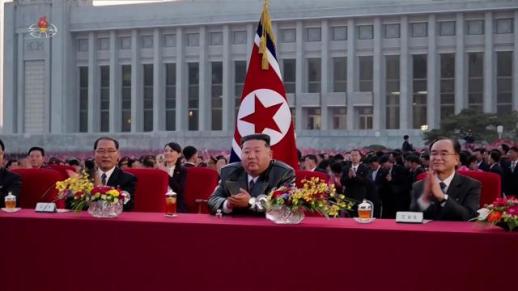 Kim Jong-un reaffirms closer ties with Beijing in message to Xi SEOUL, March 28 (AJP) - North Korean leader Kim Jong-un sent a message to Chinese President Xi Jinping reaffirming Pyongyang’s commitment to strengthening bilateral ties, state media reported Saturday. According to the Korean Central News Agency (KCNA), Kim sent a reply on Friday to Xi, who had congratulated him on his reappointment as chairman of North Korea’s State Affairs Commission. Kim expressed “deep thanks,” saying he felt the “invariable support and emotion of friendship” from Xi and the Chinese government toward him, his party and North Korea’s government. Referring to what he described as key agreements reached during a North Korea-China summit held last September on the sidelines of China’s 80th Victory Day parade, Kim said he was pleased that the “traditional DPRK-China relations are being put on a new high stage in keeping with the aspiration and desire of the two parties and the peoples of the two countries.” He also stressed that North Korea’s position remains firm in continuing to deepen and develop bilateral cooperation centered on socialism. Kim further expressed confidence that China, under Xi’s leadership, would achieve “fresh progress” in building a modern socialist state. North Korea’s Supreme People’s Assembly, the country’s parliament, reappointed Kim as chairman of the State Affairs Commission on March 22. Xi sent a congratulatory message on Thursday, saying that safeguarding, consolidating and developing China–North Korea relations is a consistent and unwavering policy of the Communist Party of China and the government. 2026-03-28 17:14:39
 -
 EDITORIAL: Tokenized securities are reshaping U.S. markets — Is Korea ready? SEOUL, March 28 (AJP) - The U.S. capital market is once again attempting to reshape the backbone of financial infrastructure. This time, the catalyst is not artificial intelligence, but tokenized securities — asset tokenization built on blockchain technology. The Financial Times recently observed that tokenized stocks may succeed precisely because investors hardly notice the transition. In an opinion piece titled “Tokenised stocks are coming, and ideally nobody will notice,” the newspaper argued that real-time, blockchain-based settlement could transform trading infrastructure without dramatically changing the user experience. Industry leaders are echoing this view. BlackRock CEO Larry Fink has repeatedly emphasized tokenization as a key evolution in capital markets, arguing that expanding access to investments through tokenization could modernize financial ownership structures. Meanwhile, Robinhood CEO Vladimir Tenev has argued that token-based ownership could soon demonstrate advantages over traditional stock ownership, highlighting faster settlement and broader access. The core issue is not marketing hype but efficiency — speed, cost reduction and simplified market infrastructure. Today’s stock trading is digital, yet it still relies on multiple intermediaries and layered record-keeping systems, resulting in delayed settlement. Blockchain-based tokenized assets, by contrast, could theoretically enable near-instant settlement and 24-hour trading. What matters most is that major exchanges are already moving. Nasdaq received approval from the U.S. Securities and Exchange Commission (SEC) in March to allow certain securities to trade in tokenized form. Initially, the program will cover companies within the Russell 1000 index and major ETFs, with settlement conducted through the Depository Trust Company, integrating blockchain into existing infrastructure. The New York Stock Exchange is taking a different approach. NYSE recently partnered with digital asset firm Securitize to develop a blockchain-based platform for tokenized securities. The proposed system aims to enable round-the-clock trading, instant settlement and even the use of stablecoins for transactions. London is not standing still either. The London Stock Exchange Group announced plans to develop an on-chain settlement service called the Digital Securities Depository, designed to support tokenized bonds, equities and private market assets. The first deliverables are expected in 2026, pending regulatory approval. This signals that tokenization is no longer an experiment within the crypto industry. Traditional exchanges and financial institutions are now competing to shape the next generation of capital market infrastructure. However, the future is not without risks. One of the biggest challenges is ensuring investor protection. Tokenized securities can blur the boundaries of ownership, custody and settlement finality. If investor rights are not clearly defined, trust in markets could erode quickly — as seen in past financial crises. Critics also note that some tokenized securities currently available in global markets resemble price-tracking instruments rather than actual shares, lacking full shareholder rights such as dividends or voting power. The real challenge, therefore, is not whether tokenization happens, but whether it can be implemented without weakening investor protections. Where does Korea stand? Despite active discussions around digital assets, Korea has been slower to address how tokenization could reshape capital market infrastructure. Tokenized securities should not be viewed merely as another financial product. They represent a fundamental redesign of issuance, custody, settlement, disclosure and investor protection. The direction emerging from the United States is clear. First, regulated exchanges must take the lead. Second, regulators must allow controlled experimentation. Third, the goal must be market efficiency — not speculative hype. Korea’s task is equally clear. The Korea Exchange, Korea Securities Depository, brokerages, banks, asset managers and fintech firms should jointly develop a roadmap for tokenized securities infrastructure. This does not mean immediately tokenizing listed equities. A phased approach — beginning with private securities, private debt, fund shares and alternative assets — would allow regulators to build safeguards gradually. Financial history often changes quietly. When markets transitioned from paper to digital records, investors did not immediately grasp the magnitude of change. Tokenization may follow the same path. But by the time the shift becomes visible, the infrastructure leadership may already be decided. The digital tokenization of U.S. securities markets is not merely an American experiment. It is a competition to define the future standard of global capital markets. If the era of tokenized securities truly arrives, Korea should not be a spectator — but a designer. 2026-03-28 16:23:50
 -
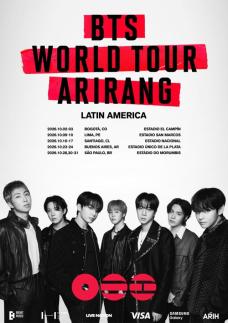 BTS sets Latin America tour across five cities in October SEOUL, March 28 (AJP) - BTS will embark on a Latin America leg of its world tour in October, performing across five cities, the group’s agency said Saturday. Big Hit Music released detailed schedules for the “Arirang” world tour in Latin America, with concerts set to begin in Bogotá on Oct. 2–3. The tour will then continue to Lima on Oct. 9–10, Santiago on Oct. 16–17, Buenos Aires on Oct. 23–24, and São Paulo on Oct. 28 and 30–31, for a total of 11 shows. The concerts will mark BTS’s first full-group performances in Colombia, Peru and Argentina. Member Jin previously appeared as a guest during Coldplay’s world tour concert in Buenos Aires in 2022. The world tour will kick off on April 9 at Goyang Stadium in Goyang. According to the agency, all 46 shows across South Korea, Japan, North America and Europe have already sold out. BTS returned as a full group on March 21 after nearly four years. The group held a special comeback performance at Seoul’s Gwanghwamun Square the following day, drawing about 22,000 fans. 2026-03-28 15:43:45
 -
 KBO League Opens 2026 Season With Sellouts at All Five Ballparks Marking its 45th anniversary, South Korean professional baseball opened the 2026 season with strong turnout from the first day. The KBO League said 105,878 fans attended the season openers held March 28 at five ballparks nationwide. It was the third-largest opening-day total on record, behind 2019 (114,021) and 2025 (109,950). All five stadiums sold out. The first sellout came at Incheon SSG Landers Field for the KIA Tigers-SSG Landers game, where all 23,000 seats were gone by 10 a.m. The Daejeon game between the Kiwoom Heroes and Hanwha Eagles also sold out about two hours before first pitch. Sellouts followed at Jamsil for kt wiz-LG Twins, in Daegu for the Lotte Giants-Samsung Lions game, and in Changwon for Doosan Bears-NC Dinos. The league has now recorded sellouts at all opening-day venues for four straight years. After topping 10 million in total attendance in back-to-back seasons — about 10.88 million in 2024 and about 12.31 million in 2025 — the KBO is on track to reach the mark for a third consecutive year. Before the season began, exhibition games drew more than 440,000 fans, setting a record and adding to expectations for strong interest this year.* This article has been translated by AI. 2026-03-28 15:42:00