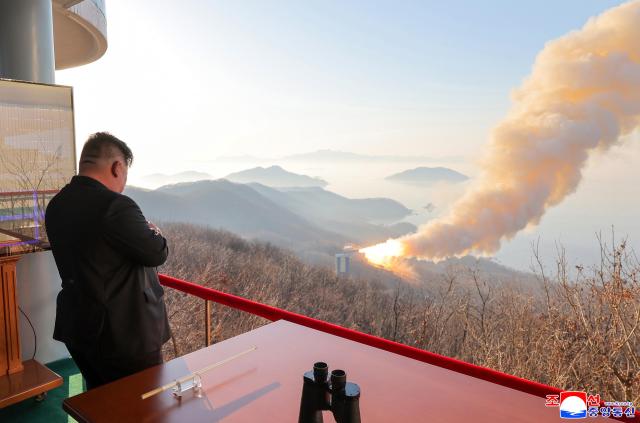
The engine revealed Sunday generated a maximum thrust of 2,500 kilonewtons (kN), up from 1,971 kN recorded in a September 2024 test, the Korean Central News Agency reported. The upgraded powerplant is widely believed to be destined for the Hwasong-20, a new solid-fuel ICBM Pyongyang has been developing.
Analysts say the thrust increase points less toward extending range — the North is already assessed to field ICBMs capable of reaching the U.S. mainland — and more toward enabling a multiple independently targetable reentry vehicle (MIRV) warhead configuration. A MIRVed ICBM can strike several targets simultaneously, making interception far more difficult.
The test came about a month into the U.S.-Israeli war against Iran, whose own multi-warhead ballistic missiles have penetrated allied missile defense shields to hit targets. With Washington also having moved against Venezuelan President Nicolás Maduro earlier this year, Pyongyang appears intent on reminding the United States that it possesses strategic weapons capable of striking the American homeland.
North Korea has not launched an ICBM since the Hwasong-19 flight on Oct. 31, 2024, and has refrained from direct criticism of U.S. President Donald Trump, leaving a narrow diplomatic channel open.
South Korea's Joint Chiefs of Staff said U.S. and South Korean intelligence agencies are "closely monitoring" the North's weapons development activities.

Copyright ⓒ Aju Press All rights reserved.