
Journalist

Lee Hugh
=
-
 KBO League to Allow “Torpedo” Bats, Add Asia Player Slot and Shorten Pitch Clock in 2026 The 2026 KBO League regular season is set to open in one day after exhibition games wrapped up. The Korea Baseball Organization has overhauled rules to strengthen competitive fairness and deliver a faster-paced product. At the plate, the league will allow so-called “torpedo” bats for the first time. The KBO also removed an exception that had allowed bats not distributed through certified vendors if they were approved for Major League Baseball or Japan’s NPB. Instead, the KBO will allow additional bat certification during the season through Aug. 31, using the same process as the regular January application period. The newly introduced Asia quota system is expected to be the biggest variable this season. Designed to boost league competitiveness and ease foreign-player recruitment, it allows each club to sign one player from an Asian league — including Australia — for up to $200,000, with no position restrictions. Dual nationals from non-Asian countries are not eligible. Clubs can now carry four foreign players: the existing three plus one Asia-quota player. All four may appear in the same game. Nine of the 10 teams used the slot on a pitcher. The only club to sign a position player was the KIA Tigers, who added Australian infielder Jared Dale. By nationality, Japan accounts for seven players, Australia two and Taiwan one. The league is also pushing to shorten games. The pitch clock in the top division has been reduced by two seconds: pitchers must deliver within 18 seconds with the bases empty and 23 seconds with runners on. The Futures League will operate the same as last year. To speed and improve officiating, first- and second-base umpires will use wireless intercoms, allowing them to communicate with the replay center and handle in-stadium announcements without moving. Replay review has been expanded to include “strategic overruns” at second and third base. A new authority also allows officials to correct an obvious error on a different play not requested by a club during a review. Base-running interference rules have been tightened. If interference occurs on a pickoff play, the runner will be awarded one base rather than being sent back. Penalties for illegal defensive shifts were clarified, including charging an error to the fielder who first touches a ball in play. For consistent rulings, the foul-line width at all parks was standardized at 4 inches (10.16 centimeters). Player-protection measures were also updated. Injuries occurring after the start of exhibition play can be placed on the injured list if the move is made within three days of the Opening Day roster announcement. Players who apply for an extension can return to the active roster without waiting 10 days, easing roster strain. Doubleheaders were tightened as well. They may be scheduled only from April 12 to May 31, and back-to-back weeks of doubleheaders are prohibited. A Sunday doubleheader will be played as two nine-inning games only when a Saturday game is canceled, and teams may add two special roster spots for that day only.* This article has been translated by AI. 2026-03-27 14:54:00
 -
 Gulf Crisis, One Month On: From Gulf battleground to shockwaves across Asia Editor's Note: One month into the Iran war, a conflict that began in the Middle East is rapidly evolving into a broader economic and strategic shock for Asia, and in this special series, AJP examines those spillovers in full — from a comprehensive overview of Asia-wide shocks to industrial realignments, the mounting risk of a third oil shock, and rising security tensions — as the central question shifts from how the war unfolds in the Middle East to how deeply its consequences will be embedded across Asia. SEOUL, March 27 (AJP) - The immediate battlefields may be in the Gulf, but the war’s toll has landed heavily on Asia, as regional economies scramble to survive without Middle Eastern fuel while the critical chokepoint of the Strait of Hormuz remains effectively closed for a month. The shock in South Korea has spilled beyond capital markets. Gas stations saw lines stretch until midnight ahead of the lifting of a temporary price cap on Friday, even as the government rolled out sweeping “wartime” measures — from extended fuel tax cuts and sovereign bond buybacks to a ban on naphtha exports and emergency supplementary budgeting. Consumers are hoarding trash bags and delivery containers amid fears of a plastic shortage after a domestic cracking facility halted operations due to naphtha supply disruptions. More than 70 percent of South Korea’s energy imports come from the Middle East, and over 90 percent of that oil passes through the Strait of Hormuz — a route now at the center of geopolitical risk. While Seoul holds one of the world’s largest strategic reserves — enough for more than 200 days when combined with private stockpiles — the immediate economic shock has proven difficult to contain. The impact is more pronounced in emerging Asian economies with far thinner buffers. The war, triggered by U.S. and Israeli airstrikes on Iran on Feb. 28, has effectively choked off one of the world’s most vital energy arteries. Roughly a fifth of global oil consumption and a similar share of LNG trade typically pass through the Strait of Hormuz. The disruption has been compounded by direct damage to supply. Qatar, the world’s second-largest LNG exporter, has lost 17 percent of its export capacity following Iranian attacks, with recovery expected to take up to five years, according to QatarEnergy CEO Saad al-Kaabi. Asia buys about four-fifths of Qatar’s LNG — a share that has increased further since sanctions on Russia following its invasion of Ukraine. In Southeast and South Asia, the crisis has rapidly escalated from an energy shock into a broader economic emergency. The Philippines has declared a “national energy emergency,” warning of imminent fuel shortages as gasoline and diesel prices surge. The country relies on the Middle East for over 90 percent of its crude imports, while its reserves cover just 45 days of demand. Pakistan faces even deeper vulnerabilities. With 99 percent of its gas imports sourced from Qatar, authorities have warned that shortages could disrupt electricity supply within weeks, threatening its export-critical textile sector. In Laos, more than 40 percent of gas stations have shut down, prompting school closures and remote work policies. Cambodia has seen a third of its stations suspend operations, while Thailand is grappling with fuel shortages severe enough to disrupt farming and even halt cremations at temples. Cremation is the standard funeral practice in the country, and the abbot of Wat Saman Rattanaram temple said in an interview, “In my 50 years, I have never seen anything like this.” In India, shortages of cooking gas have reportedly triggered street clashes, while restaurants and hotels are closing temporarily. Thailand is no different. The Bangkok Post reported on March 22 that despite the rice harvest season, farmers are struggling due to a lack of fuel for harvesting machinery and transport trucks. Panic buying has spread at gas stations, and rising fuel prices have sharply increased the cost of essential goods such as palm oil and bottled water. In Myanmar, the impact has been even more severe. Authorities have implemented an odd-even vehicle rationing system, while the military government has introduced fuel rationing as gasoline prices have doubled. While South Korea and Japan hold strategic reserves well above the International Energy Agency’s recommended 90 days, countries such as Indonesia and Vietnam have stockpiles lasting just 20 to 23 days. Unlike crude oil, LNG lacks a global reserve system due to the high cost of storage, leaving many Asian economies reliant on just-in-time imports. Shipping costs for LNG carriers have more than doubled since the war began, forcing countries such as Vietnam and the Philippines to suspend purchases altogether. "On the one-month anniversary of the war in Iran, its impact on the global economy has been severe, with developing countries suffering the most,” said John Kirton, Professor Emeritus at the University of Toronto. “Almost all countries around the world have suffered in many ways, starting with rising prices and dwindling supplies of Middle Eastern oil, natural gas, helium, sulphur, and chemicals,” he said, noting the spillover into food, medical supplies, and critical minerals. Kirton warned that the crisis is evolving into a macroeconomic threat. “We are looking at a potential 1% reduction in global growth, inflation rising toward 5%, and the growing risk of stagflation,” he said. The burden, however, is not evenly shared. “These countries are being hit hardest due to high debt burdens, limited fiscal capacity, and reduced international aid,” Kirton added, pointing to rising food prices, weakening currencies, and growing political instability. Andreas Rasche of Copenhagen Business School framed the divide as structural. “Many of them are highly dependent on imported energy and food, so price increases hit faster and harder,” he said. “At the same time, they have far less fiscal and monetary space to respond.” Richer economies like South Korea retain greater policy flexibility, stronger institutions, and in some cases strategic reserves that cushion the immediate blow. Yet even for them, the crisis is exposing a deeper vulnerability. For decades, the global economy has depended on a narrow waterway that carries nearly every barrel exported from Saudi Arabia, Kuwait, Iraq, Qatar and the United Arab Emirates. As long as that dependency persists, the shockwaves now rippling across Asia may not be a one-off crisis — but a recurring fault line in the global energy system. 2026-03-27 14:39:54
 -
 South Korea honors fallen sailors of naval skirmishes in West Sea SEOUL, March 27 (AJP) - South Korea honored some 50 sailors and other victims who died defending the maritime border in the West Sea at a ceremony in Daejeon on Friday. About 1,500 people gathered at Daejeon National Cemetery to mark the 11th anniversary of a joint commemoration honoring victims of naval incidents and skirmishes with North Korea including a naval battle near the border island of Yeonpyeong in June 2002, the sinking of the corvette Cheonan in March 2010, and the shelling of the same island in November 2010. The country has observed the fourth Friday of March as a day of remembrance, holding annual ceremonies since 2016 to honor those who gave their lives defending the nation. Among those in attendance were President Lee Jae Myung, the bereaved families of the fallen sailors, their surviving crewmembers, as well as military officials and veterans. In his speech, Lee vowed to ensure that the "blood and sweat shed by our heroes" would not be forgotten and prayed for their "eternal rest." He also offered condolences to families who "buried loved ones in their hearts" and thanked veterans living with "wounds and memories," saying, "Because you are here, South Korea stands firm today." Pledging proper treatment and compensation for those who served and sacrificed for the country, Lee said monthly payments will be handed out to spouses of war veterans to support their livelihoods, starting from May. He also promised that the number of medical institutions accessible to veterans and other national merit recipients would be increased to 2,000 nationwide by 2030, adding that "those in uniform" can serve their duties with greater pride. He said building a peaceful Korean Peninsula, free from the fear of war, is the legacy the West Sea heroes left behind. 2026-03-27 14:36:37
 -
 South Korea Policy Lenders Form ‘One Team’ to Expand Productive Finance Major South Korean policy finance institutions agreed to step up cooperation to expand what they call “productive finance,” aiming to channel more private capital into innovation industries amid overlapping risks such as rising global protectionism and instability in the Middle East. Korea Development Bank said it held a meeting on March 27 at its headquarters in Seoul with the Industrial Bank of Korea, the Korea Credit Guarantee Fund, the Export-Import Bank of Korea, the Korea Trade Insurance Corp. and the Korea Technology Finance Corp., and signed a memorandum of understanding. The institutions selected seven core joint initiatives to support government policy goals, focusing on expanding productive finance, strengthening cooperation with the National Growth Fund and increasing regional finance to back locally led growth. They also agreed on ways to work together. The seven areas are: expanding productive finance support and leading private finance; supporting the successful operation of the National Growth Fund; expanding regional finance for locally led growth; supporting ventures and startups through closer links among venture platforms; creating joint funds to strengthen the innovation ecosystem; building a system to foster climate tech; and boosting the competitiveness of small and midsize companies. Park Sang-jin, chairman of Korea Development Bank, said the institutions formed a “one team” to pool their capabilities and expand productive finance support “amid a complex crisis,” adding that they would serve as a catalyst for private money to flow into innovation industries and would also expand the scale of regional finance operations to drive locally led growth. Jang Min-young, president of the Industrial Bank of Korea, said combining the institutions’ expertise “organically” could help lead a successful shift toward productive finance despite domestic and external uncertainty and further strengthen the growth foundation for South Korean industries and companies. The consultative body was set up as a follow-up to instructions given in January by Lee Eok-won, chairman of the Financial Services Commission, during a work report by public and affiliated agencies under the commission. Park said that while the commission had called for three organizations to form a consultative group, he believed it was more important for all institutions involved in productive finance to gather and cooperate. Addressing criticism that projects promoted by KDB were being prioritized, Park said the basic principle was fairness. He added that he preferred reviewing regional projects first in the interest of balanced regional development, and said that could lead to misunderstandings. Separately, Park said that regarding the scale of damage to South Korean companies from the recent Hormuz situation, large companies had not prepared specific answers because they expected it to end quickly, but were now tallying losses and appeared likely to request financial support.* This article has been translated by AI. 2026-03-27 14:30:11
 -
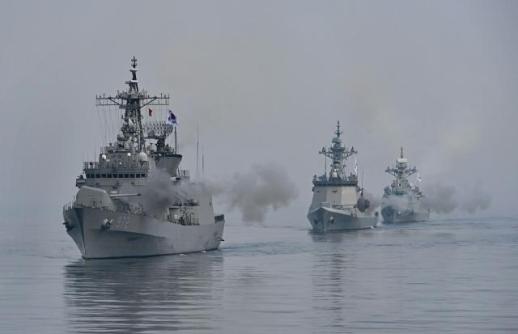 South Korea joins France-led defense chiefs talks on Hormuz SEOUL, March 27 (AJP) - South Korea joined a France-led meeting of chiefs of defense from 35 countries Thursday to discuss security in the Strait of Hormuz, officials said. France’s Ministry of Armed Forces said the video conference was chaired by Chief of the Defence Staff Gen. Fabien Mandon and brought together military leaders from countries interested in contributing to maritime security in the strategic waterway. “The meeting provided an opportunity to gather the positions of nations willing to participate in joint efforts to contribute to safe maritime navigation in this strategic region,” the ministry said in a statement. French officials emphasized that the meeting was unrelated to ongoing military operations in the region and described it as “purely defensive in nature.” The discussions focused on organizing the resumption of maritime traffic in the Strait of Hormuz after hostilities subsided. South Korea was represented by Joint Chiefs of Staff Chairman Adm. Jin Yong-sung, according to the South Korean military. A military official said the meeting served as an opportunity to exchange views and build a basic consensus on the Hormuz situation, adding that no decisions were made regarding specific military contributions. “The defense ministry and the Joint Chiefs of Staff will closely monitor international developments related to the Strait of Hormuz and continue communication for joint efforts,” the official said. “In coordination with relevant ministries, the government will carefully review possible response measures.” Earlier, U.S. President Donald Trump requested allied nations in Europe and Asia, including France, to dispatch naval vessels to help reopen the Strait of Hormuz, which Iran has effectively blockaded. However, most allies have declined the request, citing concerns about becoming entangled in the conflict. Many countries have indicated they would only consider escort missions after a ceasefire is reached. British media recently reported that the United Kingdom and France are exploring multinational efforts to reopen the Strait of Hormuz, and the multinational chiefs of defense meeting led by France appears to be part of such preparatory efforts. Separately, France’s navy chief also held discussions with naval leaders from several countries, including the United Kingdom, Germany, Italy, India and Japan, regarding the Middle East situation, French officials said. 2026-03-27 14:20:39
 -
 Why the Name ‘Grace’ Matters in ‘Project Hail Mary’ In 'Project Hail Mary,' Ryan Gosling’s character, Grace, can look at first like a familiar genius archetype. After waking in deep space, he calculates gravity and speed and reasons that he is no longer in the solar system. Instead of collapsing into fear, he observes, forms hypotheses and tests them. He responds to panic with experiments. The film’s interest, however, is that it does not treat him as a simple hero or a one-note prodigy. Grace is tasked with saving the world, yet he is also an ordinary person with an ordinary routine. He is content teaching children, rides a bicycle to and from work, and lives within his own small comfort. He has no grand ambition to remake society and no outsized hunger for fame. He fits daily life more than sweeping history. Grace is not cold. He is the kind of person who can offer a brief prayer for someone he never knew. The issue is not indifference but distance: he has goodwill without deep ties, compassion without entanglement. He does not hate people; he is practiced at keeping them at arm’s length. That is why he cannot immediately step forward for a mission that carries humanity’s fate. Calling it cowardice only partly captures it. He is afraid and does not want to die, and he is not trained to throw himself into a heroic narrative. More fundamentally, “humanity” is too large and abstract for him. He can understand the argument that it must be saved, but that does not automatically translate into a reason to give up his life. He refuses space not because he is uniquely selfish, but because he is recognizably human. What runs through his psychology is scientific thinking. A scene in which Grace tests falling objects to understand his surroundings underscores science as more than knowledge — it is experiment, failure and repeated challenge. Even in extreme conditions, he does not linger in self-pity. He accepts what is in front of him and looks for the next task. For Grace, science is not only a professional skill but a way to endure fear: he measures instead of breaking down, and he divides problems instead of surrendering to despair. The film deepens when it shows that even Grace is not completed by science alone. What ultimately changes him is not calculation but relationship — Rocky. After meeting Rocky, Grace learns for the first time how to survive with someone else. The bond moves beyond the fact that they are different species. They supply what the other lacks: scientist and engineer, thinking and execution, explanation and making, language and sensation. Together they solve problems neither could handle alone, turning friendship into a metaphor for cooperation on a cosmic scale. The emotional shift matters most. Through Rocky, Grace first feels that he can be essential to someone. He also realizes he cannot endure without Rocky. That is why a celebration scene lands: a laptop filled with human knowledge, a knitted pouch shaped like Earth, the line “Remember me,” and the reply, “You gave me everything.” What is exchanged is not just objects, but time that eased loneliness, a reason to keep living, and the arrival of someone who understands. From there, Grace’s choices change. If he initially hesitated to risk his life for humanity, later he turns back for Rocky. The shift may seem paradoxical, but it is familiar: people often change more in front of a specific face than for an abstract cause. There are moments when “one friend” becomes a stronger ethical motive than “billions of people.” Through Rocky, Grace learns even how to love humanity — not as a starting point, but as something reached through a single relationship. That is why Grace differs from a conventional hero. He is not noble from the beginning. He wants to run, hesitates, feels fear and prioritizes his own safety. The character becomes credible not because he is perfect, but because he moves forward while still incomplete. The name “Grace” is pointed. Read symbolically, he is less a person born with heroic qualities than someone who changes through what he gives and receives in relationships. To Rocky, he is salvation, and Rocky becomes the same for him. Grace is not a figure who saves others in one direction; he is completed within a bond that keeps both alive. In the end, what sets 'Project Hail Mary' apart is that it places a deeply human question inside the scale of space and science. As critic Lee Dong-jin has said, it is both the story of an exceptional astronaut and an SF projection of problems everyone faces: loneliness, avoidance of responsibility, fear, the need for connection, and the willingness to change for someone else. Grace is a scientist solving problems in space, but also a person becoming larger through meeting another. * This article has been translated by AI. 2026-03-27 14:12:20
 -
 Doosan E&C We’ve Golf Team Expands to Eight Players for 2026 KLPGA Season Doosan Engineering & Construction said its We've golf team has completed preparations for the 2026 season with an expanded eight-player roster. The company said the team posted its best results since its launch last season on the Korea Ladies Professional Golf Association (KLPGA) Tour. Starting with Park Hye-jun, Kim Min-sol (two wins) and Lee Yul-lin won titles in sequence, giving the club a combined four victories. Doosan E&C finished third in the 2025 KLPGA club wins standings, the company said. For the new season, Doosan E&C strengthened its lineup by signing rookie Lee Se-young, described as a long-hitting player. The roster now includes Im Hee-jung, Park Gyeol, Yoo Hyun-joo, Yoo Hyo-joo, Kim Min-sol, Lee Yul-lin, Park Hye-jun and Lee Se-young. On March 20, all eight players gathered for their first official schedule at a studio in Nonhyeon-dong, Seoul's Gangnam district, for a profile photo shoot. Wearing team uniforms, they took group photos and individual shots in various concepts, the company said. After the shoot, Lee Yul-lin said, "I always come to profile shoots feeling happy and excited," adding, "It was fun because we could see each other in a different, interesting way than when we're training." Park Gyeol said, "Every time we do a profile shoot once a year, I really feel we're one team," and added, "Since we've done it together several times, we work well together and the shoot went faster." Lee Se-young, entering her debut season, said, "No matter the situation, I want to stay steady and show my own bold style of play," adding, "Last year, all the older players who newly joined the team won. I will also challenge for a win." Im Hee-jung said she aims to carry over her strong form from the second half of last year and contend for victories early in the season. Kim Min-sol, who won multiple times last year, said, "Whenever someone on the team wins, our group chat goes crazy," adding, "I hope we have even more to celebrate this year." Park Hye-jun, the team's first winner, said her victory and strong second-half results last year boosted her confidence. "This year, personally, I want to win multiple times," she said. "I hope our team does well together and reaches No. 1 in club wins, too." A Doosan E&C official said the photo shoot offered an early look at the teamwork the eight players will build this season. The official pledged that, through the company's "one team" culture and support, the players will encourage one another and create synergy in the 2026 season.* This article has been translated by AI. 2026-03-27 14:09:00
 -
 Volvik Names Jang Seok-heon as CEO Volvik said Friday it has officially appointed Jang Seok-heon as its new CEO, following a board meeting held March 26. Jang, born in 1970, graduated from Seoul National University with a degree in international economics. He has served as chief financial officer at Long-Term Credit Bank, Korea Technology Investment Corp. (KTIC), Coamagic and Hyundai Rental Service, building expertise across finance and overall management. Since April 2023, he has led Volvik’s overall management, overseeing company operations. Volvik said the appointment reflected a comprehensive review of leadership, global capability and management expertise needed to drive sustained growth and management innovation. “Volvik is a homegrown golf brand that represents South Korea, and we will strengthen our competitiveness in global markets based on the standing we have built at home,” Jang said. “We will establish a sound management culture and achieve sustainable growth built on trust and innovation.”* This article has been translated by AI. 2026-03-27 13:03:00
 -
 Asian stocks fall as geopolitical tensions rise and tech shares weaken SEOUL, March 27 (AJP) — The Seoul bourse led broad losses across Asia as the toll from the Middle East crisis weighed heavily on the region, largely dependent on energy and commodities, with the critical transit Strait of Hormuz remaining crippled for a month. In Japan, the Nikkei 225 fell 1.61 percent to 52,738.55 in morning trade, as selling pressure mounted on concerns over a possible deployment of U.S. ground troops. Expectations for ceasefire negotiations also weakened following continued pressure on Iran from U.S. President Donald Trump. Hong Kong’s Hang Seng Index fell 0.35 percent to 24,768.66, China’s Shanghai Composite slipped 0.22 percent to 3,880.44, and Taiwan’s TAIEX dropped 1.54 percent to 32,825.21. The retreat was sharper in Korean markets, reflecting the heavy weight of chipmakers Samsung Electronics and SK hynix. Samsung Electronics fell 4.39 percent to 172,200 won, while SK hynix dropped 5.47 percent to 882,000 won in morning trade. The weakness followed concerns over Google’s newly unveiled “TurboQuant” algorithm, which is expected to significantly improve data efficiency and potentially reduce memory demand for artificial intelligence workloads. The technology, which compresses data to roughly one-sixth of its original size, is seen as easing memory bottlenecks in large-scale AI models, raising doubts over the long-held equation that AI demand directly translates into memory demand. The benchmark KOSPI fell 2.79 percent to 5,308.24, while the KOSDAQ dropped 1.02 percent to 1,125.03 as of 11:00 a.m. Broader market pressure was compounded by rising oil prices as hopes for a near-term resolution between the United States and Iran faded. Brent crude futures for May delivery rose 5.66 percent to $108.01 per barrel, while West Texas Intermediate gained 4.61 percent to $94.48. Overnight, U.S. stocks closed sharply lower. The Dow Jones Industrial Average fell 1.01 percent, while the S&P 500 and Nasdaq Composite dropped 1.74 percent and 2.38 percent, respectively. The Nasdaq entered correction territory, falling more than 10 percent from its recent peak, led by declines in major chip stocks including Nvidia, SanDisk and Micron Technology. The Philadelphia Semiconductor Index plunged 4.79 percent. Across sectors, declines were broad-based. Autos and batteries fell, with Hyundai Motor down 4.34 percent to 468,750 won, Kia slipping 3.17 percent to 149,800 won, and LG Energy Solution losing 4.16 percent to 368,500 won. Samsung SDI dropped 4.41 percent to 379,000 won. Defense and heavy industry stocks also declined, as Hanwha Aerospace fell 4.53 percent to 1,307,000 won, HD Hyundai Heavy Industries lost 5.68 percent to 482,000 won, and HD Hyundai Electric slid 7.67 percent to 891,000 won. In chemicals and industrials, SK Square dropped 5.02 percent to 530,000 won, while Doosan Enerbility fell 5.45 percent to 95,400 won. Financials traded lower, with KB Financial down 2.50 percent to 148,400 won, Samsung Life Insurance slipping 2.25 percent to 217,000 won, Mirae Asset Securities falling 3.83 percent to 62,800 won, and Shinhan Financial declining 3.00 percent to 90,600 won. Samsung Biologics fell 2.33 percent to 1,548,000 won, Samsung C&T dropped 6.47 percent to 260,000 won, Hanwha Ocean declined 6.21 percent to 117,900 won, Hyundai Mobis slipped 1.38 percent to 393,000 won, and Naver edged down 1.89 percent to 207,500 won. The won stayed above the 1,500 level for a third straight session as U.S.-Iran ceasefire talks stalled, hovering at 1,509.20 per dollar from a previous close of 1,507.0. 2026-03-27 11:35:49
 -
 Hyundai Rotem unveils prototype of modified battle tank for Middle East exports SEOUL, March 27 (AJP) - Hyundai Rotem, a South Korean manufacturer specializing in railway vehicles, said Friday that it unveiled a newly modified prototype of South Korea's main battle tank to the public for the first time the previous day. The modified K2 tank, developed by Hyundai Rotem and its partners with the aim of exporting mainly to Middle Eastern countries, was unveiled at the manufacturer's plant in Changwon, South Gyeongsang Province, during an event attended by military and defense officials including those from the Defense Acquisition Program Administration (DAPA), which oversees the project. Designed to endure the extreme heat of the mostly arid desert region, it is built to carry out missions reliably in temperatures of up to 50 degrees Celsius. Hyundai Rotem, which took on the project to modify and upgrade the tank in 2024, has sought to equip it with about 90 percent domestic parts. It was made possible after an amendment to relevant regulations was passed by the National Assembly in July last year, allowing defense firms to produce or possess defense equipment for research, development, or promotional purposes. "Amid rapidly changing global security environments, the achievements made through the K2 tank will help further strengthen the country's global competitiveness in defense weapons," said Hyundai Rotem CEO Lee Yong-bae. 2026-03-27 11:26:05