
Journalist

Lee Hugh
=
-
 Rapper San E Says He Has Become a Father, Thanks Fans for Congratulations Rapper San E said he has become a father. On the 25th, San E posted a photo on social media with the message, "I became a dad," adding, "Thank you to everyone who is congratulating me." The photo shows his wife holding their newborn, with San E beside her in tears. San E, who held a wedding ceremony with a non-celebrity in 2022, said in September last year that his wife was pregnant. * This article has been translated by AI. 2026-03-26 07:12:14
 -
 SK Biopharm’s Xcopri posts record U.S. sales, lifts earnings outlook SK Biopharm said its central nervous system drug cenobamate, sold in the United States as Xcopri, drove record results as the company expanded its foothold in the U.S. epilepsy market. The company said U.S. sales of cenobamate totaled 630.3 billion won last year, up 44% from a year earlier. SK Biopharm reported total revenue of 706.7 billion won and operating profit of 203.9 billion won, up 29.1% and 111.7%, respectively, from the previous year. The company said that compares with 246.2 billion won in revenue in 2022, nearly tripling over that period. The company said cenobamate is an epilepsy treatment that became the first new drug developed by a South Korean company to win U.S. Food and Drug Administration approval in 2019. It said U.S. prescriptions in the fourth quarter jumped 29.2% from a year earlier, pushing the 2025 monthly average above 47,000. Market watchers have credited a strengthened U.S. sales organization and “line of therapy” marketing for expanding early prescribing. SK Biopharm said, “As new patient inflows continue, the foundation for growth has become solid,” and raised its 2026 guidance for U.S. cenobamate sales to $580 million, about 860 billion won. Lee Dong-hoon, SK Biopharm’s CEO, attended the company’s “2026 National Sales Meeting” in Florida earlier this year and said, “Based on a shared goal, we will break down organizational boundaries and move in the same direction,” adding that the company would pursue business expansion on the back of cenobamate’s success. Lee, described by the company as an investment professional, has led the global sales expansion of cenobamate. He also serves as CEO of SK Life Science, SK Biopharm’s U.S. subsidiary, and oversaw the buildout of a direct U.S. sales system that helped lift operating profit above 200 billion won last year. The company said Choi Yoon-jung, head of the strategy division and the eldest daughter of SK Group Chairman Chey Tae-won, is overseeing investments and shaping a mid- to long-term roadmap. It said she was promoted to strategy chief in a recent reorganization and is directly managing future growth initiatives, including the launch of a radiopharmaceutical therapy, or RPT, division. SK Biopharm said it plans to use cenobamate’s momentum to increase research and development spending and accelerate pipelines that apply precision-medicine approaches, including for Parkinson’s disease. Some in the market have said expanding cenobamate’s share and moving RPT into clinical trials could speed the company’s push toward a top-tier biotech position. Analysts said cenobamate is expected to hold a favorable position because it is the only branded new drug among epilepsy treatments. Huh Hye-min, an analyst at Kiwoom Securities, said, “For now, cenobamate is the only branded new drug, so favorable market penetration is expected,” and added that because most R&D catalysts remain at early stages ahead of Phase 1 entry, the company is likely to expand R&D investment to secure growth drivers after Xcopri’s patent expiration. SK Biopharm said it traces its origins to the “P Project” launched at the Daejeon research complex in 1,993 under the late SK Group Chairman Choi Jong-hyun’s vision to build new growth engines. The company said the “P” stood for the first syllable of “pharmaceutical,” and that it began with six researchers focused on developing new drugs. It said it later built a global base by establishing a cooperation system with a pharmaceutical research center in New Jersey and is now pursuing global markets with a CNS-focused pipeline. The company said it is also expanding beyond cenobamate into next-generation modalities such as RPT and targeted protein degradation, or TPD, as it seeks to demonstrate SK Group’s “30-year commitment” to biotech.* This article has been translated by AI. 2026-03-25 18:27:00
 -
 Changdeokgung Palace opens doors and windows to usher in spring SEOUL, March 25 (AJP) - A two-week-long event to soak in the atmosphere of spring is underway at Changdeokgung Palace in central Seoul, welcoming visitors who want to enjoy the historic royal palace with flowers in bloom. According to the Korea Heritage Service, the event, under the banner of "Letting in Light and Breeze at Changdeokgung," which kicked off last Tuesday, runs until April 5 and opens "changho" or the traditional windows and doors of palace buildings, to visitors. Changhos were installed in windows and doors to allow access, and they also help preserve buildings by allowing light into interiors and ensuring proper air circulation. During the event, visitors can tour the palace's historic buildings with all windows and doors open. Daejojeon, a major hall at the palace that served as the main living quarters of the king and the queen's office, has also been opened following the recent completion of restoration work. 2026-03-25 17:50:19
 -
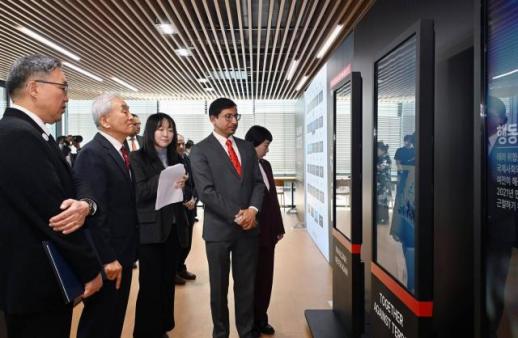 Embassy of India in Seoul hosts digital exhibition on "Human Cost of Terrorism" SEOUL, March 25 (AJP) - The Embassy of India in Seoul, in association with the Korea Democracy Foundation, hosted a two-day digital exhibition titled “Human Cost of Terrorism” at the National Museum of Korean Democracy. The exhibition was inaugurated on Tuesday by Mr. Lee Jae-oh, President, Korea Democracy Foundation (KDF); H.E. Mr. Gourangalal Das, Ambassador of India to the Republic of Korea (ROK); and Ms. Kim Jae-won, Hon’ble Member of the National Assembly. Mr. Lee Jae-oh in his welcome remarks underscored the symbolic significance of the venue, noting that a site once associated with the denial of freedom and human rights now stands as a reminder of the enduring value of democracy and human dignity. He emphasized that democracy is sustained through sacrifice and solidarity, and called for continued collective efforts to ensure that such tragedies are never repeated. In his keynote address, Ambassador Gourangalal Das highlighted the shared democratic values underpinning the India–Republic of Korea Special Strategic Partnership. He emphasized that terrorism remains a global threat to peace and stability and democracies like India and the ROK have the extra responsibility to speak out against terrorism in all its forms and manifestations. He underlined that perpetrators, organizers, and financiers of terror acts must all be held accountable and called for a coordinated, resolute and global response. Ms. Kim Jae-won, Member of the National Assembly during her special address highlighted the importance of cultural cooperation in promoting shared humanitarian values. She expressed hope that India and the ROK would continue to work together to advance peace, democratic principles, and cultural understanding. Over the two days the exhibition saw participation of the people from diverse fields including journalists, civil society representatives and government officials. The digital exhibition aims to fosters greater awareness of the universal nature of terrorism and reinforces the importance of international cooperation in combating terrorism in all its forms and manifestations. 2026-03-25 17:48:00
 -
 Korea Music Copyright Association disputes audit criticism over AI works registration The Korea Music Copyright Association, known as KOMCA, on Tuesday rejected a recent audit finding and related reports on artificial intelligence, calling them an interpretation that overlooks the specific nature of music copyright and the group’s response efforts. The Board of Audit and Inspection said in a March 24 announcement that 11 copyright collective management organizations, including KOMCA, were registering works and collecting and distributing royalties without separately verifying whether AI had been used. KOMCA responded in a statement Tuesday that it has reviewed internal policy while operating an AI task force team since 2023 and has officially implemented a “registration hold policy” for AI-used works since March. Under the policy, members seeking to register songs must check whether AI was used, and any work reported as AI-assisted is put on hold, the association said. KOMCA said the measure is a temporary management step meant to prevent confusion in the creative ecosystem and distortions of rights in the absence of legal standards. It said it is not denying copyright for AI-used works across the board, but taking a preemptive step to reduce disputes. The association also said there is no widely trusted technology worldwide that can perfectly determine whether AI was used. Given those technical limits, it said, the system inevitably relies on creators’ self-reporting, and a small number of false filings should not be treated as overall negligence by the association. As alternatives, KOMCA said its new chairman, Lee Si-ha, had proposed verification steps even before taking office, including requiring submission of DAW (digital audio workstation) files that can help show the actual creation process. It added that the association is accelerating development of a “Korean-style AI detection program.” KOMCA said it is also strengthening after-the-fact monitoring, including screening suspected AI-use cases found on platforms such as YouTube Shorts and withholding royalty payments while conducting additional analysis. The association said it is discussing national-level standards through the “K-Music Rights Organizations Coexistence Committee,” launched in February under Lee’s leadership. Topics include requiring transparency in AI generation processes and establishing clear criteria to distinguish human-created works from AI-generated works. “Even though management systems have not been established globally, the association has responded proactively,” a KOMCA official said. The official added that KOMCA will work closely with the Ministry of Culture, Sports and Tourism to help establish a fair copyright order.* This article has been translated by AI. 2026-03-25 17:45:57
 -
 Suzy fronts Longines 2026 event in Seoul SEOUL, March 25 (AJP) -Singer and actress Suzy, global ambassador of Swiss watch brand Longines, takes part in a photo call at the brand’s 2026 new product presentation on Wednesday at The Westin Seoul Parnas in Gangnam, Seoul. Dressed in a dark navy suit with a white shirt and black tie, she completed the look with long, softly waved hair and understated accessories. 2026-03-25 17:39:18
 -
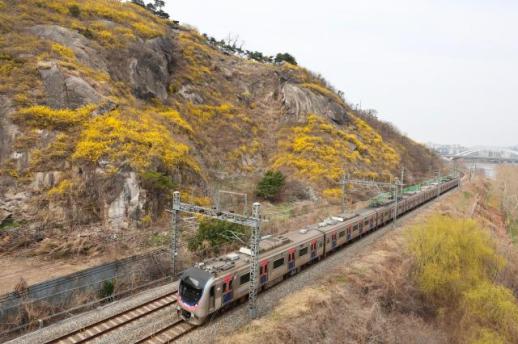 Spring is finally here, heralded by first blossoms SEOUL, March 24 (AJP) - Spring arrives a little earlier in one corner of Seoul. Each year, Eungbongsan Mountain turns into a wash of yellow as forsythia blooms blanket the entire hillside. Located in Seongdong-gu, Eungbongsan is a well-known sunrise and scenic spot in Seoul, attracting crowds each year as warmer weather brings the season’s first blossoms. Climbing to the observation deck, visitors paused to photograph the hillside bathed in yellow, where forsythia blooms stretched across the view. Few places better capture the flower’s symbolism of hope, expectation and new beginnings. Seoul also offers a spot where visitors can fully take in another hallmark of spring — plum blossoms. Cheonggyecheon Hadong Plum Street in Seongdong-gu, the same district as Eungbongsan, has become a favored destination for viewing the delicate blooms. Plum trees bursting with buds line the Cheonggyecheon Stream, creating a striking springtime scene. Visitors of all ages paused to take photos, exchanging remarks such as “It’s beautiful” and “It feels like spring has arrived.” The street was formed after Hadong County in South Gyeongsang Province donated the plum trees. Spring is unfolding across Korea as the flowering season begins, with blooms spreading northward from warmer southern regions such as Jeju and Busan. Magnolia, red plum blossoms, forsythia and rapeseed are now in full display. In Uiseong County, North Gyeongsang Province, a cornel cherry blossom festival is underway. Various spring flower festivals are approaching, including the azalea festival in Yeosu, South Jeolla Province in 3 days, the Yeouido Spring Flower Festival in Seoul in 9 days, and the rapeseed flower festival in Jindo County, South Jeolla Province in 15 days. 2026-03-25 17:37:28
 -
 Callaway Golf Korea Opens Brand Pop-Up at Shinsegae Gangnam Callaway Golf Korea said it is operating an experiential brand pop-up, “Nothing Beats This Park,” based on its 2026 brand campaign “Golf, Nothing Beats This,” through April 5 at the Open Stage on the first floor of Central City at Shinsegae Department Store’s Gangnam branch. The pop-up, which opened March 24, was planned as an interactive space themed “golf’s best moments.” The company said it is designed to let visitors experience Callaway’s innovation and brand story and explore their own golf style. The space is laid out as a journey toward a “best moment.” Visitors receive a stamp-tour mission on entry and move through the zones in order; those who complete the missions receive various rewards. A smart waiting system is also in place to reduce lines, the company said. The “Callaway Driver History” zone introduces the company’s innovation and brand philosophy. In the “360-degree photo zone,” visitors can try Callaway apparel and clubs in a tour-locker-themed setting and record their performance style with 360-degree video. A “Putting Challenge” zone lets visitors test their touch using Odyssey putters, with programs also offered for families. A “Scoreboard photo zone” is set up for visitors to record and share their experience. A Callaway Golf Korea official said the pop-up goes beyond a product display and was designed as a brand space where visitors can experience what the company means by “Golf, Nothing Beats This.” The official said the company hopes visitors will discover and share their own “best moments.”* This article has been translated by AI. 2026-03-25 17:36:22
 -
 Asian stocks climb as easing Middle East tensions push oil prices lower SEOUL, March 25 (AJP) - Asian stock markets rose broadly on Wednesday as tensions around the Strait of Hormuz were somewhat eased, pushing oil prices lower, lifting sentiment across the region. The move followed comments from U.S. President Donald Trump the previous day, signaling progress in peace negotiations with Iran, raising expectations for a possible end to the conflict in the Middle East and also reducing fears of disruptions to global energy supplies. Brent crude hovered near US$100 per barrel, while West Texas Intermediate traded around $93, providing relief to energy-importing economies. Across Asia, markets moved in tandem. Japan's Nikkei 225 surged 2.9 percent, Taiwan's TAIEX climbed 2.54 percent, while China's Shanghai Composite and Hong Kong's Hang Seng rose 1.3 percent and 0.6 percent, respectively, reflecting a renewed appetite for risk assets. In Seoul, the benchmark KOSPI rose 1.6 percent to close at 5,642.2 points, extending gains after fluctuations throughout the day's trading session. Institutional investors drove the rally, buying 2.32 trillion won ($1.5 billion), while foreign investors sold 1.29 trillion won and retail investors offloaded 1.33 trillion won. The divergence showed that offshore investors are still cautious, while domestic institutional investors supported the market, meaning the rebound was driven more by local liquidity than a full return of foreign investors. Technology shares showed mixed. Samsung Electronics slipped 0.4 percent to 189,000 won, while SK hynix edged up 0.9 percent to 995,000 won, supported by expectations of continued strength in AI-driven memory demand. Technology shares were mixed. Samsung Electronics slipped 0.4 percent to 189,000 won, while SK hynix edged up 0.9 percent to 995,000 won, supported by expectations of continued strength in artificial intelligence (AI)-driven memory demand. Autos and platform stocks moved higher, with Hyundai Motor rising 1.8 percent to 501,000 won, NAVER gaining 0.9 percent to 215,500 won and Kakao advancing 1.8 percent to 49,050 won. Battery maker LG Energy Solution added 0.4 percent. The tech-heavy KOSDAQ outperformed, jumping 3.4 percent to 1,159.6 after touching a high of 1,160.1. Foreign investors led buying on the secondary board, purchasing 373.4 billion won, as institutions added 12.3 billion won, while retail investors sold 381.1 billion won. Gains were concentrated in high-beta and growth-oriented names. Samchundang Pharm surged 19.3 percent on continued optimism over its oral insulin development, while Pearl Abyss jumped 23.3 percent following strong global sales momentum for its new releases. Hanwha Systems also rose 7.3 percent on expectations of expanding aerospace and defense cooperation. Despite the broad rally overall, underlying risks remained. The Korean won stayed near the 1,500 level against the dollar, while the VIX, a real-time market indicator that measures the market's expectation of 30-day forward-looking volatility, rose to 26.95, signaling elevated market volatility. Despite the broad rally overall, underlying risks remained. The Korean won stayed near the 1,500 level against the dollar. The VIX, a real-time indicator that measures the market's expectation of 30-day volatility, rose to 26.95, suggesting lingering geopolitical concerns and continued global uncertainty. 2026-03-25 17:29:23
 -
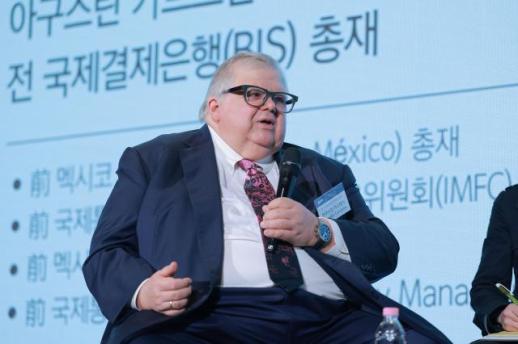 Korea's relative 'under-globalized' may underpin Korean Inc. strength SEOUL, March 25 (AJP) - South Korea’s financial sector may look under-globalized next to the country’s export-driven industrial giants, but that is not necessarily a weakness, former Bank for International Settlements (BIS) General Manager Agustín Carstens said Wednesday. Speaking at the 19th Asia-Pacific Financial Forum (APFF) 2026 in Seoul, Carstens said Korea’s financial system has played a strategically effective role by channeling resources into the country’s strongest industries rather than simply pursuing international expansion for its own sake. “The fact that it does not internationalize so much doesn’t mean that it’s a failure of the Korean banking system,” Carstens said at the forum hosted by Aju Business Daily and ABC at The Plaza Seoul. “Basically, what the financing strategy of Korea has done is concentrating on the winner sectors, and you chose very well who the winners would be — the automobile industry, the appliance industry, the shipping industry, the building industry, semiconductors, and so on.” This year’s forum, held under the theme of why Korean finance remains largely domestic while non-financial Korean companies have expanded aggressively abroad, drew banking leaders, policymakers and lawmakers, including Aju Business Daily President Lim Kwu-jin, Reform Party leader Rep. Lee Jun-seok, and People Power Party lawmakers Rep. Yoon Han-hong and Rep. Kang Myung-gu. Carstens, who previously served as governor of Mexico’s central bank before leading the BIS, said the domestic focus of Korean finance should be understood in the broader context of its economic role. “The financial system plays a tremendously important role in the economy and it basically transforms savings into investment,” he said, stressing that finance serves as the foundation for industrial growth. He also said global supply chains are no longer being shaped solely by economic efficiency. “Supply chains are being reorganized along geopolitical lines, not purely economic lines,” he said. That shift, he added, is part of a broader structural transformation in which manufacturing will gradually lose its dominance as the main engine of employment. “Manufacturing will be less important in the economy and will not be the main source of employment,” he said. In a dialogue session that followed, Carstens spoke with Kim Jun-san, senior researcher at the KB Financial Group Research Institute, on the future of Korean finance, deglobalization and digital money. On trade fragmentation, Carstens argued that deglobalization should be seen less as a breakdown than as a reshuffling of existing patterns. “Deglobalization means reorganization of trade,” he said, describing the return of protectionism as a restructuring of the global order rather than its collapse. On digital finance, Carstens reiterated his skepticism toward stablecoins, saying, “stable coins by themselves are not stable,” and instead laid out a vision centered on central bank digital currencies. He said the future financial system should enable “transactions with anybody at any time in any currency immediately,” underscoring the need for an integrated system built around central bank-backed digital infrastructure. Carstens also briefly noted that Shin Hyun-song, the former BIS Monetary and Economic Department chief and a longtime colleague, is an expert in digital finance. The forum then turned to artificial intelligence and digital assets. Kim Jun-san described AI as more than a tool for efficiency, calling it “core infrastructure reshaping entire industries.” He said finance has moved beyond simple digital transformation into what he called an era of “intelligent transformation,” in which AI fundamentally changes business models and customer experiences. Citing JPMorgan as an example, Kim said AI adoption should not be limited to automation, but should be approached as a force capable of reshaping the business itself. He argued that South Korea should focus less on competing head-on with the United States and China in foundation models and more on embedding AI quickly and deeply across existing industries. “Korea is not so much a country that makes AI best, but a country that adopts and utilizes it fastest,” he said. “In the AI era, data, organization, and usage methods determine competitiveness more than technology.” Park Jung-pil, head of the Digital Innovation Office at the Bank of Korea, echoed that view, saying the success of AI adoption at a central bank depends less on the technology itself than on data governance and institutional readiness. “Data governance is most important in the process of adopting AI,” Park said, emphasizing that data must be reorganized into a form AI systems can effectively use, rather than merely accumulated. He added that cultural and human factors remain a critical obstacle. “There is also cultural resistance from users who do not want to use AI,” he said, calling for parallel efforts to reshape organizational culture and strengthen workforce capability. Kim Min-seung, head of the Korbit Research Center, closed the session with an overview of the digital asset market, describing the current phase as a shift “from regulation-centric to institutional integration.” He said virtual assets, once viewed negatively by political and financial circles, have gained legitimacy following exchange-traded fund approvals and policy changes, particularly in the United States. “The market has continuously grown despite political and institutional pressure,” Kim said, adding that digital assets are increasingly being seen as strategic national assets. Still, he said, regulatory refinement remains essential as on-chain finance moves closer to becoming part of the broader financial system. 2026-03-25 17:29:16