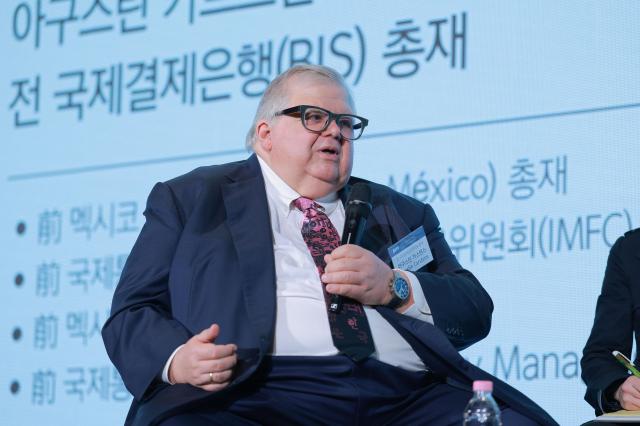
SEOUL, March 25 (AJP) - South Korea’s financial sector may look under-globalized next to the country’s export-driven industrial giants, but that is not necessarily a weakness, former Bank for International Settlements (BIS) General Manager Agustín Carstens said Wednesday.
Speaking at the 19th Asia-Pacific Financial Forum (APFF) 2026 in Seoul, Carstens said Korea’s financial system has played a strategically effective role by channeling resources into the country’s strongest industries rather than simply pursuing international expansion for its own sake.
“The fact that it does not internationalize so much doesn’t mean that it’s a failure of the Korean banking system,” Carstens said at the forum hosted by Aju Business Daily and ABC at The Plaza Seoul.
“Basically, what the financing strategy of Korea has done is concentrating on the winner sectors, and you chose very well who the winners would be — the automobile industry, the appliance industry, the shipping industry, the building industry, semiconductors, and so on.”
This year’s forum, held under the theme of why Korean finance remains largely domestic while non-financial Korean companies have expanded aggressively abroad, drew banking leaders, policymakers and lawmakers, including Aju Business Daily President Lim Kwu-jin, Reform Party leader Rep. Lee Jun-seok, and People Power Party lawmakers Rep. Yoon Han-hong and Rep. Kang Myung-gu.
Carstens, who previously served as governor of Mexico’s central bank before leading the BIS, said the domestic focus of Korean finance should be understood in the broader context of its economic role.
“The financial system plays a tremendously important role in the economy and it basically transforms savings into investment,” he said, stressing that finance serves as the foundation for industrial growth.
He also said global supply chains are no longer being shaped solely by economic efficiency.
“Supply chains are being reorganized along geopolitical lines, not purely economic lines,” he said.
That shift, he added, is part of a broader structural transformation in which manufacturing will gradually lose its dominance as the main engine of employment.
“Manufacturing will be less important in the economy and will not be the main source of employment,” he said.
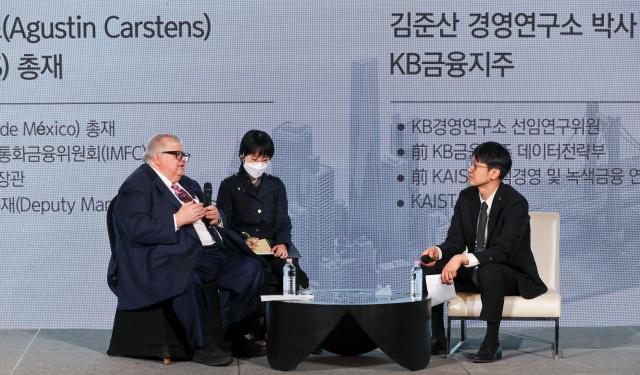
In a dialogue session that followed, Carstens spoke with Kim Jun-san, senior researcher at the KB Financial Group Research Institute, on the future of Korean finance, deglobalization and digital money.
On trade fragmentation, Carstens argued that deglobalization should be seen less as a breakdown than as a reshuffling of existing patterns.
“Deglobalization means reorganization of trade,” he said, describing the return of protectionism as a restructuring of the global order rather than its collapse.
On digital finance, Carstens reiterated his skepticism toward stablecoins, saying, “stable coins by themselves are not stable,” and instead laid out a vision centered on central bank digital currencies.
He said the future financial system should enable “transactions with anybody at any time in any currency immediately,” underscoring the need for an integrated system built around central bank-backed digital infrastructure.
Carstens also briefly noted that Shin Hyun-song, the former BIS Monetary and Economic Department chief and a longtime colleague, is an expert in digital finance.
The forum then turned to artificial intelligence and digital assets.
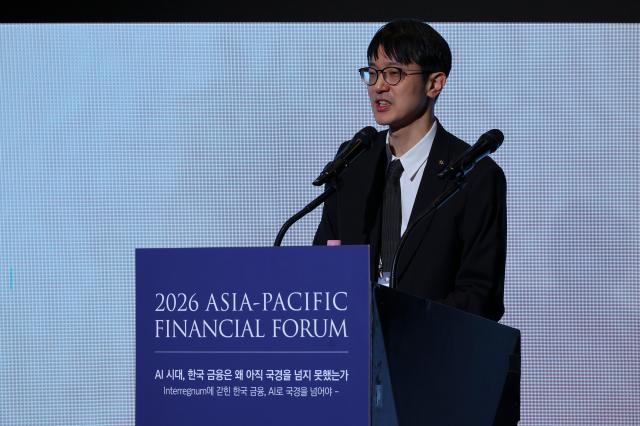
Kim Jun-san described AI as more than a tool for efficiency, calling it “core infrastructure reshaping entire industries.” He said finance has moved beyond simple digital transformation into what he called an era of “intelligent transformation,” in which AI fundamentally changes business models and customer experiences.
Citing JPMorgan as an example, Kim said AI adoption should not be limited to automation, but should be approached as a force capable of reshaping the business itself.
He argued that South Korea should focus less on competing head-on with the United States and China in foundation models and more on embedding AI quickly and deeply across existing industries.
“Korea is not so much a country that makes AI best, but a country that adopts and utilizes it fastest,” he said.
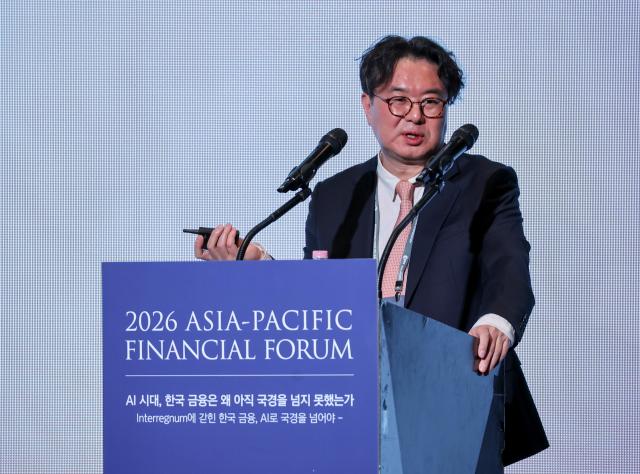
“In the AI era, data, organization, and usage methods determine competitiveness more than technology.”
Park Jung-pil, head of the Digital Innovation Office at the Bank of Korea, echoed that view, saying the success of AI adoption at a central bank depends less on the technology itself than on data governance and institutional readiness.
“Data governance is most important in the process of adopting AI,” Park said, emphasizing that data must be reorganized into a form AI systems can effectively use, rather than merely accumulated.
He added that cultural and human factors remain a critical obstacle.
“There is also cultural resistance from users who do not want to use AI,” he said, calling for parallel efforts to reshape organizational culture and strengthen workforce capability.
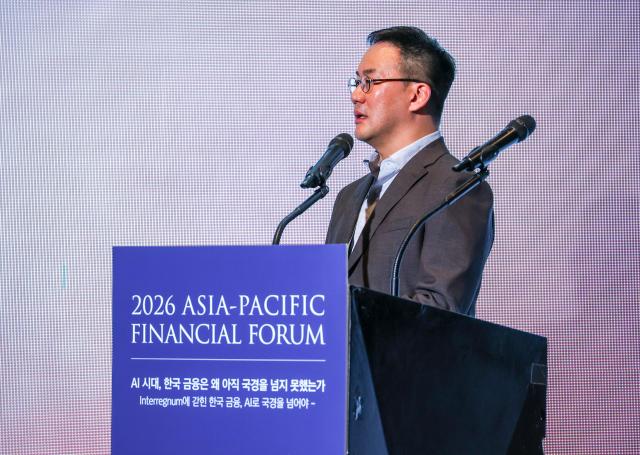
Kim Min-seung, head of the Korbit Research Center, closed the session with an overview of the digital asset market, describing the current phase as a shift “from regulation-centric to institutional integration.”
He said virtual assets, once viewed negatively by political and financial circles, have gained legitimacy following exchange-traded fund approvals and policy changes, particularly in the United States.
“The market has continuously grown despite political and institutional pressure,” Kim said, adding that digital assets are increasingly being seen as strategic national assets.
Still, he said, regulatory refinement remains essential as on-chain finance moves closer to becoming part of the broader financial system.

Copyright ⓒ Aju Press All rights reserved.