
Journalist

Lee Hugh
=
-
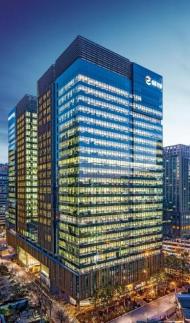
 KT&G Named to Dow Jones Sustainability World Index for Second Straight Year KT&G said it was included for a second consecutive year in the top-tier “World Index” of the Dow Jones Best-in-Class Indices (DJBIC), a global ESG (environmental, social and governance) assessment that recognizes leading sustainability performance. The company said Monday it was also included in the Dow Jones “Asia Pacific” and “Korea” indices. DJBIC is an annual sustainability evaluation published by S&P Global, and is used by global investors as a benchmark for responsible investment. The World Index includes only the top 10% of companies for ESG performance among roughly 2,500 firms with the largest global market capitalization, KT&G said. It said it was ranked No. 1 within its industry group after receiving high marks across governance, environmental and social categories. KT&G said it earned the highest score in governance-related items including board independence, diversity policies and having an ESG governance structure. In the environmental category, it cited recognition for climate-change response and water-resource management based on its “2030 Green Impact” environmental management vision. In the social category, it said it scored highly for efforts such as implementing human-rights management. “This World Index inclusion is the result of the global capital market objectively recognizing our continued efforts to advance ESG management,” said Shim Young-a, head of ESG management at KT&G. “We will continue to strengthen execution of ESG management in step with enhancing our core business competitiveness and establish ourselves as a trusted company.” KT&G said it is also strengthening its compliance and ethics management system. In January, it elevated its compliance management center to a compliance management office to enhance companywide compliance and ethics oversight. It also designates June 2 each year as “KT&G Corporate Ethics Day” and shares ethics messages with employees. * This article has been translated by AI. 2026-05-04 13:48:31
 -
 GS E&C Wins $4.9 Billion Seocho Jinheung Apartment Rebuild Contract in Seoul GS Engineering & Construction will build the reconstruction project for Seocho Jinheung Apartments in Seoul’s Seocho district. The company said in a regulatory filing on Monday that it was selected as the contractor for the Seocho Jinheung Apartments reconstruction and maintenance project near 385 Seocho-daero. The complex was completed in 1979. The existing site consists of seven buildings with 615 households. After reconstruction, it is planned to become a residential complex ranging from five basement levels to 58 stories above ground, with 879 households in total. The construction cost is about 679.3 billion won, equal to 5.46% of the company’s consolidated revenue as of the end of last year. GS E&C proposed the new name ‘Seocho Xi Cullinus.’ Dutch architecture firm MVRDV will take part in the exterior design, and U.S.-based LERA will handle structural design. Landscape design is to be led jointly by SWA, which has worked on Disney World landscaping, and Everland, Samsung C&T’s resort unit. The company expects the project to take 53 months from the actual start of construction. 2026-05-04 13:42:20
 -
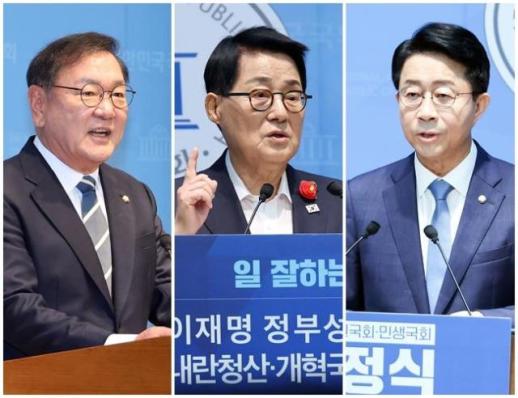 Democratic Party race for National Assembly speaker heats up with three candidates The race to choose the National Assembly speaker for the second half of the year began in earnest on May 4 as the Democratic Party opened candidate registration. Five-term lawmakers Kim Tae-nyeon and Park Jie-won and six-term lawmaker Cho Jung-sik each declared their candidacies, setting up a three-way contest. With the Democratic Party holding a majority of seats, its internal primary is widely seen as the decisive contest. Kim pitched an “effective, working Assembly,” Park called for “ending insurrection forces and completing reforms,” and Cho emphasized a “livelihood-focused Assembly.” Kim told a news conference at the Assembly that he proposed the 2020 “Working National Assembly Act” and the 2026 “Effective Working National Assembly Act.” “To complete the era of popular sovereignty through institutions and protect Korea’s future amid a wave of major transformation, we need an Assembly that works well. I, Kim Tae-nyeon, am the right person,” he said. He said the framework is ready to be implemented, arguing that plenary sessions would open automatically, bills would be handled within deadlines, and committee chairs who do not work could be replaced. Kim also pledged to complete legislation for the “popular sovereignty government’s” policy agenda, make constitutional revision a reality, create a strategic council for the people’s economy, elevate parliamentary diplomacy to a national strategy, and turn the Assembly into a venue for social dialogue. Park, the party’s oldest lawmaker, said “insurrection forces” were still blocking the president’s governance and reforms toward what he called a “real Republic of Korea.” He accused the main opposition party of rejecting even minimal constitutional changes, including adding the March 15 uprising, the Bu-Ma Democratic Protests and the May 18 Gwangju Uprising to the Constitution’s preamble and tightening requirements for martial law, while “handpicking and nominating insurrection forces.” “We must make the Lee Jae-myung government a success and open wide the door to the Seventh Republic and recreate the administration — only then can we finally end the insurrection,” Park said. “This is the last wish I want to fulfill as Park Jie-won, who has been able to live again thanks to the people and party members. Give a chance to Park Jie-won, who will support you better,” he added. Park’s pledges included proactive steps on prosecution and judicial reform to “complete the revolution of light,” building a “K-Assembly that works,” strengthening lawmaker diplomacy and special envoys, and creating a tentative “National Assembly Future Special Committee” to prepare for AI, future energy, robots, the population and regional extinction crisis, and low birthrates and aging. Cho, the party’s most senior lawmaker by terms and who stepped down the previous day as the president’s special adviser for political affairs, said the Lee Jae-myung government was showing the public “the effectiveness of politics” through fast results. “Now it’s time to show the public the effectiveness of the National Assembly as well,” he said. “What matters most for a speaker from the ruling party is coordination with the government and stability. As a proven six-term lawmaker, I, Cho Jung-sik, am the right person,” he said, calling the bid his third run for speaker and his final political challenge in Yeouido. Cho’s key pledges included building a “livelihood-focused Assembly” and a “popular sovereignty Assembly,” completing constitutional revision, strengthening the Assembly’s role and standing, and expanding parliamentary diplomacy. Two four-term lawmakers, Nam In-soon and Min Hong-cheol, also entered the race for the deputy speaker post allocated to the Democratic Party. Nam urged support for “a female deputy speaker who communicates and listens,” saying she would raise the Assembly’s sensitivity to human rights. Min said he believed a deputy speaker from Yeongnam — often described as difficult terrain for the party — could become “the signal flare for victory.” The Democratic Party plans to pick its nominees for speaker and deputy speaker on May 13 and later put them to a plenary vote. The party will combine an online vote of dues-paying members (20%) held over two days starting May 11 with an in-person vote by lawmakers on the day of selection (80%). Election in the plenary session requires approval by a majority of all lawmakers. With the Democratic Party holding a majority, passage is expected to be smooth. The Assembly speaker ranks second in the state protocol order and has authority to open plenary sessions and bring bills to the floor. The new speaker’s approach is expected to shape the legislative calendar and handling of contentious bills in the second half of the year.* This article has been translated by AI. 2026-05-04 13:15:18
 -
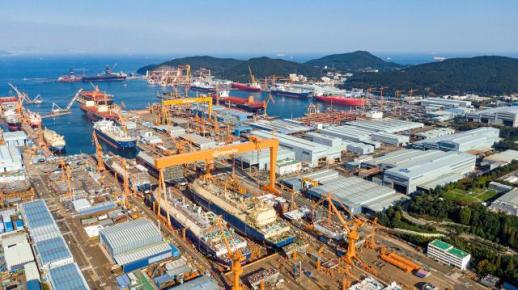 Hanwha Ocean Wins $3.7 Billion Order for Three Very Large Ammonia Carriers Hanwha Ocean said Monday it has won an order worth 507.4 billion won ($3.2 billion) from an African shipowner for three very large ammonia carriers, or VLACs. Including the latest deal, the company said it has secured orders for a total of 10 ammonia carriers so far this year, expanding its presence in the segment. Hanwha Ocean has continued to develop technology for building zero-carbon ships, including obtaining approvals in principle in 2022 from Bureau Veritas and Lloyd's Register for an ammonia carrier design. Last year, it also began work with the Korean Register on developing a 150,000-cbm very large ammonia carrier. The VLAC market has faced greater short-term uncertainty as exports have fallen amid the war in the Middle East, the company said. Still, it said overall cargo volumes have been maintained as exports from other regions, including the United States, have increased. With major importers concentrated in Asia, a shift in export weight from the Middle East to the United States and other areas is lengthening shipping distances. Against that backdrop, ammonia carriers are emerging as a new specialized ship type for South Korea's shipbuilding industry, following LNG carriers, where South Korean companies hold more than 80% of the market, the company said. Hanwha Ocean said it will continue its selective order strategy focused on high value-added and eco-friendly vessels to respond flexibly to market volatility, and will keep strengthening competitiveness in ship types tied to rising demand for vessels using cleaner fuels. The company said it has booked orders this year for 18 ships — 10 very large crude carriers, four LNG carriers, three VLACs and one wind turbine installation vessel — totaling about $3.2 billion. "As ammonia is considered a key energy source in the transition to a hydrogen economy, demand for carriers is also expected to rise steadily," an industry official said. "South Korean shipbuilders are likely to maintain market leadership based on their technology and construction experience."* This article has been translated by AI. 2026-05-04 13:12:15
 -
 Daewoong Pharma Wins Approval to Use Fexuclue in H. pylori Eradication Therapy Daewoong Pharmaceutical said Sunday that South Korea’s Ministry of Food and Drug Safety has approved its gastroesophageal reflux disease drug, Fexuclue Tablets 40 mg (fexuprazan hydrochloride), for use in combination antibiotic therapy to eradicate Helicobacter pylori. Fexuclue can be taken regardless of meals. With the added indication, its approved uses now include treatment of erosive GERD, improvement of gastric mucosal lesions in acute and chronic gastritis, prevention of nonsteroidal anti-inflammatory drug-induced peptic ulcers, and combination therapy for H. pylori eradication. H. pylori infection has a high prevalence in South Korea, at about 50%, and is known to contribute to chronic gastritis, gastric ulcers, duodenal ulcers and gastric cancer, prompting recommendations for active eradication treatment. As resistance to clarithromycin, used in first-line eradication therapy, has increased, demand has grown in clinical practice for a wider range of treatment options, the company said. Daewoong Pharmaceutical said results from a domestic Phase 3 trial conducted at multiple institutions from February 2024 to April last year showed Fexuclue’s treatment effect was particularly pronounced in patients with clarithromycin resistance. A company official said the eradication rate for a Fexuclue-based regimen in the clarithromycin-resistant group was 54.76%, about 26 percentage points higher than a lansoprazole-based regimen at 28.57%.* This article has been translated by AI. 2026-05-04 13:06:16
 -
 Trump Floats ‘Project Freedom’ to Move Ships Stuck in Strait of Hormuz, Easing Korea Oil Supply Fears 도널드 트럼프 미국 대통령이 호르무즈 해협에 발이 묶여 있는 제3국 선박을 안전하게 이동시키는 '해방 프로젝트(Project Freedom)' 추진을 시사했다. 계획이 예정대로 시행되면 한국의 원유 수급에도 도움이 될 수 있다. 다만 이란의 반발이 즉각 나오면서 불확실성은 여전하다는 지적도 나온다. 4일 관계 부처에 따르면 트럼프 대통령은 3일(현지시간) 트루스소셜에 "전 세계 여러 나라에서 호르무즈 해협에 갇힌 자국 선박들을 풀어줄 수 있는지 문의해 왔다"며 "이들은 이 분쟁과 아무 관련이 없는 중립적이고 무고한 방관자일 뿐"이라고 적었다. 그는 "우리는 선박들이 안전하게 해협을 빠져나갈 수 있도록 지원해 자유롭고 원활하게 사업을 진행할 수 있도록 하겠다고 약속했다"며 "자유 프로젝트는 중동 시간으로 월요일 아침에 시작될 예정"이라고 밝혔다. 또 "이란과 매우 긍정적인 논의를 진행하고 있으며 이러한 논의가 모두에게 매우 긍정적인 결과를 가져올 수 있을 것"이라며 "어떤 식으로든 이 인도주의적 절차가 방해를 받는다면 유감스럽게도 강력한 조치를 취할 수밖에 없다"고 강조했다. 이 구상이 물류 불확실성을 낮출 수 있을지 주목된다. 현재 페르시아 만에 고립된 선박은 약 2,000척으로 추정된다. 산업통상부에 따르면 이 가운데 한국 정유사와 관련된 유조선은 7척이며, 이 중 4척은 국적 선사가 운항한다. 해당 선박에 실린 원유는 약 1,400만 배럴 수준이다. 정부는 5월 원유 수급에는 큰 문제가 없을 것으로 보고 있다. 다만 해방 프로젝트가 계획대로 추진되면 추가 물량 확보에 도움이 될 것으로 기대하고 있다. 산업통상부에 따르면 5월 대체 원유 확보 물량은 평시 도입 물량의 87% 수준인 7,462만 배럴이다. 호르무즈 해협에 계류 중인 원유가 한국에 도착하려면 약 3주가 걸리는 만큼, 단순 계산으로는 5~6월에 현재 계류 중인 유조선이 입항할 수 있다는 관측이 나온다. 정유업계의 중동산 원유 의존도가 높은 만큼 단기간 숨통이 트일 수 있다는 것이다. 다만 계획이 현실화될지는 미지수다. 이란에서는 해당 구상이 휴전협정 위반이라는 반발이 나왔다. AFP 통신에 따르면 에브라힘 아지지 이란 의회 국가안보·외교정책 위원장은 트럼프 대통령의 계획 공개 직후 X(옛 트위터)에 "호르무즈 해협의 새로운 해상 질서에 대한 미국의 어떠한 개입도 휴전 위반으로 간주될 것"이라고 경고했다. 지난달 초 중동전쟁 휴전 합의 이후 호르무즈 해협을 빠져나간 선박이 극소수에 그치고 있다는 점도 불확실성을 키운다. 군사적 충돌 가능성이 여전히 높아 선주 등이 신중한 태도를 보이고 있기 때문이다. 트럼프 대통령이 강경 발언과 협상 가능성을 동시에 내비치는 행보를 반복하는 점도 변수로 꼽힌다. 정부는 신중한 입장이다. 산업부 관계자는 "5월 원유 수급에는 문제가 없는 상황"이라며 "해방 프로젝트로 7척의 초대형 원유 운반선(VLCC)이 빠져나오면 수급에 도움이 되겠지만 실제로 프로젝트가 이행될지 지켜봐야 할 것"이라고 말했다.* This article has been translated by AI. 2026-05-04 12:09:17
 -
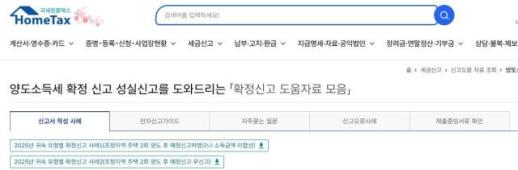 South Korea Tax Agency Alerts 220,000 to File Capital Gains Tax Returns by June 1 Taxpayers who traded real estate, stocks or other assets must file their final capital gains tax return by June 1, South Korea’s National Tax Service said. The agency has sent filing notices to about 220,000 people and is expanding support for simplified online filing through Hometax. The NTS said it began sending mobile notices on the 4th to about 220,000 taxpayers required to file final capital gains tax returns for 2025 income. Those include people who sold real estate, stocks or other assets last year but did not file a preliminary return; those who made two or more transactions but did not file a combined return; and traders of overseas stocks and derivatives. Returns are due by June 1 and can be filed electronically via Hometax (PC) or Sontax (mobile), or by visiting a tax office or filing by mail. Payments can be made by bank transfer, credit card or simple payment services, and taxpayers owing more than 10 million won may pay in installments. To make filing easier, the NTS said it strengthened Hometax assistance tools, including a “pre-fill” function that automatically loads preliminary filing data and a “tax rate selection helper” that applies rates based on entered information and provides step-by-step guidance. The agency also provides electronic filing guides, videos, sample filings and common error examples. Supporting documents can be submitted by photographing them with a smartphone or sending them through a virtual fax service. The NTS said it continues to find a range of tax evasion cases amid recent changes in the real estate market. Common methods include using false contract prices, inflating deductible expenses, improperly applying tax exemptions and conducting low-price transactions between related parties. The agency said it has uncovered cases such as reporting a lower-than-actual price when reselling subscription rights for new apartments, exaggerating interior renovation costs to reduce capital gains, and claiming the one-household, one-home exemption despite effectively owning two homes. An NTS official said the agency will work with related institutions, including the Real Estate Market Monitoring Task Force, to closely analyze real transaction data and money flows, and will “track down transactions with suspected evasion to the end and collect unpaid taxes without exception.” The official added that the NTS will “thoroughly verify” cases involving intentional misreporting or irregular transactions through intensive tax audits. * This article has been translated by AI. 2026-05-04 12:04:53
 -
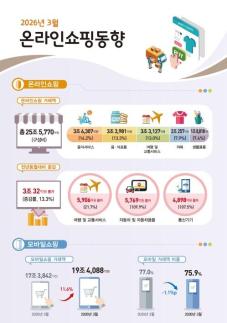 March Online Shopping in Korea Hits Record 25.6 Trillion Won, Led by Travel and Autos March online shopping transactions topped 25 trillion won, the highest monthly total since the statistics series began. The National Data Agency said Monday in its “March 2026 Online Shopping Trends” report that online shopping transactions totaled 25.577 trillion won, up 13.3% from a year earlier. It was the largest monthly figure since tracking began in 2017. Growth was driven by travel and transportation services, automobiles, and communications devices. Auto and auto-related products surged 109.9% from a year earlier, communications devices jumped 107.5%, and travel and transportation services rose 21.7%. By category, food services accounted for the largest share of online shopping transactions at 14.2%, followed by food and beverages at 13.3% and travel and transportation services at 13.0%. Mobile shopping transactions increased 11.6% to 19.4088 trillion won. Mobile purchases made up 75.9% of total online shopping, down 1.1 percentage points from a year earlier. In mobile shopping, food services led with an 18.5% share, followed by food and beverages at 14.3% and travel and transportation services at 11.6%. By product range, transactions at general online malls rose 6.7% to 13.472 trillion won, while specialized malls climbed 21.7% to 12.105 trillion won. By operating type, online-only malls posted 19.2494 trillion won in transactions, up 9.6%, while retailers running both online and offline channels recorded 6.3276 trillion won, up 26.5%. In the first quarter, direct overseas sales totaled 1.0599 trillion won, up 24.4%, while direct overseas purchases rose 1.2% to 1.9789 trillion won. The agency attributed the gap to a higher won-dollar exchange rate raising the burden of buying foreign products, while improving the price competitiveness of South Korean companies and boosting overseas sales. 2026-05-04 12:04:05
 -
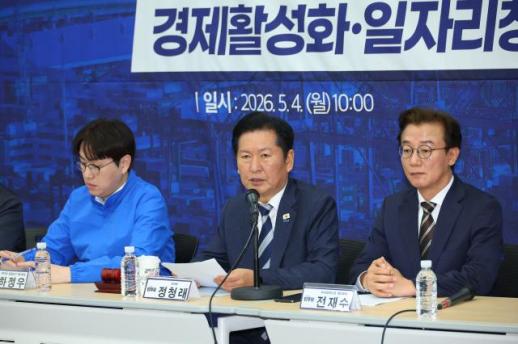 Democratic Party Slams People Power Nominations as ‘Yoon Again’ Push Ahead of June 3 Local Elections The Democratic Party of Korea on May 4 stepped up its criticism of the People Power Party’s nominations for the June 3 local elections, with party leader Jung Cheong-rae calling them, in his words, a declaration of a return to a “Yoon Again party.” Speaking at an on-site Supreme Council meeting in Busan, Jung said the lineup of nominees was “shocking,” and asked whether the party was nominating “remnants” or the “main body” of an insurrection, and whether it was trying to “stage another insurrection” by nominating “insurrection collaborators.” He said he was angry that such figures were returning to the center of power “without remorse,” and demanded the party immediately withdraw the nominations of “insurrection collaborators.” On the possibility that the People Power Party could nominate Jeong Jin-seok, described in the article as a former presidential chief of staff, Jung pointed to comments by South Chungcheong Gov. Kim Tae-heum, saying Kim appeared to be signaling a decision to split from the party. Jung asked whether the party would press ahead with Jeong’s nomination. Kim said on May 2 that if Jeong’s nomination became reality, he would accept even leaving the party and running as an independent. Supreme Council member Hwang Myung-sun also criticized what he called “Yoon Again” nominations. He said the People Power Party was regrouping a “Yoon Suk Yeol-style Hanahoe” through its nominations for the June 3 local elections and by-elections, and said nominating Lee Jin-sook, Lee Yong and Kim Tae-gyu amounted to “clear support for an insurrection.” He said putting forward people who “should be standing in court” as candidates was an insult to the public and to democracy. The meeting was also attended by Jeon Jae-soo, the party’s Busan mayoral candidate, and Ha Jung-woo, a candidate for the Buk-gu Gap parliamentary seat in Busan, who pledged to win their races. Jeon, speaking about relocating HMM’s headquarters to Busan, said the move would not be the end, adding that more shipping, logistics, finance, legal, service and future-industry companies would move to the city. “From now on is the real start,” he said, adding that if the HMM move opened the way, the flow should spread across Busan’s economy. Ha said he would make Busan’s Buk-gu district the nation’s leading hub for AI education, and said he would be a strong growth engine for the district’s development.* This article has been translated by AI. 2026-05-04 11:57:19
 -
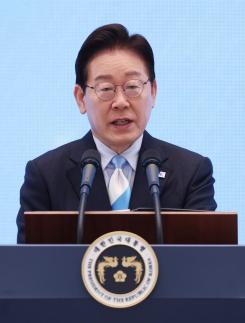 Lee Jae-myung urges public input on timing, process for special counsel probe of alleged illegal prosecution President Lee Jae-myung said Monday that a national consensus has formed around the Democratic Party’s push for a special counsel to investigate what it calls politically motivated, fabricated indictments by prosecutors. Hong Ik-pyo, the presidential senior secretary for political affairs, told reporters in a briefing at the Chunchugwan press center that a parliamentary investigation had already revealed much of the alleged illegal conduct and improper investigations carried out under the Yoon Suk Yeol administration and what he described as political prosecutors. Hong said establishing the truth through a special counsel and restoring judicial justice is “something that must be done.” However, Hong said Lee asked the ruling Democratic Party to decide the specific timing and procedures only after gathering public opinion and going through a deliberative process. The Democratic Party on April 30 introduced the “Special Counsel Act on Fabricated Indictments Under the Yoon Suk Yeol Administration.” The bill would authorize a special counsel to investigate 12 cases, including Lee’s criminal cases, and grant the special counsel the power to withdraw indictments. 2026-05-04 11:54:15