

Journalist

Ryu Yuna
Julia37@ajunews.com
-
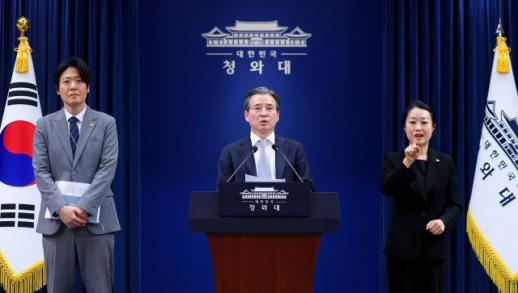 Policy chief floats 'AI dividend' concept amid AI boom in Korea SEOUL, May 12 (AJP) - South Korea's top presidential policy aide floated the idea of a national "AI dividend" on Tuesday, proposing that part of the massive profits and tax windfall expected from the artificial intelligence and semiconductor boom be structurally shared with the broader public. Presidential policy chief Kim Yong-beom argued in a social media post that the emerging AI boom was not created solely by individual firms, but by decades of national investment and collective economic development. "The AI bonanza was not generated by certain companies alone," Kim wrote. "If strategic advantages in the AI infrastructure supply chain create a structural boom and unprecedented excess tax revenue, how to use that money wisely becomes a question society must deliberate." The remarks come as South Korea's stock market has been increasingly dominated by AI-linked semiconductor giants Samsung Electronics and SK hynix. Samsung Electronics shares closed at 279,000 won on Tuesday, up about 384 percent from 57,600 won a year earlier, while SK hynix ended at 1,835,000 won, soaring roughly 841 percent from 195,000 won over the same period, underscoring how the AI-driven semiconductor rally has reshaped the country’s financial markets and broader economy. Against that backdrop, Kim argued that profits generated from industries built on "the foundations the people have cultivated over the past half century" should be shared with the broader public through institutional mechanisms. Kim warned that South Korea had squandered a similar opportunity during the semiconductor supercycle of 2021 and 2022, when large excess tax revenues were spent without long-term planning. "The scale of this cycle could be incomparable to the previous one," he said. "Allowing it to pass in the same way would mean wasting a once-in-a-generation historic opportunity." As a possible framework, Kim referenced Norway's sovereign wealth model, under which oil profits have been accumulated in a state-run fund since the 1990s and later used to support welfare and long-term fiscal stability. "In Korea's case, I would tentatively call it a 'national dividend,'" he said. Kim suggested the proceeds could be used for youth startup funding, rural basic-income programs, support for artists, expanded pension schemes or education and retraining programs designed for the AI transition era. He stressed that the final structure should emerge through broad public debate and social consensus. "If excess tax revenue never materializes, the idea of a national dividend could remain unrealistic," he said. "But letting those excess profits simply dissipate without any guiding principles could be even more irresponsible." Kim argued that the defining challenge of the AI era would not simply be generating economic growth, but managing how extraordinary profits become increasingly concentrated among dominant companies and higher-income groups. He said using part of those gains to cushion the social costs of AI-driven economic transformation should not merely be viewed as redistribution, but as a way to preserve long-term economic and social stability. Kim also suggested that if Korea successfully develops an institutional model for redistributing AI-era windfalls, it could eventually become a global reference point as governments worldwide grapple with the economic disruptions caused by artificial intelligence. "Korea could become the first country to return excess profits from the AI era back to human life," he said. "The model we begin debating and building now could later become an international standard." His remarks come as policymakers and economists globally intensify discussions over how AI-driven productivity gains may accelerate wealth concentration while reshaping labor markets and industrial structures. Kim also cited comments by Demis Hassabis, who recently argued for the need to develop new economic frameworks suited to the AI era. Earlier this month, Kim projected that Korea could post historically large tax revenues in 2026 and 2027 if the semiconductor and AI infrastructure boom extends through next year. 2026-05-12 16:12:13
 -
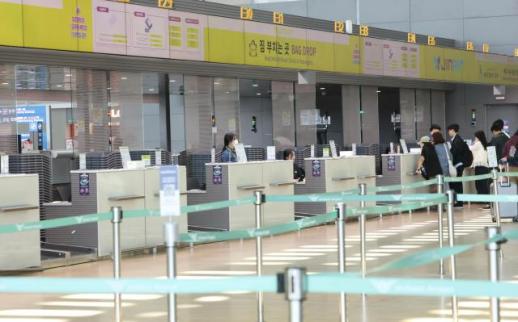 Fuel shock pushes Korean LCCs back into pandemic-like survival mode SEOUL, May 12 (AJP) - A spike in fuel prices, war-related travel restrictions and passenger jitters are pushing South Korea's budget carriers back into pandemic-era survival mode, forcing them to delay hiring as well as streamlining payrolls and flights as they try to ride out the Gulf crisis. Jin Air, a low-cost carrier under Korean Air, has informed 50 newly hired cabin crew members that they will start work in the fall instead of this week as originally planned, citing "emergency management conditions" caused by the Middle East-driven energy crisis. The airline hired 100 cabin crew members in the first half of the year, half of whom have already begun work. Despite the last-minute delay, Jin Air said it remains committed to honoring the hires. The carrier has already introduced a series of emergency cost-cutting measures, including an indefinite delay in annual safety bonus payments for employees. It has also cut 176 round-trip flights through this month to reduce fuel costs, trimming routes to destinations such as Guam and Phu Quoc Island in Vietnam. Further reductions are expected once June schedules are finalized. Low-cost carriers, whose overseas networks are heavily concentrated on Southeast Asian leisure routes, have cut around 1,000 international round-trip flights over the past two months amid the Middle East conflict. The pressure has intensified as Singapore jet fuel prices, the benchmark for Asia's aviation industry, surged to an average of $214.71 per barrel between March 16 and April 15, about 2.5 times higher than prewar levels. Airlines are increasingly concerned that higher fuel surcharges could weaken summer travel demand as operating costs continue to climb. Other budget carriers have also begun introducing unpaid leave and other belt-tightening measures. Jeju Air, the country's largest low-cost carrier, began accepting applications this week for voluntary unpaid leave among cabin crew members for June. T'way Air introduced unpaid leave for cabin crew for May and June, while Aero K, a smaller budget airline, offered voluntary unpaid leave to all employees for May. The Ministry of Employment and Labor held an emergency meeting late last month to assess postwar labor market conditions and worried that the airline industry could face broader restructuring if the conflict drags on. 2026-05-12 14:16:26
 -
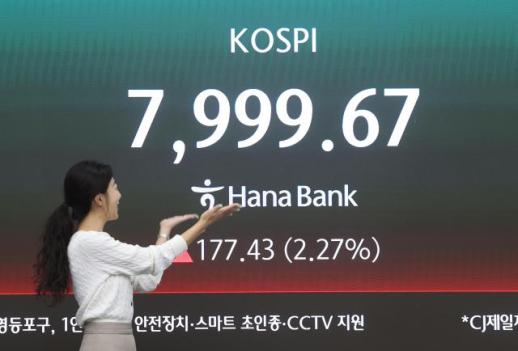 KOSPI move closer to 8,000 amid retail FOMO demand over AI SEOUL, May 12 (AJP) - South Korea’s benchmark KOSPI barreled toward the 8,000 threshold on Tuesday, nearing another four-digit milestone in just five trading sessions after first testing 7,000, as chip shares continued to attract fear-of-missing-out retail demand. As of 9:46 a.m., the KOSPI stood at 7,939.73, up 1.5 percent, while the tech-heavy KOSDAQ gained 0.83 percent to 1,217.40. The rally was driven largely by strong buying from retail and institutional investors. Individuals purchased a net 1.2 trillion won worth of local shares, while institutions added a net 368.4 billion won. Foreign investors, however, sold a net 1.59 trillion won. Market momentum remained heavily concentrated in AI-linked heavyweights, with decliners outnumbering gainers 609 to 267 on the main bourse. Major chipmakers continued their climb, with Samsung Electronics rising 0.35 percent to 286,500 won and SK hynix advancing 2.77 percent to 1,932,000 won, both heading toward fresh milestones. The upbeat mood followed another strong overnight rally in U.S. semiconductor stocks. Qualcomm surged 8.42 percent, Micron Technology climbed 6.50 percent, Western Digital gained 7.46 percent and Seagate Technology advanced 6.56 percent, lifting the Philadelphia Semiconductor Index 2.59 percent. On Wall Street, major U.S. indexes ended modestly higher despite mounting uncertainty in the Middle East. The S&P 500 and Nasdaq both closed at fresh record highs as investors continued betting heavily on the durability of the AI boom. U.S. President Donald Trump said the ceasefire with Iran was “on massive life support” after dismissing Tehran’s latest proposal as “garbage,” while also hinting at the possibility of renewed military action. The remarks helped push Brent crude futures up 2.9 percent to settle at $104.21 per barrel, reviving concerns over energy supply disruptions and inflationary pressure. Back in Seoul, sector performance remained mixed. Among automakers, Hyundai Motor gained 3.10 percent to 666,000 won, while Kia slipped 1.77 percent to 171,600 won. Industrial and energy shares traded broadly higher, with LG Energy Solution rising 1.92 percent to 477,000 won, Doosan Enerbility climbing 3.44 percent to 132,400 won and HD Hyundai Heavy Industries jumping 5.26 percent to 721,000 won. Technology-related shares also advanced. SK Square gained 2.19 percent to 1,213,000 won, while Samsung Electro-Mechanics added 3.00 percent to 927,000 won. Financial stocks were mixed. Samsung Life Insurance rose 3.84 percent to 311,000 won, Shinhan Financial Group added 1.54 percent to 98,700 won and Mirae Asset Securities advanced 1.76 percent to 80,800 won. KB Financial Group, however, edged down 0.13 percent to 158,600 won. Biotech and defense shares underperformed. Samsung Biologics slipped 0.21 percent to 1,455,000 won, while Hanwha Aerospace fell 0.84 percent to 1,304,000 won. The Korean won remained weak, trading above 1,480 per dollar compared with the previous close of 1,472.40 won. 2026-05-12 10:31:13
 -
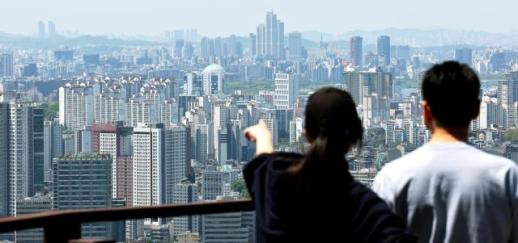 Rent inflation adds to mounting price pressures in Korea SEOUL, May 11 (AJP) -Rental offerings from monthly to longer-term contracts of more than two years are drying up in South Korea, pushing rent increases above housing price gains and adding additional pressure on inflation and household spending. The surge first emerged in jeonse system, in which tenants pay a large lump-sum deposit for two years or longer lease instead of monthly rent. It is now increasingly spilling over into the monthly rental market as more landlords move away from deposit-based leases. According to the Korea Real Estate Board, jeonse prices have risen 1.56 percent so far this year as of the first week of May, outpacing the 0.98 percent gain in apartment sale prices. In the Seoul metropolitan area, apartment lease prices climbed 2.2 percent this year, compared with a 1.79 percent increase in apartment sale prices. Outside the capital region, lease prices rose 0.94 percent, while sale prices gained just 0.2 percent. In Seoul, apartment sale prices are still rising slightly faster overall, but the gap has narrowed sharply. Lease prices have climbed 2.61 percent this year, compared with a 2.81 percent increase in sale prices. The pace of weekly gains has also accelerated. Seoul apartment jeonse prices rose 0.23 percent in the first week of May from a week earlier, marking the fastest weekly increase since November 2015. As more tenants shift toward monthly rentals amid a shortage of jeonse offerings, monthly housing costs are also rising steeply. Data from KB Real Estate showed Seoul’s apartment monthly rent price index climbed to 102.74 last month, the highest level since the index was introduced in 2015. High-end monthly rents have risen particularly sharply. In northern Seoul, the number of new monthly rental contracts worth more than 3 million won ($2,160) per month surged 53.4 percent in the first quarter from a year earlier. Yongsan became the only district in Seoul where the average monthly apartment rent exceeded 3 million won based on actual transaction prices. The increase has been especially pronounced in residential districts surrounding Seoul. The sharpest gains were recorded in Suwon’s Yeongtong District and Anyang’s Dongan District, both major residential areas in Gyeonggi Province south of Seoul, where lease prices rose 4.57 percent and 4.53 percent, respectively. Seoul’s Seongbuk District followed with a 4.2 percent increase. The trend is emerging as another source of inflationary pressure in Asia’s fourth-largest economy. Korea’s consumer price index includes both jeonse and monthly rents under housing costs. Consumer prices rose 2.6 percent in April from a year earlier, while the closely watched cost-of-living index climbed 2.9 percent. Housing, utilities and fuel prices increased 1.7 percent. While rising housing costs may not immediately drive headline inflation sharply higher, they could increasingly weigh on consumer sentiment as households devote more income to rent payments and housing-related debt costs. 2026-05-11 17:59:08
 -
 Eight out of 10 Korean retail investors pocket over $6,000 from Q1 stock cashouts SEOUL, May 11 (AJP) - Eight out of 10 South Korean retail investors who cashed out stocks in the first quarter walked away with profits, earning an average of 8.48 million won ($6,100), nearly double the 4.96 million won average loss suffered by the remaining investors, according to data released by Shinhan Securities on Monday. According to the brokerage’s analysis, Samsung Electronics provided both the joy and misery for retail investors during the first quarter. Among investors who sold Samsung Electronics shares, profitable investors recorded an average gain of 7.14 million won, while loss-making investors posted an average loss of 1.73 million won. After Samsung Electronics, the stocks that generated the largest average profits for retail investors were SK hynix with 5.94 million won, Hyundai Motor with 3.41 million won, Hanmi Semiconductor with 2.54 million won and Doosan Enerbility with 2.06 million won. Investors in their 70s and older posted the largest average gains at 18.73 million won, followed by those in their 60s with 10.11 million won. Investors in their 20s recorded the smallest gains at 1.43 million won. Male investors posted higher average gains than women, at 7.39 million won compared with 3.86 million won. The data suggests older investors were more active in taking profits during the first-quarter rally, particularly in large-cap semiconductor, nuclear-energy and defense shares that spearheaded gains in the benchmark market. South Korea’s benchmark KOSPI gained 20 percent in the first quarter. It has extended gains by another 56 percent as of Monday from the end of March amid a retail-driven frenzy led by chip and artificial intelligence-related shares. On Monday, Samsung Electronics shares rose 6.52 percent to 286,000 won, while SK hynix surged 13.23 percent to 1.909 million won, extending gains that have fueled this year’s rally. Hyundai Motor also climbed 6.04 percent to 650,000 won, while Doosan Enerbility slipped 1.62 percent to 127,500 won as of 1:53 p.m. On the tech-heavy KOSDAQ market, retail investors posted the biggest gains from stocks including Woori Technology, EcoPro, Hurim Robot and Alteogen. 2026-05-11 14:33:46
 -
 KOSPI storms past 7,800 on semiconductor rally SEOUL, May 11 (AJP) - South Korea’s main index soared nearly 5 percent Monday morning to scale a fresh peak above the 7,800 mark, powered by bellwether chip stocks and retail investors chasing the latest leg of the AI-driven rally. As of 10:39 a.m., the KOSPI was trading at 7,843.57, with a buy-side sidecar was triggered shortly after the opening bell. The KOSDAQ slipped 0.16 percent to 1,205.81. The surge followed a strong session on Wall Street on Friday, where the S&P 500 and Nasdaq closed at record highs on robust U.S. jobs data and gains in semiconductor shares. U.S. job growth totaled 115,000 in April, beating market expectations and easing concerns that the U.S.-Iran war could spill into a broader economic slowdown. Although U.S. President Donald Trump rejected Iran’s response to a U.S. peace proposal over the weekend, dimming hopes for a near-term end to the Middle East conflict, South Korean investors appeared largely unfazed as attention stayed fixed on global semiconductor demand. Market momentum again rested heavily on chip giants. Samsung Electronics rose 6.33 percent to 285,500 won after briefly touching a record 286,500 won. SK hynix jumped 12.51 percent to 1,897,000 won. Automakers also traded broadly higher, with Hyundai Motor gaining 2.77 percent to 630,000 won and Kia advancing 6.44 percent to 175,100 won. Among other major shares, SK Square climbed 4.46 percent to 1,147,000 won. Shipbuilding and industrial names remained firm, with Samsung C&T rising 5.80 percent to 447,000 won and HD Hyundai Heavy Industries gaining 3.95 percent to 684,000 won. Hanwha Aerospace added 1.22 percent to 1,323,000 won. Battery and biotech shares lagged behind the broader rally. LG Energy Solution slipped 0.73 percent to 473,000 won, while Doosan Enerbility fell 0.54 percent to 128,900 won. Samsung Biologics edged down 0.34 percent and Samsung Electro-Mechanics dropped 3.28 percent. Foreign investors turned sellers, unloading a net 1.29 trillion won worth of KOSPI shares in early trading. Retail investors poured in with 1.05 trillion won in net purchases, extending their feverish buying streak, while institutions bought a net 254 billion won. The Korean won remained stable, with the dollar trading at 1,473.80 won, compared with the previous close of 1,471.70 won. 2026-05-11 11:06:00
 -
 Seoul imposes 30-day taxi suspensions, but deeper issues remain SEOUL, May 08 (AJP) - “I thought that was just the normal price at first,” said Teo, a 28-year-old Singaporean who visited Seoul last month after paying around 50,000 won ($36) for a roughly 20-minute taxi ride from Seoul station to his hotel. South Korea will suspend taxi drivers for 30 days from their very first violation if they are caught overcharging foreign passengers, as authorities move to curb mounting complaints from overseas visitors. However, experts say tougher penalties alone may not fully resolve the issue, pointing to structural problems within South Korea’s taxi industry and limited transportation alternatives for foreign tourists unfamiliar with local systems. “Overcharging foreign tourists is clearly a problem in itself, whether it amounts to discrimination or deception targeting people unfamiliar with the system,” said Jeong Ran-soo, professor at department of Tourism at Hanyang University. The Ministry of Land, Infrastructure and Transport (MOLIT) said Friday it had proposed revisions to enforcement rules under the Taxi Transportation Business Development Act, tightening penalties for drivers who unfairly charge foreign passengers inflated fares. Jeong said foreign tourists are especially vulnerable because of what he described as “information asymmetry,” where visitors are unfamiliar with local transportation systems and pricing structures. While taxi scams exist in many countries, he noted that overseas tourists often have broader access to alternative transportation platforms such as Uber, Grab or global travel-booking services. “In Korea, foreign visitors have fewer convenient alternatives beyond taxis, buses or subways,” he said, adding that authorities should consider expanding specialized tourism transportation services, including regulated “tourist taxi” programs with clearer pricing systems tailored for overseas visitors. Under the current system, drivers caught overcharging passengers for the first time receive a warning, with a 30-day license suspension imposed after a second violation. The revised rules would eliminate the warning stage and allow immediate suspension for a first offense. Under the current system, drivers caught overcharging passengers for the first time receive a warning, with a 30-day license suspension imposed after a second violation. The revised rules would eliminate the warning stage and allow immediate suspension for a first offense. The move follows a broader government campaign unveiled at a tourism strategy meeting chaired by President Lee Jae Myung in February, where officials announced measures to curb tourist overcharging and improve service standards for foreign visitors. The ministry said it plans to finalize the revised rules after a public consultation period ending June 17. Urgency has grown as complaints over taxi overcharging continue to surface amid sharp increase in foreign arrivals. South Korea recorded an all-time high of 2.06 million foreign arrivals in March alone, while first-quarter inbound tourism rose 23% from a year earlier, driven by the global popularity of K-pop and other Korean cultural exports. Against that backdrop, Seoul Metropolitan Government introduced a QR-code complaint system for foreign passengers in June last year, making it easier for tourists to report taxi-related problems. According to data released by the city government in January, authorities received 487 complaints over roughly six months, with unfair fare charges accounting for the largest share. Administrative penalties had already been imposed in cases where violations were confirmed. Seoul also introduced English-language taxi receipts late last year, listing late-night surcharges and toll fees separately so foreign passengers could easily verify charges. Despite those efforts, complaints have remained concentrated around major tourist hubs and transportation gateways. Local reports in January highlighted several alleged overcharging cases involving foreign tourists near Incheon International Airport and Inspire Arena— a large entertainment venue that hosts K-pop concerts and international events. In one case, a Chinese tourist said she paid 150,000 won (about $110), for a taxi ride to Seoul after attending a concert. Another passenger was asked to pay 50,000 won for a short trip to an airport rail station that would normally cost around 10,000 won during snowy weather conditions. Incheon Metropolitan City government said 360 taxi-related complaints were filed last year in areas surrounding the airport and concert venue. During the same period, police detected 466 cases involving illegal transportation services near the airport. The government’s aggressive response also reflects broader concerns about South Korea’s tourism competitiveness. The country has seen a sharp rise in foreign visitors fueled by the global popularity of K-pop, K-dramas and other Korean cultural exports, but officials worry that repeated incidents involving tourists could damage the country’s international image. Data from the Korea Tourism Organization showed tourism-related consumer complaints surged 71.1 percent from a year earlier to 1,543 cases last year, with taxis, shopping and accommodations among the most common categories. Tourism industry officials warn that repeated overcharging incidents in areas heavily frequented by foreign tourists could leave visitors with a negative overall impression of traveling in South Korea. Complaints involving Korean taxi services and advice on avoiding scams are also widely shared across online travel communities and social media platforms. The ministry said unfair taxi charges could undermine trust in South Korea’s tourism industry, adding that authorities plan to strengthen enforcement and penalties to prevent repeat violations. 2026-05-08 16:28:57
 -
 KOSPI retreats after historic rally as foreign investors dump shares SEOUL, May 8 (AJP) - South Korea's KOSPI took a breather on Friday after a strong three-day rally that saw the benchmark index gain more than 13 percent, weighed down by heavy foreign selling. As of around 11 a.m., the KOSPI stood at 7,378.17, down 1.49 percent, from the previous session. The retreat came just a day after the index briefly crossed the 7,500 mark for the first time in its history, having surpassed the 7,000 threshold in the previous session, as foreign investors, who had aggressively fueled the recent artificial intelligence (AI)-driven rally through heavy buying of KOSPI-listed chip stocks, sharply reversed course. After recording a net purchase of 3.13 trillion won on May 6, the largest daily foreign inflow on record that helped push KOSPI above the 7,000 mark, foreign investors dumped more than 7 trillion won worth of shares in the previous session and extended heavy selling with another 3.45 trillion won in net sales in the day's morning trade. Investor sentiment also weakened as uncertainty resurfaced over ceasefire negotiations between the U.S. and Iran, reviving concerns that the prolonged conflict in the Middle East could escalate again. Market jitters deepened further after reports that Washington was considering restarting "Project Freedom," an operation aimed at helping commercial ships stranded near the Strait of Hormuz leave the region safely. Overnight on Wall Street, the Dow Jones Industrial Average fell 0.63 percent, while the S&P 500 and Nasdaq Composite declined 0.38 percent and 0.13 percent, respectively. The Philadelphia Semiconductor Index dropped 2.72 percent as investors locked in gains in chip stocks after recent rallies. British chip designer Arm Holdings plunged 10.1 percent overnight amid renewed doubts over the production capacity of its artificial intelligence chips, further weighing on global semiconductor sentiment. In Seoul, large-cap semiconductor shares led the decline after posting record highs a day earlier. Samsung Electronics fell 2.67 percent to 264,250 won, while SK hynix slipped 0.97 percent to 1,638,000 won. SK Square, the largest shareholder of SK hynix, also declined 1.36 percent to 1,084,000 won. Defense and heavy industry shares were broadly weaker, with Hanwha Aerospace down 1.59 percent to 1,296,000 won, HD Hyundai Heavy Industries falling 6.35 percent to 649,000 won, and Doosan Enerbility sliding 4.99 percent to 129,600 won. Battery and electronics shares also traded lower, with LG Energy Solution down 1.66 percent to 475,000 won and Samsung Electro-Mechanics falling 1.64 percent to 902,000 won. Automakers outperformed the broader market, led by Hyundai Motor, which jumped 8.04 percent to 618,000 won, while Kia gained 4 percent to 163,900 won. But the junior KOSDAQ outperformed the main board as foreign buying shifted into smaller growth stocks. The index rose 0.42 percent to 1,204.19. Foreign and institutional investors bought a net 380.2 billion won and 73 billion won worth of KOSDAQ shares, respectively, while retail investors sold a net 445.3 billion won. Robotics and biotech shares continued to lead gains on the KOSDAQ. Rainbow Robotics surged 14.35 percent to 797,000 won, while Kolon TissueGene jumped 12.30 percent to 128,700 won. Among biopharmaceutical stocks, Samchundang Pharm rose 1.38 percent to 405,000 won, ABL Bio gained 2.85 percent to 130,000 won and LigaChem Biosciences climbed 6.79 percent to 195,100 won. In contrast, secondary battery shares remained weak, with EcoPro BM falling 1.70 percent to 231,500 won and EcoPro sliding 3.57 percent to 154,000 won. Healthcare and semiconductor-related shares also traded lower, as HLB fell 2.18 percent to 58,200 won, while Alteogen edged down 0.42 percent to 355,000 won. The South Korean won weakened slightly against the U.S. dollar, trading at 1,464.60 per dollar compared with 1,454 previously. Meanwhile, the sell-off spread across major Asian markets. Japan's Nikkei 225 also fell 0.62 percent to 62,446.81 amid broader profit-taking in technology and semiconductor-related shares, Hong Kong's Hang Seng Index dropped 1.20 percent to 26,308.99 and China's Shanghai Composite slipped 0.19 percent to 4,172.13 reflecting a broader risk-off mood as investors reassessed geopolitical and valuation risks. 2026-05-08 11:33:00
 -
 AI and Employment: Adapting Education and Workplaces for Coexistence At 11 p.m. in a law office in Jongno, the sound of typing fills the air. First-year attorney Kim James, 37, substitutes a sandwich for dinner as he continues working late into the night. "These days, if you can't get work done, it's not that you get scolded; you just don't get assignments. If that happens repeatedly, you could lose your job," he said. Balancing corporate advisory and litigation, late nights have become routine for him. "Even at 1 a.m., the atmosphere in the office is intense," he explained. He actively uses AI for issue organization and case law research. Kim noted, "With clients using AI, if lawyers don't, they can't keep up." AI has deeply penetrated South Korea's professional sectors, threatening entry-level jobs. He observed, "As research tasks are increasingly replaced by AI, law firms are hiring fewer new associates." According to the Bank of Korea, from July 2022 to July 2025, about 211,000 jobs for young people were lost, with 98% concentrated in sectors highly exposed to AI. By February 2026, employment in professional, scientific, and technical services saw a decline of approximately 105,000, marking the largest drop since records began. Kim considers himself fortunate to have found a job. "For my juniors, it's more about 'escaping' than finding employment. They attend bar association training while repeatedly submitting applications," he said. He feels threatened by the rapidly evolving AI landscape, describing the change as "an opportunity for a few but a crisis for many." He emphasized that the gap between lawyers will widen based on their ability to utilize AI, stating, "Ultimately, what matters is the questions you ask AI, which requires fact-finding and communication skills with clients." "Results remain, but learning disappears" "The way new professionals grow into experts is changing," said Professor Kwon Hyuk-koo from Nanyang Technological University in Singapore. In the past, newcomers learned judgment criteria through repetitive research and drafting, but AI is replacing that process, creating a structure where "only results remain, and learning disappears." Kwon described the repetitive tasks assigned to junior staff as a "training ground" for learning the industry. He warned that companies treating AI merely as a cost-cutting tool might achieve short-term efficiency but weaken their talent pipeline in the long run. As AI rapidly spreads, the roles of humans and AI are becoming increasingly distinct. Architect Kwon Mo, 37, who leads an AI department, noted, "In recent years, the way we work in design has changed significantly due to increased AI utilization." He remarked that initial tasks like image generation and design alternatives are now much faster, greatly enhancing efficiency. However, he added, "Even with tools like Nano Banana or Midjourney, refining prompts and translating requirements into actual designs still requires human judgment." Joshua Yoo, a lawyer at a Seoul law firm, observed that as contract review and research tasks are replaced by AI, the process for new hires to learn "ways of thinking" has vanished. Kwon believes these changes are reshaping the hiring market. "The industry has cut entry-level hiring by about half, while demand for professionals with 5 to 10 years of experience is rising. Now, the ability to use AI and digital tools, along with collaboration and planning skills, are crucial hiring criteria," he explained. Challenges in Education and the Rise of 'Verification Skills' Kwon pointed out that if AI takes over tasks previously handled by junior staff, the key challenge will be how young professionals develop their judgment skills. He emphasized that universities must teach not only AI utilization but also critical verification and the integration of human judgment. Additionally, he noted that adult learning participation rates are lower than the OECD average, highlighting the need to strengthen lifelong learning and retraining systems. Professor Lyse Langlois from Laval University in Canada agreed that the automation of entry-level tasks has weakened the traditional pathway for skill development. She warned that failing to critically review AI results could lead to a state of "autopilot," where individuals follow results without independent judgment. Erik Cambria, also from Nanyang Technological University, predicted that the ability to understand concepts and relationships will become more important than simple task-oriented learning, emphasizing that the capacity to critically verify AI results based on context and human understanding will be crucial. In contrast, the healthcare sector is experiencing a "soft landing" with AI, as it reduces repetitive tasks and allows medical staff to focus on judgment. In March 2026, South Korea's employment trends indicated that the health and social welfare services sector added 294,000 jobs, the largest increase among industries, while professional, scientific, and technical services saw a decrease of 61,000 jobs during the same period. The relatively smooth integration of AI in healthcare is attributed to its role as an augmentation tool that assists rather than replaces human capabilities. As demand for healthcare rises due to aging, employment remains stable or increases, with AI helping to streamline repetitive tasks, allowing medical professionals to concentrate on patient care. Benjamin Lee, a 36-year-old resident at a university hospital in the capital region, stated, "AI has definitely made my job easier." He noted that fields like radiology and emergency medicine have seen significant changes, with AI quickly assisting in analysis and prioritization, automating tasks like patient scheduling and record-keeping, enabling doctors to focus more on clinical judgment. Proposed Solution: 'AI Apprenticeship Model' Experts suggest that universities should enhance the 'AI apprenticeship' model in education. Kwon stated, "Instead of simply submitting AI-generated results, we need to teach students what prompts they used, what they verified, and why they accepted or rejected certain outputs." Langlois emphasized that whether innovation is maximized or if AI serves as a supportive tool for everyone ultimately depends on human choices. Cambria added that education should be redesigned to go beyond technical skills, fostering a critical understanding of the relationship between humans and AI to protect oneself. As the clock nears 2 a.m., a design office in Gangnam remains lit. Monitors display design materials and AI tools, while coffee cups pile up on desks. Amid the rapidly generated outputs, the responsibility for choices still rests with human judgment. 2026-05-08 09:12:15
 -
 Singles' childbirth intentions rise above 40% in South Korea SEOUL, May 7 (AJP) - Four out of 10 South Korean adults viewed having children positively, a recent survey showed, adding to signs of a gradual demographic rebound in a country long plagued by the world's lowest birth rate. The fifth nationwide survey on perceptions of marriage, childbirth and parenting, conducted by the Presidential Committee on Ageing Society and Population Policy (PCASPP), found increasingly positive attitudes toward family formation among adults aged 25 to 49. The survey, conducted twice a year using the same questionnaire for 2,800 respondents, showed that 76.4 percent viewed marriage positively, continuing an upward trend since the first survey in 2024. Among unmarried respondents, positive perceptions of marriage rose to 65.7 percent, up from 55.9 percent two years earlier. Willingness to marry also increased by 6.4 percentage points to 67.4 percent. Attitudes toward having children likewise improved, with 71.6 percent of respondents saying children are necessary, up 10.5 percentage points from the first survey. Among respondents without children, willingness to have children rose to 41.8 percent from 32.6 percent. The committee highlighted the particularly sharp shift among unmarried adults, noting that both perceptions about the importance of having children and willingness to become parents increased by more than 10 percentage points over the past two years. The survey also indicated that economic pressures and workplace culture remain major barriers to marriage and child-rearing. When asked what was most important in addressing the country's low birthrate, 83.9 percent of respondents cited the need for stable, well-paying jobs. Dual-income households said the most urgent need was a workplace culture that supports employees in using childcare benefits, along with broader access to institutional childcare services and guaranteed care hours, including extended daycare and expanded after-school programs. Respondents also emphasized the need for greater flexibility in balancing work and family responsibilities. Support for flexible working arrangements was particularly strong among women, at 68.6 percent, compared with 53.1 percent among men. Participants also called for expanded financial support for married couples and families with children, with 51.3 percent favoring broader tax benefits. Support was higher among men at 56.5 percent, compared with 45.8 percent among women. On housing policy, lowering income thresholds for government-backed home purchase loans and lump-sum rental deposit loan programs was the most commonly cited measure, supported by 45.3 percent of respondents. The survey also found generally high satisfaction with childcare services, with more than 80 percent of respondents expressing positive views. Families with infants and toddlers prioritized longer childcare hours, while households with elementary school children placed greater emphasis on improving program quality. 2026-05-07 17:57:06