
Journalist

Kim Young-deok
angks678@ajunews.com
-
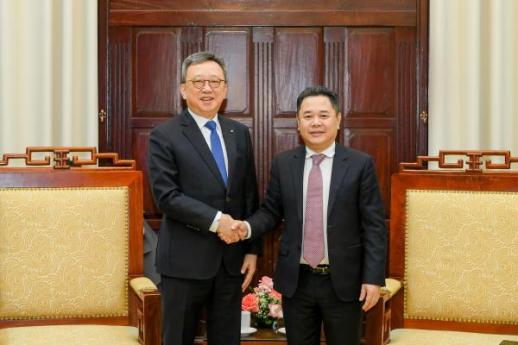 Shinhan Bank Joins Vietnam Economic Delegation, Expands Corporate Finance Push Shinhan Bank is accelerating its push to expand what it calls “productive finance” in Vietnam, following similar efforts in South Korea. The bank said Monday it joined a government-led Vietnam economic delegation from April 22-24, holding talks with the State Bank of Vietnam and signing business agreements with major local financial and industrial groups. Shinhan said the trip was aimed at strengthening the foundation for financial cooperation in Vietnam and meeting financing needs of Korean companies operating there as well as Vietnamese firms. Shinhan entered Vietnam in 1993 as the first South Korean financial company to do so and has expanded its business base since then. Shinhan Vietnam Bank has maintained the top spot among foreign banks in Vietnam in key indicators including total assets, loans and deposits, the bank said. During the visit, Shinhan Bank CEO Jeong Sang-hyeok met with Nguyen Ngoc Canh, deputy governor of the State Bank of Vietnam, to discuss financial support for expanding Korean business activity in Vietnam and cooperation in digital and ESG (environmental, social and governance) areas. Shinhan also signed an agreement with Vietcombank, a state-owned commercial bank, covering cooperation on financial support and retail, foreign-exchange transactions and capital markets, and digital transformation. Shinhan said it aims to support Korean companies entering Vietnam while strengthening its position in the local financial market. With FPT Group, a major Vietnamese information and communications technology company, Shinhan agreed to work on building a digital finance ecosystem based on artificial intelligence and big data. Shinhan also signed an agreement with Agribank, one of Vietnam’s four largest state-owned banks, focused on financial support to help companies from both countries enter each other’s markets. The bank said it plans to expand tailored services for cross-border customers, including Vietnamese workers and students living in South Korea. “Vietnam is a key market that symbolizes Shinhan Bank’s global growth roadmap,” Jeong said. “We will create a model case of ‘productive finance’ that supports the global competitiveness of Korean companies and continue a true financial partnership that grows together with local communities.” * This article has been translated by AI. 2026-04-27 10:58:35
 -
 NH NongHyup Bank launches KOSPI 200-linked ELD deposit with rates up to 10% NH NongHyup Bank said April 27 it will launch “Equity-Linked Deposit (ELD) 26-2,” a principal-protected product designed to offer additional returns. The one-year deposit uses the KOSPI 200 index as its underlying asset and comes in three types: Stable I, Return I and Return II. At maturity, principal and interest are guaranteed. Early termination carries fees and could result in a loss of principal. The deposit can be used as collateral for a loan and is covered by deposit insurance. The Stable I type has no knock-out feature and pays, for individual customers, an annual return of 2.6% to 3.2% (2.45% to 3.05% for corporate customers) if the index at maturity rises 0% to 5% from its initial level. The Return I type offers individuals an annual return of 2.6% to 5.6% (2.47% to 5.47% for corporate customers) if the index rises 0% to 30%. If it rises more than 30%, the return is fixed at the minimum rate. The Return II type offers individuals an annual return of 2.3% to 10.0% (2.17% to 9.87% for corporate customers) if the index rises 0% to 25%. If it rises more than 25%, the return is also fixed at the minimum rate. All quoted returns are annual, before tax. Subscriptions will be accepted through May 6 at branches nationwide and via NH All One Bank and NH Smart Banking. “ELDs are products that guarantee principal at maturity while offering the potential for additional returns,” an NH NongHyup Bank official said, adding the bank will continue to introduce products that meet customer demand. 2026-04-27 10:09:17
 -
 KB Kookmin Bank to Offer Free AI Cognitive Screening for Senior Customers KB Kookmin Bank said it will provide a free artificial intelligence-based cognitive screening service for senior customers as it strengthens expertise in senior-focused wealth management. The bank said on the 27th it will offer the AI cognitive test service, called AlzWIN, in partnership with dementia diagnostics company Sevenpointone. AlzWIN is an AI-based tool developed by Sevenpointone to measure cognitive ability. It can estimate brain health age and brain energy levels through about one minute of speech. The service is part of the bank’s KB Golden Life nonfinancial offerings. It will be available on a first-come, first-served basis to 1,000 customers age 55 and older who visit branches nationwide for inheritance-related consultations, including dementia trusts or will-substitute trusts. A KB Kookmin Bank official said the benefit is intended to help senior customers manage not only financial assets but also health and overall retirement planning. The official said the bank will continue to roll out services as a long-term partner for customers in retirement. Separately, the bank said it operates 18 KB Golden Life Centers nationwide to expand its senior business. On the 24th, it provided dementia-partner training to center heads and Golden Life division staff and received dementia-partner certificates.* This article has been translated by AI. 2026-04-27 09:36:47
 -
 NH NongHyup Bank Launches No-Branch Loans for Successor Farmer Development Funds NH NongHyup Bank said Sunday it has been fully rolling out a no-branch loan service for its Successor Farmer Development Fund since April 24, allowing customers to complete the process without visiting a branch. The fund is a government policy loan designed to foster future agricultural workers and help farmers settle stably. Loans are offered at an annual interest rate of 1.5% for up to 25 years, the bank said. Under the new service, applicants can use the bank’s All One Bank mobile app to handle the entire process from application to disbursement. Document submission and contract signing are also completed electronically. The bank said the move is aimed at improving access to financial services for farmers during the busy farming season. It said it was the first in the financial industry to introduce a non-face-to-face online registration system for farmland collateral and to apply a feature that exempts purchases of National Housing Bonds when taking out farming-related loans. The bank expects up to 20,000 farmers a year to benefit. “The Successor Farmer Development Fund is a key policy loan that supports young farmers’ settlement and growth,” NH NongHyup Bank CEO Kang Tae-young said. “We will expand non-face-to-face lending to improve convenience for farmers.” 2026-04-27 08:48:19
 -
 South Korea’s Top 5 Financial Groups Post Record Q1 Profit as Brokerage Units Drive Results South Korea’s five major financial holding groups — KB, Shinhan, Hana, Woori and NH NongHyup — posted more than 6 trillion won ($) in combined first-quarter net profit, with results increasingly determined by fee income and nonbank units, especially brokerages, amid a strong stock market. According to the financial industry on Saturday, the five groups reported combined first-quarter net profit of 6.1976 trillion won, up 9.8% from 5.6430 trillion won a year earlier. It was the first time their combined first-quarter profit topped 6 trillion won. By group, KB Financial logged 1.8924 trillion won in net profit, up 11.5% from a year earlier, keeping its position as the top earner. Shinhan Financial followed with a record 1.6226 trillion won. Hana Financial posted 1.2100 trillion won, its best result since the 2015 merger of Hana Bank and Korea Exchange Bank. NH NongHyup Financial reported 868.8 billion won, up 21.7%. Woori Financial was the only one to post a decline, with net profit of 603.8 billion won, down 2.1%. The group cited costs tied to voluntary retirement, provisions for overseas business and a reduction in loan assets to manage its common equity tier 1 ratio. The biggest swing factor was nonbank performance, led by securities units. With trading value surging in a buoyant stock market, brokerages emerged as a key profit engine and widened gaps among groups. KB Securities posted first-quarter net profit of 347.8 billion won, up 93.3%, as stock-trading commissions and proprietary trading both grew. Shinhan Investment Corp. reported 288.4 billion won, up 167.4%. NH Investment & Securities recorded 475.7 billion won in net profit, up 128.5%. The securities business accounted for 29.9% of NH NongHyup Financial’s group net profit, outpacing insurance and other nonbank units. Hana Securities reported 103.3 billion won, up 37.1%, but lagged the leading groups. The company said a one-time loss in its bond business followed a sharp rise in interest rates at the end of March. Woori Investment & Securities posted a 1,300% jump in profit, but the amount was only 14.0 billion won, limiting its impact on group results. Outside brokerages, nonbank results were weaker. Ten insurance companies under the five groups posted combined first-quarter net profit of 495.9 billion won, down 2,188 billion won, or 30.6%, from 714.7 billion won a year earlier. Card companies largely held profits at last year’s level as they faced pressure to cut merchant fees, higher funding costs and rising delinquency concerns. Despite the record first-quarter performance, it remains unclear whether the momentum will continue. The industry cited Middle East-related risks as a potential drag on exchange rates, interest rates and capital ratios. Rising corporate-loan delinquencies, linked to an expansion of so-called productive finance, are also adding to concerns about asset quality. “Earnings improved thanks to stronger noninterest income, but burdens from expanding productive finance and capital regulation remain,” a financial industry official said. “A key task this year will be balancing bigger shareholder returns with sound capital management.” 2026-04-26 14:58:00
 -
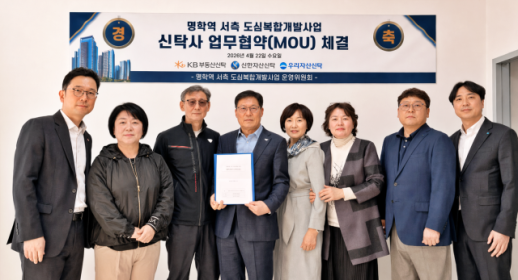 Woori, KB and Shinhan Asset Trusts Sign MOU for Anyang Mixed-Use Redevelopment Anyang’s Manan district area west of Myeonghak Station is set to be redeveloped into a mixed-use space combining housing and commercial functions. Woori Asset Trust, KB Real Estate Trust and Shinhan Asset Trust said April 26 they signed a memorandum of understanding to advance the urban mixed-use redevelopment project west of Myeonghak Station in Anyang. The project aims to revitalize an aging residential neighborhood and underused land near the station on Seoul Subway Line 1. The site is close to the station and offers convenient transportation, with access to nearby commercial and everyday amenities. Under the agreement, the consortium will provide overall advice and project management support, including reviewing the project structure, preparing financing plans and helping coordinate among stakeholders. The companies said they will draw on their experience in redevelopment, development capabilities and fund-management expertise to help keep the project stable from its early stages. A consortium official said the project will improve housing conditions in central Anyang and reorganize urban functions more efficiently, adding that the group will do its best to ensure the project moves forward smoothly.* This article has been translated by AI. 2026-04-26 11:15:41
 -
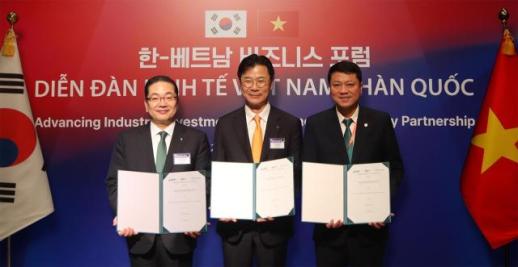 Hana Bank teams with KIND and Vietnam’s BIDV to expand infrastructure finance and QR payments Hana Bank is expanding its finance and payments footprint in Vietnam through partnerships with a state-owned Vietnamese bank and a South Korean public agency. The bank said April 26 that it signed a three-way memorandum of understanding on April 23 with the Bank for Investment and Development of Vietnam, known as BIDV, and the Korea Overseas Infrastructure & Urban Development Corp., or KIND, at the Korea-Vietnam Business Forum in Hanoi. Under the agreement, the three organizations plan to build a strategic partnership in infrastructure and energy, urban development and green projects, and to jointly identify investment opportunities to support South Korean companies entering the market. Hana Bank also said it will deepen cooperation with BIDV, one of Vietnam’s four major state-owned banks, to link investment development with financial services. Hana Bank is also moving into Vietnam’s digital payments market. Working with its subsidiary GLN International, it launched a cross-border QR payment service in partnership with Vietnam National Payment Corp., known as NAPAS, and BIDV. Hana Bank said it is the only South Korean financial institution participating in the project as a settlement bank, while GLN will operate payments directly connected to Vietnam’s national QR network. Users can pay at major tourist destinations including Da Nang, Nha Trang and Phu Quoc through domestic banking and financial technology apps without exchanging currency, the bank said. Hana Bank CEO Lee Ho-seong said the bank will combine Vietnam’s growth potential with its international financial capabilities to create practical value. He said the strategy, spanning infrastructure finance and digital payments, aims to provide convenient and stable services and to upgrade the bank’s global payments network. 2026-04-26 10:51:06
 -
 KB Financial Highlights Social Value Gains; Shinhan Unveils Expanded Shareholder Returns Plan KB Financial Group and Shinhan Financial Group are stepping up efforts on shareholder returns and inclusive finance. KB Financial said April 23 it created 828.6 billion won in social value in the inclusive finance sector in the first quarter. By category, it reported 348.1 billion won tied to support for young people, small and midsize companies and self-employed small businesses, and balanced regional development, and 349.0 billion won related to public livelihood and safety. The group said the results reflect support for household stability and sustainable corporate growth through core financial services, along with social contribution programs that expanded needed local infrastructure. KB Financial said it will further refine its return framework this year after posting cumulative social value of 2.414 trillion won through the third quarter of last year. A KB Financial official said the group will use the measurement results to review the effectiveness of its social contribution programs and strengthen a sustainable support system so the value created spreads across local communities. Shinhan Financial on April 23 announced "Shinhan Value-Up 2.0" and said it will adopt an "uncapped shareholder return ratio" linked to return on equity and growth. Under the plan, the shareholder return ratio would rise without a cap as the group grows. In July 2024, Shinhan Financial said it aimed to achieve by 2027 a 50% shareholder return ratio, 10% ROE, and the purchase and retirement of at least 50 million shares. It said the shareholder return ratio reached 50.2% last year, meeting the target early. With its share retirement plan moving ahead and the price-to-book ratio normalizing, the group said it is now setting the new goal of an uncapped shareholder return ratio. Shinhan Financial also said it will reallocate capital among group affiliates based on return on capital to strengthen nonbank competitiveness on the back of stable bank earnings. It said it plans to raise ROE by linking that approach to groupwide performance measurement, evaluation and compensation systems. The group said it will begin tax-exempt dividends for three years starting with this year-end dividend, and use remaining resources to continue its plan to buy back and retire at least 50 million shares. It also said it will maintain equal quarterly dividends and target annual growth of at least 10% in dividends per share. Shinhan Financial said it approved a first-quarter dividend of 740 won per share and is proceeding with a planned 700 billion won share buyback scheduled through July. A Shinhan Financial official said the plan is significant because it builds a sustainable structure in which group growth and shareholder returns reinforce each other, adding that the company will seek to increase shareholder value through higher ROE and a predictable shareholder return framework. * This article has been translated by AI. 2026-04-23 15:12:53
 -
 NH Financial Targets Senior Market With ‘NH All One Wonderful’ Platform As South Korea moves deeper into a super-aged society, financial firms are intensifying competition for older customers. Banks are rolling out senior brands that go beyond deposits and loans to offer broader services such as trusts, inheritance, pensions and long-term care. Hong Sun-ok, executive vice president for business strategy at NH Financial Group, said in an interview Thursday at the company’s headquarters in Seoul that senior-focused business is “no longer a choice but a sign of the times,” adding that the senior market’s economic influence is growing. Hong said South Korea’s retirement pension reserves totaled about 500 trillion won as of the end of last year, rising more than 10% annually over the past three years. She added that annual asset transfers through inheritance and gifts have exceeded 120 trillion won. “We will build the ‘NH All One Wonderful’ brand not as a set of financial products, but as a platform that takes responsibility for customers’ lives overall,” she said. NH Financial launched the senior-focused brand in November, aiming to support customers preparing for the second stage of life, including financial needs and broader daily-life services, while also considering their children’s generation. In the near term, Hong said the group will expand product offerings to meet demand during “income cliff” periods, including funding for children’s wedding costs and education expenses. Over the medium to long term, she said, the platform will link to nonfinancial areas such as health care, nursing care and re-employment to broaden the customer experience. With competition rising across the financial sector, Hong pointed to NH Financial’s nationwide network as a key differentiator. She said the group plans to provide close-to-home services by leveraging about 12 million senior customers across the group and its regional base. “Aging is not a problem of one generation but a structural change across society,” she said. “NH Financial is expanding its role as a financial partner that systematically supports seniors’ lives beyond simply offering products.” Hong said the group will pursue a strategy of “nearby, long-lasting finance” using infrastructure that extends beyond the Seoul area to smaller regional cities. She said NH Financial plans to develop 100 branches nationwide as senior comprehensive counseling hubs offering retirement planning and tailored asset management. She also said the group plans to expand into health care through initiatives such as senior day care centers inside Hanaro Mart stores and cooperative projects for dementia management. Hong said last year focused on laying the groundwork for the senior business through the NH All One Wonderful brand, while this year is significant because the group has built a dedicated system to coordinate efforts across affiliates. She said the group will continue developing life-stage products and services so that “every moment” of seniors’ lives after retirement can be “filled in a wonderful way.”* This article has been translated by AI. 2026-04-23 12:04:35
 -
 Crypto Prices Rise After Trump Extends Iran Ceasefire; Bitcoin Nears $79,000 Donald Trump, the U.S. president, extended the ceasefire deadline with Iran, lifting global markets and pushing cryptocurrencies higher. Bitcoin was trading at $78,553 as of 8 a.m. Thursday, up 4.18% from a day earlier, according to CoinMarketCap. Major altcoins also gained. Solana rose 2.66% to $87.43, ether climbed 3.88% to $2,396.88, and XRP added 1.27% to $1.43. Investor sentiment improved after Trump said Wednesday that he had received a “unified negotiating proposal” from the Iranian government and would extend the ceasefire until talks conclude in either direction, easing geopolitical tensions. The rally also appeared to draw support from Strategy, the publicly traded company with the world’s largest bitcoin holdings, which said it bought an additional $2.54 billion worth of bitcoin from April 12 to 19 local time. The purchase was its third-largest single buy on record. Some in the market say a move above $79,000 and a break past $80,000 could trigger a short squeeze — a surge driven by short sellers buying to cut losses — and set off a broader rally. In South Korea, bitcoin was trading at about 116.32 million won ($78,621) on Bithumb as of 8 a.m., down 0.4% from the previous day. The so-called kimchi premium, which reflects higher domestic prices than overseas markets, stood at about 0.15%. 2026-04-23 08:24:15