
Journalist

Ahn Seon Young
asy728@ajunews.com
-
 Shinhan Financial Says It Blocked $800,000 in Voice Phishing Losses in Two Weeks Using Linked FDS Shinhan Financial Group said Tuesday it prevented about 800 million won ($800,000) in customer losses within two weeks of launching its “one-stop joint response service” against voice phishing. The service is the first in South Korea’s financial industry to link fraud detection system (FDS) information across group affiliates, Shinhan said. It shares suspicious transaction data in real time among key units — banking, card, securities and insurance — to detect and respond to voice phishing early. The Financial Services Commission designated the program as an innovative financial service in September last year. Since full operations began April 10, Shinhan said it analyzed 1,111 suspicious cases over about two weeks and detected 41 abnormal transactions. Under the Financial Holding Company Act, sharing customer information among affiliates has been limited to internal management purposes, creating institutional constraints on real-time linkage of abnormal-transaction data for voice phishing prevention, the group said. Shinhan said it addressed those limits by integrating FDS operations that had been run separately by each company, allowing consolidated analysis of transaction flows across affiliates. Shinhan said it plans to strengthen industrywide safeguards by linking the service with the financial authorities’ AI-based voice phishing information-sharing and analysis platform, ASAP. A Shinhan official said the initiative is significant because it removes institutional barriers in fraud prevention and improves customer asset protection through group-level cooperation. The official said Shinhan will continue working with financial authorities and the broader financial sector to help build a safer financial environment. 2026-05-06 17:28:28
 -
 Woori Bank Launches Samsung Card Savings Account With Rates Up to 10% A new card-linked savings product offering rates as high as 10% a year has hit the market, adding to competition among financial firms rolling out cross-industry partnership products. Woori Bank said Tuesday it launched the “Samsung Card Woori Savings,” which offers preferential rates of up to 10% annually depending on Samsung Card usage and other conditions. The 12-month, flexible-deposit product is limited to one account per person, with monthly deposits capped at 500,000 won. The base rate is 2.5% a year, and customers can add up to 7.5 percentage points in preferential rates for a maximum of 10%. The product is designed to link spending and saving by applying different preferential rates based on card payment volume, so higher card use can translate into a higher savings rate. Preferential rates vary by whether the customer is a new Samsung Card member and by cumulative spending. New cardholders receive an additional 2 percentage points with cumulative spending of at least 6 million won but less than 9 million won, or 4 percentage points with spending of 9 million won or more. Existing Samsung Card users receive an additional 2 percentage points with cumulative spending of at least 10 million won but less than 15 million won, or 4 percentage points with spending of 15 million won or more. In both cases, the spending-recognition period runs from the start of the month the savings account is opened through the month before maturity. Customers can also earn an additional 2.5 percentage points if their card bill is debited from a Woori Bank account in their name and automatic transfers are withdrawn at least six times a month. Another 1.0 percentage point applies to customers who have not held Woori Bank deposits or savings products in the previous six months. The product will be sold on a first-come, first-served basis, limited to 20,000 accounts. “This is a new type of savings product that connects customers’ everyday spending to financial benefits,” said Lee Young, head of Woori Bank’s retail deposit products team. “We will continue to expand innovative products that provide tangible benefits through a range of partnerships.” * This article has been translated by AI. 2026-05-06 17:18:05
 -
 Korea to Sell Public Growth Fund With Tax Breaks and Loss Backstop, Testing Policy-Fund Model A public-participation National Growth Fund, promoted with what officials call unprecedented tax and loss-support benefits, will go on full sale later this month. The fund is designed to address shortcomings of the earlier New Deal fund and strengthen incentives, but its success will hinge on whether it draws real inflows and delivers results. The Financial Services Commission said on the 6th that the Public Participation Growth Fund will be sold for three weeks, from the 22nd through the 11th of next month, through branches and online channels of 25 banks and securities firms. Total sales to individuals will be 600 billion won, offered on a first-come, first-served basis until the allocation is exhausted. The annual subscription cap is 100 million won per person. Minimum subscriptions vary by seller, ranging from 0 to 1 million won. Investors should be cautious because early redemption is not allowed during the five-year term. Tax support is the fund’s biggest draw. Investors can claim income deductions up to 18 million won: a 40% deduction rate on investments up to 30 million won, 20% on amounts over 30 million won up to 50 million won, and 10% on amounts over 50 million won up to 70 million won. Dividend income is separately taxed at 9% if the investment is held for five years. The main investment targets are companies in advanced strategic industries — including semiconductors, future vehicles and artificial intelligence — and related firms. Ten sub-fund managers operating under the National Growth Fund must invest at least 60% of their committed capital in those areas. The remaining 40% may be invested at the managers’ discretion. The fund aims to channel private money into future growth industries, but critics warn it could repeat the familiar limits of policy funds, given that similar products in the past fell short of expectations. As an example, the average annual return for the general public on the New Deal fund launched in 2021 under the Moon Jae-in government was 2.37%, roughly in line with bank deposit rates. That figure reflected the government budget taking losses first; excluding fiscal funds, the average return of 10 sub-funds was just 0.75%. The structure that ties up money for years is also similar. The New Deal fund had a four-year maturity, while the National Growth Fund has a five-year term and bars redemptions. If an investor transfers the holding within three years, an amount equivalent to the tax benefit will be clawed back. Some also question whether the fund’s target return — 30% cumulatively over five years — will look compelling given the KOSPI’s 56.6% rise over the past four months. With the KOSPI topping 7,300 on the day, some analysts said investors may worry about buying in near a peak. Na Hye-young, director of the FSC’s Public and Regional Participation Support Division, said the government sought to improve on the New Deal fund by diversifying sub-fund strategies and methods. “Within a 20% range, fiscal funds will take losses first for each sub-fund, and tax benefits are provided, which has the effect of increasing investors’ net returns,” she said. 2026-05-06 14:54:15
 -
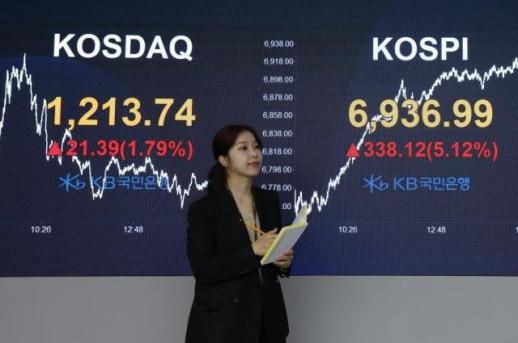 Bank Deposits Shift to Stocks as KOSPI Rally Fuels 'Money Move' Expectations that the KOSPI will break above 7,000, along with forecasts of a rally in large-cap technology shares, are accelerating the shift of money from bank deposits into the stock market. Analysts say the trend reflects a clearer move away from deposit-centered asset management as investors chase higher returns. According to the Bank of Korea’s Economic Statistics System, the number of time-deposit accounts at commercial banks with balances of 100 million won ($72,000) or less totaled 21,629,000 at the end of last year. That was the lowest since the end of the first half of 2019 (20.7 million). The figure fell 3.2% from the end of the first half of last year (22,334,000) and 3.1% from the end of 2024 (22,330,000). The total amount held in those sub-100 million won time deposits also slipped. The balance stood at 299.709 trillion won at the end of last year, down 2.2% from a year earlier (306.528 trillion won). After rising for three years and six months and hitting a record at the end of the first half of last year (308.333 trillion won), the uptrend reversed. Most time deposits under 100 million won are believed to be held by individuals. Banks say the decline reflects a recent personal-finance trend in which retail investors are moving beyond deposits and taking a more active approach to investing. For similar reasons, demand deposits—often treated as cash waiting to be invested—have been swinging sharply. At the five major banks (KB Kookmin, Shinhan, Hana, Woori and NH Nonghyup), demand-deposit balances were 699.9081 trillion won at the end of March, fell to 680.9236 trillion won on April 16, then rebounded to 700.6712 trillion won at the end of April, showing nearly 20 trillion won moving out and back in within about two weeks. Analysts attribute the pattern to money flowing heavily into stocks as the KOSPI repeatedly set new highs, then returning to banks at month-end as investors rebuilt cash positions. A key gauge of leveraged stock buying in Korea—outstanding margin loans—has also set fresh records. Margin loans refer to money investors borrow from brokerages for stock purchases that has not yet been repaid. The balance first topped 35 trillion won on April 23, then hit another high five days later on April 28 (35.6895 trillion won). It has risen for 13 straight trading sessions since April 10 and is up 2.7 trillion won so far this month. The shift is expected to persist for now, with bank deposit rates stuck in the 2% range and the KOSPI pushing higher day after day, lifting expected returns. Global investment banks have raised their KOSPI forecasts sharply, to as high as 8,500, adding to the flow of funds. A commercial bank official said that in the past, people tended to park lump sums in time deposits, but now they are increasingly moving money frequently based on market conditions. The official added that the pace of transfers has quickened alongside the recent stock-market rise.* This article has been translated by AI. 2026-05-05 17:03:15
 -
 Woori Bank Arranges $825 Million Refinancing for Ohio Gas Power Plant Woori Bank said it has completed a refinancing arrangement worth $825 million (about 1.1 trillion won) for a 950-megawatt gas-fired combined-cycle power plant in Trumbull County, Ohio, expanding its footprint in North American infrastructure finance. The bank said Sunday the refinancing was timed to the start of commercial operations at the plant. The project is jointly funded by Korea Southern Power Co., the Korea Overseas Infrastructure & Urban Development Corp. (KIND) and Siemens Energy. After the plant began full operations on April 15, Woori led the conversion of construction-stage loans into long-term facilities financing suited to the operating phase. Woori said it first provided financial support for the project in 2022, when it secured a lead role by raising $150 million from South Korean financial institutions. In the latest refinancing, it said it and KB Kookmin Bank jointly underwrote a total of $230 million in long-term facilities loans and a revolving credit line to be used for working capital. Lee Hae-yeon, deputy head of Woori Bank’s infrastructure finance department, said the deal supplied funding on schedule with the start of commercial operations and strengthened the bank’s position in the North American energy market. Lee said Woori will continue to seek high-quality global assets and support South Korean companies expanding overseas as a financial partner. 2026-05-03 10:09:15
 -
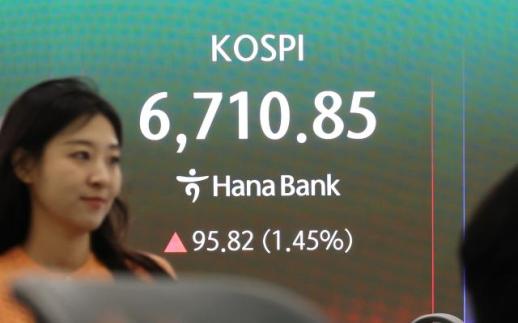 How to Use Korea’s RIA Account as the Kospi Hits Record Highs Korea’s Domestic Market Return Account, known as the RIA, has marked its first month on the market, introduced to steer money back into local stocks. With the Kospi repeatedly setting record highs, investor interest in the account has also grown. Experts say investors should weigh the benefit structure, restrictions and the direction of the local market, rather than signing up solely for tax breaks. The RIA is a special account the government introduced on a limited-time basis this year to help stabilize the exchange rate and invigorate Korea’s capital markets. It launched March 23. Investors can move overseas stocks into the account, sell them, convert proceeds into won and reinvest in domestic assets; if the money is kept invested for at least one year, they can receive a deduction on capital gains tax from overseas stock sales. If overseas stocks held before Dec. 23, 2025, are transferred into an RIA, sold, and the proceeds are reinvested for at least one year in domestically listed stocks, Korea-focused equity funds and ETFs, investors can receive a capital gains tax deduction of up to 100%. The benefit is capped at 50 million won per person, based on the overseas stock sale amount. The deduction rate is 100% for sales by the end of May, 80% by the end of July, and 50% by year’s end. As the Kospi has regained strength compared with the period around the product’s launch, interest in using the RIA has risen. Inquiries have increased, centered on large blue chips such as SK hynix, Samsung Electronics and Hyundai Motor, as well as ETFs like the KODEX 200, according to the report. Still, investors need to check key conditions to fully secure the tax benefit. The 50 million won threshold is based on sale proceeds, not capital gains. For investors holding multiple overseas stocks, using the account first for positions with lower purchase prices and higher returns can increase tax savings. After overseas stocks are transferred into the RIA and sold, the converted funds must be invested only in domestic assets such as locally listed stocks or Korea equity ETFs. Even if an ETF is listed in Korea, the benefit does not apply if it tracks an overseas index. There is also an early-termination risk. If funds are withdrawn or the account is closed before one year, all tax benefits received are canceled. Switching among domestic stock holdings within the account, however, is allowed. Experts said the RIA should be viewed less as a stand-alone tax product and more as a supplemental account for investors who already intend to invest in Korean equities. A financial industry official said, “If you want to keep holding overseas growth stocks right now or plan to use the money in the short term, the practical benefit may not be large.” The official added, “For investors considering taking profits on overseas stocks and looking for a timing to re-enter the domestic market, it can be an option to use the tax benefit.”* This article has been translated by AI. 2026-05-02 07:03:40
 -
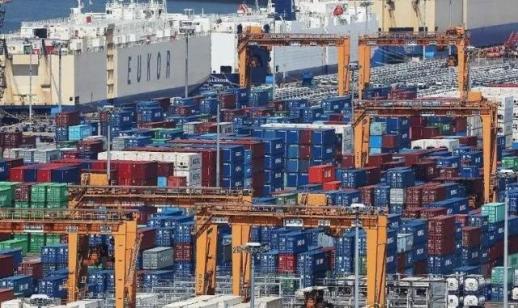 Korea’s SME Divide Widens as Exports Hold Up but Domestic Sectors Struggle Exports led by semiconductors, autos and shipbuilding have continued to recover, but domestic-facing industries such as real estate leasing, construction and wholesale and retail are seeing worsening cash conditions amid high interest rates and weak consumption. According to the financial sector on the 29th, the Industrial Bank of Korea said its delinquency rate for small and medium-sized enterprises in real estate and leasing stood at 1.28% at the end of the first quarter, based on principal and interest overdue by at least one month. That was up 0.74 percentage points from a year earlier and the highest level in 13 years since the first quarter of 2013 (1.36%). The rise is attributed to a combination of growing vacancies in commercial properties, stagnant rents and heavier interest burdens. Borrowers who once relied on rising collateral values are now facing shrinking rental income and mounting financing costs, eroding repayment capacity. Major commercial banks reported similar increases. Shinhan Bank’s delinquency rate in the sector was 0.35% at the end of the first quarter, the highest since it began compiling related data in 2021. Hana Bank’s was 0.57%, the highest in about 10 years since the second quarter of 2016, and Woori Bank’s was 0.41%, the highest since its data series began in 2019. The figures point to growing repayment pressure across domestic-demand sectors. An IBK official said, “The prolonged uncertainty in the domestic and global economy and worsening business conditions have weighed on overall domestic demand, which has also hurt the real estate leasing market.” Delinquency rates were also elevated in other sectors tied to domestic demand. IBK’s SME construction delinquency rate was 1.64% at the end of the first quarter, up 0.30 percentage points from 1.34% a year earlier. Wholesale and retail (1.07%) and food and lodging (1.40%) were also above 1%. Manufacturing, however, remained relatively stable. IBK’s delinquency rate for SME manufacturers fell to 0.86% in the first quarter from 0.92% a year earlier. The improvement in export-driven industries appears to have eased funding conditions for smaller suppliers, and some analysts said the weaker won has benefited certain exporters. A financial industry official said, “Even among small businesses, the on-the-ground economy feels completely different between manufacturing and domestic-demand sectors,” adding that polarization is deepening as the export rebound has not spread to local commercial districts, self-employed businesses and real estate leasing. 2026-04-29 14:29:21
 -
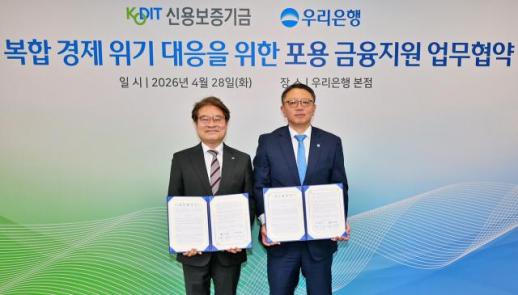 Woori Bank, Credit Guarantee Fund to Provide 240 Billion Won in Support for Small Firms Woori Bank said Tuesday it will work with the Korea Credit Guarantee Fund to provide 240 billion won ($2400억원) in financial support to help small and medium-sized businesses weather a crisis. The bank and the fund signed a business agreement Monday on inclusive financial support to respond to a complex economic downturn. The program is aimed at easing financing burdens for SMEs facing difficulties from a global slowdown and increased volatility in financial markets, while supporting a stable recovery in the real economy. Woori Bank will contribute a total of 6 billion won ($60억원) to the fund, enabling about 240 billion won in support. Eligible firms include small businesses and vulnerable industries tied to oil and price stabilization; companies involved in supply-chain management, including materials, parts and equipment; businesses directly or indirectly affected by changes in external conditions such as the war in the Middle East; and exporters, importers and companies expanding overseas. Participating firms will receive higher guarantee coverage, raised to 100% from 85%, and support equivalent to 0.7 percentage points of guarantee fees. Separately, Woori Bank said it signed another agreement with the fund on April 10 to provide 310 billion won ($3100억원) in stage-by-stage financing for innovative-growth sectors and export-leading small and mid-sized companies. The bank said it plans to expand cooperation with policy finance institutions to bolster resilience and growth for small and mid-sized firms. Woori Bank CEO Jeong Jin-wan said the latest agreement will help improve access to financing for SMEs struggling to raise funds. He said the bank will expand what it called productive finance, in close cooperation with the fund, to support normal operations and sustainable growth for small and mid-sized companies.* This article has been translated by AI. 2026-04-29 09:16:12
 -
 Hana Financial’s ‘Hana Universe’ Tops 23 Million YouTube Views With Star Cast Hana Financial Group said its brand content series “Hana Universe,” released to mark the group’s 20th anniversary, has surpassed 23 million cumulative views on YouTube. The big-budget project, which brings together top names from film, sports and music, is drawing attention as a new approach to brand marketing in the financial sector. According to the financial industry on Monday, the main “Hana Universe” video posted April 10 on Hana Financial’s official YouTube channel, HanaTV, had nearly 13 million views as of 2 p.m. that day (12.96 million). Combined with the teaser and trailer (7.62 million), brand film (2.40 million) and production presentation (620,000), related videos totaled 23.60 million views. Short-form clips are also drawing hundreds of thousands of views each. “Hana Universe” departs from a standard ad format, presenting a nine-minute short film set inside an airplane cabin and built around director Ha Jung-woo’s comedic style. It features the group’s advertising models, including singer G-Dragon and Lim Young-woong, along with soccer player Son Heung-min, TV personality Kang Ho-dong and Ahn Yu-jin of IVE. Through a series of episodes, the film highlights key products and services, including the Hana Nara Sarang Card, Hana Gold Trust, Hana Pension Doctor, Hana The Next and Travelog. With a cast rarely seen in financial advertising and a movie-style storyline, the video spread quickly across online communities and social media after its release. Re-edited versions, including YouTube Shorts, have helped sustain word-of-mouth interest. Industry watchers say Hana Financial is shifting away from TV-centered advertising and putting more emphasis on digital content to build brand familiarity. Last year, it tested the mix of entertainment-style content and star marketing through “Hanappunin Mureupak Baksa,” hosted by Kang and featuring G-Dragon and Son. “Financial advertising used to focus on conveying trust and stability, but it is evolving into a way for people to experience brands through entertainment and buzz,” a financial industry official said. “After this success, competition in financial-sector content marketing is likely to intensify.” 2026-04-28 15:11:29
 -
 NH NongHyup Bank Launches First Transition Loan to Back Low-Carbon Upgrades NH NongHyup Bank said Tuesday it has executed its first transition loan, financing environmental improvement investments for companies that need to shift to lower-carbon operations. The bank said the case shows how financial support can help fund equipment investments that improve environmental performance in the real economy. It plans to keep expanding green and transition lending in line with the group’s transition finance strategy. The loan supported funds to install a wastewater treatment facility at a livestock products distribution company in Goseong County, South Gyeongsang Province. The company will use the project to reduce pollution and move to more environmentally friendly facilities. NH NongHyup Bank said the loan was handled as transition lending after a suitability review under Korea’s green taxonomy, known as the K-Taxonomy, aimed at supporting a practical low-carbon shift. The bank has also moved to broaden climate finance, including signing a business agreement Monday with the Korea Technology Finance Corp. on an evaluation project based on the K-Taxonomy. It said it plans to expand support to transition finance and continue strengthening low-carbon transition and ESG-related financial support for companies.* This article has been translated by AI. 2026-04-28 10:09:16