
Journalist

Lee Jung-woo and Yoo Na-hyun
cannes2030@ajupress.com
-
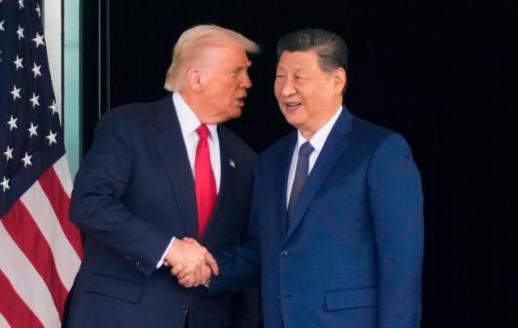 Iran war likely to sideline North Korea at Trump-Xi summit of reduced ambitions SEOUL, May 13 (AJP) - North Korea is expected to take a back seat at this week’s summit between U.S. President Donald Trump and Chinese President Xi Jinping as the Iran war, disruption in the Strait of Hormuz and intensifying superpower rivalry overshadow Pyongyang in what increasingly appears to be a crisis-management meeting rather than a breakthrough summit. Iran looms large over the two superpowers even as both sides seek to avoid openly framing the summit around the conflict. Broader issues including trade tensions, Taiwan, rare earths, semiconductors and energy security are expected to dominate the two-day talks, leaving limited room for North Korea to emerge as a central agenda item. Trump departed for China aboard Air Force One on Tuesday, leaving Joint Base Andrews in Maryland at 2:36 p.m. local time. He is expected to arrive in Beijing late Wednesday afternoon ahead of a two-day official visit beginning Thursday. Trump is making the first U.S. presidential state visit to China in nearly a decade after the trip was delayed by the Iran war. The meeting is also the first of several planned face-to-face encounters between the two leaders this year. The summit comes after Washington and Beijing lowered tensions in their trade war, but the two sides remain divided over tariffs, rare earth minerals, advanced semiconductors, electric vehicles and sanctions linked to Iranian oil shipments. Trump said last week, “We’re doing a lot of business with China.” He also said the United States was “making a lot of money” from trade with China. But the meeting arrives under the shadow of the unresolved Iran conflict that delayed Trump’s Beijing trip and sharply reduced expectations for major diplomatic breakthroughs. Instead of projecting decisive strength after the U.S. strikes on Iran, Washington now faces mounting pressure over the continued closure of the Strait of Hormuz, a critical chokepoint for global energy flows. The Strait of Hormuz, through which roughly a fifth of the world’s oil traditionally flows, remains closed with no clear pathway toward reopening. The disruption poses a direct threat to China’s economy and its Gulf relationships because Beijing relies heavily on energy imports transiting the route. U.S. Treasury Secretary Scott Bessent called on China this week to “step up with some diplomacy,” as Washington looked to Beijing for help in easing the crisis. Rather than pursuing sweeping diplomatic breakthroughs, the summit is increasingly shaping into an exercise in managing instability across trade, Taiwan, energy security and supply chains amid mounting uncertainty over the Iran war. Taiwan is also expected to be among the most sensitive agenda items. Beijing claims the self-ruled island as part of its territory and has vowed to take control of it, using force if necessary. Washington does not formally recognize Taiwan but continues to provide defensive weapons to Taipei. An $11 billion U.S. arms package for Taiwan has reportedly been stalled ahead of the summit. Beijing is also expected to press Washington to change its official wording on Taiwan from saying it “does not support” Taiwanese independence to explicitly “opposing” it. Against that backdrop, North Korea appears likely to remain a secondary issue despite historically serving as an occasional diplomatic icebreaker between Trump and Xi as the two share a degree of personal rapport with reclusive ruler Kim Jong-un. Political scientists and regional experts broadly predicted that the summit would focus overwhelmingly on Iran and economic security rather than the Korean Peninsula. Dov Levin, a professor in the Department of Politics and Public Administration at the University of Hong Kong, predicted that there will be no significant discussion on North Korea at the summit. Levin said the Iran war and maintaining the truce in the U.S.-China trade war would be the two major topics. He said Trump may ask Xi for help on Iran to get Tehran to “make more concessions to the U.S. regarding the nuclear issue” and reopen the Strait of Hormuz. “I do not expect North Korea to emerge as a key issue during the summit,” Christopher Fariss, a professor in the Department of Political Science at the University of Michigan agreed. Fariss said he expects the meeting to focus on trade and tariff issues, noting chief executives of major U.S. Big Tech and Wall Street firms are accompanying Trump to China. He added that South Korea and Taiwan could emerge as talking points within broader economic discussions. Elon Musk, Apple CEO Tim Cook and Boeing CEO Kelly Ortberg are reportedly included in Trump’s delegation to China. Greg Albo, a professor in the Department of Political Science at York University, also argued that North Korea would not be treated as a major agenda item. “The main items will be on several economic matters,” Albo said, citing as examples “the tariff war, e-vehicles and rare earths, the chip war and international monetary issues.” Iran war and the Strait of Hormuz instead would be treated as important agenda items. He added that “the Gulf states bending away from the U.S. adds to the east-east trade linkages between the GCC and China.” James Morrow, a professor of world politics at the University of Michigan, said other issues are likely to overshadow North Korea during the visit. He pointed first to U.S.-China trade and broader global trade tensions, followed by Taiwan, which he said Xi is expected to raise, and the U.S.-Israel war against Iran. Compared with those issues, Morrow said North Korea appears less urgent in Washington, noting that Kim Jong-un has not pushed the country back onto the international agenda as he did in 2017, when Pyongyang conducted a series of missile and nuclear demonstrations. While South Koreans may view the situation differently, Morrow said North Korea’s tests this year are not seen as a central concern in the United States. Watchers in South Korea are in general agreement. “I expect that North Korean issues will not be addressed, as this U.S.-China summit is focused on economic security,” said Rep. Kim Young-bae of the Democratic Party of Korea, vice chair of the National Assembly’s Foreign Affairs and Unification Committee. “I think North Korean issues may be addressed sometime next year after the Iran issue is settled following the U.S. midterm elections in November,” Kim added. Rep. Yoon Hu-duk of the Democratic Party of Korea, also a member of the Foreign Affairs and Unification Committee, similarly predicted that North Korean issues would not be addressed at the summit. “Ahead of last year's U.S.-China summit in Busan, President Trump continued to send love calls to Kim Jong-un, raising the possibility of a North Korea-U.S. summit, but currently President Trump is not sending any love calls to Kim Jong-un at all,” Yoon said. “North Korean issues appear to be outside President Trump's current area of interest,” he added. “The Iran issue and economic issues such as rare earths will make up most of the discussions, and North Korean issues may be addressed formally but will not become a major agenda item,” said Rep. Kim Ki-woong of the People Power Party, a former vice unification minister. Kim said that for Trump, North Korean issues are not urgent and remain merely a diplomatic card that could be used later as a political achievement before the U.S. midterm elections. He added that with Trump currently needing Xi’s cooperation because of the Iran war, there is little reason for Washington to specifically press Beijing on North Korea. “There are many other issues, and North Korea is not responding to the United States, so the possibility of a North Korea-U.S. summit is slim,” said Rep. Kim Joon-hyung of the minor Rebuilding Korea Party and former chancellor of the Korea National Diplomatic Academy. “However, as six meetings are scheduled between President Trump and Chinese President Xi Jinping, I expect the U.S. side will bring up a discussion on North Korea at least once,” Kim added. Dong Wang, a professor at the School of International Studies at Peking University, maintained that the two leaders would still treat North Korea as an important agenda item. He said regional security in Northeast Asia is a “critical matter for peace and stability,” and therefore the two leaders will address it as a major issue. 2026-05-13 11:40:53
 -
 Google says it blocked AI-assisted cyberattack plot, warns of North Korean hacking activity SEOUL, May 12 (AJP) - Google claimed it had preemptively blocked hackers who were preparing large-scale cyberattacks using artificial intelligence and identified North Korean state-linked hacking activities leveraging AI to refine cyber operations. According to its report published on the Cloud Security blog, Google’s Threat Intelligence Group (GTIG) uncovered a threat actor believed to have used AI in preparations for a “zero-day” attack campaign. Google said the actor appeared to be planning broad operations, but the company’s early intervention likely prevented the attacks from being executed. A zero-day attack exploits previously unknown software vulnerabilities before developers can issue security patches, making such intrusions especially difficult to defend against. The disclosure adds to mounting concerns in the cybersecurity industry that rapid advances in AI-assisted vulnerability detection could accelerate the discovery and weaponization of software flaws. According to the report, the attackers sought to exploit vulnerabilities to bypass two-factor authentication systems. Google stressed there was no evidence its own AI model, Gemini, had been used in the operation. While Google did not identify the actor behind the attempted attacks, it separately warned that state-backed hacking groups linked to China and North Korea are showing “particular interest” in applying AI to cyber operations. The company said such groups are adopting increasingly sophisticated AI-assisted techniques for vulnerability discovery and exploitation, including integrating specialized, high-quality security datasets into their workflows. Google specifically highlighted North Korean hacking group APT45, saying there were indications the group had conducted automated research by repeatedly submitting thousands of prompts to analyze vulnerabilities and validate exploit code. “Attackers are not hesitating to experiment and innovate, and neither are we,” Google said in the report, adding that it is sharing research findings and defensive measures across the cybersecurity and AI communities to stay ahead of evolving threats. The warning comes amid broader concerns over AI-powered cyber threats following Anthropic’s recent announcement of “Claude Mitos,” an AI model reportedly capable of expert-level vulnerability discovery. Anthropic said access to the model would initially be restricted to selected companies and institutions because of security concerns. Security experts have also warned that threat actors may be able to assemble comparable cyber capabilities by combining already publicly available AI models. Meanwhile, OpenAI recently introduced “GPT-5.5-Cyber,” a cybersecurity-focused AI model reportedly accessible only to a limited group of researchers and organizations. 2026-05-12 13:55:35
 -
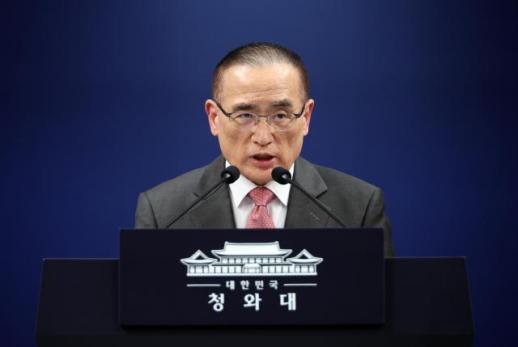 Seoul condemns attack on HMM vessel in Strait of Hormuz SEOUL, May 11 (AJP) - South Korea on Monday formally condemned a kinetic strike on a specialized cargo vessel in the Strait of Hormuz after a joint investigation concluded that two airborne projectiles hit the ship. The confirmation follows a week of uncertainty regarding the Panama-flagged HMM Namu, which was left with a massive hull rupture and an engine room fire after the May 4 strike. The vessel was carrying 24 crew members, including six South Korean nationals. The foreign ministry said on Sunday that its investigation confirmed the ship was hit on its port side ballast tank by two objects arriving approximately one minute apart. The strike created a rupture five meters wide and seven meters deep about 1.5 meters above the waterline. "Our government maintains that attacks on privately operated vessels, including the HMM Namu, can neither be justified nor tolerated, and we strongly condemn them," National Security Advisor Wi Sung-lac said during a press briefing held at the presidential Blue House in central Seoul. Wi noted that the pattern of damage and the presence of hemispherical penetration shapes made it unlikely that sea mines or torpedoes were used. One crew member was reported injured in the attack, while the remaining 23 were unharmed. The 182-meter general cargo ship is operated by HMM Co. and specializes in transporting ultra-heavy loads. Launched in September 2025 at the HPWS shipyard in Guangzhou, China, the vessel operates on non-scheduled routes for heavy-lift cargo rather than standard shipping lanes. The attribution of the attack has emerged as a point of diplomatic friction as Iranian entities issued conflicting statements. Iran's state-run Press TV has reported that the Revolutionary Guard targeted the vessel, while the Iranian embassy in Seoul denied any involvement in an attack against South Korea. The Iranian state news agency IRNA published an analysis titled 'Failed Liberation Operation' on May 7. The report claimed that at least two vessels from South Korea and France were struck while attempting to transit the strait under the protection of the United States military. South Korea's main opposition People Power Party criticized the administration for what it described as a hesitant response. The party accused the government of downplaying the incident and failing to explicitly name Iran as the aggressor despite the claims made by Iranian state media. Investigators have faced difficulties accessing the engine room to determine the internal cause of the fire due to high concentrations of carbon dioxide. The vessel was towed to a port in Dubai on May 8 for repairs and further forensic analysis of debris recovered from the hull. 2026-05-11 17:57:53
 -
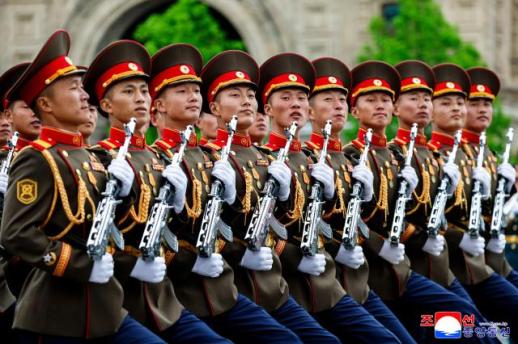 North Korean march in Russia's Victory Day parade sends message on new alliance SEOUL, May 11 (AJP) - Missing were the regular VIPs from China and Iran at this year's Victory Day in Russia, while the military hardware usually showcased along Red Square was notably scaled back amid the ongoing wars in Ukraine and the Middle East. What stood out instead during the 45-minute spectacle was the march of North Korean servicemen fighting alongside Russian troops in Ukraine. The message came across clear. The spectacle was intended to “show off the military alliance relationship between North Korea and Russia at home and abroad,” said Yoon Min Ho, spokesman for Seoul’s Unification Ministry. The parade, commemorating the Soviet Union’s victory over Nazi Germany in World War II, was held under heavy security amid concerns over possible Ukrainian attacks. Russian President Vladimir Putin used the occasion to draw parallels between the sacrifices of the 1940s and Russia’s current war in Ukraine. The legacy of the wartime generation inspired Russian soldiers in the “special military operation,” he said. “They stand against an aggressive force armed and supported by the entire NATO bloc,” Putin said. “And despite this, our heroes move forward. Victory has always been and will always be ours.” This year’s event was notably more restrained than previous years. Instead of the customary display of missiles and armored vehicles, spectators were shown video presentations highlighting Russia’s drone capabilities and nuclear arsenal. A column of North Korean soldiers marched across Red Square as Pyongyang and Moscow deepen military cooperation. North Korean troops have reportedly been deployed alongside Russian forces, particularly in Russia’s Kursk region. The ceremony lasted about 45 minutes, roughly half the length of past Victory Day events. Russian authorities acknowledged tightened security measures were intended to protect Putin amid fears of possible Ukrainian strikes on Moscow. In a congratulatory message to Putin, North Korean leader Kim Jong-un emphasized the countries’ “comprehensive strategic partnership.” An estimated 14,000 North Koreans have been dispatched to the frontlines of Russia since October 2024, with 2,251 presumed to be killed. North Korea’s state-run Rodong Sinmun prominently featured the parade on its front pages. According to the newspaper, a combined column of the Korean People’s Army’s ground, naval and air forces was led by Army Col. Choe Yong-hun. “It was a display to the world of the closeness of North Korea-Russia relations at a time when North Korean troops are participating in the Ukraine war and fighting Ukrainian forces in Kursk,” said Kim Yong-hyun, professor of North Korean studies at Dongguk University. Kim said deepening ties between Pyongyang and Moscow could also encourage China to move closer to North Korea. He added that relations between Pyongyang and Moscow were likely to remain close for a considerable period because a quick end to the war appeared unlikely. 2026-05-11 16:31:08
 -
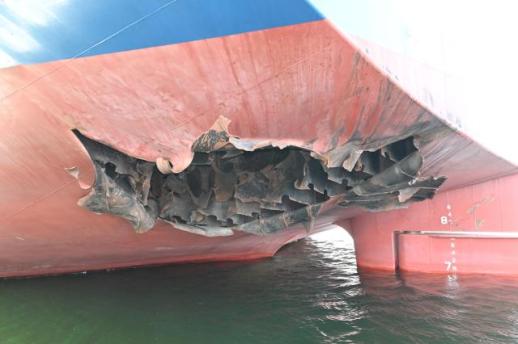 Seoul stays cautious on blaming Iran over HMM Hormuz attack SEOUL, May 11 (AJP) - South Korean Foreign Minister Cho Hyun maintained a cautious stance Monday, stopping short of directly blaming Iran for the attack on a Korean-operated cargo ship near the Strait of Hormuz despite the government’s initial conclusion that the vessel had come under an external strike. “There are still things that need to be studied before making a judgment,” Cho told reporters, signaling Seoul’s reluctance to escalate tensions before the investigation is fully completed. His remarks came a day after the foreign ministry disclosed that two “unidentified airborne objects” struck the stern of the Panama-flagged cargo ship HMM Namu last week, triggering an explosion and fire aboard the vessel. The ship, operated by HMM, was carrying 24 crew members, including six South Koreans. No casualties were reported. Additional analysis is underway on engine fragments recovered from debris found at the scene. Seoul’s calibrated response reflects the delicate diplomatic balancing act facing South Korea as tensions surrounding the Strait of Hormuz intensify. South Korea remains heavily dependent on Middle Eastern crude imports and has sought to avoid being drawn directly into confrontation between Washington and Tehran despite its alliance with the United States. The foreign ministry summoned Iranian Ambassador to South Korea Saeed Koozechi on Sunday to explain the findings, Cho said, adding that the investigation results had also been shared with Washington. Koozechi did not speak publicly upon arriving at the ministry. According to Seoul officials, First Vice Foreign Minister Park Yoon-joo briefed the Iranian envoy on the preliminary investigation outcome. U.S. President Donald Trump earlier claimed that Iran had “taken some shots” at the HMM vessel and other targets in the region. The Iranian Embassy in Seoul strongly denied any involvement, saying Tehran “firmly and categorically” rejects allegations linking its military to the incident. The attack came just hours after Washington launched — and later suspended — “Project Freedom,” a U.S.-led operation aimed at assisting commercial ships stranded around the strategic waterway. Tehran condemned the operation as a violation of the ceasefire framework that has nominally remained in place since early April. The incident is expected to surface during talks between South Korean Defense Minister Ahn Gyu-back and U.S. Defense Secretary Pete Hegseth in Washington on Monday local time. The trip marks Ahn’s first visit to the United States since taking office. 2026-05-11 14:14:09
 -
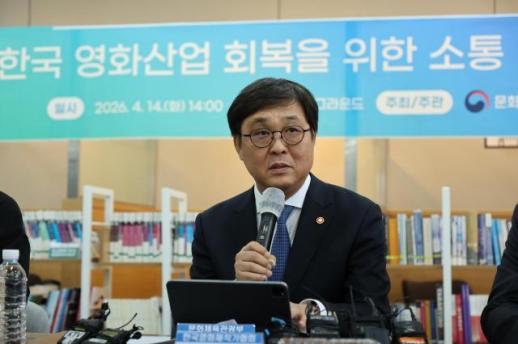 S. Korea to distribute 2.25 million movie discount coupons to boost film industry SEOUL, May 8 (AJP) - In an effort to boost the local film industry, South Korea will begin distributing 2.25 million movie discount coupons next week, the Ministry of Culture, Sports and Tourism and the Korean Film Council said Friday. The coupons will allow moviegoers to watch films for about 8,000 won to 9,000 won, a significant discount from the regular 14,000 won to 15,000 won ticket price. The coupon program is part of a 461.4 billion won ($314 million) supplementary budget for the ministry approved by the National Assembly in April, as the government seeks to cushion the culture, sports and tourism sectors from weak consumption, high oil prices and inflation. In all, 65.6 billion won has been earmarked for the film sector to help revive private consumption and support the local cinema ecosystem. Of that amount, 27.1 billion won was allocated to fund 4.5 million movie discount coupons worth 6,000 won each. The remaining 2.25 million coupons are scheduled to be distributed in July. The support package for Korean film production includes an additional 26 billion won for mid-budget films, 4.5 billion won for independent and art films and 8 billion won for a newly created program supporting films that use advanced production technologies. The expanded support will cover live-action feature films with net production costs of 10 billion won to less than 15 billion won, as well as independent and art films with net production costs of 1 billion won to less than 2 billion won. The measures come as the film industry continues to struggle in the aftermath of the COVID-19 pandemic. From 2023 to 2025, locally produced commercial films posted an average return of minus 27 percent, with only 18 percent of titles surpassing their break-even points. By comparison, commercial films released between 2016 and 2019 recorded an average return of 10 percent, while 40 percent exceeded their break-even points. Beginning May 13, each person will be able to receive two coupons through the websites and mobile apps of major multiplex chains CGV, Lotte Cinema, Megabox and Cine Q. The coupons will be automatically issued to each theater member’s online coupon box. Once the allocated supply at each theater runs out, unused coupons will expire automatically. For independent and art film theaters, small cinemas and senior-friendly theaters, the coupons will be available through their websites. Theaters unable to issue the coupons online because of system limitations will distribute them on-site on a first-come, first-served basis. A list of participating theaters will be available on the Korean Film Council’s website. The discount can be combined with other benefits. Moviegoers who visit CGV, Lotte Cinema or Megabox on Culture Day, held on the second and last Wednesday of every month, can use the 6,000-won coupon on top of the 10,000-won Culture Day ticket price, lowering the final price to 4,000 won. The coupon can also be combined with discounts for people with disabilities, seniors, teenagers and early-morning screenings. If the final discounted price falls below 1,000 won, however, the ticket price will be adjusted to 1,000 won. Discounts offered by telecommunications companies cannot be combined with the coupon. A report released by NICE Investors Service on April 28 showed that Korean commercial films, excluding independent and art films, recorded a return of minus 33.1 percent in 2025 among films with net production costs of at least 3 billion won. The sharp downturn has been blamed on rising production costs, higher break-even points and a shrinking supply of high-quality theatrical releases. Industry concerns have also grown over a weakening production pipeline. The culture ministry said last year that fewer than 20 films with production budgets of more than 3 billion won were expected to be produced in the country, compared with around 100 in a typical year, as investment slowed and theater attendance remained weak. Korea's box office in 2025 underscored the difficult market environment. No film reached the 10 million admissions milestone, and only one Korean title ranked among the year's five most-watched films, reflecting the industry's struggle to regain its pre-pandemic momentum. 2026-05-08 17:30:32
 -
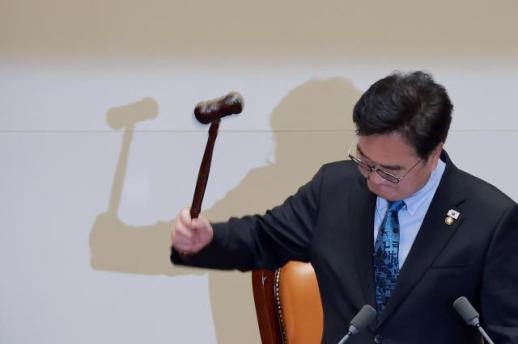 South Korea's first constitutional reform push in decades fails amid boycott SEOUL, May 08 (AJP) - South Korea's National Assembly came close this week to passing its first constitutional amendment in nearly four decades aimed at preventing presidential abuses of power such as martial law declarations, but the effort collapsed after a boycott by the opposition People Power Party. National Assembly Speaker Woo Won-shik withdrew plans to resubmit the amendment shortly after Thursday's plenary session opened after the People Power Party warned it would launch a filibuster if the proposal returned to the floor. The move effectively ended efforts by the ruling Democratic Party of Korea and five smaller parties to hold a national referendum alongside the June 3 local elections. The amendment, narrower than many past reform proposals, focused primarily on democratic safeguards rather than broader changes to presidential power or the electoral system. Its key provisions included stronger National Assembly control over emergency martial law, elevating parliament's authority to terminate martial law, adding the spirit of the 1979 Bu-Ma Democratic Protests and the 1980 May 18 Gwangju Democratic Movement to the Constitution's preamble, and making balanced regional development an explicit constitutional obligation. The Bu-Ma protests in Busan and Masan against the Yushin dictatorship of President Park Chung-hee are widely seen as a prelude to the collapse of authoritarian rule. The May 18 Gwangju Democratic Movement, violently suppressed by military forces after the expansion of martial law in 1980, later became a defining symbol of South Korea's democratization. The bill was introduced on April 3 with backing from 187 lawmakers from the Democratic Party of Korea, Rebuilding Korea Party, Progressive Party, Reform Party, Basic Income Party, Social Democratic Party and six independents. But constitutional amendments require approval from at least two-thirds of the 300-member National Assembly before proceeding to a referendum. The proposal failed to secure a valid vote the previous day after lawmakers from the People Power Party boycotted proceedings, leaving the chamber without quorum. Because the vote was deemed invalid rather than defeated, the ruling bloc argued the bill could legally return for another attempt. But the plan unraveled after the People Power Party made clear it would block any renewed vote through an unlimited debate, or filibuster — an unprecedented move against a constitutional amendment bill. The boycott also made the numbers impossible, as at least 12 party lawmakers would have needed to participate and support the measure for it to clear the constitutional threshold. The most urgent part of the amendment concerned martial law powers. Supporters argued that requiring parliamentary approval for emergency martial law, or otherwise strengthening legislative oversight at the outset, would reduce the risk of abuse before democratic order could be threatened. The proposal also sought to strengthen parliament's authority after martial law is imposed. Under the current Constitution, the president must lift martial law when the National Assembly demands it by majority vote. The revision would have transformed that into a more direct constitutional power for the legislature to terminate emergency rule. Legal scholars, however, warned that stricter controls could weaken the government’s ability to respond during wartime or national emergencies. Seung Lee-Do, a former rapporteur judge at the Constitutional Court and now a professor at Konkuk University Law School, said he agreed with the purpose of preventing abuse of martial law powers, but warned that prior parliamentary approval could delay urgent responses. "While I agree with the purpose of preventing the possible abuse of martial law authority, martial law is a system designed to respond urgently to emergency situations such as war or similar national crises," Seung said. "If prior approval by the National Assembly is required, there is a risk that the government may be unable to respond in time to a national emergency." The ruling Democratic Party of Korea criticized the People Power Party for refusing to participate, arguing the amendment could prevent future illegal martial law declarations and reduce administrative costs. Rep. Park Kyun-taek said, "This is a highly meaningful constitutional amendment in symbolic, practical, and regional-development terms. If the amendment is put to a vote during the local elections, there would be no need to designate an additional public holiday, nor would there be separate election costs. I am deeply disappointed in the People Power Party for rejecting the amendment." Responding to criticism that the amendment could politically hurt the opposition in the June 3 elections, Park said, "I find it difficult to understand why a party that was brought down by illegal emergency martial law would consider it electorally disadvantageous to take part in an amendment designed to prevent that from happening again." He added that if the Constitution were revised to require National Assembly approval for martial law declarations, "illegal emergency martial law will not be able to happen in the future," adding that the amendment "will be highly practical and will be able to prevent abuse of executive power in the form of illegal emergency martial law." PPP criticized the amendment as being pushed through hastily and unilaterally. Party lawmakers said constitutional reform should proceed through broader bipartisan and public deliberation. Rep. Yoon Sang-hyun emphasized, "The People Power Party is not opposed to constitutional amendment itself." He argued that public consensus should come first and warned that the ruling party's approach — "pushing it through unilaterally, tied to the election schedule, while excluding the main opposition party as it is doing now" — risked prioritizing politics over national unity. He added, "The Constitution should be a document of national unity, not a political document for the winners." Cho Eung-cheon, the Reform Party's candidate for Gyeonggi governor, also stressed the need for bipartisan agreement, saying, "There can be no constitutional amendment without agreement," and adding, "A constitution is created through broad consensus, and forcing through an amendment by sheer numbers is not procedurally right." 2026-05-08 17:29:58
 -
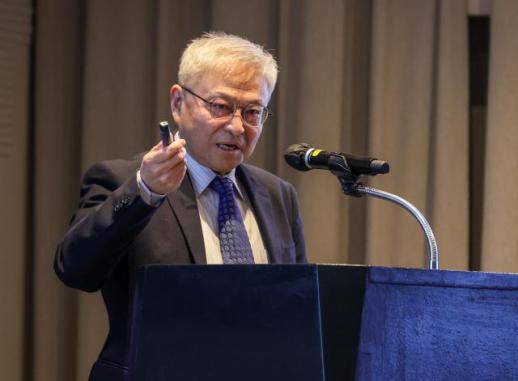 Trump-Xi summit likely sideline Iran and security issues: Yan Xuetong SEOUL, May 06 (AJP) - Iran will likely dominate the backdrop of next week’s summit between U.S. President Donald Trump and Chinese President Xi Jinping, but the two leaders are unlikely to produce any coordinated strategy on the Strait of Hormuz crisis as the world drifts deeper into a fragmented “G0 order,” according to prominent Chinese international relations scholar Yan Xuetong. Yan, speaking Wednesday at a seminar titled “Changes and Prospects in U.S.-China Relations” hosted by the Gyeonggi Research Institute in Seongnam, argued that Trump and Xi are more likely to focus on trade and economic tensions than on resolving security flashpoints in the Middle East. “As the Trump administration abandons global leadership, the world is entering a G0 order in which no country is willing or able to exercise clear global leadership,” Yan said. The scholar said the center of global rivalry has fundamentally shifted away from ideology and territorial disputes toward technology, data and artificial intelligence. Rather than a revival of the Cold War, he described current U.S.-China tensions as a strategic competition over semiconductors, AI infrastructure, cloud computing and digital ecosystems. “Cyberspace is becoming more important than natural space in both economic and security terms,” Yan said, pointing to the war in Ukraine as evidence that digital infrastructure and technological superiority can outweigh traditional geopolitical advantages. He said the escalating Hormuz crisis reflects how military power, energy security, satellite navigation systems and digital targeting technologies have become increasingly intertwined. According to Yan, many of the technologies used by Iran in recent military operations are linked more closely to Chinese systems than to U.S. infrastructure. Yan argued that AI is rapidly becoming a core strategic asset tied to economic productivity, industrial policy, military operations and national security. Both Washington and Beijing, he said, are increasingly moving toward self-contained technology ecosystems and domestic data governance structures, deepening fragmentation across global supply chains. He identified electricity, rare earth minerals and skilled engineers as the three critical foundations for AI competitiveness. Europe, he said, has struggled to keep pace partly because of insufficient power generation capacity, while the United States is already facing rising electricity demand and localized supply pressures linked to AI data centers. China, by contrast, is preparing 33 nuclear power plants to support future AI-driven electricity demand. For South Korea, Yan warned that the geopolitical balancing act will become increasingly difficult. While Seoul’s security structure remains anchored to the United States, its economy remains deeply intertwined with China. As semiconductors, batteries, AI and strategic technologies become more politicized, he said, South Korea will face growing pressure to make choices that blur the traditional divide between security and economics. Yan also suggested that Trump’s “America First” approach could accelerate strategic uncertainty across East Asia if U.S. allies begin questioning Washington’s long-term reliability. At the same time, he argued that the region is unlikely to split cleanly into rival blocs, as many countries continue pursuing a hedging strategy that combines U.S. security ties, Chinese economic links and flexible diplomacy. Taiwan is expected to remain another sensitive issue at the summit. Yan said both Washington and Beijing understand that destabilization across the Taiwan Strait or the broader Indo-Pacific would sharply raise risks for both sides, even as tensions continue to rise following recent U.S. arms sales to Taiwan. Yan concluded that the coming decade will likely be defined by uncertainty, fragmented markets and increasingly politicized technology systems. Supply chains, technology standards and cross-border data flows, he said, will be shaped less by economic efficiency and more by national security calculations. He also warned that while AI will intensify competition between the United States and China, it will simultaneously create shared global risks involving unemployment, overproduction, trade disputes, military misuse of AI and the absence of internationally coordinated governance standards. 2026-05-06 18:05:32
 -
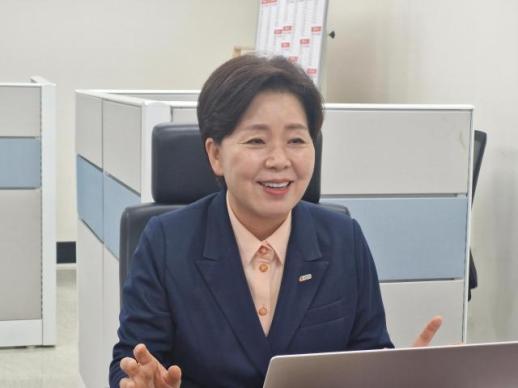 INTERVIEW: Chip czar rides AI chip boom to challenge political Goliath for Gyeonggi governorship SEOUL, May 05 (AJP) - Bidding for the gubernatorial post that birthed the current president — whose approval rating is nearing 60 percent — while facing a ruling-party heavyweight known for colliding head-on with disgraced former president Yoon Suk Yeol would not be an easy race for most politicians. But for Yang Hyang-ja, the determination appears rooted in something deeper than party politics: an almost singular devotion to semiconductors, the industry responsible for roughly a quarter of South Korea’s exports and much of the country’s AI-driven market boom. That commitment to chips also shaped her political realignment. Yang was effectively disowned by the Democratic Party of Korea following a sexual harassment scandal involving her aide, a political rupture that deepened her frustration over what she viewed as the party’s reluctance to aggressively back the semiconductor industry through measures similar to the U.S. CHIPS Act. She later joined the conservative bloc and spearheaded the so-called “K-Chips Act,” aimed at expanding tax credits for facility investments in semiconductors and other national strategic industries. The bill passed the National Assembly in March 2023. “People in semiconductors prepare a future that arrives first,” Yang said in an interview with AJP. “We make things that do not exist in the world. We make possible what others say is impossible.” That obsession has become both her greatest political strength and a potential limitation. Yang, the People Power Party candidate for Gyeonggi governor, built her reputation not through elite legal or activist circles but inside the clean rooms and research culture of Samsung Electronics. Rising from a teenage research assistant who cleaned desks and copied technical papers to become Samsung’s first female executive from a commercial high school background, her life story carries an unusual degree of industrial credibility in South Korean politics. “Gyeonggi Province is the heart of South Korea’s semiconductor industry,” Yang said. “The person who understands semiconductors should be the one to lead Gyeonggi.” Her rise inside Samsung has long bordered on corporate legend. After repeatedly being rejected from Samsung’s internal semiconductor engineering college because there was “no precedent” for a female commercial high school graduate entering the program, Yang reportedly challenged the company’s own rules and insisted she would become the precedent herself. “I have created roads where none existed,” Yang said. “There is no such thing as no road. There is only no will.” The phrase captures the core of Yang’s political identity: relentless self-construction through technical mastery and persistence. Her early years inside Samsung reflected the rigid hierarchies of industrial Korea at the time. She recalled being treated as a replaceable assistant whose role was limited to copying documents and running errands. “At that time, I was like a stone mixed into rice,” Yang said. “I could not even dream of a future. I felt a sense of inferiority.” The turning point came while copying Japanese semiconductor papers. Having studied Japanese at Gwangju Girls’ Commercial High School, Yang began annotating technical documents for engineers who could not read them. The researchers who had once called her “Miss Yang” began addressing her respectfully as “Yang Hyang-ja ssi.” “That was the moment I found my name,” she said. “I learned what it means to be recognized.” Yang later graduated with honors from Samsung’s semiconductor engineering program, accumulated dozens of semiconductor-related patents and climbed through SRAM, DRAM and flash memory divisions over three decades. When Samsung promoted her to executive director in 2013, Yang said the announcement coincided with the anniversary of her father’s death. “It felt as if every condensed part of my life burst open like popcorn,” she said. “I felt that the world’s standard for looking at me had changed.” That persistence — combined with firsthand experience in one of the world’s most strategically important industries — gives Yang a profile rare among South Korean politicians. She speaks less like a conventional campaigner than like a semiconductor executive explaining long-cycle investment logic. That industrial mindset is central to her pitch for Gyeonggi Province, home to the country’s largest semiconductor clusters including Samsung Electronics and SK hynix. Yang argues that the province should be governed not merely as an administrative region but as the command center of South Korea’s next industrial leap. Her strengths are obvious. Few politicians possess comparable understanding of semiconductors, AI infrastructure and manufacturing ecosystems at a time when technological supremacy increasingly overlaps with national security. Her life story also resonates in a country where younger generations often feel trapped by rigid educational and class hierarchies. Yet the same qualities that make Yang distinctive also raise questions about the breadth of her political vision. Nearly every major policy proposal in her campaign eventually returns to semiconductors. Her blueprint for economic growth, AI competitiveness, foreign investment and geopolitical leverage places chips at the center. “Taiwan can stand freely amid U.S.-China rivalry because TSMC influences the whole world,” Yang said. “South Korea has become a hegemonic power in memory semiconductors through Samsung Electronics and SK hynix.” That focus reflects economic reality. But critics may question whether Gyeonggi — a province of more than 14 million residents grappling with housing shortages, transportation congestion, welfare demands and regional inequality — can be governed primarily through the prism of semiconductor expansion. There is also the issue of Samsung’s overwhelming presence in her political identity. Although Yang references broader industrial ecosystems and repeatedly mentions SK hynix, Samsung remains the emotional and symbolic anchor of her worldview. Her personal narrative, political language and conception of national competitiveness are deeply intertwined with the company that shaped her life. Supporters see proof of execution and industrial realism. Critics may see over-identification with chaebol-centered growth at a moment when South Korea is debating economic concentration and overdependence on a handful of conglomerates. Yang rejects the idea that ideology or party affiliation should define provincial governance. “The central value of moderates is the courage to set aside faction, party and ideology for the country and the people,” Yang said. “Gyeonggi has collective intelligence. I trust that collective intelligence.” Her political path itself has been unusually fluid. Recruited into politics by former president Moon Jae-in, later estranged from the Democratic Party, founder of a third party and now standard-bearer for conservatives, Yang has repeatedly crossed ideological boundaries while insisting she belongs above factional politics. Still, Yang’s candidacy reflects a broader shift underway in Korean politics itself. As AI, semiconductors and supply-chain rivalry increasingly define economic survival and geopolitical power, industrial technocrats are beginning to acquire political weight once reserved for prosecutors, activists and career lawmakers. Few embody that transformation more sharply than Yang Hyang-ja. 2026-05-05 10:47:54
 -
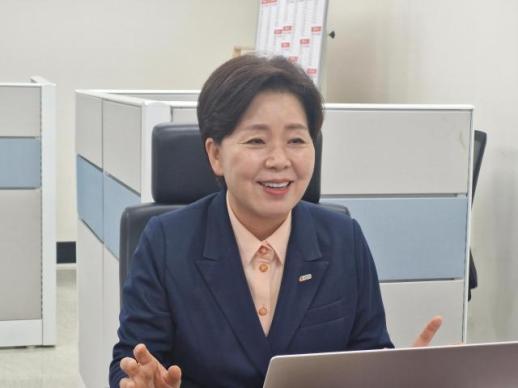 PPP’s Yang Hyang-ja Pledges Semiconductor-Led Growth in Gyeonggi Governor’s Race “Samsung Electronics’ market capitalization is expected to grow fivefold from last year, so why do you think a 100 million won era in per-capita GRDP for Gyeonggi is impossible?” People Power Party candidate Yang Hyang-ja, laying out her vision for Gyeonggi Province, put semiconductors ahead of politics. “In the end, it’s about who can do it,” she said, arguing that industrial competitiveness drives regional and national strength. In the Gyeonggi governor’s race, Yang has described herself less as a “politician” than as an “industry expert.” She also framed her matchup with Democratic Party candidate Choo Mi-ae not as a contest between female politicians, but as “a showdown between an advanced-industry expert and a legal professional.” Yang, a former semiconductor engineer who joined Samsung Electronics as a research assistant and rose to executive director, served as a 21st National Assembly lawmaker. She is currently a People Power Party supreme council member and chair of the party’s special committee on advanced industries, including semiconductors and artificial intelligence. In an interview with Ajou Economy, Yang pledged to raise Gyeonggi’s per-capita gross regional domestic product, now about 46 million won, to 100 million won. She said about 80% of the province’s GRDP is generated in the south and vowed to promote industries tailored to the characteristics of each of its 31 cities and counties to achieve more balanced north-south development. Yang called Gyeonggi the heart of South Korea’s advanced industries. “Even amid U.S.-China rivalry, Taiwan prospers because a global semiconductor company called TSMC shapes the world’s industrial order,” she said. “Gyeonggi’s memory semiconductors serve as the heart that can make South Korea a leading power.” Yang said her mission is to build “a science-and-technology powerhouse” and “a prosperous, strong nation that leads the world,” adding that such a goal “can ultimately be achieved through semiconductors.” She said the province needs a governor with expertise and a vision for advanced industries and that the election would prove that point. She repeatedly stressed that Gyeonggi is the core base of the country’s semiconductor industry. “Eighty-four-point-six percent of the value added and 76% of sales in our semiconductor industry come from Gyeonggi,” she said, arguing that an advanced-industry expert should lead the province. Targeting her rival, Yang said Choo, “a legal technician,” knows “nothing at all” about advanced industries. “Gyeonggi needs an industry expert, not a legal technician,” she said. On the issue of relocating the Suwon military airfield, Yang said it should be approached at the national level. Yang said she has experience handling and resolving the Gwangju military airfield issue first. Because military airfields are national infrastructure managed by the Defense Ministry, she said, the central government should take responsibility for relocation decisions. She said a governor’s role is to mediate and resolve conflicts among cities and counties, adding that she is best suited to do that. She said it would be difficult for Choo, whom she called a “conflict maker.” Yang said that because South Korea remains in an armistice situation, officials should first consider where a military airfield should be located to protect security most efficiently. “The situation is complex, but the essence is simple,” she said. “All issues must be approached from the essence.” Yang also emphasized the role of local government as a check on what she called the ruling party and government’s “runaway” power. “Candidate Choo will move relying only on the president’s power, and that is extremely dangerous,” Yang said. She added that her work as head of the National Human Resources Development Institute gave her a deep understanding of the civil service and government systems. “Trust and choose Yang Hyang-ja, who understands industry and administration,” she said, adding, “Collective intelligence is alive in Gyeonggi. I will move forward trusting only the collective intelligence of the residents.” 2026-05-05 09:24:05