
Journalist

AJP
davekim0807@ajupress.com
-
 The birth of humanoid robots (4): A Christmas Carol for steel and silicon Editor's Note: This is the fourth and final installment in AJP's series on humanoid robotics, examining the anatomy, technologies and economic logic behind one of the most hyped industries of the decade. SEOUL, February 27 (AJP) - A line of humanoid robots flips in unison. They lunge, pivot, brandish swords beside children in a synchronized kung fu routine. In the next sequence, they stagger theatrically, swaying through a stylized "drunken boxing" set — collapsing backward only to rebound with uncanny balance. The spectacle, staged by China's Unitree Robotics at the Spring Festival Gala, ricocheted across the globe. For many viewers it was entertainment. For roboticists elsewhere, it was a reckoning. In South Korea, some scientists watched with admiration; others, with a familiar pang. Decades of painstaking work still sit largely confined to laboratories — brilliant machines, but rarely public performers. In a lab at Hanyang University, a different drama unfolds. A humanoid named Alice 4 stands tethered to a rear frame — a metal Pinocchio awaiting animation. With a light tap on a keyboard, the machine jolts to life. It runs in place, almost straining against its restraints, optical sensors fixed straight ahead — on its creator. Han Jae-kwon, professor of robotics at Hanyang University and chief technology officer of Aei Robot, watches without theatrical flourish. "It's not about the kung fu or the backflips," he said. "The essence of a humanoid robot is what it does for work. Replace dangerous, undesirable labor. Help address the population cliff." That, he insists, is the measure that matters. The long arc of Korean humanoids South Korea's humanoid lineage stretches back more than two decades, to an era when bipedal machines were symbols of national ambition. At the Korea Institute of Science and Technology (KIST), a towering metallic figure still hangs in the institute's history hall. Known as "Centaur," it never truly walked upright. Its lower half resembled a mechanical horse — four legs instead of two. Korea's first humanoid was, in effect, a compromise between aspiration and stability. "Centaur was a small project we undertook to understand intelligent machines. Not long after Japan's Honda showcased ASIMO, we were asked to build ubiquitous robot companions capable of performing multiple tasks," recalled You Bum-jae, principal research scientist and former head of humanoid development at KIST. Japan's unveiling of ASIMO had electrified the region. In response, two Korean institutions embarked on parallel paths. At the Korea Advanced Institute of Science and Technology (KAIST), Professor Oh Jun-ho and his team introduced HUBO in late 2004 — a full-scale biped capable of walking, grasping and limited speech. "HUBO is the beginning of that history, we believe," Han said. "There was a sense of national pride — we could do what only Japan had done." In early 2005, KIST followed with MAHRU, billed as the world's first network-based humanoid. Standing 150 centimeters tall, MAHRU was designed for domestic assistance — a precursor to what today might be called "physical AI." "MAHRU was a network-based humanoid, capable of understanding vocal commands. It could walk to a microwave, open it, pick up a piece of toast, place it in the toaster, take it out and deliver it to its master," said Yoo, gently patting the robot's original plastic head. "We didn't have advanced AI back then — only recognition skills and programs to support it. But that's essentially how all humanoids aim to function even today: a body running light, a powerful computer supporting it through a network, now equipped with AI." Yet progress proved incompatible with political cycles. As Yoo noted, humanoid development was "not capable of significant results within two-year government projects." By the 2010s, funding for large-scale bipedal programs was pared back. Then disaster intervened. The Fukushima nuclear accident in 2011 prompted the U.S. Defense Advanced Research Projects Agency to launch the DARPA Robotics Challenge in 2012. The competition was designed to push robots into hazardous environments no human should enter. By the finals in June 2015, 24 teams had qualified. Three were Korean — each fielding its own platform rather than relying on Boston Dynamics' Atlas. Team KAIST, led by Professor Oh, won in 44 minutes and 28 seconds. Han's team from Robotis and a team from Seoul National University also competed — both using robots Han had helped design. For a brief moment, Korea stood at the apex of disaster-response robotics. But the aftermath told a more complicated story. In the United States, many participants flowed into emerging ventures such as Figure AI or Tesla's Optimus program. In Korea, talent dispersed. Rainbow Robotics, spun off from Team KAIST, pivoted to collaborative industrial arms and was later acquired by Samsung Electronics. Robotis listed publicly and diversified. "The people who competed back then — it's such a waste," Han said. "Many went to the U.S., others became professors but stopped working on humanoids. If all of them had stayed, the situation would be very different today." Research continued, though largely out of public view. A five-year project funded by the Ministry of Trade, Industry and Energy sustained further development at KAIST, including hydraulically actuated humanoids capable of dynamic motion. "But if the media doesn't cover much of it, the public simply doesn't notice," said Park Hae-won, who now leads KAIST's humanoid lab. The motor that changed the race Ironically, the decisive shift did not originate in humanoids at all. At the Massachusetts Institute of Technology, Professor Kim Sang-bae's MIT Cheetah project advanced quasi-direct drive (QDD) motor technology — compact, high-torque electric actuators that allowed quadruped robots to run with unprecedented speed and efficiency. Crucially, the designs were open-sourced. Hydraulics, long dominant in high-performance robots, were heavy and maintenance-intensive. Electric QDD systems offered lighter frames and lower costs — prerequisites for commercialization. Korean researchers argue that China moved quickly to absorb this architecture and adapt it to bipedal platforms. "China absorbed the QDD technology very quickly, establishing firm baseline requirements for humanoid development. That includes critical reinforcement learning for robots as well — we now believe the government distributes it to Chinese robotics firms," said Yoo. "That's how so many Chinese humanoids can run from the start, while ours begin with baby steps. We can't share reinforcement learning in Korea — institutions and private firms alike refuse to give up hard-earned data." The divergence, in this telling, is less about talent than about scale and coordination. AI as accelerant The recent resurgence of humanoid ambition in Korea owes much to artificial intelligence. When OpenAI signaled investment interest in Figure AI, the message was clear: large language models might finally supply the cognitive layer humanoids had long lacked. "Bipedal robots could perform tasks, but they required heavy engineering and years of coding. Imagine AI guiding them — robots understanding whatever their operators say and handling tasks without tedious step-by-step instructions. It was sensational," Yoo said. At KAIST, Park's team is assembling a fully domestically developed humanoid under MOTIE funding, targeting full integration by April 2026. At KIST, a joint effort with LG Electronics is producing KAPEX, described as Korea's first AI humanoid platform, with more than 70 degrees of freedom and predominantly domestic actuators. Yet laboratory elegance is not factory reliability. "What you see at trade shows is the most refined version," Park said. "If a robot falls over at the exhibition, imagine how many times it crashed in the lab." The initial commercial target, Park suggests, is not spectacle but small and medium-sized factories — cramped, uneven spaces where wheeled automation struggles. "If you visit Korean SME factories, the floors are uneven, spaces are narrow — wheels can't even get through," he said. "Humanoids could help there, if they can handle tasks without disrupting existing workflows." Han is candid about Korea's relative position. "This year's Chinese Spring Festival Gala — robots were doing gymnastics, flipping like athletes," he said. "Our spirits sink. But the essence of a humanoid is not dancing or kung fu. The real question is: what are you going to do with it?" He argues that Korea's strength lies in manufacturing depth — batteries, semiconductors, precision motors and bearings — the physical half of "physical AI." Equally important is data. "Which country has industrial complexes in every neighborhood?" Han said. "That's all data. If we digitize it quickly and feed it to our robots, ours will outperform the competition." China's scale and cost advantages loom large. The United States is reviewing robotics imports under a Section 232 national security investigation. Korea is unlikely to erect similar barriers. "The only option is to make them cheaper than China," Han said. More pressing than tariffs, however, is demonstration. Korea spends substantially on humanoid research, Han noted, but allocates only a fraction of that to large-scale deployment trials. "What's needed now is getting existing robots into factories, gathering data and proving they work," he said. "That's demonstration projects — not more lab R&D." Yoo tempers expectations. "It's going to take at least five years for robots to be genuinely useful. They can only perform simple tasks like moving items, and even that carries a 10 percent margin of error. Humanoid-tailored AI has yet to arrive — the global race is now on," he said. "We should stop comparing robots against one another and instead draw on each one's unique characteristics to work as a team, talents putting heads together. Of course, that would require a new breed of engineers — ones who understand both software AI and hardware robotics. Attention, money, time — we need all of it." Korea's humanoid story — from HUBO and MAHRU to Alice and KAPEX — is neither triumphalist nor moribund. It is incremental, intermittently brilliant, frequently underfunded. Whether it can contend with American venture capital and Chinese industrial scale will define the next chapter. Han's closing line carries neither romance nor despair. "Try running in a factory," he said. "They'll tell you to stop." Robots, he implies, must earn their keep the same way humans do — not by acrobatics, but by utility. For steel and silicon, the future will not be written on a gala stage. It will be decided on the factory floor. 2026-02-27 14:57:15
 -
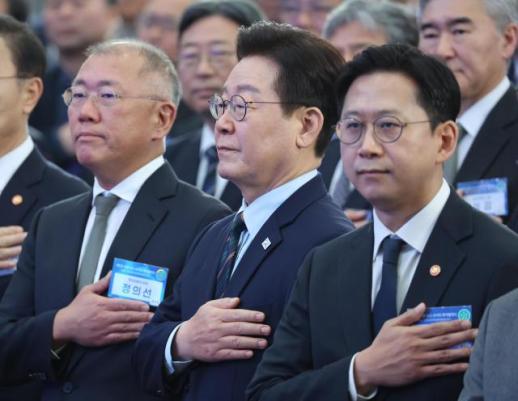 Hyundai Motor pledges $6.3 billion to build data center, robot factory in Saemangeum SEOUL, February 27 (AJP) - Hyundai Motor Group on Friday pledged around 9 trillion won ($6.28 billion) in the Saemangeum reclaimed coastal zone in North Jeolla Province, pledging to erect an AI data center, a robotics manufacturing cluster and hydrogen energy facilities on the country's western seaboard. The sprawling project under central and local government backing is set to break ground from 2027 across a 1.12 million-square-meter site in Gunsan, about 180 kilometers southwest of Seoul. The project is one of the largest private-sector commitments to the Saemangeum zone — a decades-long national land reclamation endeavor spanning 409 square kilometers. The bulk of the outlay — about 5.8 trillion won — will flow into an AI data center equipped with 50,000 graphics processing units, designed to crunch vast volumes of data for autonomous driving, software-defined vehicles and robotics development. A separate 400 billion won robotics manufacturing and parts cluster will house a factory capable of turning out 30,000 robot units per year, including wearable industrial robots and mobile platforms. Hyundai will also pour 1 trillion won into a 200-megawatt water electrolysis plant to produce green hydrogen, and channel 1.3 trillion won into gigawatt-scale solar power generation to feed the data center and hydrogen facilities. An additional 400 billion won is earmarked for a so-called "AI Hydrogen City" within the Saemangeum smart waterfront district. President Lee Jae Myung, who attended the signing ceremony alongside Hyundai Motor Group Chairman Chung Eui-sun, vowed sweeping government backing for the project. "The government will respond to the bold decisions made by businesses with even bolder support," Lee said. "We will dramatically lower regulatory and administrative barriers so that companies can fully unleash their capabilities and grow." Lee said Saemangeum would be reborn as a "city of the future" where robots become part of everyday life, predicting the hub would draw top talent from home and abroad and allow young people in the region to pursue their ambitions without migrating to the capital. Under the deal, South Korea's transport, industry, science and climate ministries will streamline permitting, furnish policy backing for robotics, AI and hydrogen industries, and bolster transportation infrastructure in the region. The AI data center and solar facilities are slated for completion by 2029, while the water electrolysis plant will begin phased operations from 2029 with capacity to expand. The robotics cluster is expected to wrap up construction in 2029 after breaking ground in 2028. The investment forms a centerpiece of Hyundai Motor Group's 125.2 trillion won domestic spending plan for 2026 through 2030, unveiled in November after Seoul finalized a trade agreement that trimmed U.S. tariffs on South Korean automobiles to 15 percent from 25 percent. 2026-02-27 14:32:11
 -
 Hanwha Aerospace diversifies into LNG trading with landmark Venture Global contract SEOUL, February 27 (AJP) - Hanwha Aerospace has secured a 20-year liquefied natural gas supply agreement with U.S. producer Venture Global, signaling a strategic expansion beyond its core defense and aerospace operations into global energy markets. Under the deal revealed Friday, Hanwha Aerospace will secure 1.5 million tons of LNG annually for 20 years starting in 2030, supplying the fuel to end users across Europe and Asia. The volume represents about 4.4 percent of South Korea's total annual LNG consumption, based on 2024 figures of about 34.12 million tons. The agreement is part of a broader push by the Hanwha Group to build an integrated LNG value chain, leveraging affiliates across the energy supply spectrum. Hanwha Ocean brings shipbuilding and floating LNG production capabilities, Hanwha Energy handles LNG power generation and operations, and Hanwha Shipping oversees maritime transport. Hanwha Aerospace said the move into LNG is designed to bolster its core defense and shipbuilding businesses as well as open new revenue streams. Geopolitical tensions have ushered energy supply chains to become increasingly intertwined with national security strategies, particularly in Europe, where governments are seeking to diversify away from Russian gas. The company plans to use its energy portfolio as leverage to deepen security partnerships with client nations and expand defense exports, while also driving LNG carrier orders for Hanwha Ocean. "Defense, shipbuilding and energy are closely linked as pillars of national security," a Hanwha Aerospace spokesperson said. "We will contribute to global security through eco-friendly energy solutions spanning production, distribution and utilization." Hanwha Aerospace has been steadily laying the groundwork for the venture, investing about 180 billion won ($125 million) in U.S. LNG firm NextDecade in 2024 and signing a memorandum of understanding with Hanwha Energy and Korea South-East Power in 2025 to expand global LNG supply networks. 2026-02-27 10:33:13
 -
 Korea's battery makers forge lithium alliance to counter China's grip SEOUL, February 26 (AJP) - POSCO Group and SK On have sealed a long-term lithium supply deal worth up to 25,000 tons through 2028, in the latest sign that South Korean battery players are locking arms to build a domestic supply chain capable of challenging China's stranglehold on the global battery market. Under the agreement announced Wednesday, POSCO Argentina will ship lithium extracted from the Salar del Hombre Muerto salt flat in Argentina's Salta province to SK On's electric vehicle battery projects in Europe and North America. The volume is enough to produce batteries for about 400,000 EVs, and SK On is also exploring the use of the material in energy storage systems. The deal marks POSCO's largest lithium supply contract since it launched commercial production in Argentina in 2024. POSCO Group Chairman Jang In-hwa recently outlined a vision to elevate battery materials, LNG, energy and recycling as the group's "Next Core" business pillars. For SK On, the contract bolsters a "de-China" lithium procurement strategy at a time when the raw material accounts for about 40 percent of cathode costs - the single most expensive component in a battery cell. The partnership arrives after a bruising 2025 for South Korea's battery sector. The combined value of terminated contracts in the final months of last year exceeded 17 trillion won ($11.9 billion). Ford Motor scrapped a 9.6 trillion won deal with LG Energy Solution in December, while SK On itself dissolved its BlueOval joint venture with Ford, splitting control of three gigafactories. The combined global EV battery usage of LG Energy Solution, SK On and Samsung SDI slid to about 15.4 percent during of 2025, down 3.3 percentage points year-on-year, according to SNE Research. China's CATL alone commanded 39.2 percent, while BYD held 16.4 percent - meaning a single Chinese automaker-battery maker now outsells all three Korean producers combined. A government-backed study released Tuesday by the Korea Institute for Industrial Economics and Trade reinforced the urgency. The report found that South Korea has fallen behind China across most next-generation industries, including batteries, where Chinese firms have achieved localization rates exceeding 90 percent across raw materials, components and equipment. "Competition between Korea and China has now shifted from simple catch-up to structural rivalry," said Cho Eun-kyo, head of KIET's China analysis team. "China has built integrated industrial systems that Korea is struggling to match." The POSCO-SK On lithium deal is part of a broader wave of domestic collaboration. In August last year, Hyundai Motor, Kia and all three Korean battery makers signed a memorandum of understanding to jointly develop EV battery safety technologies, including shared patents and fire prevention systems - the first time a Korean automaker and its domestic cell suppliers had pooled resources on safety. "The global EV battery market is a competition between countries, and the way we can survive it is cooperation - going beyond competition," LG Energy Solution CEO Kim Dong-myung said at the signing ceremony. Later in December, Samsung SDI struck a deal with automaker KGM to co-develop battery pack systems based on its 46-millimeter cylindrical cells. The partnership is notable because KGM had previously relied almost exclusively on BYD and other Chinese suppliers for its passenger EV batteries. On the commercial front, LG Energy Solution secured a cumulative $16 billion worth of battery contracts with Mercedes-Benz over 2024 and 2025, spanning more than 150 gigawatt-hours of next-generation cylindrical cells. Industry sources said the orders were clinched after intense competition with China's CATL and Farasis Energy. The government has also stepped forward, with Seoul moving to back the industry with both money and policy. In January 2025, the government unveiled a plan to channel at least 21 trillion won into eco-friendly vehicles and batteries, with 7.9 trillion won earmarked for the secondary battery sector - a 31.7 percent increase from the previous year. In November, it announced an additional 280 billion won over four years for next-generation battery technologies including all-solid-state and lithium-sulfur cells. How effective Korean battery solidarity can play to challenge China's dominance remains an open question. Chinese manufacturers control more than 90 percent of the global ESS market and have built end-to-end supply chains that Korean firms are still assembling piece by piece. But the flurry of domestic alliances signals a strategic recalibration that the industry's survival depends on collective, rather than solitary, strength. 2026-02-26 15:26:01
 -
 China's Unitree Robotics unveils new robot dog with enhanced speed and mobility SEOUL, February 25 (AJP) - Chinese robotics firm Unitree Robotics has unveiled the As2, a new quadruped robot with upgrades in speed, endurance and terrain-handling capability, as the company expands its lineup of compact size industrial capability robots. The Hangzhou-based company announced the As2 on its website on Tuesday, offering the robot dog in three variants — Air, Pro and Edu. Weighing about 18 kilograms with its battery, the machine's standout feature is its pace: the Air version reaches a top speed of 3.0 meters per second, while the Pro and Education models hit 3.7 m/s, climbing to 5 m/s under no-load conditions. The As2 also delivers notable endurance, covering around 20 kilometers on a single charge over four hours without a load. Even carrying about 15 kilograms of payload, it can operate for over two and a half hours and travel more than 13 kilometers with its maximum batter capacity of 15000mAh. Agility is another hallmark of the new model. The As2 can scale 25-centimeter stairs, traverse slopes of up to 40 degrees and mount vertical ledges as high as 50 centimeters, making it suited for rugged outdoor terrain as well as indoor staircases. Rated IP54 for dust and water resistance, the robot operates in temperatures ranging from minus 20 to 50 degrees Celsius, equipping it for harsh industrial and field environments. Unitree is one of China's leading robotics companies, producing both quadruped robots and humanoid machines. The firm gained global attention last year when its humanoid robots performed a synchronized dance alongside human performers during the Spring Festival Gala, China's most-watched television broadcast. Its humanoid robot H1 returned to the gala stage this year, showcasing a martial arts routine featuring complex maneuvers that underscored the company's rapid advances in robotic mobility and control. 2026-02-25 14:27:58
 -
 Except for chips, Korea now a laggard behind China in next-gen industries SEOUL, February 25 (AJP) - With the exception of semiconductors, South Korea has slipped into laggard status behind China across most next-generation industries, from robotics and electric vehicles to batteries and autonomous driving, a government-backed report warned Tuesday, underscoring a widening competitiveness gap that is no longer narrowing. A study released by the Korea Institute for Industrial Economics and Trade (KIET) found that China now holds comprehensive value-chain advantages over Korea in core advanced manufacturing sectors, with chipmaking emerging as the country's lone remaining area of relative strength. Based on expert surveys and focus group interviews conducted in September 2025, the report said competition between the two countries has moved beyond technological catch-up into a structural phase involving ecosystems, supply chains and global markets. "Competition between Korea and China has now shifted from simple catch-up to structural rivalry," said Cho Eun-kyo, head of KIET's China analysis team. "China has built integrated industrial systems that Korea is struggling to match." China's rapid ascent in future industries has redrawn the regional landscape, leaving Korean manufacturers increasingly on the defensive in sectors they once viewed as core growth engines. Robotics: China almost a monopoly in humanoid market The gap is most pronounced in robotics. Chinese firms accounted for about 87 percent of the roughly 13,000 humanoid robots shipped worldwide in 2025, according to Omdia. Shanghai-based AgiBot captured about 39 percent of global shipments, followed by Unitree Robotics with 32 percent. Korea, by contrast, remains largely confined to industrial robots used in factories. KIET said that while Korea retains limited strengths in research and development for manufacturing robots, China leads in mass production, procurement and overseas market expansion. In humanoid and personal service robots, China holds advantages in technology, pricing and infrastructure. "Yes, to be candid, South Korea does lag behind in the humanoid race," said Han Jeak-weon, a professor of robotics at Hanyang University. "But Korea still has long-term potential if it can translate manufacturing know-how into new platforms." Batteries: scale and localization favor China The battery sector presents a similar picture. According to SNE Research, six major Chinese companies controlled about 69 percent of global electric-vehicle battery installations in the first 10 months of 2025. CATL and BYD together accounted for roughly 55 percent of the total. By contrast, Korea's three leading battery makers — LG Energy Solution, SK On and Samsung SDI — saw their combined market share fall to about 15.7 percent, down 3.5 percentage points from a year earlier. KIET noted that China's lithium battery industry has achieved localization rates exceeding 90 percent across raw materials, components and equipment. South Korea, meanwhile, continues to rely heavily on imports for key materials such as cathodes, anodes and electrolytes, leaving it vulnerable to supply disruptions and cost pressures. EVs and autonomous driving In electric vehicles, China has surpassed even its own industrial targets. Under the "Made in China 2025" strategy, new energy vehicles were meant to account for 20 percent of total auto sales by 2025. The actual figure reached 45.3 percent in 2024. Korea's EV penetration stood at about 13 percent in 2025, crossing into double digits for the first time but remaining far behind China. The gap is widest in autonomous driving. KIET said China leads across every segment of the value chain, supported by massive road-testing data, advanced artificial intelligence capabilities and extensive government-backed infrastructure. In contrast, Korea's autonomous driving sector remains fragmented, with limited large-scale commercialization. Semiconductors: the lone bright spot Semiconductors remain South Korea's principal stronghold. Its dominance in memory chips continues to offset China's growing presence in non-memory areas such as AI processor design and system chips. Even here, however, KIET described the balance as "contested," warning that China's heavy investment and policy support are steadily narrowing the gap. "The semiconductor sector is no longer a guaranteed safe zone," the report said. KIET urged policymakers and corporate leaders to fundamentally reassess Korea's industrial strategy toward China. Rather than focusing solely on narrowing technology gaps, the institute recommended what it called "competitive cooperation" — leveraging China's massive industrial ecosystem as a testing ground for next-generation technologies, while protecting Korea's niche strengths in premium markets in the United States and Europe. China should no longer be viewed simply as a low-cost production base or a rival to be outrun, the report said, but as a strategic learning environment. Without structural reforms, sustained investment and clearer industrial priorities, the country risks becoming increasingly dependent on semiconductors as its last remaining pillar in the global technology race, it concluded. 2026-02-25 14:11:33
 -
 Seoul opts for antidumping duties on Chinese, Japanese steel for industry relief SEOUL, February 24 (AJP) - South Korea's shipbuilders enjoy heyday on robust orders and backlog, but they had limited trickle-down effect on steelmakers at home as they struggled with the flood of cheaper Chinese and Japanese imports. The government stepped in for relief as the industry undergoes stringent cost-saving streamlining to survive a global glut, a protectionist environment and the U.S. 50-percent tariff on steel imports. On Monday, it warned of antidumping duties of up to 33.43 percent on steel imports after a yearlong investigation. The Korea Trade Commission (KTC), which operates under the Ministry of Trade, Industry and Energy, recommended a set of penalty duties to the Minister of Economy and Finance for final approval. The tariffs, ranging from 28.16 percent to 33.43 percent depending on the exporter, will replace provisional duties that have been in force since September 2025. It will hear counterclaims from nine exporters — three Japanese and six Chinese firms — that together accounted for about 81 percent of South Korea's total hot-rolled steel imports over the past three years. Focus on hot-rolled coils The judgment centers on hot-rolled coils (HRC), the foundational building block of the modern steel supply chain. Produced by rolling heated steel slabs at temperatures exceeding 1,000 degrees Celsius, HRC serves as the primary feedstock for downstream products including cold-rolled sheets, galvanized steel, steel pipes and color-coated plates. South Korea's domestic HRC market alone is valued at about 10 trillion won ($6.92 billion) annually. Because HRC is a commodity-grade material with minimal technical differentiation, pricing is the dominant factor in purchasing decisions, making it especially vulnerable to low-cost import competition. Sector downturn deepens The antidumping action comes as South Korea's broader steel sector grapples with its worst downturn in years. Domestic reinforcement bar (rebar) consumption plunged to a 25-year low in 2025, dragged down by a prolonged slump in the construction industry, according to the Korea Iron & Steel Association. Rebar usage shrank 14.4 percent year on year to 6.66 million tons, the lowest since the association began tracking the data in 2000. Local steelmakers, strained by Chinese oversupply, slowing domestic demand and U.S. tariffs, have resorted to restructuring to survive. Hyundai Steel has decided to permanently shut down one production line at its Incheon rebar plant, while Dongkuk Steel halted production at its own Incheon facility due to similar overproduction issues. Earnings under pressure End-year results show that the financial toll has been stark. Dongkuk Steel's full-year 2025 operating profit tumbled 42.1 percent to 59.4 billion won on revenue of 3.2 trillion won. POSCO Holdings saw consolidated operating profit drop 16 percent to 1.83 trillion won as revenue slipped 5 percent to 69.1 trillion won. Hyundai Steel, which filed the original antidumping petition in December 2024, posted 2025 revenue of 22.7 trillion won, down 2.1 percent, though its operating profit rose 37.4 percent to 219.2 billion won, buoyed by lower raw material costs. However, the company posted an earnings shock in the fourth quarter, with revenue of 5.5 trillion won and operating profit of 43.3 billion won, plunging 53.6 percent from the previous quarter and sharply missing market expectations. Price gap narrows The root of the trade remedy lies in a widening price gap. Japanese and Chinese HRC was sold in the Korean market at an average of about 708,000 won per ton in July 2025, roughly 12.8 percent cheaper than comparable domestic products priced at 812,000 won. After stripping out tariffs and logistics costs, exporters' home-market prices were estimated to be 15 to 20 percent below Korean mills' prices. Provisional duties took effect in September 2025, narrowing the price differential to about 5 percent and resulting in import decline. The government projected that domestic HRC shipments could rise by more than 1 million tons, lifting local producers' market share by about 8.9 percentage points. Some analysts say the latest U.S. tariff measures may have a more limited impact than feared. "The steel tariffs were already imposed during Trump's first term under Section 232 of the Trade Expansion Act, which allows the president to impose duties on national security grounds, so the impact is limited," said Park Sung-bong, an analyst at Hana Securities. "The Trump administration is reportedly reviewing a reduction in tariffs on derivative products containing steel and aluminum. If this materializes, exports of those products to the U.S. could recover, which is expected to have a partially positive effect on domestic steel demand." 2026-02-24 14:32:32
 -
 Celltrion unveils dual-track obesity drug strategy with quad-action injectable and oral pill SEOUL, February 24 (AJP) - Celltrion announced it is pursuing a two-pronged approach to the fast-growing obesity treatment market, developing both a first-in-class quadruple-action injectable and a multi-target oral drug designed to challenge dominant players in the space. The injectable candidate reported Tuesday, CT-G32, targets four biological pathways simultaneously, moving beyond the dual- and triple-action GLP-1-based therapies that currently dominate the market. Celltrion said the drug aims to minimize side effects such as muscle loss and efficacy variation among patients while enhancing appetite suppression and weight reduction. The company plans to file an investigational new drug application in the first half of 2027. The oral candidate, meanwhile, acts on multiple targets including GLP-1 receptors, distinguishing it from rival oral treatments that rely on a single mechanism. Celltrion said the pill is expected to broaden patient access by offering easier storage and administration compared to injectables, with an IND filing targeted for the second half of 2028. The push for obesity drug follows a worldwide demand for the market, soon to grow to $173.5 billion by 2031, according to GlobalData, as the worldwide adult overweight rate has surged past 40 percent from about 25 percent in the 1990s. The South Korean drugmaker said the two treatments are designed to complement each other across different stages of obesity care — the injectable for patients requiring aggressive early weight loss, and the oral drug for those seeking long-term maintenance or alternatives to injections. "We plan to enter the obesity drug market with differentiated competitiveness, building on our established dominance in autoimmune diseases and oncology," a Celltrion spokesperson said. "We will do our utmost to maximize corporate value and evolve into a global pharma giant." 2026-02-24 09:17:51
 -
 EastSoft's AI dubbing platform surpasses 460,000 users, with 90% from overseas SEOUL, February 23 (AJP) - South Korean software firm EastSoft said that its artificial intelligence dubbing and AI human video generation platform, Perso AI, has surpassed 460,000 registered users, with about 90 percent of sign-ups originating from markets in North America and Europe. The milestone announced Monday underscores Perso AI's rapid pivot toward a global user base. While Korean-to-English dubbing dominated early adoption, the platform has since seen a surge in multilingual demand, particularly for English-to-French and English-to-Spanish conversions. EastSoft said it has identified untapped potential in the Japanese and Spanish-speaking markets and plans to sharpen its international strategy accordingly. The company pointed to a series of technical upgrades as key drivers of its competitive edge, including prompt optimization tailored to Google's latest large language model Gemini, performance benchmarking against leading global audio engines, and the adoption of a content delivery network to bolster service stability. The company said it plans to continue refining the platform based on usage patterns from paying subscribers while lowering the entry barrier for new users through hands-on trial content. An EastSoft spokesperson said the platform's strength lies in its accessibility, noting that users can generate AI human video content as simply as building a presentation by entering prompts and making minor adjustments, while also creating digital characters with distinct identities as standalone intellectual properties. "With language demand expanding well beyond French and Spanish into a growing number of countries, we will strengthen our foothold in the global AI dubbing market through continued technological advancement and user experience optimization," the spokesperson said. 2026-02-23 12:05:11
 -
 Korean shipbuilders mull local and robotic options instead of foreign hires SEOUL, February 23 (AJP) - Two out of every 10 workers at shipyards across South Korea are foreigners, but major builders are increasingly looking to scale back overseas hiring by expanding domestic recruitment and accelerating automation, industry officials said. Leading the shift is HD Hyundai, the world's largest shipbuilder by order backlog, which plans to prioritize replacing departing foreign workers with Korean nationals as labor contracts expire. As of the end of 2025, HD Hyundai's shipbuilding units employed about 11,300 foreign workers, including subcontractors, accounting for roughly 19.8 percent of its 47,000-strong workforce. The industry's reliance on foreign labor has grown steadily in recent years. The number of overseas workers at Korean shipyards surged from 4,640 in 2021 to about 20,200 by the end of 2024, quadrupling in three years, as yards struggled to attract domestic workers to physically demanding jobs with relatively modest pay. However, a prolonged shipbuilding supercycle has strengthened the sector's finances, enabling companies to absorb the higher costs of local hiring and invest aggressively in artificial intelligence and robotics. The combined order backlog of Korea's three major builders stood at about $124 billion in late 2025, near record highs. Vessel exports reached $31.2 billion last year, up 22 percent, driven by demand for LNG carriers and large container ships, according to the Korea Chamber of Commerce and Industry. The boom has also been supported by geopolitical tailwinds. Seoul and Washington's "Make American Shipbuilding Great Again" initiative has opened new opportunities, with Korea pledging about $150 billion in shipbuilding-related investments to upgrade U.S. facilities. Domestic political pressure has added momentum. President Lee Jae Myung publicly questioned in January whether foreign workers were displacing Korean job seekers. Yet domestic hiring is only one pillar of a broader transformation. Korean builders are simultaneously pouring resources into AI, digital twins and robotics to offset rising labor costs and chronic shortages of skilled technicians. Earlier this month, HD Hyundai selected Siemens Xcelerator as the backbone of an integrated digital platform spanning its global shipyards under its "Future of Shipyard" program, targeting completion by 2030. "The selection of Siemens Xcelerator represents an important milestone in advancing HD Korea Shipbuilding & Offshore Engineering's digital shipbuilding strategy," said Lee Tae-jin, executive vice president at HD Hyundai. The group has also expanded its partnership with Palantir Technologies to deploy AI-driven analytics across its operations. Hanwha Ocean is investing about 160 billion won to turn its Geoje yard into a smart facility, targeting automation of up to 70 percent of production processes. The company is deploying drones and internet-of-things sensors to collect real-time data, while expanding the use of welding and fabrication robots. Hanwha is also applying its proprietary smart-yard technology to its Philadelphia shipyard in the United States as it seeks to expand in the North American maintenance, repair and overhaul market. Meanwhile, Samsung Heavy Industries has tested a wall-climbing quadruped robot developed by KAIST spinoff Diden Robotics for welding and inspection, with commercial deployment planned for the second half of 2026. The company has also partnered with Rainbow Robotics to co-develop AI-equipped welding robots and mobile dual-arm systems. Industry officials say the parallel push for domestic hiring and automation reflects a calculated strategy to maintain Korea's competitiveness against Chinese rivals, which now control about 63 percent of global new vessel orders. By pairing a more stable workforce with advanced digital tools, Korean shipbuilders are betting they can preserve their technological edge and long-term leadership in the global market. 2026-02-23 11:59:36