

The sprawling project under central and local government backing is set to break ground from 2027 across a 1.12 million-square-meter site in Gunsan, about 180 kilometers southwest of Seoul.
The project is one of the largest private-sector commitments to the Saemangeum zone — a decades-long national land reclamation endeavor spanning 409 square kilometers.
The bulk of the outlay — about 5.8 trillion won — will flow into an AI data center equipped with 50,000 graphics processing units, designed to crunch vast volumes of data for autonomous driving, software-defined vehicles and robotics development.
A separate 400 billion won robotics manufacturing and parts cluster will house a factory capable of turning out 30,000 robot units per year, including wearable industrial robots and mobile platforms.
Hyundai will also pour 1 trillion won into a 200-megawatt water electrolysis plant to produce green hydrogen, and channel 1.3 trillion won into gigawatt-scale solar power generation to feed the data center and hydrogen facilities.
An additional 400 billion won is earmarked for a so-called "AI Hydrogen City" within the Saemangeum smart waterfront district.
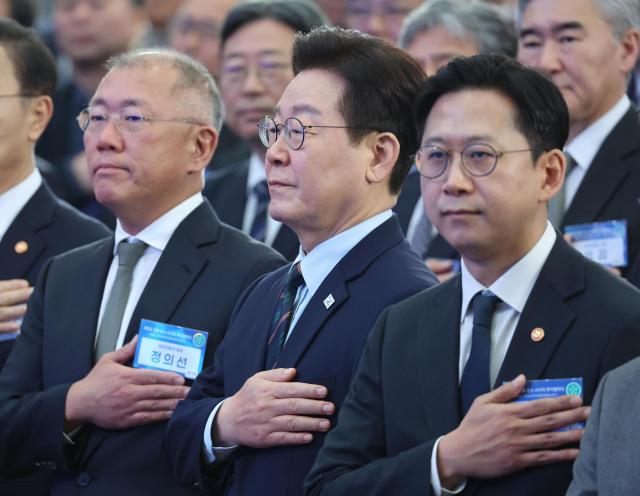
President Lee Jae Myung, who attended the signing ceremony alongside Hyundai Motor Group Chairman Chung Eui-sun, vowed sweeping government backing for the project.
"The government will respond to the bold decisions made by businesses with even bolder support," Lee said. "We will dramatically lower regulatory and administrative barriers so that companies can fully unleash their capabilities and grow."
Lee said Saemangeum would be reborn as a "city of the future" where robots become part of everyday life, predicting the hub would draw top talent from home and abroad and allow young people in the region to pursue their ambitions without migrating to the capital.
Under the deal, South Korea's transport, industry, science and climate ministries will streamline permitting, furnish policy backing for robotics, AI and hydrogen industries, and bolster transportation infrastructure in the region.
The AI data center and solar facilities are slated for completion by 2029, while the water electrolysis plant will begin phased operations from 2029 with capacity to expand. The robotics cluster is expected to wrap up construction in 2029 after breaking ground in 2028.
The investment forms a centerpiece of Hyundai Motor Group's 125.2 trillion won domestic spending plan for 2026 through 2030, unveiled in November after Seoul finalized a trade agreement that trimmed U.S. tariffs on South Korean automobiles to 15 percent from 25 percent.
Copyright ⓒ Aju Press All rights reserved.
