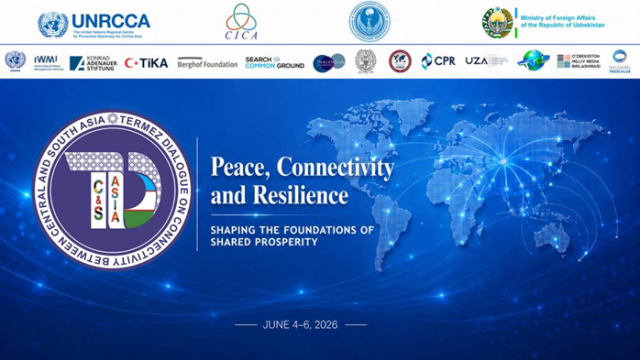
SEOUL, June 01 (AJP) - Uzbekistan is establishing the Termez Dialogue as a permanent interregional forum to anchor its expanding economic integration with South Asian consumer markets. The institutionalization marks a structural shift in Eurasian supply chains, transforming neighboring Afghanistan from a source of geopolitical instability into a primary commercial transit bridge.
The policy evolution moves the region away from isolated cross-border trade toward a comprehensive model of economic interdependence. This integration is backed by a rapid surge in bilateral commerce, infrastructure development, and targeted regulatory easing along the southern border.
Overall trade turnover between Uzbekistan and South Asian nations expanded 3.2 times over a nine-year period from 2016 to 2025, reaching 3.5 billion dollars. According to data from Ziyoda Rizaeva at the Center for Economic Research and Reforms, Uzbek exports to the region tripled to two billion dollars, while imports grew 4.1 times to 1.5 billion dollars.
Food products formed the largest component of Uzbek exports to the region, totaling 976.4 million dollars or 48.1 percent of the total. Mineral oils followed at 368 million dollars, transport services accounted for 277.8 million dollars, industrial goods reached 140.5 million dollars, and chemical products stood at 134.9 million dollars.
Chemical products led the import categories from South Asian countries at 477.6 million dollars, representing 32.2 percent of inbound trade. The remaining imports consisted of 391.4 million dollars in food products, 309.1 million dollars in machinery and equipment, 99 million dollars in miscellaneous products, and 67 million dollars in finished goods.
Afghanistan secured the largest share of this regional trade in 2025, with total turnover reaching 1.7 billion dollars, or 47.7 percent of the total. Uzbekistan maintained a highly favorable trade balance with Kabul, sending 712.7 million dollars in food exports, which accounted for 75.5 percent of all Uzbek food shipments to South Asia.
India ranked as the second-largest trading partner with bilateral trade reaching 1.3 billion dollars in 2025, representing 37.5 percent of the regional market. Pakistan occupied the third position at 445.9 million dollars, with Uzbekistan exporting 260.2 million dollars in food products and importing 45.3 million dollars in chemical goods from Islamabad.
Capital flows between the blocks have risen alongside physical trade, yielding 1.3 billion dollars in foreign direct investment and loans from South Asia over the nine-year period. Nearly 40 percent of that total arrived in 2025 alone, with India contributing 586.7 million dollars and Afghanistan providing 519.2 million dollars.
The southern border city of Termez serves as the physical and logistical anchor for this entire integration strategy. The Termez Cargo Center international logistics hub has operated since 2016 at the intersection of Afghanistan, Tajikistan, and Turkmenistan, acting as a major corridor for United Nations humanitarian assistance.
Commercial capacity scaled up significantly with the launch of the Airitom International Trade Center in 2024 near the Afghan border. The 36-hectare complex features a dedicated free trade zone with simplified business conditions, a visa-free entry regime, and permission for unrestricted transactions in foreign currencies.
The Airitom facility currently hosts more than 3,000 individual retail outlets and provides approximately 5,500 local jobs. Since its opening, the trading center has attracted more than 440,000 visitors while generating 1.2 billion dollars in annual export volume.
Copyright ⓒ Aju Press All rights reserved.