

Journalist

Kim Doo Il
dikim@ajunews.com
-
 Seoul’s Low-Sugar ‘Seoul Bread’ Tops 10,000 Sold in 10 Days SEOUL — Seoul’s new “Seoul Bread,” developed with a private bakery company, has sold more than 10,000 units in just 10 days, the city government said. Officials credited the strong response to a “less sweet, clean-tasting” health concept that aligns with growing consumer interest in low-sugar foods. Seoul said on the 28th that “Seoul Sweet Red Bean Bread” and “Seoul Whole-Wheat Bread,” jointly planned with Koryodang, an 80-year-old bakery company, recorded cumulative sales of 10,339 as of the 25th after going on sale on the 15th. Average daily sales topped 1,000, with some stores selling out early and customers waiting to buy. The products have been sold at Koryodang stores inside Lotte Department Store’s main branch and Shinsegae Department Store’s Gangnam branch. With sellouts continuing since launch, the city said the items are emerging as another Seoul-branded food souvenir following “Seoul Ramen.” Seoul pointed to the recipes as a key driver. The sweet red bean bread uses a fermentation process to boost flavor while cutting the sweetness of the filling by 36% compared with existing products. The whole-wheat bread uses no sugar or butter. Consumers have responded with comments such as, “It’s less sweet, so it’s not heavy,” and “It’s filling enough for a meal.” Packaging also helped, the city said, featuring major Seoul landmarks including Gwanghwamun, Dongdaemun Design Plaza and Namsan Tower, drawing souvenir demand among foreign tourists. Based on the early results, Seoul plans to expand the lineup. Starting in late May, it will roll out castella, madeleines, rice twisted doughnuts, and cookie-and-yanggaeng sets. In the second half of the year, it plans to broaden distribution to convenience stores and duty-free shops. The city will also run a pop-up store May 1-5 at the Seoul Gallery inside Seoul City Hall to sell the products to visitors during the Children’s Day holiday period. “Seoul Bread is drawing strong interest from both residents and tourists and is becoming a new Seoul food content,” said Min Su-hong, Seoul’s director general for public relations planning. “Through private-sector partnerships, we will continue to expand the Seoul brand experience,” he said. * This article has been translated by AI. 2026-04-28 13:27:18
 -
 Seoul to Open One-Stop Center to Help International Students Find Jobs and Settle Seoul is shifting policy to move foreign students from “potential talent” to long-term residents, aiming to link study with employment and settlement rather than simply increasing arrivals. The city said April 28 it will open the Seoul Global International Student Support Center in the Sinchon university district and begin full operations in May. The center is designed as a one-stop platform offering integrated help with jobs, startups and daily life, positioning Seoul as a hub where global talent gathers and stays. The move responds to a surge in international students. Over the past decade, the number of foreign students in South Korea rose from about 90,000 to 250,000, but officials and others have said pathways to jobs and long-term settlement remain weak. A survey found 65.5% of international students want to remain in South Korea, while only 13.8% end up employed. To close what the city called a gap between “inflow” and “settlement,” Seoul plans an integrated model connecting education → employment → settlement, with the new center serving as the main base for delivering services. The center includes counseling space, a shared office, classrooms and community facilities. It will provide job support, startup support, visa and residency counseling, and help with adapting to life in Seoul. The city remodeled an existing youth startup facility, shifting its function to meet changing policy demand. Employment links are a major focus. Programs include training for trade marketers, business Korean courses and on-site work-experience programs. The center will also provide foreigner hiring information, resume and interview consulting, and “career fairs” aimed at connecting students to jobs. Support for stable settlement will run in parallel. A “30 days around Seoul” program will offer cultural and company experiences, while TOPIK preparation classes and Korean-language meetups will help students adjust. The center will also provide information on visas, housing and daily life and support community activities to encourage local integration. Seoul said it will expand the support system with universities and related organizations, including job programs linked with the Korea SMEs and Startups Agency, and will develop demand-based policies through communication with university international offices and international student associations. Lee Young-mi, head of Seoul’s foreign residents and immigration office, said international students are “already proven global talent.” She said the city will build “systematic support that leads to employment and long-term settlement” to make Seoul a place where global talent gathers and remains. 2026-04-28 12:42:17
 -
 Column: A Campaign Visit to Seoul City Hall Raises Questions About Power and Humility The pressroom at Seoul City Hall is usually quiet. That does not make it a light place. It is not where power is proclaimed, but where it is tested. Policies pass through here before they become public debate, and those who seek authority must pass through here before they can stand before citizens. That steady atmosphere is part of the order that holds the city together. A small ripple crossed that order a few days ago, on a Friday afternoon. Several people connected to the Democratic Party’s Jung Won-oh campaign suddenly came into the pressroom. Reporters were not there at the time. There was a leader, and some appeared focused on looking over the space. A brief, formal greeting was exchanged with one person, but what stood out more was the direction of their steps. They seemed to treat the room less as a place for conversation than as a space they would soon be passing through. The difference may look subtle, but it is decisive. Power often shows its face first in such details. Politics moves on assumptions about the future. Anyone can imagine victory and prepare to govern. But there is a difference between preparing for the future and acting as if the future is already secured. The first is tension; the second is another name for arrogance. That arrogance tends to surface first in small scenes — how someone knocks on a door, how they treat a space, how they look at people. It reveals how they understand power. The scene brought back an old memory from the Seoul mayoral race between Oh Se-hoon and Han Myeong-sook. It was the atmosphere among Han’s supporters on the night they were confident of victory even before the vote count ended. In central Seoul, at Seoul Plaza, they beat drums and sang. As the caption “certain to win” ran, they chanted, “Oh Se-hoon, move out — move out now.” The cheering seemed to go beyond the results themselves. The heat of that night was intense, but it did not last. The count was still underway, and the result flipped at the last moment. Seoul made its choice — not the side intoxicated with certainty, but the side that kept its tension to the end. Seoul is often like that. It can look as if it is swayed by emotion, but at decisive moments it steps back and judges. It is not a city driven only by factional logic. It watches not who shouts louder, but who keeps balance. Parties, too, must stand on that balance — especially those that dream of governing. Winning power may be possible with the passion of supporters, but holding it is shaped by one’s attitude toward all voters. Elections can create power, but its dignity is visible even before Election Day. What language is used, what posture is taken, what is treated as “obvious” — all of it signals the level of power. The same questions apply to Jung Won-oh and his campaign. What is needed now is not stronger certainty of victory, but humility in attitude. Seoul is not a city to be “taken over.” Interests are tightly intertwined, many ways of life coexist, and even a single policy can set countless interests against one another. Seoul cannot be anyone’s possession. Administration is a public system that works on behalf of citizens. The moment anyone steps onto that system, they should become more modest. That is a basic order of democracy. 2026-04-26 13:30:19
 -
 Seoul to Run 'Seoul Welcome Week' for Foreign Tourists May 1-8 Seoul is rolling out a broad welcome campaign for foreign visitors, aiming to provide tightly linked services from airports to major downtown areas during the spring peak travel season. The Seoul Metropolitan Government said Sunday it will run “2026 Seoul Welcome Week (Seoul Welcome Week 2026)” from May 1 to 8 with the Seoul Tourism Association. The city is targeting a Northeast Asia travel rush as Japan’s Golden Week overlaps with China’s Labor Day holiday, as demand to visit Korea rises amid events such as K-pop concerts. The main hubs will be Myeongdong and Yeouido. The city will set up a “welcome center” near Myeongdong Station and a “welcome booth” at Yeouido Hangang Park, operating them intensively from May 1 to 5. It will extend the campaign through May 8 via major tourist information centers and local tourism “antenna shops.” At the Myeongdong welcome center, the city will run a “Seoul styling spot” and an “AI smart travel guide consultation desk” to provide tailored information. Interactive offerings will include an art-drawing guestbook and K-pop cover dance performances. A K-beauty experience zone will also be offered for visitors to try current Seoul trends. At Yeouido Hangang Park, the city will operate tourist information programs tied to the Seoul Spring Festival. Along with multilingual assistance, the site will offer a “daenggi meori” traditional hair-ribbon styling experience and souvenir-giveaway events. The city said the week is also designed to expand travel routes “from Seoul to the rest of the country.” Working with local tourism antenna shops, it plans to introduce region-specific content and provide discount coupons to encourage foreign visitors to travel outside Seoul. Seoul also highlighted a “welcome from departure” strategy. In cooperation with China Eastern Airlines, it will place welcome leaflets at departure airports on major routes including Shanghai, Qingdao and Nanjing. The city also plans to spread welcome messages across Seoul through outdoor digital billboards, mobility advertising and hotel media platforms. Kim Myeong-ju, director general of Seoul’s Tourism and Sports Bureau, said foreign tourist arrivals to Korea in the first quarter rose about 23% from a year earlier, showing a rapid recovery in demand. “Through a welcome system that runs from the airport to the city center, we will further enhance Seoul’s appeal as a destination,” he said. 2026-04-26 11:18:17
 -
 Seoul Turns Gwanghwamun Plaza Into Outdoor Reading Space Central Seoul is being recast as a city of readers. Areas once closely associated with rallies and protests — Gwanghwamun Plaza, Seoul Plaza and parts of the Cheonggyecheon stream corridor — are drawing strong public response as places to read and relax. The Seoul Metropolitan Government said Sunday it has opened its outdoor library program, operating spaces at Gwanghwamun Plaza and along Cheonggyecheon where residents can read freely. Visitors who came over the weekend spent time reading or resting in warm spring sunshine. Along Cheonggyecheon, seats filled with people reading to the sound of running water. At Gwanghwamun Plaza, a “book yard” offered a range of setups, from cushioned chairs for reclining with a book to small tents for quieter personal time. Visitors said they welcomed the change, coming with friends, partners and family. One resident of Gwanak-gu said, “Downtown always feels noisy, so it feels special to have a place like this where you can read quietly.” Another resident, from Seocho-gu, said, “When I think of Gwanghwamun, I only think of rallies, traffic and noise, so I can’t say how happy I am that there’s now a place to read.” The “Seoul Outdoor Library” began in 2022 as “Reading Seoul Plaza,” aimed at helping people encounter reading culture in everyday life. The city expanded the concept beyond indoor libraries to sites across the downtown area. Seoul said the program drew a cumulative 8 million visitors through last year. Seoul plans to open an additional “Reading Plaza” on May 1. The city said it will place about 5,000 books each at Seoul Plaza and Gwanghwamun Plaza, and about 2,000 along Cheonggyecheon — about 12,000 in total — to broaden access. The initiative has also drawn international attention. The Organization for Economic Cooperation and Development selected the Seoul Outdoor Library as an example of government innovation, and 22 overseas institutions, including from Japan and the United States, have sought to benchmark it, the city said. Lee Min-kyung, spokesperson for the Seoul Metropolitan Government, said the reading spaces are expanding around Gwanghwamun Plaza and Cheonggyecheon for use in all four seasons. “We will continue to expand an environment where anyone can easily access books in the heart of the city,” Lee said. * This article has been translated by AI. 2026-04-26 10:24:16
 -
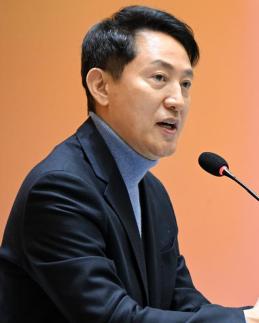 Seoul Mayor Oh Se-hoon Calls Lee Jae-myung a ‘Soft Dictator,’ Warns Checks and Balances Eroding Seoul Mayor Oh Se-hoon on Thursday labeled President Lee Jae-myung a “soft dictator” and criticized him directly. In an interview with TV Chosun released by the Seoul city government, Oh said Lee was “insulting the judiciary” while having “completely” taken control of the legislature and the executive branch. “If this continues, the separation of powers will collapse,” Oh said. “In that case, the likelihood of moving toward a ‘soft dictatorship’ is high.” Oh said that if a government keeps the outward form of democracy while effectively monopolizing lawmaking, controlling the administration and then moving to pressure the courts, “checks and balances will inevitably be neutralized.” He added that power would then “race like a runaway locomotive with no brakes.” Oh warned that if the Democratic Party wins by a landslide in the upcoming local elections, “that trend will accelerate,” and said “protecting Seoul” could become “the last pillar” for checking power. -“Soft dictatorship” warning, comparisons to Russia A soft dictatorship refers to a system in which elections and institutions remain, but power-sharing does not function in practice. It appears democratic, but legislative and executive power concentrates and the judiciary also comes under influence, undermining the balance of power. Internationally, Russian President Vladimir Putin and Turkish President Tayyip Erdogan are often cited as similar cases. Oh described the Seoul mayoral race as more than a local contest, calling it a turning point for the national balance of power. He said results in major cities such as Seoul and Busan would shape the future power structure, adding that “protecting Seoul” was most important. -Appeal to young voters, highlights activist and lawmaker background Oh also highlighted his resume. A lawyer by training, he worked with the civic group Korean Federation for Environmental Movement and later served as a broadcaster and a lawmaker. As a member of the National Assembly, he led efforts to enact the Political Funds Act, known as the “Oh Se-hoon law,” and legislation to improve air quality in the Seoul metropolitan area. He said air pollution was difficult to address without a legal framework, and that after he enacted the law, it took effect starting July 1, 2006, the day he took office as Seoul mayor. Oh said he both wrote the Seoul metropolitan air-quality law and oversaw its first implementation. Oh said that under the law, Seoul received central government budget support and carried out measures such as emissions-reduction policies for diesel vehicles, leading to a sharp improvement in air quality. “In the past, even wearing a dress shirt for one day would turn the collar and cuffs pitch-black,” Oh said. “Now it’s fine even after two or three days.” * This article has been translated by AI. 2026-04-24 13:45:19